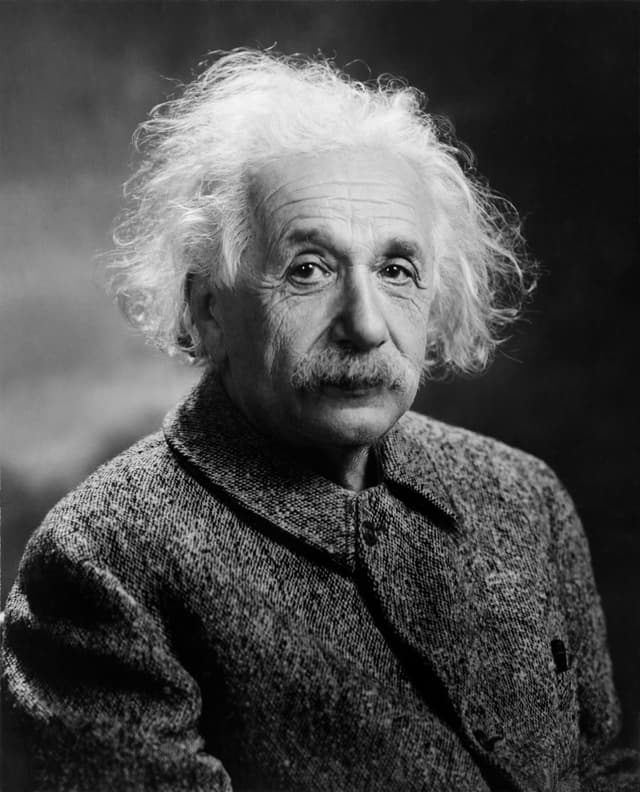
Albert Einstein
Princeton Institute for Advanced Study
A renowned physicist and visionary, Albert Einstein founded the Princeton Institute for Advanced Study, a pivotal institution in science and research that has nurtured groundbreaking ideas since its establishment in 1930. His belief that "imagination matters more than knowledge" resonates deeply with today's entrepreneurs, urging them to challenge conventional wisdom and embrace creativity. Einstein's journey, marked by years of rejection before achieving fame, exemplifies the importance of resilience and independent thought in overcoming obstacles. By advocating for solitude as a catalyst for innovation, he highlighted that significant breakthroughs often arise from focused introspection rather than group consensus. His enduring insight that "not everything that counts can be counted" continues to inspire business builders to prioritize meaningful impact over mere metrics.
Core Principles
culture
Personal responsibility and individual freedom are the foundation for creative achievement. Design your organizations, families, and institutions around these principles.
Einstein believed that intellectual freedom, where lecturers could teach as they chose and students could select their own classes, was the university's most valuable institution. Later, when student revolutionaries tried to impose top-down governance, he argued against it. Freedom and responsibility, not control, produce creativity.
“The German university's most valuable institution is academic freedom, whereby the lecturers are in no way told what to teach, and the students are able to choose what lectures to attend.”
Education based on free action and personal responsibility is superior to education based on outward authority and rote drills. Allow learners to reach their own conclusions.
Einstein experienced two very different educational systems. His time in the authoritarian German gymnasium left him repulsed by the systematic training in worship of authority. When he found schools like Pestalozzi's that allowed free action and personal responsibility, he became far more engaged. He carried this philosophy forward, believing students should select their own courses and teachers should have freedom in how they teach.
“An education based on free action and personal responsibility is to one relying on outward authority.”
Create intellectual circles and accountability groups to sharpen your thinking. Regular discussion of great ideas with peers accelerates your own creative development.
Einstein and friends created the Olympia Academy in Bern, meeting regularly to read great thinkers and discuss ideas. These meetings lasted all night and were followed by mountain hikes to watch sunrises. Einstein remained close to these friends throughout his life, later reminiscing that their academy was less childish than the respectable ones he encountered in academia.
“Our cheerful academy was less childish than those respectable ones I later got to know at close quarters.”
A foolish faith in authority is the worst enemy of truth. Build cultures and organizations that reward questioning and skepticism rather than obedience.
Einstein hated the authoritarian teaching methods of German schools and the systematic training in worship of authority. Throughout his life, he resisted any form of dogma and questioned received wisdom, including from senior scientists and government officials. He believed that organizations thrive when members are free to question premises and challenge conventional thinking.
“A foolish faith in authority is the worst enemy of truth.”
focus
Seek solitude for creative breakthroughs. Withdraw from group dynamics and immerse yourself completely in focused problems to achieve outsized results.
Einstein voluntarily sought isolation to do his best thinking. Even in noisy environments, he could withdraw completely into a problem. He later suggested that scientists be employed as lighthouse keepers so they could think undisturbed. His most creative period came while working alone at the Swiss Patent Office.
“The monotony of a quiet life stimulates the creative mind.”
Develop intense powers of focus and concentration. The ability to withdraw from distractions and lose yourself in a problem is a trainable skill that separates exceptional achievers from others.
Einstein demonstrated remarkable concentration from childhood. Even in large, noisy groups, he could withdraw with pen and paper and lose himself so completely in a problem that surrounding conversation stimulated rather than disturbed him. This ability allowed him to accomplish significant work during the less structured hours at the patent office.
“Even in a large, noisy group, he could withdraw to the sofa, take a pen and paper in hand, and lose himself so completely in a problem that the conversation of many voices stimulated rather than disturbed him.”
innovation
Imagination matters more than knowledge. Success comes from questioning conventional wisdom, challenging authority, and finding wonder in mundane things, not from memorizing facts.
Einstein never excelled at rote learning as a student. His breakthroughs in physics came from his ability to imagine unconventional solutions and ask questions others considered settled. He actively rejected the authoritarian teaching methods of his German gymnasium in favor of schools that encouraged hands-on exploration and personal discovery.
“Imagination is more important than knowledge.”
Only individuals produce new ideas, not groups. Organizational success depends on fostering individuality, free minds, and free spirits rather than enforcing conformity.
Einstein believed deeply that creativity springs from individuals, not committees. He saw his role as protecting intellectual freedom and resisting any form of tyranny or groupthink. He repeated this belief across decades of his life, from his student years through his role advising on university governance.
“It is important to foster individuality, for only the individual can produce the new ideas.”
Challenge every premise and assume conventional wisdom is wrong until proven otherwise. This is the mental habit of truly creative problem-solvers.
Einstein's boss at the Swiss Patent Office, Holler, had a credo that deeply influenced Einstein: remain critically diligent, question every premise, challenge conventional wisdom, and never accept something as true merely because everyone else views it as obvious. This same approach is used by Jeff Bezos, who assumes each sentence he reads is wrong until he can prove otherwise.
“You have to remain critically diligent, question every premise, challenge conventional wisdom and never accept the truth of something merely because everyone else views it as obvious.”
Prioritize excellence over obedience. When given instructions that conflict with better solutions, pursue the better path even if it means deviating from orders.
When given experiment instructions in one of Pernet's classes, Einstein discarded them and pursued the experiment his own way. His teaching assistant noted that while Einstein always did something different from what was ordered, his solutions were right and his methods were of great interest. This willingness to deviate from instructions in pursuit of better results became a hallmark of his approach.
New ideas come from earlier intellectual experience combining in intuitive ways. Creativity depends on deep exposure to the field, even when breakthroughs feel sudden and inspired.
Einstein's 1905 miracle year, when he published four revolutionary papers, appeared to come from nowhere. But this burst of creativity was built on years of independent study, patent office work, and intellectual conversation. He explained that intuitive insights are actually the outcome of earlier intellectual experience, not random inspiration.
“A new idea comes suddenly and in a rather intuitive way, but the intuition is nothing but the outcome of earlier intellectual experience.”
leadership
Kindness and decency should be impersonal and extended to all people regardless of status. True morality comes from respect for free minds and free individuals.
Einstein was genuinely kind to people of all ages and classes, but this kindness was thoroughly impersonal and not rooted in emotional attachment. He extended respect and gentle compassion to humanity in general while maintaining distance from even family and close friends. His morality was based on abstract principles of freedom rather than personal bonds.
“His extreme kindness and decency are thoroughly impersonal and seem to come from another planet.”
Teaching and communication skills are essential for success, even when your primary work is technical or solitary. You must be able to translate your ideas to others.
Einstein struggled with formal teaching early in his career but eventually became known as a first-class teacher once his fame preceded him. His students loved his lectures because he developed ideas spontaneously rather than from prepared notes, allowing them to watch his thinking process. He demonstrated that the ability to communicate complex ideas clearly is as important as discovering them.
“He is a first-class teacher because all of this is expressed in his lectures which force the audience to think along.”
Separate questioning authority from disrespecting people. You can challenge conventional wisdom and authority while still maintaining relationships and showing respect to those around you.
Einstein's early career suffered because he was unwilling to show respect to professors like Weber and Pernet, even when disagreeing with their methods. Nine years after graduation, he was the only graduate in his section not offered a job due to poor references from these professors. Later, he learned to separate intellectual disagreement from personal disrespect, allowing him to build effective relationships while maintaining his contrarian thinking.
Build relationships with people you disagree with, especially those in positions of authority. Ego management in public is not the way to build effective organizations or advance your career.
Einstein's inability to manage his impudence with authority figures cost him nine years of joblessness despite being brilliant. Sam Walton noted that exercising your ego in public is the wrong way to build an organization. Einstein eventually learned this lesson and began to navigate relationships more tactfully, though his early career suffered considerably from this learning curve.
mindset
Recognize that traits serving you well in one domain can become weaknesses in another. Self-awareness about context matters more than celebrating any single trait.
Einstein's impudence and unwillingness to show respect for authority served him brilliantly as a young scientist questioning physics fundamentals. However, this same trait became a major liability when dealing with professors and authority figures, preventing him from getting academic positions. His genius eventually transcended this weakness, but awareness of context would have accelerated his career.
Distance yourself from emotional entanglements that drain your creative capacity. Detachment from emotional demands allows you to maintain productivity and think more clearly.
Einstein's personal detachment and scientific creativity were subtly linked. His apartness enabled him to reject emotional intimacies as well as scientific conventional wisdom. This detachment allowed him to walk through life immersed in thought and pursue his theories in a single-minded manner. However, this same detachment caused deep pain in personal relationships, particularly with his children.
“Einstein's personal detachment and scientific creativity seem to be subtly linked.”
Recognize that your personal detachment can produce both remarkable creativity and deep emotional pain. Balance is impossible, so choose consciously what you are willing to sacrifice.
Einstein's emotional detachment allowed him to achieve extraordinary scientific breakthroughs but caused severe suffering in his personal relationships, particularly with his children. When separated from his sons by World War I borders, he became deeply emotional, crying all afternoon and evening. His inability to maintain warm family bonds despite his desire for his children was a consequence of his fundamental nature.
“I would be a real monster if I felt any other way. I have carried these children around innumerable times. I play with them. I've joked with them. They used to shout with joy when I came home, now they will be gone forever.”
Resist conformity and the undignified attempt to adapt and assimilate. Non-conformity becomes easier when you can emotionally detach from the opinions of others.
Einstein saw the pursuit of conformity as repulsive and beneath dignity. His ability to nonconform stemmed directly from his emotional detachment and apartness. He could walk through life with emotional indifference to conventional expectations because he had never felt a strong need for direct human contact or social belonging.
“The undignified mania of trying to adapt and conform and assimilate, which happens among many of my social standing, has always been very repulsive to me.”
Never lose childlike curiosity. Maintain wonder about ordinary things and approach problems with the mindset of a perpetual student, not an expert.
Throughout his life, Einstein retained a sense of awe at nature and asked fundamental questions others took for granted. He believed education should emphasize personalities who showed independence of character and judgment, and he practiced this by never accepting received wisdom about how the world worked.
“An appreciation for the glories of science is a joyful trait for a good society. It helps us remain in touch with that childlike capacity for wonder about such ordinary things as falling apples and elevators.”
operations
Maintain independence in your work by outsourcing or delegating personal responsibilities. Create conditions that allow you to focus entirely on your highest-value thinking.
In his second marriage to Elsa, Einstein outsourced all personal management, including meals, travel, wardrobe, and finances. She told him when to eat and where to go, packed his suitcase, and doled out pocket money. This freed him completely to enter deep states of concentration on physics. When he was seized with a problem, she recognized the faraway look and kept all disturbing elements away.
resilience
Use work as a distraction from emotional pain. Diving into intellectual challenges can be a legitimate way to process and move through difficult personal periods.
Einstein explicitly used intense intellectual work and communion with nature as a way to weather life's storms. When facing marital difficulties, family separation, and personal loss, he would immerse himself in physics. He described this as finding reconciling and fortifying angels in strenuous intellectual work and looking at God's nature.
“Strenuous intellectual work and looking at God's nature are the reconciling fortifying yet relentlessly strict angels that shall lead me through all of life's troubles.”
Guard against intense ideology. Hatred and rigid belief systems destroy decision-making capacity and lead to catastrophic errors that harm the hater more than the hated.
Hitler's intense hatred of Jews led him to pass laws excluding them from academic and governmental positions. This expelled 14 Nobel laureates and 26 professors of theoretical physics from Germany, creating a massive brain drain. These refugees, including Einstein and Fermi, helped ensure the Allies rather than Nazis developed the atomic bomb first. Hitler's ideology turned his brain to cabbage, as Charlie Munger would say.
Assimilation is not a reliable defense against systemic persecution. Trying to blend in does not protect you when those in power decide to target your group.
Einstein watched as his friend Walter Rathenau and others believed that thorough assimilation into German society would protect them from anti-Semitism. They were mistaken. Once the Nazis took power, no amount of cultural assimilation provided safety. Einstein had never believed this strategy would work and ultimately fled when it became clear Germany was no longer safe.
“Assimilation did not bring safety.”
Adjust your philosophy when faced with existential threats. Pacifism is a luxury belief that must yield when civilizations face annihilation.
Einstein was a lifelong pacifist who believed war was inevitable but unethical to participate in. As Hitler's threat became clear, he shifted from militant pacifism to active involvement, ultimately writing to FDR about atomic weapons development. He explained that if he had known Germany could not develop the bomb, he would never have lifted a finger. Context and threat level demand philosophical adjustment.
“I am not only a pacifist, I'm a militant pacifist.”
strategy
Learn from every experience and bring that learning back to your core work. This is how visionary founders create remarkable organizations.
Steve Jobs learned from every experience at Pixar and brought those lessons back to Apple. He used this approach across multiple domains to build an organization of A players. Einstein similarly applied insights from his patent office work and his independent study to his physics, and maintained this practice throughout his life.
Frameworks
Challenge Every Premise Framework
Assume all conventional wisdom is wrong until you can prove it otherwise. Apply critical diligence to every statement, premise, and claim. This is not skepticism for its own sake but a disciplined habit of verification. It works equally well for patent examiners evaluating inventions and entrepreneurs evaluating business assumptions.
Use case: When evaluating new ideas, reviewing employee work, assessing market opportunities, or solving complex problems. Particularly useful for founders and leaders who must maintain a contrarian perspective without becoming simply contrary.
The Personal Curriculum Approach
Rather than following a standard prescribed curriculum, take ownership of your own education. Identify what you most need to learn, find the resources (books, teachers, mentors), study independently, and prove your mastery through results rather than credentials. This produces deeper learning and faster advancement than passive institutional education.
Use case: For individuals seeking rapid skill development outside institutional frameworks. Particularly effective for self-directed learners who can identify knowledge gaps and create accountability systems. Works well for technical and creative domains where results matter more than credentials.
The Detachment Strategy for Creative Intensity
Cultivate emotional distance from personal entanglements and social demands. Recognize that some people achieve their highest creative output not despite but because of this detachment. Design your life to minimize emotional demands that drain focus. Use relationships instrumentally when they serve your work, but do not expect close emotional connection from those enabling your creative output.
Use case: For individuals in highly creative or technical roles where sustained concentration is essential. Requires explicit conversations with partners and family about emotional expectations. This is a high-risk strategy that produces great work but damaged relationships, so it demands conscious choice and honesty about what you are sacrificing.
The Independent Intellectual Circle
Form a small group of peers committed to studying great thinkers and discussing ideas regularly. Meet in person, maintain continuity over years or decades, and create a culture where challenging conventional wisdom is expected. These circles accelerate creative development faster than solo study because they combine deep thinking with accountability and debate.
Use case: For founders, researchers, and creative professionals seeking peer accountability and intellectual sharpening. Works best when members have complementary expertise and genuine intellectual humility. The Olympia Academy model demonstrates that informal gatherings of serious thinkers produce remarkable outputs.
Stories
Einstein's father, desperate to help his jobless son, wrote a letter to the physicist Oswald begging for a recommendation or encouragement after Einstein had been rejected everywhere for nine years. Oswald didn't even respond to the letter. Nine years later, Oswald became the first person to nominate Einstein for the Nobel Prize.
Lesson: Persistence through rejection is essential for visionary work. The same people who reject you today may be forced to acknowledge your genius tomorrow. Do not let their initial rejection define your trajectory or your self-worth.
When Einstein threw his first honorary doctorate invitation in the waste paper basket because it seemed odd and impersonal, his friends persuaded him to attend. He showed up in a straw hat and informal suit, stood out completely, and told the person next to him that the university founder would have burned them all for sinful extravagance. The man never spoke to him again.
Lesson: Your authenticity and comfort with your own principles matter more than social convention. Einstein refused to conform even to a formal honor, choosing to be himself regardless of judgment. This integrity attracts some people deeply and repels others completely.
During a physics lecture, Einstein became momentarily stuck on a mathematical transformation. Rather than pretending to know the answer, he said to the class, 'There must be some silly mathematical transformation I can't find for a moment.' Ten minutes later, while developing another point, he suddenly exclaimed 'I've got it,' having solved the problem in the background of his mind.
Lesson: Model intellectual humility and transparent thinking for others. Show your work and your struggle, not just your conclusions. This teaches people how to think rather than what to think, and makes you a far better teacher and leader.
Einstein left Germany in December 1932 to take a position at Princeton, still believing he might return to Europe several months per year. Telling his wife to take a good look because they would never see it again, he proved prescient. One month after he left, Hitler took power. Within three months, the Nazis had ransacked his Berlin apartment five times. He never saw Europe again.
Lesson: You never know when your circumstances will change permanently and irrevocably. What seems like a temporary decision becomes the last moment. Cherish what you have now because timing is not within your control, and windows close without warning.
Einstein was devastated when separated from his two sons during World War I because borders prevented travel. Later in life, his oldest son Hans Albert wrote him saying 'if you come for Easter, you'll be here and we'll have a papa again.' Einstein never truly recovered from the guilt of being absent from his sons' lives, despite his worldwide fame. His father died never seeing Albert become anything more than a patent examiner.
Lesson: No amount of professional success compensates for time lost with family. Your children want your presence, not your fame. Time with loved ones is irreplaceable and cannot be earned back through achievement.
When student revolutionaries kidnapped the deans of the university where Einstein worked and drafted new statutes for governance, they asked Einstein for his opinion. Rather than flattering them or hedging, he told them directly that their new rules would abolish academic freedom. His honesty did not help his mission to free the deans, but it revealed his unwillingness to compromise his principles for practical advantage.
Lesson: Sometimes your principles prevent you from achieving your immediate goals. Einstein valued intellectual freedom more than the release of the deans in that moment. Know when this trade-off is worth it and accept the consequences.
Einstein had created a brutal contract for his first wife proposing to cohabitate for the sake of their children with zero personal intimacy. The terms included maintaining his clothes, providing meals in his room, never expecting intimacy, and speaking to him only when absolutely necessary. Unsurprisingly, this contract failed to sustain the marriage, and he eventually separated from her.
Lesson: You cannot engineer human relationships through logical contracts. Attempting to reduce personal relationships to rational terms ignores the emotional and irrational nature of human connection. Honesty about your limitations is better than false promises disguised as agreements.
Hitler's intense hatred of Jews led him to expel 14 Nobel laureates and 26 professors of theoretical physics from German universities. These refugees, including Einstein and Enrico Fermi, fled to the United States and other countries. Their presence helped ensure that the Allies, not the Nazis, developed the atomic bomb first. Hitler's ideology destroyed his own strategic position.
Lesson: Intense ideology destroys your decision-making capacity and harms you more than your enemies. Hatred clouds judgment so completely that you sabotage your own interests. Avoid building organizations or movements around rigid hatreds.
Notable Quotes
“Not everything that counts can be counted, and not everything that can be counted counts.”
Sign that hung in Einstein's office, which Bogle applied to business to argue that trust matters more than metrics.
“I can imagine your inner conflicts. It is somewhat like having to abandon a theory on which you have worked your whole life. It is not the same for me because I never believed it in the least.”
Einstein's letter to Haber, counseling him to leave Germany when Nazi persecution began, noting that Einstein never believed in German acceptance of Jews
“Imagination is more important than knowledge.”
Discussing how his success as a young scientist came not from memorizing facts but from his ability to imagine unconventional solutions and question conventional wisdom.
“Long live imprudence. It is my guardian angel in this world.”
A personal maxim Einstein returned to throughout his life, celebrating his willingness to question authority and reject conventional respectability.
“A foolish faith in authority is the worst enemy of truth.”
Explaining his resistance to authoritarian teaching methods and dogmatic thinking in all forms.
“It is important to foster individuality, for only the individual can produce the new ideas.”
Speaking to the importance of organizational culture that rewards individual creativity over group conformity.
“The monotony of a quiet life stimulates the creative mind.”
Describing his belief in the importance of solitude and detachment from social demands for creative breakthroughs.
“An education based on free action and personal responsibility is superior to one relying on outward authority.”
Comparing his experiences at authoritarian German schools with progressive Swiss schools that encouraged independent thinking.
“A new idea comes suddenly and in a rather intuitive way, but the intuition is nothing but the outcome of earlier intellectual experience.”
Explaining the real source of his creative breakthroughs, which only appeared to be sudden inspiration.
“I would be a real monster if I felt any other way. I have carried these children around innumerable times. I play with them. I've joked with them. They used to shout with joy when I came home, now they will be gone forever.”
Expressing the emotional devastation of being separated from his sons during World War I and the conflict between his ambitions and his role as a father.
Frequently Asked Questions
What are Albert Einstein's key business principles?▼
Albert Einstein's core principles include: Personal responsibility and individual freedom are the foundation for creative achievement. Design your organizations, families, and institutions around these principles.. Education based on free action and personal responsibility is superior to education based on outward authority and rote drills. Allow learners to reach their own conclusions.. Create intellectual circles and accountability groups to sharpen your thinking. Regular discussion of great ideas with peers accelerates your own creative development.. Founder Almanac has cataloged 27 total principles from Albert's career.
What can entrepreneurs learn from Albert Einstein?▼
Key lessons from Albert Einstein include: Persistence through rejection is essential for visionary work. The same people who reject you today may be forced to acknowledge your genius tomorrow. Do not let their initial rejection define your trajectory or your self-worth.. Explore 8 stories and 4 frameworks from Albert's experience.
What is Albert Einstein known for in business?▼
A renowned physicist and visionary, Albert Einstein founded the Princeton Institute for Advanced Study, a pivotal institution in science and research that has nurtured groundbreaking ideas since its establishment in 1930. His belief that "imagination matters more than knowledge" resonates deeply with today's entrepreneurs, urging them to challenge conventional wisdom and embrace creativity. Einstein's journey, marked by years of rejection before achieving fame, exemplifies the importance of resilience and independent thought in overcoming obstacles. By advocating for solitude as a catalyst for innovation, he highlighted that significant breakthroughs often arise from focused introspection rather than group consensus. His enduring insight that "not everything that counts can be counted" continues to inspire business builders to prioritize meaningful impact over mere metrics.
Want Albert's advice on your business?
Our AI has studied Albert Einstein's biography, principles, and decision-making frameworks. Ask any business question.
Start a conversation