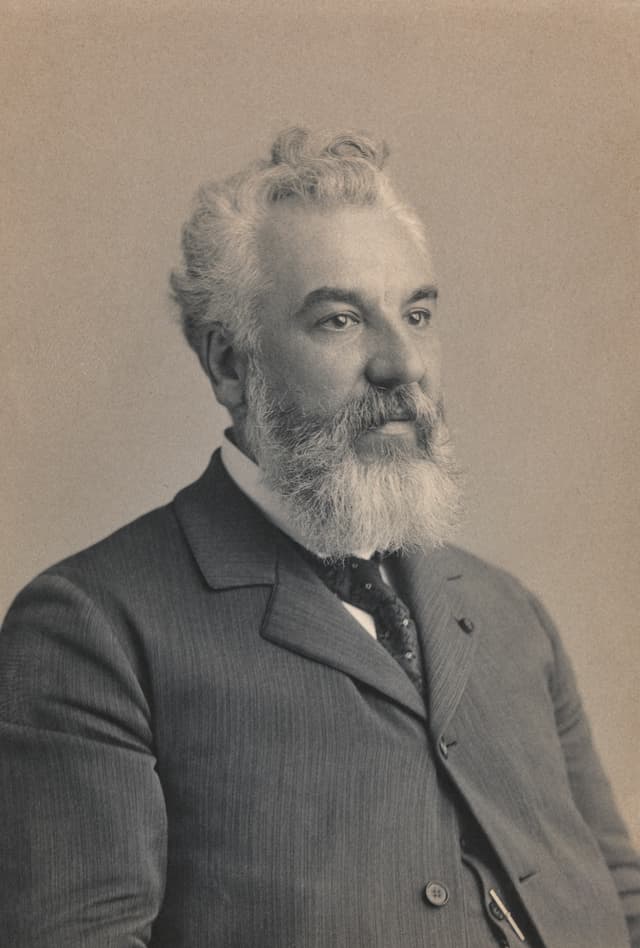
Alexander Graham Bell
Bell Telephone Company
A pioneer in telecommunications, Alexander Graham Bell founded the Bell Telephone Company in 1877, revolutionizing communication with the invention of the first practical telephone. His unique mastery of acoustics, rather than electrical engineering, set him apart and contributed to his success, demonstrating the value of interdisciplinary thinking. Overcoming personal challenges, including an overbearing father, he embraced independence and focused on his passions, leading to breakthroughs that transformed everyday life. Bell famously remarked on the fragility of innovation, saying, "It is a most astonishing thing to me that I could possibly have let this invention slip through my fingers," a reminder to entrepreneurs today about the importance of perseverance and focus in their creative endeavors.
Frameworks
Cross-Disciplinary Innovation
Combine deep knowledge from one domain with principles or concepts from unrelated fields to create breakthroughs others cannot. Bell's mastery of acoustics and the human ear, learned through teaching the deaf, allowed him to apply Helmholtz's theories on sound to telegraph problems in ways electrical engineers could not. This creates a sustainable competitive advantage because the insight is unique to the specific combination of your experiences.
Use case: When facing technical problems that standard solutions cannot solve, look for principles from adjacent domains that your competitors lack exposure to.
The Complementary Partnership Model
Identify the specific capabilities you lack and find partners or employees who excel in exactly those areas. Bell could not manage business, patents, or money. Gardner Hubbard could do little invention but excelled at all three. The partnership worked because each person did what the other could not and did not try to overlap. This is distinct from hiring experts to consult; it is building a permanent partnership where each person is truly indispensable.
Use case: When founding a company or scaling beyond your current capabilities, seek co-founders whose weakness map to your strength and vice versa. Test the partnership early before formal commitment.
The Eureka Retreat
When stuck on a difficult problem, remove yourself from competitive pressure, busy environments, and interruptions. Retreat to a quiet place with no obligations and allow your subconscious to work on the problem while you walk, observe nature, or sit in contemplation. Bell called his retreat overlooking the Grand River his dreaming place. The eureka moment for the telephone occurred there, not in the lab.
Use case: When facing technical or creative blocks that analytical work is not solving, take a deliberate retreat to remove pressure and allow intuition and subconscious processing to surface solutions.
The Obsessive Documentation Practice
Capture every fact, experiment, and observation related to your invention in written or visual form as it happens. Gardner Hubbard advised Bell to jot down everything immediately because time would be essential to proving the date of invention in patent disputes. This documentation also becomes the record that proves you conceived the idea first, protecting your patent claim against competitors.
Use case: In competitive fields where patent primacy matters, document everything in real time. In any innovative work, documentation forces clarity and creates a record that can be reviewed and refined.
The Lecture and Demonstration Strategy
When a new invention does not yet generate revenue, fund yourself and build market awareness through public lectures and demonstrations. Speak from genuine passion about how the invention works and what it could become. People respond to authentic enthusiasm more than sales pitches. This also builds credibility and social proof that sustains you through the early lean years.
Use case: For breakthrough inventions where the market does not yet exist, use public education and demonstration to build belief in the invention while generating income to sustain development.
The Long-Term Product Control through Leasing
Instead of selling a product outright, lease it to customers while you retain ownership and maintenance responsibility. This creates recurring revenue, allows you to continuously improve the product, and gives you leverage to control how the product is used and presented to the market. Gardner Hubbard applied this with telephones, and it became foundational to the company's long-term wealth creation.
Use case: For durable goods or services where ongoing improvement is possible and customers will use the product long-term, consider leasing over selling to align incentives and create recurring revenue.
Stories
At age 16, Bell left home to teach at a boys' boarding school, finally gaining independence from his overbearing father. He reveled in this freedom but developed a pattern of taking on far more projects than he could handle, staying up all night reading and working, and experiencing chronic headaches and sleeplessness. This work pattern would define the rest of his life.
Lesson: Intense independence and the freedom to pursue your interests can be tremendously energizing, but without boundaries, can create unsustainable work patterns that damage health. The same traits that enable breakthrough thinking can become self-destructive if not managed.
After his older brother, younger brother, and nephew all died of tuberculosis within weeks, Bell's family moved from London to the Canadian backwoods. This tragic exodus freed Bell from the need to work immediately and gave him time to pursue his passion for understanding sound and electricity. The tragedy became the catalyst for his greatest invention.
Lesson: Adversity and loss, though painful, can create space for creative work if you have the courage to repurpose the disruption. Sometimes the worst events create the conditions for the greatest breakthroughs.
Bell sat in his dreaming place overlooking the Grand River and suddenly understood that sound vibrations could be mimicked by undulating electrical currents, allowing sound to travel along telegraph wires. The receiver could act like an electrical mouth, vibrating a membrane that would make the listener's eardrum vibrate. This moment of insight, which came after months of struggling in competitive pressure, solved the core problem that had baffled other inventors.
Lesson: Eureka moments often come in quiet places away from competitive pressure, after long periods of research and failure. The subconscious processing that occurs during retreat is as important as conscious effort.
Bell met Gardner Hubbard at a dinner at Hubbard's home and impulsively demonstrated his piano party trick, explaining that telegraph wires could carry multiple messages if vibrating at different frequencies. Hubbard was hunting for exactly this innovation. Bell had the ideas; Hubbard had capital and patent expertise. They became partners that created the telephone company, with Hubbard insisting on meticulous documentation that won the crucial patent race against Elijah Gray by mere hours.
Lesson: Complementary partnerships are often discovered by accident, but they succeed because each partner's weakness is the other's strength. The partnership multiplies both parties' capabilities beyond what either could achieve alone.
For seven years after inventing the telephone, Bell made almost no money. He was competing against Western Union, which was printing money and would cut his telephone wires. Employees went unpaid, suppliers demanded payment, and Bell himself wrote letters expressing disgust with life and wanting to give up. Yet he persisted. The company eventually won a landmark patent lawsuit against Western Union, creating a monopoly.
Lesson: Breakthrough inventions typically require years of struggle and near-failure before monetization occurs. The emotional and financial stress during these years can be as severe as any challenge you will face. Perseverance through this specific dark period is what separates successful founders from those who quit.
When a fire damaged Bell's study, his housekeeper hired young Charles Thompson to clean up. Bell treated the 18-year-old African-American with genuine courtesy, shaking his hand as if greeting a longtime friend. Bell then explained to Charles which items were important to preserve because they contained his most crucial thoughts. This single act of courtesy and trust resulted in Charles committing to serve Bell for the next 35 years, managing his eccentricities and household.
Lesson: How you treat people when no obligation requires it reveals your character. Simple courtesy and respect can inspire decades of loyalty and unlock human potential in ways money and authority never can.
In his later years, Bell spent his life in seclusion on his estate in Nova Scotia, running experiments with assistants and pursuing inventions in hydrofoils, human-powered flight, and selective breeding. He never commercialized another invention. But every summer his grandchildren would visit, and he would light up their minds, exciting them about the wonderful things in the world they could learn. His purpose shifted from commercial invention to intellectual stimulation and teaching.
Lesson: Once an invention has created sufficient wealth and security, you are freed to pursue your deeper purpose. For Bell, that was pure scientific investigation and teaching, not commercialization. Defining what you truly care about, separate from what makes money, allows you to live with integrity in your later years.
Notable Quotes
“It is a most astonishing thing to me that I could possibly have let this invention slip through my fingers.”
Bell's reaction in early 1878 to learning about Edison's phonograph, expressing regret that he had come close to inventing the device but had not thought to use indentation in a medium to record and reproduce sound waves.
“It is a most astonishing thing to me that I could possibly have let this invention slip through my fingers.”
Bell's reaction in early 1878 to learning about Edison's phonograph, expressing regret that he had come close to inventing the device but had not thought to use indentation in a medium to record and reproduce sound waves.
“A man's own judgment should be the final appeal in all that relates to himself. Many men do this or that because someone else thought it right.”
Bell wrote this note to himself early in his career, establishing his commitment to independent thinking and decision-making rather than blind adherence to others' opinions.
“When you see me flagging, getting tired, discouraged, put your hands over my eyes so that I go to sleep and let me sleep as long as I like until I wake. Then I may hang around, read novels, and be stupid without an idea in my head until I get rested and ready for another period of work.”
From a letter to his wife describing his unusual work rhythms and requesting her support in managing his cycles of intense focus and necessary rest.
“I have to, he replied. Speaking was a supreme effort.”
Bell's last words, spoken to his secretary on August 1st when she urged him not to hurry. Despite suffering his final illness, he insisted on continuing to dictate, unable to stop working even as he lay dying.
“Thoughts, my dear sir, are like the precious moments that fly past. Once gone, they can never be caught again.”
Bell explaining to his secretary why he could not tolerate interruptions, even a knock on his door, during his intense periods of focus and invention.
“I felt so much encouraged by his interest, Alex later wrote, that I determined to ask his advice about the apparatus I had designed for the transmission of human voice by telegraph.”
Bell describing the impact of Dr. Joseph Henry's encouragement when Henry validated Bell's telephone idea as the germ of a great invention.
“I cannot tell you how much these two words had encouraged me.”
Bell reflecting on the profound impact of Dr. Henry's simple command 'Get it', which transformed his self-doubt into determination.
“It is a neck and neck race between Mr. Gray and myself who shall complete our apparatus first. He has the advantage over me in being a practical electrician, but I have reason to believe that I am better acquainted with the phenomenon of sound than he is. So I have the advantage there.”
Bell writing to his parents about the competitive race to complete the telephone invention, expressing confidence in his unique advantage despite lacking electrical training.
“Business is hateful to me at all times. As the months in England dragged on and his hopes of cashing in on his invention slipped away, business became even more odious.”
Bell expressing his deep aversion to business and commercial concerns, which remained a constant tension throughout his life despite the necessity of commercialization.
Frequently Asked Questions
What are Alexander Graham Bell's key business principles?▼
Founder Almanac has cataloged 0 principles from Alexander Graham Bell's career at Bell Telephone Company.
What can entrepreneurs learn from Alexander Graham Bell?▼
Key lessons from Alexander Graham Bell include: Intense independence and the freedom to pursue your interests can be tremendously energizing, but without boundaries, can create unsustainable work patterns that damage health. The same traits that enable breakthrough thinking can become self-destructive if not managed.. Explore 7 stories and 6 frameworks from Alexander's experience.
What is Alexander Graham Bell known for in business?▼
A pioneer in telecommunications, Alexander Graham Bell founded the Bell Telephone Company in 1877, revolutionizing communication with the invention of the first practical telephone. His unique mastery of acoustics, rather than electrical engineering, set him apart and contributed to his success, demonstrating the value of interdisciplinary thinking. Overcoming personal challenges, including an overbearing father, he embraced independence and focused on his passions, leading to breakthroughs that transformed everyday life. Bell famously remarked on the fragility of innovation, saying, "It is a most astonishing thing to me that I could possibly have let this invention slip through my fingers," a reminder to entrepreneurs today about the importance of perseverance and focus in their creative endeavors.
Want Alexander's advice on your business?
Our AI has studied Alexander Graham Bell's biography, principles, and decision-making frameworks. Ask any business question.
Start a conversation