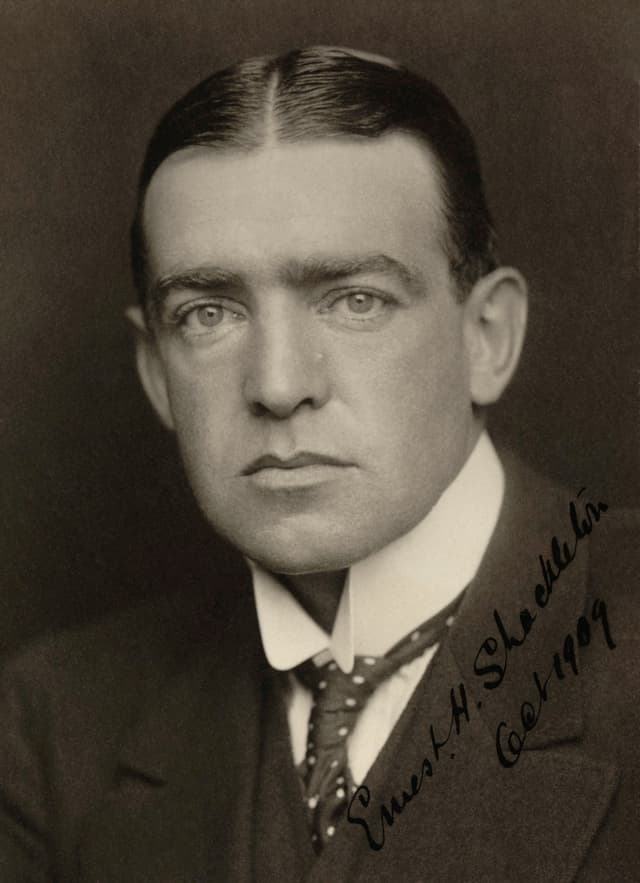
Ernest Shackleton
Imperial Trans-Antarctic Expedition
A defining figure of the Heroic Age of Antarctic Exploration, Ernest Shackleton led the Imperial Trans-Antarctic Expedition from 1914 to 1916, aiming to cross the Antarctic continent. His journey aboard the Endurance faced insurmountable challenges when the ship became trapped in pack ice, ultimately leading to a remarkable survival story where all 28 crew members were rescued. Shackleton's unwavering perseverance and strategic decision-making in high-stakes situations exemplify the importance of resilience and instinct in leadership. His belief that true ambition lies in tackling difficult goals continues to inspire modern entrepreneurs, reminding them that success often hinges on the refusal to quit in the face of adversity.
Core Principles
focus
Focus simplifies complexity. When multiple options exist, committing to a single clear goal eliminates ambiguity and reduces mental burden.
Before departure, Shackleton faced uncertainty about whether to proceed with the expedition or serve in World War I. Once the government ordered him to proceed, all secondary concerns vanished. The men's diaries show that having one clear objective instead of thousand petty problems reduced stress and clarified decision-making.
“Life had been reduced from a highly complex existence with a thousand petty problems to one of the barest simplicity in which only one real task remained, the achievement of the goal.”
Ambition can be a liability if not properly channeled. Unfocused pursuit of numerous ventures leads to failure, while concentrated effort toward a single monumental goal succeeds.
Before the expedition, Shackleton pursued many get-rich schemes: cigarette manufacturing, taxi cabs, mining, whaling factories, treasure hunting. None succeeded. Yet with the Antarctic expedition, his characteristic boldness and perseverance were focused on one massive goal, producing results that changed history.
hiring
Trust your instinct when making high-stakes personnel decisions. Speed in hiring prevents overthinking and reveals character through intuition.
Shackleton conducted crew interviews that lasted no more than five minutes, making rapid decisions based on gut feeling rather than extensive evaluation. These snap judgments proved remarkably effective in assembling a crew that remained loyal even through extreme hardship.
“These decisions were made with lightning speed. There is no record of any interview that Shackleton conducted with a prospective expedition member that lasted much more than five minutes.”
leadership
A leader must bear the burden of responsibility alone and maintain deliberate aloofness from the team. This separation allows clear decision-making when others seek relief.
Shackleton understood that his crew could rest and live for the moment, but he could not afford that luxury. The responsibility for their survival was entirely his. He maintained emotional distance that allowed him to make difficult decisions like abandoning the ship and later separating the group.
“It was inescapable. He was the boss. There was always a barrier, an aloofness that kept him apart.”
Leaders must manage their own psychological state before managing others. Inner doubts and anxieties must be contained and never transmitted to the team.
Shackleton was tormented by fears of failure and doubts about his capability, especially after multiple setbacks. However, he understood that revealing these thoughts would demoralize his crew. He maintained emotional composure and optimism externally while processing stress privately in his diary.
“He was careful, however, not to betray their home [his feelings] for the next several hundred days.”
The greatest enemy in extreme situations is demoralization, not physical hardship. A leader must actively combat hopelessness through psychological management of the team.
Shackleton identified demoralization as his chief concern, exceeding even the threats of cold, ice, and sea. He actively placed pessimistic team members in his tent to influence their thinking, told parable stories to temper overconfidence, and maintained visible optimism to anchor group morale.
“Shackleton was concerned of all the enemies, the cold, the ice, and the sea. He feared none more than demoralization.”
mindset
Do not think too far ahead. Focus only on the next immediate step. Extended time horizons encourage despair, while narrow focus maintains momentum.
While navigating in boats toward Elephant Island with no sleep for 80 hours, the crew focused only on the next row, the next moment. Shackleton would note in his diary not to think beyond the present action. This psychological technique of breaking overwhelming challenges into single steps maintains mental resilience.
“They were in the boats and that was all that mattered. They thought neither of patience camp, meaning the past, nor an hour in the future. There was only the present and that meant row, get away, escape.”
When faced with impossible situations, hope itself becomes a form of power. A man does not pin his last hope for survival on something and then expect it will fail.
As the crew prepared to launch the tiny boat toward South Georgia Island, they had to maintain conviction in its success, though the odds appeared insurmountable. Any mental concession to failure would have sabotaged the effort. Hope was not naive but a psychological necessity.
“No matter what the odds, a man does not pin his last hope for survival on something and then expect that it will fail.”
Extreme self-confidence and belief in personal invincibility are necessary to attempt the impossible, but they can blind you to reality. Your greatest strength becomes your greatest weakness.
Shackleton's absolute belief in his invincibility enabled him to undertake expeditions most would consider suicide. However, this same quality made defeat feel like personal inadequacy and could lead to poor judgment. He expected others to share his extreme optimism and struggled when they did not.
“Shackleton was not an ordinary individual. He was a man who believed completely in his own invincibility.”
operations
Travel light and sacrifice total preparedness for speed. Historical expeditions that burdened themselves with contingency equipment fared worse than those that prioritized mobility.
After abandoning ship, Shackleton instructed his crew to ruthlessly discard supplies regardless of value. He had studied past expeditions and observed that the correlation between equipment load and expedition failure was direct. Speed and mobility proved more valuable than comprehensive preparation.
“From studying the outcome of past expeditions, he believed that those that burdened themselves with equipment to meet every contingency had fared much worse than those that had sacrificed total preparedness for speed.”
resilience
Perseverance is the primary differentiator between those who succeed and those who fail. Half of what separates successful people from unsuccessful ones is pure refusal to quit.
Steve Jobs observed this principle and it applies broadly beyond entrepreneurship. Shackleton embodied this throughout the expedition, refusing to surrender even after multiple failed attempts to reach safety. His crew remarked that even after catastrophic setbacks, his fundamental characteristic was unwillingness to yield.
“The thought of quitting was abhorrent.”
The will to survive overcomes squeamishness and psychological barriers. Necessity forces humans to do things they previously believed impossible.
Initially, the crew was uncomfortable killing seals and penguins by hand. Facing starvation, they quickly abandoned these qualms. The instinctual drive to survive overrode social conditioning and moral hesitation. This reveals human adaptability under extreme pressure.
“The will to survive soon dispelled any hesitancy to obtain food by any means.”
We are all more capable than we believe. Humans prove this when they have no alternative but to endure and persevere.
Shackleton crossed South Georgia Island in 36 hours without sleep with minimal equipment (50 feet of rope and a carpenter's axe), a crossing that a well-equipped expert climbing party accomplished only 40 years later with helicopters and extensive gear. His achievement demonstrated that capability emerges from necessity.
“I do not know how they did it, except they had to.”
strategy
Make critical decisions under extreme uncertainty with conviction. Waiting for perfect information guarantees failure. Choose the least-bad option and commit fully.
When the ice floe began breaking apart, Shackleton had to decide whether to launch the boats into unknown waters or stay on crumbling ice. The pack ice was open but might close within hours. With minutes to decide under extreme uncertainty, he gave the order: Launch the boats. The decision was irrevocable but necessary.
“At 1240, Shackleton gave the order in a quiet voice. Launch the boats.”
Attempt ambitious goals not because they are easy, but because they are hard. Enormous challenges test and organize the best of human capability.
Shackleton justified the Trans-Antarctic Expedition by noting it was the last great polar journey available. He chose this goal specifically because it was sufficiently difficult to command his full capability and drive. This mirrors JFK's moon landing rationale.
“From the sentimental point of view, it is the last great polar journey that can be made. It will be a greater journey than the journey to the pole and back.”
Frameworks
The Morale Management Framework
A leader must actively diagnose and combat demoralization before it spreads. Identify pessimistic individuals, place them in close proximity to the leader for direct influence, tell stories that temper unrealistic optimism, and maintain visible confidence to anchor group psychology. Demoralization spreads like infection, so it requires active quarantine and reframing.
Use case: Leading teams through extended hardship, uncertainty, or high-stakes situations where psychological collapse poses greater danger than physical obstacles
The Present-Moment Focus Technique
Break overwhelming challenges into single, actionable steps. Prevent the mind from projecting too far into the future or dwelling on past setbacks. The mental instruction is always the same: complete this one step, then the next. This creates psychological momentum and prevents despair from paralyzing decision-making.
Use case: Surviving extended periods of hardship, maintaining team focus during multi-stage projects, or recovering from major setbacks that could trigger long-term demoralization
The Rapid Crew Selection Method
Conduct brief, intuitive interviews (5 minutes or less) to assess character and fit rather than credentials. Trust gut instinct. Speed prevents overthinking and reveals authentic personality. The most capable teams are often built on instinctive character judgment rather than lengthy evaluation processes.
Use case: Building expedition or startup teams under time pressure, or situations where personality compatibility and resilience matter more than specialized credentials
Stories
When the ice floe beneath the crew began breaking apart with cracks appearing where Shackleton's tent stood moments earlier, he faced a decision: launch the boats into unknown open water with no guarantee of finding land, or remain on the rapidly disintegrating ice. The pack ice was temporarily open but could close within hours. Shackleton gave the order: Launch the boats. Minutes later, they escaped the ice that would have crushed them.
Lesson: Critical decisions must be made under extreme uncertainty without waiting for perfect information. The worst option is often inaction when action carries risk. Sometimes you must commit fully to the least-bad alternative with conviction.
During a moment of peak morale when the crew felt overconfident about their chances of survival, Shackleton told them a parable about a mouse who found a barrel of beer in a tavern. After drinking, the mouse looked around arrogantly and said, 'Where's that damn cat?' The implied message: do not mistake temporary safety for victory.
Lesson: Leaders must actively temper unrealistic optimism and overconfidence. A single well-timed story or parable can reset psychological expectations and prevent dangerous complacency.
With no fresh water for days, starving, and facing hurricane-force winds in a 22-foot boat, Shackleton's crew began falling asleep during a required rest. One crew member started to doze off and Shackleton immediately jumped up and woke the others, claiming they had slept for a half hour when it had only been five minutes. He understood the Arctic sleep of death: once you fell asleep in extreme cold, you might never wake. He forced them to continue moving.
Lesson: A leader must sometimes override the crew's immediate desires (rest, relief) to preserve survival. Sometimes the most caring decision is the harshest one. Awareness of hidden dangers (the sleep of death) allows you to make counterintuitive calls.
After 522 days on drifting ice and failed marches, Shackleton and five men were tasked with traveling 650 miles across the Drake Passage (the stormiest ocean on Earth) in a 22-foot boat to reach South Georgia Island, an island only 25 miles wide. They had to hit this pinpoint target or die. They succeeded, reaching the island during hurricane-force winds.
Lesson: The most difficult goals require precision under chaos. Success demands both the ability to navigate with extreme accuracy and the psychological toughness to maintain course through overwhelming conditions.
Shackleton and two crew members crossed South Georgia Island (mountains, ice, unexplored) in 36 hours without sleep using only 50 feet of rope and a carpenter's axe. Forty years later, a well-equipped British survey team with expert climbers, helicopters, planes, and extensive gear accomplished the same crossing. They marveled at how Shackleton did it with so little.
Lesson: Humans prove their true capability when necessity forces them. The myth of equipment and preparation often obscures the reality that extreme capability emerges from extreme constraint.
Notable Quotes
“From the sentimental point of view, it is the last great polar journey that can be made. It will be a greater journey than the journey to the pole and back. And I feel it is up to the British nation to accomplish this.”
Explaining his motivation for attempting the Trans-Antarctic Expedition despite having already nearly died in previous Antarctic expeditions
“By endurance we conquer.”
The family motto that Shackleton chose as the name for his ship, the Endurance
“I pray God I can manage to get the whole party safe to civilization.”
Written in his diary on the eve of the departure from South Georgia Island, before the ship was crushed by ice
“I turned in but could not sleep, thought the whole matter over and decided to retreat to more secure ice. It is the only safe thing to do. I am anxious. I do not like retreating, but prudence demands this course.”
Written in his diary after being forced to turn back during one of the attempts to march across the ice to safety, demonstrating the internal struggle between his refusal to quit and the necessity of pragmatic retreat
“The thought of quitting was abhorrent.”
Description of Shackleton's fundamental characteristic and psychological orientation toward challenges
“At 1240, Shackleton gave the order in a quiet voice. Launch the boats.”
The command to abandon the ice floe and launch into the open sea when the floe was breaking apart, with no guarantee of landing
“By endurance, we conquer.”
Shackleton's family motto that deeply influenced both Garriott and Senra. Shackleton is Senra's lock screen wallpaper as a daily reminder not to quit.
Frequently Asked Questions
What are Ernest Shackleton's key business principles?▼
Ernest Shackleton's core principles include: Focus simplifies complexity. When multiple options exist, committing to a single clear goal eliminates ambiguity and reduces mental burden.. Ambition can be a liability if not properly channeled. Unfocused pursuit of numerous ventures leads to failure, while concentrated effort toward a single monumental goal succeeds.. Trust your instinct when making high-stakes personnel decisions. Speed in hiring prevents overthinking and reveals character through intuition.. Founder Almanac has cataloged 15 total principles from Ernest's career.
What can entrepreneurs learn from Ernest Shackleton?▼
Key lessons from Ernest Shackleton include: Critical decisions must be made under extreme uncertainty without waiting for perfect information. The worst option is often inaction when action carries risk. Sometimes you must commit fully to the least-bad alternative with conviction.. Explore 5 stories and 3 frameworks from Ernest's experience.
What is Ernest Shackleton known for in business?▼
A defining figure of the Heroic Age of Antarctic Exploration, Ernest Shackleton led the Imperial Trans-Antarctic Expedition from 1914 to 1916, aiming to cross the Antarctic continent. His journey aboard the Endurance faced insurmountable challenges when the ship became trapped in pack ice, ultimately leading to a remarkable survival story where all 28 crew members were rescued. Shackleton's unwavering perseverance and strategic decision-making in high-stakes situations exemplify the importance of resilience and instinct in leadership. His belief that true ambition lies in tackling difficult goals continues to inspire modern entrepreneurs, reminding them that success often hinges on the refusal to quit in the face of adversity.
More Exploration Founders
Want Ernest's advice on your business?
Our AI has studied Ernest Shackleton's biography, principles, and decision-making frameworks. Ask any business question.
Start a conversation