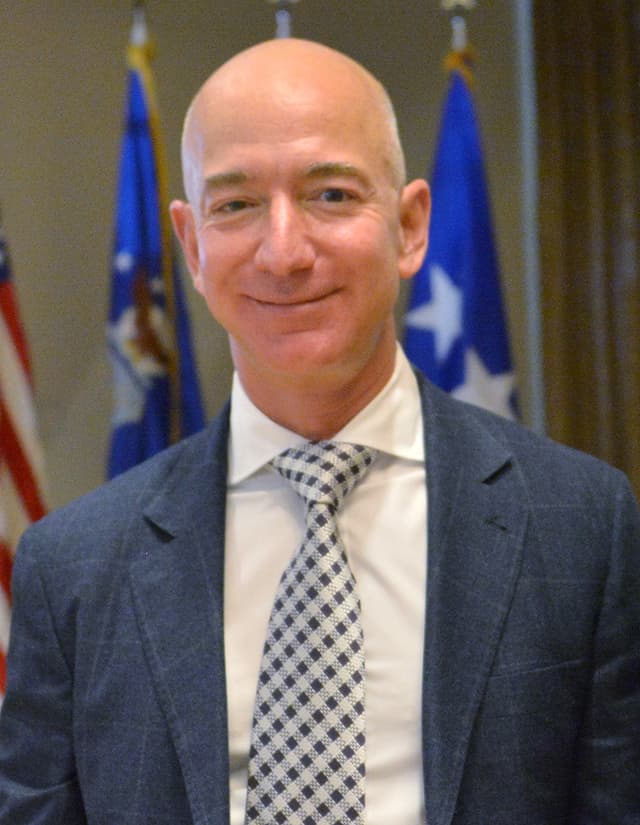
Jeff Bezos
Amazon
A visionary in the E-commerce and Retail Tech industry, Jeff Bezos transformed the way consumers shop by founding Amazon in 1994. Under his leadership, Amazon grew from an online bookstore to a global powerhouse with a market capitalization exceeding $1 trillion, introducing groundbreaking innovations such as the Alexa Echo device, despite initial skepticism. Bezos championed principles of customer obsession and frugality, emphasizing that true value comes from prioritizing customer needs and eliminating wasteful spending. His approach to decision-making, rooted in the Regret Minimization Framework, encouraged bold actions and long-term thinking, allowing Amazon to score significant victories in a competitive landscape.
Core Principles
competitive advantage
Infrastructure investments compound over time. A dollar invested in shared infrastructure (fulfillment centers, servers) generates exponentially greater returns than a dollar spent in traditional retail stores.
While competitors scattered inventory across thousands of stores, Amazon centralized it in a few warehouses and one website. This superior cost structure allowed Amazon to undercut competitors on price while maintaining better margins, creating a sustainable competitive advantage.
“A dollar that was plugged into Amazon's infrastructure could lead to exponentially greater returns than a dollar that went into the infrastructure of any other retailer in the world.”
Show professional pride in your category. If you pioneered something, don't let competitors take the lead away from you. Prevent others from winning the game you invented.
When discussing the virtual assistant market, Bezos acknowledged competitors would enter but said it would be 'incredibly annoying' if Amazon lost its pioneer advantage. This appeal to professional pride motivated the team to maintain market leadership.
“Wouldn't it be incredibly annoying if we can't be the leader in creating this?”
Embrace technology to solve customer problems that others avoid. Be willing to tackle distribution, logistics, and infrastructure challenges that competitors outsource.
While other retailers used UPS and FedEx, Bezos built Amazon's own logistics network, Flex, and later leased aircraft for Prime Air. He took on problems everyone else avoided because solving them provided competitive advantage.
Relentlessly lower prices by passing efficiency gains to customers. Lower prices drive volume, which spreads fixed costs, enabling further price reductions in a virtuous cycle.
After meeting with Costco founder Jim Sinegal, Bezos implemented everyday low prices across Amazon's catalog. This required operational discipline and resisting short-term margin pressure, but it created the flywheel that fueled Amazon's growth and customer loyalty over decades.
“Please expect us to repeat this loop: Focus on cost improvement, which allows lower prices, which drives growth, which spreads fixed costs and makes more price reductions possible.”
Maintain distinctiveness and resist the pull toward normalcy. The world constantly pressures you to become typical. Maintaining differentiation requires continuous energy and intention.
In his final shareholder letter, Bezos emphasized that differentiation is survival. The universe wants you to be typical. Great companies must actively resist this pressure and maintain the practices and principles that make them unique.
“Differentiation is survival, and the universe wants you to be typical.”
culture
Do not confuse work-life balance with work-life harmony. Excellence in important work requires full commitment. Hire people who want to give everything to a meaningful mission.
When an employee asked about work-life balance, Bezos responded that the reason Amazon exists is to get stuff done, and that is the DNA of the company. He did not apologize for the demanding culture. Instead, he made clear this was not the place for people seeking comfort, and those who could not excel should leave.
“The reason we're here is to get stuff done. That is the top priority. That is the DNA of Amazon. If you can't excel and put everything into it, this might not be the place for you.”
Maintain day-one thinking throughout a company's lifecycle. Treat every phase as the beginning, never assuming stability. The moment a company stops taking calculated risks and shifts to preservation mode, decline becomes inevitable.
Bezos made day one a rallying cry at Amazon, reminding employees that day two is stasis, irrelevance, decline, and death. He applied the same philosophy to Blue Origin, ensuring the company never settled into comfortable patterns despite its slow pace.
“Day two is stasis, followed by irrelevance, followed by excruciating painful decline, followed by death, and that is why it's always day one.”
Culture that supports small businesses with big potential is a competitive advantage. Not all businesses need to be large on day one.
Amazon's history of watching multiple $10 million businesses grow into billion-dollar businesses created a culture that encouraged long-term investment in small ideas. This patience and faith in potential was rare in large companies and gave Amazon competitive advantage in innovation.
“Amazon's culture is unusually supportive of small businesses with big potential, and I believe that's a source of competitive advantage.”
Design foundational documents that guide decisions for decades. These memos encode principles that survive across all business lines and market conditions.
The Amazon shareholder letter and Blue Origin welcome memo serve as decision-making frameworks that transcend temporary circumstances. Employees reference these documents years later, and they guide choices even after founders step back from daily operations.
Maintain a shared base of knowledge across leadership teams. Read the same books, discuss the same ideas, and align on principles so everyone operates from the same mental models.
Bezos is a voracious reader and ensures his senior executives read books like The Innovator's Dilemma and The Great A&P. This creates a common language and shared understanding that enables better decision-making across the company.
customer obsession
Customer obsession should guide every decision, not competitor analysis or short-term profits. Direct employees to focus on customer value rather than competitive threats.
During an all-hands meeting addressing Barnes and Noble's entry into online retail, Bezos told employees to worry about customers instead of competitors because competitors would never send Amazon money anyway. This shifted the company's entire strategic focus to customer-centric innovation rather than defensive positioning.
“Look, you should wake up worried, terrified every morning. But don't be worried about our competitors, because they're never going to send us any money anyway. Let's be worried about our customers and stay head down focused.”
Be relentless in customer focus, understanding that customer loyalty is conditional and fleeting without constant improvement.
Bezos reminded employees to wake up every morning terrified not of competitors, but of customers. He understood that people's love for a company lasts only until someone else offers better service. This drove Amazon's obsession with lower prices, faster delivery, and superior experience.
“We constantly remind our employees to be afraid, to wake up every morning terrified, not of our competition, but of our customers.”
Treat customer experience improvements as long-term investments that will continue paying dividends for years, not as expenses to minimize.
Bezos invested heavily in free shipping, price reductions, and experience improvements knowing they hurt short-term margins. He was confident these investments would compound over time because customer needs like lower prices, faster delivery, and better selection are durable and won't change.
“Our belief in the durability of these pillars is what gives us confidence, the confidence required to invest in strengthening them.”
Allow customers to post negative reviews and features that reduce short-term sales if they serve the customer's long-term interest.
Amazon allowed customer reviews including negative ones, and created features like instant order update that prevented duplicate purchases. These features cost short-term revenue but built long-term trust and customer satisfaction, which proved more valuable.
“Though negative reviews cost us some sales in the short term, helping customers make better purchase decisions ultimately pays off for the company.”
Validate your competitive claims through direct customer experience testing, not assumptions. Spend time and money to prove you're actually better.
In 2002, Amazon physically visited bookstores in New York and Seattle to verify their pricing claims. They spent six hours across four stores to compare prices on 100 bestsellers, finding Amazon was 23% cheaper on average. This was non-scalable but provided proof for their marketing claims.
“We priced all 100 titles by visiting their super stores in both Seattle and New York... we discovered that at their stores, these 100 best-selling books cost $1,561. At Amazon, the same books cost $1,195 for a total savings of $366 or 23%.”
Frameworks
Regret Minimization Framework
When facing a significant decision, project yourself to age 80 and ask which choice you would regret more. This shifts focus from short-term comfort or loss to long-term meaning and opportunity. Rather than worrying about foregone bonuses or security, ask what you would wish you had done when looking back on your life from old age.
Use case: Career decisions, major strategic pivots, risk assessment for founders considering leaving stable jobs to start companies
The Amazon Flywheel
A self-reinforcing loop where lower prices drive customer visits, visits drive sales volume, volume attracts third-party sellers and justifies infrastructure investment, which reduces per-unit costs, enabling further price cuts. Each reinforcement of the loop accelerates the entire system. The flywheel can be fed from multiple entry points and scales with additional services like Prime.
Use case: Strategic planning for platform businesses, understanding how to create defensible competitive advantages through reinforcing loops rather than isolated improvements
Two-Pizza Team Structure
Organize the company into autonomous teams small enough to be fed by two pizzas (fewer than 10 people). Each team owns an end-to-end problem and makes decisions independently without requiring cross-team alignment. Teams may duplicate efforts or compete for resources, but this Darwinian structure enables speed and ownership over consensus.
Use case: Scaling organizations while maintaining startup speed, reducing communication overhead, enabling rapid iteration and feature deployment
The Narrative Format for Decision-Making
Replace PowerPoint presentations with written narratives or mock press releases. For product pitches, write the press release first (how the customer will learn about this), then work backward to define the feature. This forces complete, unambiguous thinking and prevents hiding behind vague bullet points. Meetings begin with silent reading of the document, then discussion follows.
Use case: Improving decision quality in meetings, ensuring complete communication of complex ideas, aligning teams around customer-centric product positioning
Data-Driven Verification Over Assumption
Do not accept claims without verifiable evidence. Test assertions in real time if necessary. Establish a culture where only data and logic matter, not rank, seniority, or precedent. Personal verification of metrics reinforces that no one is above scrutiny.
Use case: Building accountability cultures, preventing group thinking, ensuring accurate metrics inform strategy
Slow is Smooth, Smooth is Fast
A Navy SEAL principle that Bezos adopted for Blue Origin. By moving deliberately and avoiding errors that require rework, you ultimately move faster. Rushing leads to mistakes, course corrections, and delays. Methodical progress with quality at each step prevents the need to backtrack.
Use case: Apply when building complex systems, managing teams, or executing long-term strategies where mistakes are costly. Most valuable in high-risk environments like aerospace, medicine, or critical infrastructure.
Day One Mentality
Treat every phase of your company as the beginning, never settling into the assumption of permanence or stability. Day two is stasis, irrelevance, decline, and death. Continuously question assumptions, take appropriate risks, and maintain beginner's mind regardless of company age or success.
Use case: Essential at all business stages to prevent organizational calcification. Particularly important in scaling phase when the temptation to 'milk' success and avoid risk becomes strongest.
Step by Step Ferociously
Blue Origin's explicit motto. Break large visions into smaller incremental steps, execute each with intensity and quality, and use the learnings from each step to inform the next. This combines patience with urgency, combining the opposite forces into a coherent strategy.
Use case: Ideal for moonshot projects that seem impossible as a whole but become achievable when broken into meaningful increments. Works well for resource-constrained startups and patient capital situations.
Generational Long-termism
Frame your work as part of a multi-generational project. Understand that you may not see completion. Take pride in laying foundations and building infrastructure that future teams will build upon. This reframes success away from personal achievement toward system-building.
Use case: Use when building infrastructure, platforms, or pursuing scientific goals that naturally span decades. Helps maintain morale and focus when short-term returns are impossible.
Passionate Hiring Bar
Don't hire primarily for credentials or experience. Hire for genuine passion for the mission, complemented by extreme technical capability. Screen explicitly for people who want to work in a small, mission-driven company rather than comfortable incumbents.
Use case: Use when building high-performance teams for mission-critical projects. Most effective in startup and early growth phases where team alignment on vision matters more than industry experience.
Stories
When developing the Alexa Echo device, internal beta testers said it was 'terrible' and they 'didn't miss it when it was gone.' Bezos himself told Alexa to 'shoot yourself in the head' in frustration. Rather than abandon the project, he recognized it needed massive expansion of testing beyond employees. He created the Amped project, renting apartments nationwide and hiring temporary workers to read scripts to various devices all day, every day, for six days a week.
Lesson: Failed prototypes are learning opportunities, not reasons to quit. When something shows promise but isn't working, redesign the approach completely rather than iterate slightly. Move from small internal testing to large-scale external data collection. Bezos's willingness to invest millions in Amped proved he was 'serious,' and it eventually led to hundreds of millions of Echo sales.
A Swedish customer emailed Bezos at 2 a.m. asking why Amazon was waiting to develop language-specific Alexa versions before entering European markets. Why not just sell English-language Alexa everywhere first? By the following morning, six independent teams across Amazon were working to sell Alexa in 80 new countries. The entire strategy shifted based on one customer insight.
Lesson: Customer intelligence can redirect entire organizations at scale. Founders who maintain direct access to customer feedback can respond faster than competitors. Speed of response to customer insight is a competitive advantage. The fact that Bezos read customer emails at 2 a.m. and could mobilize teams by morning reveals how founder engagement drives execution.
When reviewing Amazon Go prototypes, Bezos walked through stores where customers had to wait in line for fresh meat and seafood to be weighed and added to their bill. The whole concept was 'no waiting.' He realized the team had built the wrong thing despite three years of work. He told them to eliminate the self-service checkout complications and focus purely on the walk-out experience, making it the equivalent of Amazon's one-click ordering for physical retail.
Lesson: The founder's most important contribution is seeing what the team missed. Teams can become invested in complex solutions and lose sight of core value. A founder with fresh eyes can identify what truly matters and what's noise. Bezos's insight forced a complete redesign that made the product viable.
Retail executives buried Amazon's advertising revenue growth inside consolidated financial results so competitors couldn't see the new profit engine. When reviewing numbers, Bezos asked what unit profitability looked like in retail without advertising. The team calculated it. He asked for 2016. They recalculated. Then 2014. The trend showed advertising was masking retail stagnation. He immediately demanded the retail business return to underlying profitability standards without the advertising safety blanket.
Lesson: Transparency into business unit economics reveals hidden problems. By disaggregating numbers, Bezos discovered that his core retail business was deteriorating, something the team's reporting had obscured. Smart leaders use financial questions to uncover the truth. The decision then led to massive advertising expansion, which now generates $20+ billion in annual revenue.
After leasing 40 Boeing 767s from ATSG and Atlas Airlines for Prime Air, Bezos asked his team to not just operate the planes but to purchase warrants to buy 19-20% of each airline company's stock. The partnership announcement sent those airline stocks soaring. Amazon's equity investment gained nearly $500 million in value, essentially paying for the entire five-to-ten-year aircraft leasing arrangement. Bezos sent one word in response: 'Fantastic job. That's how it's done.'
Lesson: Solve problems in ways competitors haven't imagined. Rather than buy or build aircraft, Bezos created a deal structure that let the airlines maintain operations while Amazon gained exclusive access and upside. The equity upside from the partnership essentially subsidized the entire logistics expansion. This is creative problem-solving at the highest level.
Bezos read The Great A&P and the Struggle for Small Business in America, understanding how a predecessor retail giant was destroyed by populist political pressure and inaction. He then required his S-team to read it. Rather than respond passively to criticism like A&P had, Amazon decided to fight back with information, correct the record actively, and use criticism as intelligence to improve. When criticized for low wages, he examined the critique, found it accurate, and raised Amazon's minimum wage to $15/hour.
Lesson: Historical precedent is a crystal ball. By understanding what destroyed competitors, you can anticipate your own challenges and respond proactively. Additionally, criticism shouldn't be resisted; it should be examined for truth and acted upon if valid. This humble approach to feedback, combined with aggressive response, gave Amazon tools to weather regulatory and political pressure.
Bezos was offered the opportunity for the Washington Post to join Apple's News Plus bundle, which would give the publication access to 1.5 billion iPhones and iPads. Despite the obvious scale advantage, Bezos rejected it. He reasoned that bundling would undermine the Post's own subscription strategy and that he preferred to build independent distribution rather than depend on Apple's platform.
Lesson: Independence and control matter more than reaching a larger audience through someone else's channel. By refusing Apple's bundle, Bezos preserved the Post's ability to own its customer relationship and build its own sustainable business model. He prefers to build moats and platforms rather than distribute through others' platforms.
When the team wanted to implement Prime Now in 100 days, creating a separate team devoted solely to ultra-fast delivery, Bezos approved the aggressive timeline. Despite the seemingly impossible deadline, the team launched in 108-111 days, only slightly over. The deadline forced radical simplification and prevented endless planning.
Lesson: Ambitious speed targets force innovation and prevent overthinking. The gap between the 100-day target and actual delivery (108-111 days) was tiny, proving the deadline worked. Teams overestimate how much time they need when given unlimited windows. Constrained deadlines force clarity about what's actually essential.
Jeff Bezos attended his high school valedictorian. His graduation speech was entirely about space colonization, space hotels, and humanity living among the stars. These weren't vague ambitions, but concrete visions of the future. Forty years later, he is executing this exact vision through Blue Origin.
Lesson: Articulated visions from youth can guide entire life trajectories. What you say and think about when young matters more than you realize.
Bezos' grandfather pulled him aside after Jeff told his grandmother that her smoking habit would shorten her life by nine years. Rather than scold him for being hurtful, the grandfather quietly said, Jeff, one day you'll understand that it's harder to be kind than clever. This lesson stayed with Bezos throughout his career.
Lesson: Intelligence and speed must be balanced with compassion. Being kind requires more effort and wisdom than being smart, and sustainable leadership depends on both.
Notable Quotes
“We all know that if you swing for the fences, you're going to strike out a lot, but you're also going to hit some home runs. The difference between baseball and business is that baseball has a truncated outcome distribution. In business, when you step up to the plate, you can score a thousand runs. This long-tailed distribution of returns is why it's important to be bold.”
Shareholder letter on taking bold bets, referenced by David Senra as supporting Evan's philosophy
“We are genuinely customer-centric. We are genuinely long-term oriented, and we are genuinely like to invent. Most companies are not those things. They are focused on the competitor rather than the customer. They want to work on things that will pay dividends in two or three years. And if they don't work in two or three years, they will move on to something else. And they prefer to be close followers rather than inventors because it's safer.”
Describing what makes Amazon different from competitors and explaining the core principles that drive his decision-making
“When you are in the thick of things, you can get confused by small stuff. I knew when I was 80 that I would never think about why I walked away from my 1994 Wall Street bonus. At the same time, I knew that I might sincerely regret not having participated in this thing called the internet that I thought was going to be a revolutionizing event. When I thought about it that way, it was incredibly easy to make that decision.”
Explaining his decision-making process when deciding whether to leave Wall Street to start Amazon
“Communication is a sign of dysfunction. It means people aren't working together in a close organic way. We should be trying to figure out a way for teams to communicate less with each other, not more.”
Responding to junior executives' recommendations to improve cross-group communication at an offsite meeting
“PowerPoint is a very imprecise communication mechanism. It is fantastically easy to hide between bullet points. You are never forced to express your thoughts completely.”
Explaining why he banned PowerPoint presentations in favor of written narratives at Amazon
“I don't want this place to become a country club. What we do is hard. This is not where people go to retire.”
Setting expectations for the intensity and commitment required to work at Amazon
“There are two kinds of retailers. There are those folks who work to figure out how to charge more, and there are companies that work to figure out how to charge less. And we are going to be the second, full stop.”
Announcing Amazon's pricing philosophy after meeting with Jim Sinegal
“That is not how an owner thinks. That's the dumbest idea I've ever heard.”
Responding to a VP's suggestion that Amazon executives be allowed to fly business class
“The reason we're here is to get stuff done. That is the top priority. That is the DNA of Amazon. If you can't excel and put everything into it, this might not be the place for you.”
Responding to an employee's question about work-life balance at an all-hands meeting
“Jeff, one day you'll understand that it's harder to be kind than clever.”
A lesson given to young Bezos after he hurt his grandmother's feelings with a harsh comment about her smoking
Frequently Asked Questions
What are Jeff Bezos's key business principles?▼
Jeff Bezos's core principles include: Infrastructure investments compound over time. A dollar invested in shared infrastructure (fulfillment centers, servers) generates exponentially greater returns than a dollar spent in traditional retail stores.. Show professional pride in your category. If you pioneered something, don't let competitors take the lead away from you. Prevent others from winning the game you invented.. Embrace technology to solve customer problems that others avoid. Be willing to tackle distribution, logistics, and infrastructure challenges that competitors outsource.. Founder Almanac has cataloged 30 total principles from Jeff's career.
What can entrepreneurs learn from Jeff Bezos?▼
Key lessons from Jeff Bezos include: Failed prototypes are learning opportunities, not reasons to quit. When something shows promise but isn't working, redesign the approach completely rather than iterate slightly. Move from small internal testing to large-scale external data collection. Bezos's willingness to invest millions in Amped proved he was 'serious,' and it eventually led to hundreds of millions of Echo sales.. Explore 10 stories and 10 frameworks from Jeff's experience.
What is Jeff Bezos known for in business?▼
A visionary in the E-commerce and Retail Tech industry, Jeff Bezos transformed the way consumers shop by founding Amazon in 1994. Under his leadership, Amazon grew from an online bookstore to a global powerhouse with a market capitalization exceeding $1 trillion, introducing groundbreaking innovations such as the Alexa Echo device, despite initial skepticism. Bezos championed principles of customer obsession and frugality, emphasizing that true value comes from prioritizing customer needs and eliminating wasteful spending. His approach to decision-making, rooted in the Regret Minimization Framework, encouraged bold actions and long-term thinking, allowing Amazon to score significant victories in a competitive landscape.
More E-commerce & Retail Tech Founders
Want Jeff's advice on your business?
Our AI has studied Jeff Bezos's biography, principles, and decision-making frameworks. Ask any business question.
Start a conversation