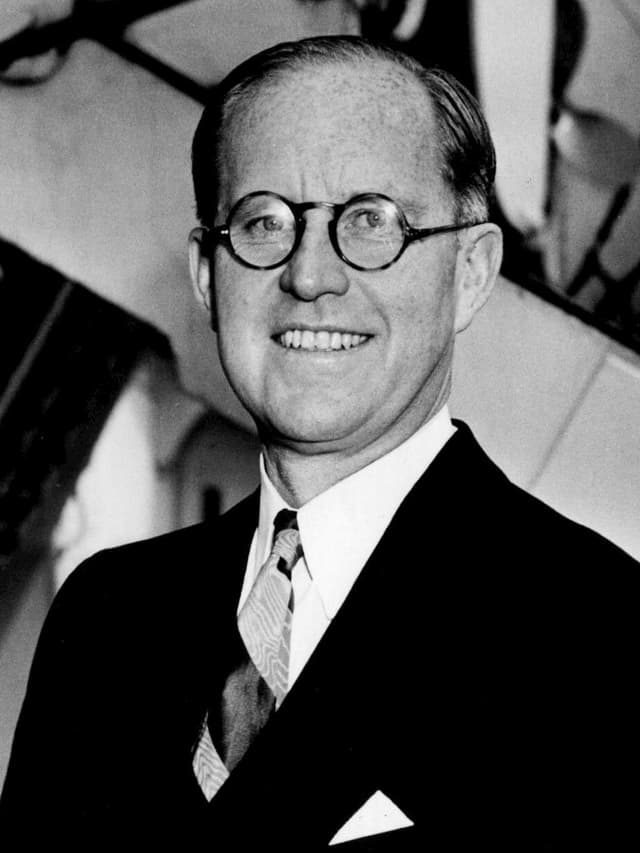
Joseph P. Kennedy
Multiple (Columbia Trust, FBO, RKO, PATH)
A visionary in the finance and investing sector, Joseph P. Kennedy founded and led multiple influential companies, including Columbia Trust and RKO. At just 20 years old, he demonstrated entrepreneurial spirit by launching a successful sightseeing tour business while attending Harvard, buying a dilapidated bus for $600 and transforming it into a profitable venture. Kennedy's ability to navigate complex business landscapes and identify alternative pathways for access to decision-makers set him apart, as did his philosophy of maintaining diverse revenue streams to mitigate risk. His legacy serves as a blueprint for modern entrepreneurs, emphasizing the importance of solving specific problems and seizing opportunities before they become apparent.
Core Principles
competitive advantage
Build an irreplaceable reputation as a problem-solver in a specific niche, allowing you to command premium compensation and equity when other businesses need your intervention.
After successfully reviving FBO, Kennedy became the go-to fixer for Hollywood companies struggling with the transition to sound pictures and financial management. PATH, KAO, and other studios competed for his services, offering him salaries of $2,000 per week plus massive equity options because they knew he could save their operations.
“There would be other studios bidding for his service and he would oblige them, but only on his terms.”
Adopt an outsider's perspective as a competitive advantage, especially when entering an industry controlled by insiders with outdated practices.
Kennedy positioned himself explicitly as an outsider, Harvard-educated, banker, baseball-playing, suburban house owner, and father, as proof he could bring fresh thinking to Hollywood's problems. He refused to apologize for not being a film person and instead weaponized his lack of industry bias.
“On the contrary, he trumpeted his outsider status as a Harvard-educated banker born of American-born parents, a Bostonian whose only language was English, a baseball-playing, suburban house-owning, father of seven.”
Experience and credentials matter less than the ability to solve a specific financial or operational problem that others cannot or will not solve.
Kennedy had no film production experience when he entered Hollywood, yet he succeeded by recognizing that studio executives did not understand accounting, cash flow management, and cost control. He marketed himself as an outsider banker who could fix their broken financials rather than apologizing for his lack of industry experience.
“Nobody in Hollywood knew how to make a balance sheet that gave a banker what he needed. Certainly nobody knew how to depreciate, to amortize, to capitalize.”
finance
Diversify from volatile sectors into stable asset classes and real estate once you have accumulated sufficient wealth to protect against market crashes.
After making $1.7 million from stock trading and Hollywood equity deals by 1929, Kennedy shifted focus to preserving wealth rather than pursuing additional trading profits. He invested heavily in real estate and oil, reducing exposure to market crashes he knew were coming because he understood manipulation and manipulation limits.
“A fabulously wealthy man, he shifted his investment strategies, focusing more attention on preserving his fortune than adding to it.”
Trade actively for short-term profits rather than holding for long-term appreciation when you have information asymmetries and market knowledge.
Kennedy made his initial fortune trading stocks aggressively, buying on bad news and selling on good news. Later, he shorted PATH stock when he discovered its financial weakness through insider knowledge, then used that weakness to negotiate a position as its chief operating officer, profiting multiple times from the same opportunity.
“He made his money as a trader, not an investor. He bought on bad news and sold on good news.”
Establish irrevocable trusts for family members early, focusing on preserving principal and allowing only interest withdrawal, to build generational wealth.
Kennedy created trust funds for his children, stipulating that principal could never be touched and could only pass to grandchildren. This ensured wealth compounding over decades and freed his children from financial pressure to work, allowing them to pursue public service as he intended.
“It was at the time that he established the trust funds for the children, because he did not know how his venture would turn out, and he wanted the children to have some money laid aside in case anything happened to him.”
Buy or invest when others are panicked or desperate, not when markets are booming, to maximize profit margins.
Kennedy entered FBO when it was struggling and British bankers wanted to sell at a discount. He used leverage and other people's capital to acquire it for $1.1 million. Within months, as the market recovered and sound film technology became essential, the company's value multiplied.
“I am in a new game and I will probably be tossed around a bit, but I may have some fun and may get away with it.”
Never use your own capital when you can borrow at favorable rates or use other investors' money to fund expansion.
Kennedy consistently borrowed against future earnings, stock holdings, and real estate. He borrowed $55,000 in 1915 to invest in stocks, took loans to acquire FBO, and used Boston investors' capital to fund his ventures. He never defaulted and always negotiated favorable terms, but he understood leverage as a core wealth-building tool.
“He never borrowed more than he thought he could repay, and only at preferential rates, and he never defaulted.”
innovation
Identify inefficiencies in emerging industries and implement standardized business practices from other sectors to create competitive advantage.
Kennedy recognized that film studios had no proper accounting, cost controls, or borrowing efficiency compared to other industries. He imported banking and manufacturing best practices, cut overpaid executives, reorganized production budgets, and created Cinema Credits Corporation to finance films at better rates, immediately creating profit.
“The trouble with many concerns like my own was that employees occupying positions parallel to positions in other lines were vastly overpaid.”
leadership
Maintain operational discipline and personal stamina to execute multiple complex ventures simultaneously without sacrificing quality of execution.
Kennedy worked 65-70 hours per week at Four River while managing stocks, real estate, and side businesses. Later, he simultaneously ran three major entertainment companies across multiple cities while managing stock trades and real estate. Even those who worked with him marveled at his capacity for concentration and energy.
“He worked day and night, six days a week, 52 weeks a year.”
mindset
Establish clear life goals early and measure every business decision against whether it advances or detracts from that goal.
Kennedy's goal from age 24 was to amass enough wealth so his children would never need to work and could devote lives to public service. Every venture, trade, and business decision from that point forward was filtered through this lens. He achieved it by age 40, then shifted focus to preservation and philanthropy.
“His primary goal as a younger man was to make so much money his children would not have to make any, and then they could devote their lives to public service.”
Cultivate unshakeable self-confidence in your ability to learn and solve problems, even without prior experience or credentials in that domain.
Kennedy demonstrated what some called 'Tom Ford syndrome,' believing he was fabulous while others were not. He entered banking, shipping, stock trading, and film without prior experience in each, yet moved confidently because he believed he could work hard, learn, and outthink the competition.
Build intellectual capital before spending financial capital by studying the details of any industry you intend to enter, even while employed elsewhere.
Kennedy studied banking thoroughly as a state bank examiner before starting at Columbia Trust. He studied stocks for years before becoming a broker. He researched Paul Revere and Boston history for his tour bus business. This deep knowledge allowed him to move quickly and confidently when opportunities arose.
“Passengers didn't take the ride just for fresh air or for the thrill of motor driving. They were interested in history, and I let them have it. I made special studies of Paul Revere and dug up every record I could find in the Boston libraries.”
product
Understand the difference between production and distribution, recognizing that distribution often provides better margins with less capital and operational complexity.
Kennedy lost money producing films but realized quickly that distribution offered better economics. He shifted from FBO production to Columbia Films distribution, achieving profitability with lower risk. This insight about business model structure, not industry expertise, drove his success.
“Kennedy learned quickly from his misadventures as a producer that for aspiring businessmen with large ambitions but limited capital, it made more sense to distribute and exhibit moving pictures than to make them.”
strategy
Reduce scope and lower ambitions temporarily if direct paths are blocked, as a tactical step toward larger goals rather than a retreat.
Kennedy returned to tiny Columbia Trust in East Boston after failing to secure a position at major Boston banks. Rather than view this as a step backward, he recognized it as an entry point into the banking industry. He learned, proved himself, and eventually used that platform to achieve his ambitions elsewhere.
Know when to exit a successful venture and move capital to the next opportunity rather than staying to defend or optimize existing success.
After making millions in Hollywood, Kennedy exited when RCA purchased FBO and KAO, immediately converting his holdings and options into $1.2 million profit from KAO alone, then into RKO shares which he sold for another $905,000. He never intended to stay in any industry long-term, only to build and sell.
“I entered the amusement business with the viewpoint of a banker. If, after the organization of the new corporation, it is running smoothly, I look around and get a good offer for my holdings, I will make a trade.”
When direct paths are blocked by gatekeepers, find lateral entry points that still grant access to the same industry or decision-makers.
Kennedy wanted to work at major Boston banks but was rejected due to his Irish Catholic background. Instead of giving up, he became a state bank examiner, which gave him access to meet the same bankers and trustees he wanted to work for, eventually positioning himself to take over Columbia Trust.
“Banking ranked as high as any commercial profession. It was the basic business profession, and it offered a career ladder with more than one rung.”
Maintain multiple revenue streams and side businesses simultaneously to hedge risk and capture opportunities before they become obvious.
Throughout his career, Kennedy managed a primary job while actively trading stocks, investing in real estate, and launching new ventures. At Fort River, he worked 65-70 hours weekly while still running Old Colony Realty and the Four River Lunch Company. This diversification prevented any single setback from derailing him.
Frameworks
The Lateral Entry Strategy
When direct access to an industry or company is blocked by gatekeepers, identify roles or positions that grant legitimate access to the same decision-makers and information without requiring their approval. Become valuable in that adjacent role, then leverage that position to enter the desired field. Kennedy used state bank examiner position to meet Boston bankers, then moved to Columbia Trust.
Use case: Breaking into industries with closed networks, restricted access, or discrimination against your background.
The Problem-Solver Premium Model
Identify a specific, painful problem that affects multiple organizations in an industry. Develop expertise in solving that problem. Market yourself as the specialist who fixes that problem, then command premium salaries, equity, and options from desperate companies that need your services. Exit once the problem is solved or the market consolidates.
Use case: Scaling consulting or operational turnaround work; building a reputation for fixing specific bottlenecks.
The Multi-Stream Leverage Model
Operate multiple revenue streams simultaneously, some capital-intensive and some not, to hedge risk and create cross-selling opportunities. Use income from stable streams to fund experimentation in volatile ones. This allows you to recover from failures in one area while others generate returns.
Use case: Early career financial security, portfolio diversification, opportunity capture in emerging sectors.
The Outsider Advantage Positioning
When entering an industry dominated by insiders with outdated or inefficient practices, explicitly position your lack of experience as an asset rather than a liability. Frame your outside perspective as fresh thinking that will disrupt incumbents and solve their problems in ways they cannot see.
Use case: Entering traditional industries ripe for operational improvement; capturing credibility in emerging sectors.
The Generational Trust Architecture
Create irrevocable trusts for beneficiaries with principal that cannot be withdrawn and interest that begins only at specified ages. Structure trusts so principal passes to next generation upon death. This approach compounds wealth over decades and removes pressure on heirs to work for income.
Use case: Protecting family wealth, achieving dynastic goals, removing financial pressure from heirs.
The Active Trading vs Holding Framework
Distinguish between trading (active buy-sell on news, rumors, and information asymmetries for short-term profit) and investing (long-term hold for appreciation). Use trading when you have information advantages and market volatility. Switch to holding and diversification once wealth is secured and market knowledge becomes less predictive.
Use case: Wealth accumulation in volatile markets; wealth preservation in mature markets.
The Industry Consolidation Exit Strategy
Build a valuable position in a fragmented industry, then time your exit to coincide with major consolidation or acquisition by larger players. Convert your holdings and options into the acquiring company's equity, then immediately liquidate before the new company's strategy becomes clear or your role diminishes.
Use case: Maximizing returns in consolidating industries; avoiding dilution or role reduction in merged entities.
Stories
At age 20, Kennedy bought a decrepit bus for $600 on installment, painted it cream and blue with 'Mayflower' on the side, and started a sightseeing tour business while still at Harvard. He researched Paul Revere's history extensively to give passengers authentic tours, partnering with his friend Donovan to drive while he handled the megaphone.
Lesson: Start small and capital-light even when aiming high. Learn the details of what you're selling. Test business ideas while in school without sacrificing primary education.
After being rejected by Boston's elite banks due to his Irish Catholic background, Kennedy became a state bank examiner for $1,500 annually. He traveled the state learning banking deeply, compiled reports on assets and liabilities, and built relationships with bank trustees and directors. This unglamorous role became his entry point into the banking industry.
Lesson: When doors are closed, find adjacent positions that grant access to the same decision-makers. Lower compensation temporarily to gain knowledge and relationships that lead to higher-paying opportunities later.
Kennedy spent everything he had to acquire Columbia Trust stock in 1913, leaving him with only $500 when the 1914 financial panic hit and the bank's assets fell 5%. Within months, the economic recovery from World War I ally purchasing reversed the trend, and his assets rose 5% in six months. He had committed fully to his position and survived the downturn.
Lesson: Concentrate your capital in opportunities you believe in, even during downturns, if you have conviction and can survive the volatility. Patience through cycles is rewarded.
In 1915, Kennedy was convinced stocks would only rise and feared the market would close before he owned all he wanted. He made a killing until the Lusitania sinking in May 1915 caused a market reversal that wiped out all his profits and knocked his dreams of easy money 'into a cocked hat.' He learned quickly that short-term reversals could erase gains.
Lesson: Confidence in market direction is often misplaced. Markets can reverse on external shocks. Even when right about overall trajectory, timing and volatility matter more than direction.
During World War I, Kennedy worked 65-70 hours per week at Four River managing shipyard operations, negotiating housing construction, organizing a cafeteria serving 1,380 meals in 15 minutes, founding the Four River Lunch Company, and managing the 1918 flu epidemic by converting dormitories to infirmaries. The stress caused him to develop a severe ulcer and collapse from exhaustion.
Lesson: Extreme work hours and stress compound faster than income. Recognize physical and mental limits before collapse occurs. Success requires sustainability, not just intensity.
Kennedy spent months producing films at FBO, losing money on every venture. He realized quickly that production required creative judgment he lacked, so he pivoted to distribution in 1919, organizing Columbia Films to distribute Universal's pictures in New England. Within months, distribution generated profit where production had lost money.
Lesson: Admit failure quickly and change strategy. The same industry can have vastly different economics in different segments. Business model choice matters more than industry expertise.
Kennedy discovered PATH was in financial distress through short-selling their stock. He then negotiated to become the company's Hollywood operations manager, demanding $2,000 weekly salary plus 100,000 paid PATH shares deliverable over time. He sold the shares at peak value for $579,000 profit in just months of part-time work.
Lesson: Use information asymmetries (short selling reveals weakness) to identify turnaround opportunities, then leverage that knowledge into operational control. Extract equity and compensation before markets discover the same facts.
Between November 1926 and October 1929, Kennedy's capital account grew from $373,000 to $1.7 million despite the stock market crash. He achieved this by shorting stocks, exploiting consolidation opportunities in entertainment, collecting equity from three simultaneous studio positions, and converting options at peak moments.
Lesson: Wealth multiplies fastest at inflection points in industries. Operating three positions simultaneously creates negotiating leverage and exponential optionality. Exit timing matters more than entry timing.
Notable Quotes
“Passengers didn't take the ride just for fresh air or for the thrill of motor driving. They were interested in history, and I let them have it. I made special studies of Paul Revere and dug up every record I could find in the Boston libraries.”
Explaining how he made his sightseeing tour bus business successful while still in college. He understood that customers wanted value and education, not just transportation.
“Banking ranked as high as any commercial profession. It was the basic business profession, and it offered a career ladder with more than one rung.”
Explaining to a reporter in 1928 why he chose banking as his career path after Harvard. He saw it as foundational to all business.
“I knew the time had arrived for me to do at 34 what I had been determined to do at 24, be my own master in my own business.”
Announcing his departure from Hayden Stone to launch his own private banking business in 1924. This was his stated life goal from age 24.
“I am in a new game and I will probably be tossed around a bit, but I may have some fun and may get away with it.”
Responding to congratulations and advice after acquiring FBO for $1.1 million in 1926. He expressed his characteristic mixture of self-deprecation and self-confidence.
“The trouble with many concerns like my own was that employees occupying positions parallel to positions in other lines were vastly overpaid. It was not an uncommon thing for accountants to receive $20,000 a year when in other business they graded from $5,000 to $10,000 a year. My first problem was to change that, which was easy.”
Explaining his strategy for FBO operations to a journalist in 1928. He identified and fixed cost overruns in studio operations through comparative industry analysis.
“Nobody in Hollywood knew how to make a balance sheet that gave a banker what he needed. Certainly nobody knew how to depreciate, to amortize, to capitalize. Those very things spelled success or failure in any other business.”
Observations after moving to Hollywood and auditing studio financials. He identified the core inefficiency he could solve better than industry insiders.
“I entered the amusement business with the viewpoint of a banker. If, after the organization of the new corporation, it is running smoothly, I look around and get a good offer for my holdings, I will make a trade. I have wanted to get out of this business for some time.”
Responding to a Boston Daily Globe reporter asking about his future plans during the RCA consolidation of FBO and KAO. He revealed his exit strategy and transactional mindset.
Frequently Asked Questions
What are Joseph P. Kennedy's key business principles?▼
Joseph P. Kennedy's core principles include: Build an irreplaceable reputation as a problem-solver in a specific niche, allowing you to command premium compensation and equity when other businesses need your intervention.. Adopt an outsider's perspective as a competitive advantage, especially when entering an industry controlled by insiders with outdated practices.. Experience and credentials matter less than the ability to solve a specific financial or operational problem that others cannot or will not solve.. Founder Almanac has cataloged 18 total principles from Joseph's career.
What can entrepreneurs learn from Joseph P. Kennedy?▼
Key lessons from Joseph P. Kennedy include: Start small and capital-light even when aiming high. Learn the details of what you're selling. Test business ideas while in school without sacrificing primary education.. Explore 8 stories and 7 frameworks from Joseph's experience.
What is Joseph P. Kennedy known for in business?▼
A visionary in the finance and investing sector, Joseph P. Kennedy founded and led multiple influential companies, including Columbia Trust and RKO. At just 20 years old, he demonstrated entrepreneurial spirit by launching a successful sightseeing tour business while attending Harvard, buying a dilapidated bus for $600 and transforming it into a profitable venture. Kennedy's ability to navigate complex business landscapes and identify alternative pathways for access to decision-makers set him apart, as did his philosophy of maintaining diverse revenue streams to mitigate risk. His legacy serves as a blueprint for modern entrepreneurs, emphasizing the importance of solving specific problems and seizing opportunities before they become apparent.
More Finance & Investing Founders
Want Joseph's advice on your business?
Our AI has studied Joseph P. Kennedy's biography, principles, and decision-making frameworks. Ask any business question.
Start a conversation