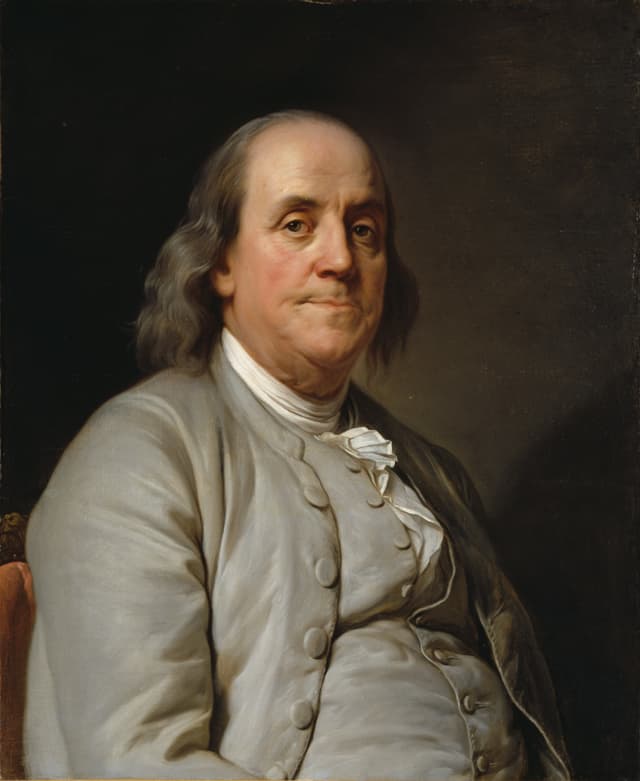
Benjamin Franklin
Franklin Printing House
A pioneer in the printing industry, Benjamin Franklin founded the Franklin Printing House, which became instrumental in disseminating information during the formative years of American politics and government. His belief in the value of collecting and applying ideas over time led him to create a mental library of concepts that informed his work and innovations. Franklin's pragmatic approach to skill development emphasized hands-on experience, which he practiced through his printing apprenticeship, ultimately leading to the establishment of the first successful newspaper in the colonies, the Pennsylvania Gazette, in 1728. His life exemplified how moderate self-confidence can drive individuals to tackle new ventures, as seen in his resolve to support friends like Collins, despite repeated disappointments.
Core Principles
brand
Build credibility through visible industry and frugality. Dress plainly, avoid idle diversion, and demonstrate commitment to your work through consistent actions, even symbolic ones.
To establish himself as trustworthy, Franklin dressed plainly, avoided entertainment, and pushed a wheelbarrow of papers through the streets himself. This branding telegraphed his industriousness to merchants and customers, who then actively solicited his business.
“I took care not only to be really industrious and frugal, but to avoid all appearances to the contrary. I dressed plainly. I was seen at no places of idle diversion.”
competitive advantage
Analyze your competitors thoroughly to identify their weaknesses and your opportunities. Superior execution in areas where competitors fail creates clear competitive advantage.
Franklin assessed both existing Philadelphia printers: Bradford was illiterate and poorly qualified, while Keimer knew composition but nothing of press work. Franklin recognized both were inadequately serving the market. He later observed that Keimer kept a miserable shop, sold without profit, and failed to track accounts, making his failure inevitable.
Understand that competitive advantage lies in home field advantage and deep environmental knowledge, not just superior discipline or resources.
The French and their Native American allies defeated Braddock's disciplined British troops because they understood the forest terrain intimately. The British were trained for open-field combat with visible enemies but faced hidden opponents using the landscape as tactical advantage. Superior training meant nothing outside your circle of competence.
“If you play games where other people have the aptitudes and you don't, you're going to lose. That's as close to certain as any prediction that you can make.”
culture
Create intellectual discussion forums that elevate thinking. Hosting conversations among capable people exposes children and associates to diverse perspectives and reinforces virtuous conduct.
Franklin's father frequently invited sensible friends and neighbors to dinner and deliberately started ingenious topics for discussion. This practice shaped Franklin's early development and later inspired him to create the Junto club in Philadelphia.
“At his table he liked to have as often as he could some sensible friend or neighbor to converse with and always took care to start some ingenious or useful topic for discourse, which might tend to improve the minds of his children.”
Distance yourself from people ruled by vice. Those who drink excessively or gamble will eventually become financial burdens and bring you down.
Franklin's childhood friend Collins reappeared as an adult addicted to brandy and gambling. He lived at Franklin's expense, borrowed money, and provided no value in return. Franklin eventually cut contact after Collins went to the West Indies.
Build a culture of learning and mutual improvement among peers. Regular meetings with other ambitious craftsmen and thinkers compound everyone's knowledge.
Franklin created the Junto, a weekly club where entrepreneurs and tradesmen gathered to trade notes on what they learned. These regular meetings became a vehicle for sharing practical business insights and building community among ambitious people.
Create institutions and structures that address community needs, not for profit but for civic improvement and to build social capital.
Franklin founded the Junto (a self-improvement club), a subscription library, a firefighting brigade, an academy that became the University of Pennsylvania, and a militia to defend Pennsylvania. These initiatives demonstrated his belief that entrepreneurial energy should extend beyond personal business to shape community infrastructure.
customer obsession
Support small businesses and individual creators rather than large corporations. Individual entrepreneurs need your patronage and will remember your loyalty.
Franklin reflects that his first customer's referral created lasting gratitude that influenced his behavior for decades. Supporting individuals who are building something creates bonds that corporate transactions never will.
“That gratitude I felt toward his acquaintance that brought him into this first business has made me often more ready than perhaps I should otherwise have been to assist young beginners.”
finance
Lower your cost of living to maintain freedom and flexibility. High expenses relative to income trap you and leave you unable to invest in opportunities.
While in London, Franklin's wages could not keep up with the high cost of living, forcing him to borrow money and limiting his ability to save capital. Later, his frugality in Philadelphia allowed him to build reserves for his own business and weather challenges.
Build reserves through industry and frugality so you can weather debt and unexpected challenges. Early financial stability prevents ruin.
Franklin's business partner Meredith's father could only provide half the needed capital. When creditors sued for the remaining amount, two friends loaned Franklin the money. His established reputation and frugality made lenders willing to help him.
Avoid excessive debt and manage credit carefully. Debt can devastate you through legal action and forced asset sales at loss.
Franklin repeatedly warns about the dangers of debt. When he and Meredith owed money to suppliers, creditors sued and threatened to seize the press and equipment. Only the help of friends and Franklin's good reputation saved him from ruin.
Keep your expenses low to amplify the power of compound returns. Low costs allow you to retain more earnings for reinvestment.
Franklin maintained frugal habits even as his circumstances improved. By keeping expenses low while his income grew, he built wealth that compounded. He illustrates this principle by noting his circumstances grew easier daily, not through income increases alone but through disciplined spending.
“My original habits of frugality continuing. My circumstances, however, grew daily easier.”
focus
Avoid time-wasting activities like taverns, games, and idle entertainment. Direct this time instead toward business and learning.
Franklin deliberately avoided taverns and amusements to focus on his business and reading. This choice gave him a competitive advantage over peers who spent time and money on entertainment.
“I spent no time in taverns, games, or frolics of any kind, and my industry in my business continued as indefatigable as it was necessary.”
innovation
Create shared value institutions that benefit a community while building your reputation. Libraries, clubs, and associations strengthen your network and brand.
Franklin founded the Junto club, a discussion group of young tradesmen that evolved into a library subscription service. This institution improved Philadelphia's literacy, attracted able minds to Franklin's circle, and enhanced his reputation as a civic leader.
“I proposed that we should all bring our books to one room where they would not only be ready to consult in our conferences, but could become a common benefit.”
Scale good ideas by proposing them to a wider audience. If something benefits a small group, it likely benefits a larger community.
Franklin's private book club worked so well that he proposed creating a public subscription library. With an entrance fee of 40 shillings and annual fees of 10 shillings, people gained access to books. The library grew, was imitated in other towns, and demonstrably improved the education and intelligence of Philadelphia's population.
“Finding the advantage of this little collection, I propose to render the benefit from books more common by commencing a public subscription library.”
Conduct experiments with the courage to challenge conventional wisdom and preconceived notions about how the world works.
Franklin approached electricity as a curiosity without preconceived notions about its nature. His brilliantly designed and easily explained experiments led to foundational discoveries in physics and practical innovations like the lightning rod and early electric battery. He transformed a scientific mystery into usable knowledge.
“He found electricity a curiosity and left it as science.”
Remain intellectually engaged and innovative even when physically declining, as mental vitality transcends bodily limitations and age.
At age 78, while largely bedridden, Franklin attributed a European winter's unusual cold to volcanic emissions from Iceland, proposed daylight saving time, invented bifocals, and contributed to early balloonatics developments. His mind remained sharp until death, proving that innovation and curiosity are not functions of physical capability.
leadership
Seek mentorship from older, successful people. Their wisdom and connections accelerate your learning and open doors.
Franklin befriended successful merchants and older figures in Philadelphia who invited him to dinners and discussions. One told him he would soon put his competitor Keimer out of business and make a fortune. These relationships provided encouragement and perspective.
Use the Socratic method instead of direct contradiction when persuading others. Gentle inquiry draws people toward your conclusions rather than creating defensive resistance.
Franklin realized that being argumentative produced disgust and enemies. After reading about Socrates' method, he replaced his abrupt contradiction style with humble questioning that let people reach conclusions themselves through gentle queries.
“Being argumentative was a very bad habit because by contradicting people you produce disgusts and perhaps enemies.”
Win over adversaries by asking them for small favors. People who have done you a kindness become more willing to help you again than those you have obliged.
When a wealthy community member opposed Franklin, instead of confrontation Franklin wrote asking to borrow a rare book from his library. After Franklin returned it with thanks, the man became a great friend and ally. This reversed the typical obligation dynamic.
“He that once has done you a kindness will be more ready to do you another than he whom you yourself have obliged.”
Study human nature relentlessly to understand what motivates behavior. Observation and reading about psychology gives you practical advantage in business and politics.
Franklin was described as a master of human nature who studied and observed behavior relentlessly. He applied these insights to turn adversaries into allies, to persuade through gentle inquiry, and to build reputation strategically. His success flowed from understanding people.
Gain cooperation through understanding human motivation and using pragmatic incentives rather than relying solely on discipline and punishment.
When Franklin needed to boost church attendance among his troops, he authorized rum distribution after services. Washington relied on discipline and punishment, which led to chronic undermanning. Franklin's force was oversubscribed because he understood what motivated people and structured incentives accordingly.
marketing
Write with skill and clarity to solve real problems for your audience. Good writing creates credibility and attracts customers who might otherwise choose competitors.
When Franklin reprinted the House address to the governor with elegance and correctness instead of Bradford's coarse, blundering manner, the government members noticed the difference and switched their printing business to Franklin.
Writing is a principal tool of advancement. Skill with the pen creates opportunities for influence, reputation, and business that manual labor alone cannot provide.
Franklin repeatedly emphasizes that writing opened more doors than any other skill. His pseudonymous contributions to the newspaper built his reputation while still an apprentice. His ability to write clearly and engagingly made him indispensable and ultimately created his fortune.
“Writing has been of great use to me in the course of my life and was a principal means of my advancement.”
Build reputation through visible action, not just quality work. Let others see your diligence and industry because the appearance of hard work generates opportunity and social capital.
Franklin understood that being industrious was not enough, he needed others to witness his work. Even after becoming successful, he personally carted rolls of paper through Philadelphia streets rather than delegating the task, knowing that merchants watching would spread word of his diligence throughout the community.
“I took care not only to be in reality industrious and frugal, but to avoid all appearances to the contrary.”
Frameworks
The Thirteen Virtues
A personal virtue tracking system Franklin developed to monitor his ethical behavior and character development. He listed 13 virtues (temperance, silence, order, resolution, frugality, industry, sincerity, justice, moderation, cleanliness, tranquility, chastity, humility) with precepts for each, then tracked his adherence daily, weekly, or monthly. The goal was not perfection but continuous improvement and self-awareness.
Use case: Personal development and character building. Useful for entrepreneurs who want to align their daily behavior with their values, and for reflecting on whether vices are limiting their success.
The Junto
A club of young tradesmen from different professions who met regularly to discuss business, philosophy, science, and literature. Members brought their books to share, asked questions to spark debate, and later created a shared library. The group expanded into multiple clubs across Philadelphia and eventually became the model for the public subscription library.
Use case: Building professional networks, continuous learning communities, and shared knowledge institutions. Useful for entrepreneurs who want to accelerate learning through group discussion and create community institutions that enhance reputation.
Competitive Analysis Through Direct Observation
Franklin assessed his competitors by observing their operations and identifying specific failures: Bradford's literacy and ignorance of quality, Keimer's inability to track accounts and tendency to sell at losses. This analysis revealed gaps in the market that Franklin could fill with better execution.
Use case: Market entry and positioning strategy. By identifying what existing competitors do poorly, you can determine where you can excel and why customers will switch to you.
Personal Branding Through Visible Behavior
Franklin built credibility by ensuring his actions visibly demonstrated industry and frugality. He dressed plainly, avoided entertainment venues, and even pushed a wheelbarrow of papers through the streets himself. This consistent signaling of hard work attracted customers and merchants who wanted to do business with a serious operator.
Use case: Early-stage business development and trust building. Before you have a track record, your visible behavior telegraphs your character and reliability to potential customers, partners, and lenders.
Personal Virtue Tracking System
Create a list of virtues you wish to cultivate with brief descriptions of how to practice each one. Review the list regularly and track your adherence to each virtue. Focus on small percentage improvements in character that compound over time into major personal and professional benefits.
Use case: Personal development and character formation, particularly for entrepreneurs who want to align their behavior with their values
Socratic Method of Persuasion
Rather than directly contradicting or arguing against someone's position, ask gentle questions that lead them toward your conclusion. This approach creates less resistance than direct contradiction and allows the other person to feel they have arrived at the conclusion themselves.
Use case: Persuading colleagues, partners, or adversaries without creating defensiveness or enemies
Vertical Integration Strategy
Control the entire value chain of your business from production through distribution. This includes owning production capacity, creating multiple products, producing original content, and controlling distribution channels. This approach is harder for competitors to replicate than single-point advantages.
Use case: Building sustainable competitive advantage in media, publishing, or any business where controlling multiple parts of the value chain is possible
Ben Franklin Method for Making Difficult Decisions
Divide a paper into two columns labeled pro and con. List all arguments for each side. Strike out any pro and con arguments that seem equal in weight. When a pro argument equals two con arguments, strike all three out. Continue until arguments are weighted. The remaining arguments show where the balance lies and point toward the best decision.
Use case: Making difficult business decisions, personal choices, or evaluating opportunities when outcomes are uncertain
Peer Learning Collective
Establish regular meetings where ambitious tradesmen, craftsmen, or entrepreneurs gather to share what they have learned. Structure these meetings around trading practical business insights. The collective increases everyone's knowledge and builds community.
Use case: Creating a culture of continuous learning among peers, often called a Junto or mastermind group
Favor-Based Relationship Building
When you want to win over an adversary or stranger, ask them for a small favor that benefits you but costs them little. When they provide the favor, express strong gratitude. They will then be more likely to help you again, creating a new ally or friend.
Use case: Converting adversaries into allies or building relationships with influential people who initially oppose you
Stories
Franklin's childhood friend Collins reappeared years later as a drunk who had gambled away his money. He lodged with Franklin and borrowed money constantly, promising repayment that never came. During a rowing incident with others, Collins refused to row, sparking conflict. He eventually left for the West Indies, never repaying Franklin a penny.
Lesson: People ruled by vice become financial drains and unreliable partners. Recognize the signs of addiction and poor character early and distance yourself before you're entangled.
Franklin jumped ship from Boston to New York at age 17 with almost no money, having fled his brother James's harsh treatment. The printer in New York couldn't employ him but directed him to Philadelphia, where he arrived dirt-covered and poorly dressed, with only a Dutch dollar and a few shillings. He eventually met his future wife standing at her father's door, thinking he looked ridiculous.
Lesson: Starting with nothing is not an excuse; it's context. Having a valuable skill (printing) and willingness to work allows you to find opportunity even in unfamiliar cities with no connections.
In London, the Pennsylvania governor promised to fund Franklin's business with a letter of credit and generous terms. Franklin waited for days for the letter while preparing to sail, but it never arrived. The governor's friend later revealed the governor had no credit to give and had lied about his ability to help.
Lesson: Never depend on promises from unreliable people. Verify capabilities and creditworthiness before building plans on someone's commitments. Maintain independence instead.
An elderly woman on Franklin's ship to England noticed two young women paying him attention and pulled him aside to warn him they were dangerous seductors and thieves. Franklin heeded her advice. Years later, he learned the women had indeed seduced the ship captain and stolen his possessions.
Lesson: Listen to warnings from experienced people who recognize patterns of deception. Older observers often see character and intent that younger people miss.
A prominent Philadelphia citizen told Franklin, without knowing his plans, that he would soon put Keimer out of business and make a fortune. Years later, Keimer, deeply in debt and mismanaging his business, was indeed forced to sell his printing house to creditors and left for Barbados in poor circumstances.
Lesson: Observers of markets can predict failures when they see fundamental incompetence. If experienced people predict your competitor will fail, pay attention to why and prepare to capture their market.
Franklin's first customer brought five shillings of revenue to his fledgling printing business when it desperately needed cash. He recalls that tiny first payment gave him more pleasure than any larger sum he earned in subsequent decades. This gratitude lasted his lifetime, making him more willing to help young entrepreneurs.
Lesson: The first person to believe in you and support you matters disproportionately. Gratitude for that initial help compounds into generous behavior toward others.
While working at a London printing house, Franklin observed coworkers drinking large quantities of beer daily, claiming it gave them strength for labor. Franklin explained that bread contained more nutrition than the grain in beer, so water and bread would provide more strength than large quantities of ale. The workers continued drinking anyway, unable to break their habit despite the logical argument.
Lesson: People are rationalizing, not purely rational creatures. Logic alone does not change behavior rooted in habit and emotion. You cannot argue someone out of a vice through reason alone.
A well-known older man with a grave manner stopped Franklin at his door to warn him that Philadelphia was bankrupt and his printing business would certainly fail. The man refused to buy property because the town was going to destruction. Years later, when the critic finally purchased a house, he paid five times what the property cost when he first began warning others of doom.
Lesson: Pessimistic critics often extrapolate current trends without understanding market forces. Their predictions are frequently wrong, and they often miss the actual opportunity themselves.
Franklin slipped anonymous written pieces under the door of his brother's printing house at night, disguising his handwriting so James wouldn't know they were from him. When the pieces appeared in the newspaper the next morning, Franklin listened as the printers discussed and praised them, attributing authorship to well-respected men. This gave him confidence and validation without risking his brother's rejection.
Lesson: If you fear authority figures will reject your ideas, test them anonymously first. Get feedback and validation before revealing your identity. Pseudonyms and indirect channels allow you to prove your work has merit.
Franklin's partner Meredith's father could only provide half the capital needed to purchase the printing house. When creditors sued for the remaining amount, two friends offered to lend Franklin money to satisfy the debt. His established reputation and frugal behavior made lenders willing to help him in crisis.
Lesson: Your reputation for industry and reliability makes others willing to lend you money in emergencies. Build credit through consistent behavior before you need it.
Notable Quotes
“What is the use of an infant? The answer of the experimentalist is to endeavor to make it useful.”
Faraday quoted Franklin when asked about the practical use of electrical discoveries. This principle drove the entire electrical industry: discoveries are only valuable if made practical and useful to humanity.
“Writing has been of great use to me in the course of my life and was a principal means of my advancement.”
Reflecting on the tools that created his success and fortune, Franklin emphasizes that skill with writing opened more doors than any other ability.
“I give it a fair quarter whenever I meet with it, being persuaded that it is often productive of good to the possessor.”
On the topic of vanity. While most people dislike vanity in others, Franklin argues that moderate pride in accomplishments often motivates better work.
“It is so convenient a thing to be a reasonable creature, since it enables one to find or make a reason for everything one has a mind to do.”
Observing that people rationalize their behavior after the fact rather than making purely rational decisions. Habits and desires come first, justifications follow.
“There was great difference in persons and discretion did not always accompany years nor was youth always without it.”
Responding to his father's concern that he was too young to run a business. Franklin points out that capability and character vary widely regardless of age.
“This countryman's five shillings, being our first fruits and coming so seasonably, gave me more pleasure than any crown I have since earned.”
Reflecting on his first customer and how that initial small payment meant more than much larger sums earned later in life.
“I never arrived at the perfection I had been so ambitious of obtaining, but fell far short of it. Yet I was by the endeavor a better and happier man than I otherwise should have been if I had not attempted it.”
On his system of tracking adherence to thirteen virtues. He acknowledges failure to achieve perfection but found the process itself valuable.
“That gratitude I felt toward his acquaintance that brought him into this first business has made me often more ready than perhaps I should otherwise have been to assist young beginners.”
Explaining how his first customer created lasting gratitude that influenced his willingness to help entrepreneurs throughout his life.
“There are croakers in every country always boating its ruin.”
Introducing the story of the pessimistic older man who predicted Philadelphia was doomed, yet the city thrived and eventually the critic paid five times the price for property.
“I took care not only to be really industrious and frugal, but to avoid all appearances to the contrary. I dressed plainly. I was seen at no places of idle diversion.”
On building credibility and personal branding through visible behavior that signals reliability and dedication to business.
Frequently Asked Questions
What are Benjamin Franklin's key business principles?▼
Benjamin Franklin's core principles include: Build credibility through visible industry and frugality. Dress plainly, avoid idle diversion, and demonstrate commitment to your work through consistent actions, even symbolic ones.. Analyze your competitors thoroughly to identify their weaknesses and your opportunities. Superior execution in areas where competitors fail creates clear competitive advantage.. Understand that competitive advantage lies in home field advantage and deep environmental knowledge, not just superior discipline or resources.. Founder Almanac has cataloged 30 total principles from Benjamin's career.
What can entrepreneurs learn from Benjamin Franklin?▼
Key lessons from Benjamin Franklin include: People ruled by vice become financial drains and unreliable partners. Recognize the signs of addiction and poor character early and distance yourself before you're entangled.. Explore 10 stories and 10 frameworks from Benjamin's experience.
What is Benjamin Franklin known for in business?▼
A pioneer in the printing industry, Benjamin Franklin founded the Franklin Printing House, which became instrumental in disseminating information during the formative years of American politics and government. His belief in the value of collecting and applying ideas over time led him to create a mental library of concepts that informed his work and innovations. Franklin's pragmatic approach to skill development emphasized hands-on experience, which he practiced through his printing apprenticeship, ultimately leading to the establishment of the first successful newspaper in the colonies, the Pennsylvania Gazette, in 1728. His life exemplified how moderate self-confidence can drive individuals to tackle new ventures, as seen in his resolve to support friends like Collins, despite repeated disappointments.
More Politics & Government Founders
Want Benjamin's advice on your business?
Our AI has studied Benjamin Franklin's biography, principles, and decision-making frameworks. Ask any business question.
Start a conversation