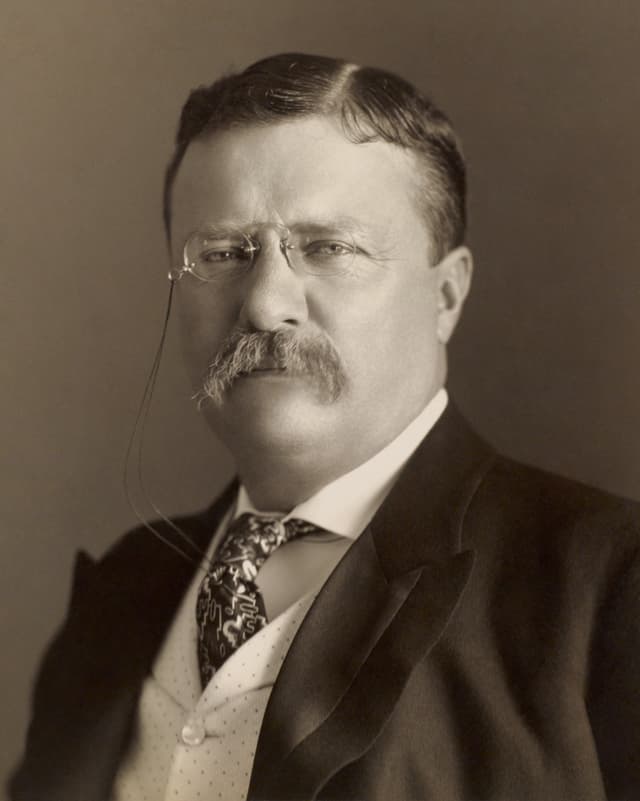
Theodore Roosevelt Jr.
Renowned for his vigorous approach to leadership and reform, Theodore Roosevelt Jr. transformed American politics in the early 20th century. As the 26th President of the United States, he championed progressive policies and established over 230 million acres of public land, laying the groundwork for modern conservation efforts. Roosevelt's belief in confronting emotional pain through physical exertion was evident in his adventurous spirit, as illustrated by his relentless pursuit of justice, famously apprehending three boat thieves after a grueling 45-mile trek. His principle of acting with courage, even in the face of adversity, resonates with today’s entrepreneurs, reminding them that proactive behavior can lead to genuine resilience and success.
Core Principles
competitive advantage
Prefer formidable adversaries to timid allies. Competition against strong opponents is more valuable than consensus with weak partners.
Roosevelt fought against J.P. Morgan, Joseph Pulitzer, and William Randolph Hearst, some of the most powerful figures of his era. He wrote approvingly of his adversaries' fearlessness and forthrightness while criticizing what he called 'timid good men who stood on the sidelines.'
“One must never shrink from what was rough in life. One must never recoil or flinch.”
focus
Never waste a moment. Fill every hour with activity, learning, or work. Idleness breeds despair while constant engagement creates purpose.
Roosevelt was 'wholly constitutionally incapable of indifference.' He read 40-50 books in weeks, served on multiple clubs and boards simultaneously while at Harvard, wrote books while ranching, and maintained an extraordinary output throughout his life. His friend Hunt could identify Roosevelt entering a boarding house by the sound of him running up the stairs.
“Was there a wasted minute in the life of Teddy Roosevelt? No!”
Observe everything and form an opinion on everything. Missing details means missing opportunities for understanding and advantage.
McCullough writes: 'Roosevelt saw everything and formed an opinion on everything.' Roosevelt maintained detailed journals of wildlife, read newspapers with tremendous speed while participating in conversation, and interrogated people relentlessly for information. This observation habit extended from nature to politics to business.
“Roosevelt saw everything and formed an opinion on everything.”
leadership
Make a stout fight. Success comes not from avoiding conflict but from engaging in it with full commitment and enjoyment.
Roosevelt 'was never more pleased with himself than when he made a stout fight.' He sought formidable opponents in politics and business, viewing life itself as a battle that required complete engagement. He needed the fight itself, not just the victory.
“He was never more pleased with himself than when he made a stout fight.”
Establish clear principles worth fighting for. Submit tamely to any injury or injustice invites certain repetition of the offense.
When thieves stole their boat in the Badlands, Roosevelt pursued them 45 miles over two days despite physical exhaustion. He explained: 'It was a matter of principle. To submit tamely and meekly to theft or any other injury is to invite almost certain repetition of the offense.' He delivered the criminals to the sheriff himself.
“It was a matter of principle. To submit tamely and meekly to theft or any other injury is to invite almost certain repetition of the offense.”
Be a person of many gifts and masks. Maintain a public image while keeping private struggles hidden. Public strength matters more than private vulnerability.
McCullough describes Roosevelt as 'shrewd, complex, a man of many gifts and masks.' Publicly, he was robust and energetic; privately, he was often melancholic and introspective. His favorite poet was Edwin Arlington Robinson, known for themes of loneliness and personal memory, yet few knew this about him.
“Still the showman. Still in command of the stage. But also shrewd, complex, a man of many gifts and masks.”
Know what you ought to feel about the world, not just what others do feel. Lead by prescriptive vision, not reactive polling.
When asked how he felt the pulse of the country, Roosevelt responded: 'I don't know the way the people do feel. I only know how they ought to feel.' He used the presidency as a 'bully pulpit' to preach righteousness, courage, and the strenuous life.
“I don't know the way the people do feel. I only know how they ought to feel.”
mindset
Live intensely and entirely in every moment as it passes. Complete engagement with life itself is the greatest achievement.
A childhood friend said of Roosevelt: 'He was so alive at all points, and so gifted with the rare faculty of living intensely and entirely in every moment as it passed.' This summarizes Roosevelt's entire approach to existence, from his reading habits to his political career to his family life.
“He was so alive at all points, and so gifted with the rare faculty of living intensely and entirely in every moment as it passed.”
Organs are made for action, not existence. Physical beings must work to function properly. Movement and exertion are prerequisites for health.
Roosevelt read this principle in a book on asthma by English physician Salter and made it his lifelong creed. Rather than accepting his asthma as a limitation, he used this insight to overcome it through constant physical activity.
“Organs are made for action, not existence. They are made to work, not to be. And when they work well, then they can be well.”
Preserve the memory of those who shaped you. Honor your mentors publicly through daily reminders and actions that reflect their values.
Roosevelt kept a large oil portrait of his father in his study between portraits of Abraham Lincoln and Grant. He repeatedly stated: 'My father was the best man I ever knew.' His entire life was structured around making his father proud and compensating for his father's one regret about not serving in the Civil War.
“My father was the best man I ever knew.”
Act as if you are courageous until courage becomes real. Behavior change precedes psychological change; fake it until you make it.
During his time in the Badlands, Roosevelt wrote: 'There were all kinds of things in which I was afraid of at first, ranging from grizzly bears to gunfighters. But by acting as if I was not afraid, I gradually ceased to be afraid.' This principle applied to his entire transformation.
“By acting as if I was not afraid, I gradually ceased to be afraid.”
Maintain a childlike sense of wonder at the world. Never lose the ability to be amazed by life's extraordinary details and possibilities.
Roosevelt maintained detailed field journals as a child cataloging wildlife, and he applied this same observational wonder to politics, people, and nature throughout his life. He approached new situations like Albany with the excitement of encountering 'fauna of unimaginable shapes and kinds.'
resilience
Separate past suffering from present action. Treat tragedy as finished and out of your life. Do not speak of past sorrows to others.
Roosevelt never publicly acknowledged his first wife Alice Lee or his mother's death. He believed dwelling on past pain was 'both weak and morbid.' He instructed others similarly, writing that one should 'show a brave and cheerful front to the world, whatever she feels, and henceforth never speak one word of the matter to anyone.'
“The only thing for her to do now is to treat the past as past. The event as finished and out of her life. She should show a brave and cheerful front to the world, whatever she feels.”
Deal with emotional pain through physical exertion. When facing grief or despair, throw yourself into strenuous activity rather than dwelling on suffering.
After his father's death and later after his wife and mother died on the same day, Roosevelt turned to intense physical activity: rowing in rough water, hiking, riding, and walking 45 miles without sleep. This became his lifelong coping mechanism and a manifestation of his father's teachings about action.
“He loved to row in the hottest sun over the roughest water in the smallest boat.”
Frameworks
The Paradox Principle
Look for contradictions in a person's life that reveal deeper truths. Roosevelt came from extreme privilege yet worked as a rancher. He was publicly robust yet privately melancholic. He was an intellectual who loved violence and fighting. These paradoxes are not inconsistencies but rather indicators of a complex, fully-realized human.
Use case: When evaluating people or making decisions, resist the urge to resolve apparent contradictions. Instead, hold both truths simultaneously and look for what the contradiction reveals about character or strategy.
The Cowboy Code
Identify and adopt the ethical standards of communities you enter. Roosevelt observed that cowboy culture had an 'unwritten code' that valued courage, honesty, self-reliance, and contempt for cowardice and hypocrisy. He explicitly borrowed these values for his own life and leadership.
Use case: When entering a new industry or organization, study the implicit values and standards of excellence within that community. Adopt what you find admirable and apply it to your own work.
The Walking Interrogation
When learning about a new domain or person, ask exhaustive questions without pause or embarrassment. Roosevelt would 'stand a man against the wall, boring in for half an hour' for information. This relentless inquiry became a primary learning method.
Use case: When entering new territory, be willing to ask perceived dumb questions continuously. Create space for extended inquiry rather than accepting surface-level answers. This is especially effective in politics, business, and relationships.
Stories
A young, exhausted Roosevelt came limping into a doctor's office with blistered feet and muddy clothes after walking 45 miles in less than two days with no sleep. He had just apprehended three boat thieves and was delivering them to jail. When asked why he hadn't simply shot or hanged them, Roosevelt said the thought had never occurred to him.
Lesson: Principle-driven action doesn't require cruelty or efficiency shortcuts. Roosevelt's adherence to justice and proper process was so ingrained that summary execution never entered his mind, despite the hardship it cost him.
At Harvard, Roosevelt threw himself into multiple clubs, sports, classes, and writing projects simultaneously while his father was dying and then after his death. He completed a book on the Naval War of 1812 as an undergraduate while serving as vice president of the Natural History Society and boxing, wrestling, and rowing.
Lesson: Grief and loss demand action and engagement, not withdrawal. Roosevelt's response to tragedy was to fill every moment with activity, learning, and productive work rather than succumbing to despair.
Roosevelt fought a drunken cowboy in a Montana saloon who was mocking him for wearing glasses. The cowboy had two guns. Roosevelt stood up and 'in quiet businesslike fashion flattened' the armed man, despite his own weakness and poor eyesight.
Lesson: Physical courage can be developed through action despite initial fear. Roosevelt's willingness to fight, even at a disadvantage, stemmed from his principle of never shrinking from what is rough in life.
After his wife Alice and mother died on the same day, Roosevelt confessed to his ranching partner that he had nothing to live for and that his daughter would be better off without him. His partner insisted he wouldn't always feel that way. Roosevelt then proceeded to spend six more years in the Badlands, working as a rancher and building his strength before returning east.
Lesson: The deepest despair can be the birth of transformation. Roosevelt's suicidal ideation and depression were not failures of character but precursors to his emergence as a major historical figure. The Badlands solitude and physical exertion were the catalysts.
Roosevelt's father paid a substitute to serve in his place during the Civil War, which was legal but costly. The father regretted this decision his entire life and felt he had 'done a very wrong thing.' Roosevelt read this regret in his father's autobiography and felt compelled to compensate for it by serving as a soldier and later pushing for military strength.
Lesson: A parent's regret becomes a child's mission. Roosevelt spent his life making up for what he saw as his father's moral failure, channeling that inherited guilt into military service, preparedness, and ultimately an aggressive foreign policy.
As a child, Roosevelt suffered severe asthma attacks that made breathing impossible. He would sleep sitting up and had to be soothed during attacks by his mother's stories of adventure and violence from her Southern family. His father then told him he must build his body through exercise, saying 'hard drudgery to make one's body, but I know you will do it.'
Lesson: Physical limitation can become the source of greatest strength. Roosevelt's asthma drove him to develop lifelong habits of strenuous exercise that became his signature and his solution to emotional pain.
On a train back east at age 27, after years in the Badlands and failed political ambitions, Roosevelt remarked to his friend Arthur Packard that he now thought he could do his best work in politics. Packard responded, 'You will become president of the United States.' Roosevelt seemed to have arrived at the same conclusion. He did become president 15 years later.
Lesson: Self-belief emerges from struggle and proves prophetic. Roosevelt's confidence wasn't arrogance but the inevitable conclusion of a person who had faced his worst fears and survived.
Notable Quotes
“It was a matter of principle. To submit tamely and meekly to theft or any other injury is to invite almost certain repetition of the offense.”
Explaining why he pursued boat thieves 45 miles over two days in the Badlands
“By acting as if I was not afraid, I gradually ceased to be afraid.”
Reflecting on his time in the Badlands facing grizzly bears and gunfighters
“My father was the finest man that I ever knew.”
From Roosevelt's autobiography, expressing his lifelong devotion to his father's memory
“One must never shrink from what was rough in life. One must never recoil or flinch.”
Writing about his philosophy of engagement with conflict and difficulty
“I don't know the way the people do feel. I only know how they ought to feel.”
Response when asked how he felt the pulse of the country as president
“Looking back on his life, it seems as if mine must be such a weak, useless one in comparison.”
From diary after his father's death, expressing grief and self-doubt
“The only thing for her to do now is to treat the past as past. The event as finished and out of her life. She should show a brave and cheerful front to the world, whatever she feels, and henceforth never speak one word of the matter to anyone.”
Letter to his sister about dealing with tragedy, also descriptive of his own approach
“She would just be as well off without me.”
To his ranching partner about his daughter after the death of his wife and mother
Frequently Asked Questions
What are Theodore Roosevelt Jr.'s key business principles?▼
Theodore Roosevelt Jr.'s core principles include: Prefer formidable adversaries to timid allies. Competition against strong opponents is more valuable than consensus with weak partners.. Never waste a moment. Fill every hour with activity, learning, or work. Idleness breeds despair while constant engagement creates purpose.. Observe everything and form an opinion on everything. Missing details means missing opportunities for understanding and advantage.. Founder Almanac has cataloged 14 total principles from Theodore's career.
What can entrepreneurs learn from Theodore Roosevelt Jr.?▼
Key lessons from Theodore Roosevelt Jr. include: Principle-driven action doesn't require cruelty or efficiency shortcuts. Roosevelt's adherence to justice and proper process was so ingrained that summary execution never entered his mind, despite the hardship it cost him.. Explore 7 stories and 3 frameworks from Theodore's experience.
What is Theodore Roosevelt Jr. known for in business?▼
Renowned for his vigorous approach to leadership and reform, Theodore Roosevelt Jr. transformed American politics in the early 20th century. As the 26th President of the United States, he championed progressive policies and established over 230 million acres of public land, laying the groundwork for modern conservation efforts. Roosevelt's belief in confronting emotional pain through physical exertion was evident in his adventurous spirit, as illustrated by his relentless pursuit of justice, famously apprehending three boat thieves after a grueling 45-mile trek. His principle of acting with courage, even in the face of adversity, resonates with today’s entrepreneurs, reminding them that proactive behavior can lead to genuine resilience and success.
More Politics & Government Founders
Want Theodore's advice on your business?
Our AI has studied Theodore Roosevelt Jr.'s biography, principles, and decision-making frameworks. Ask any business question.
Start a conversation