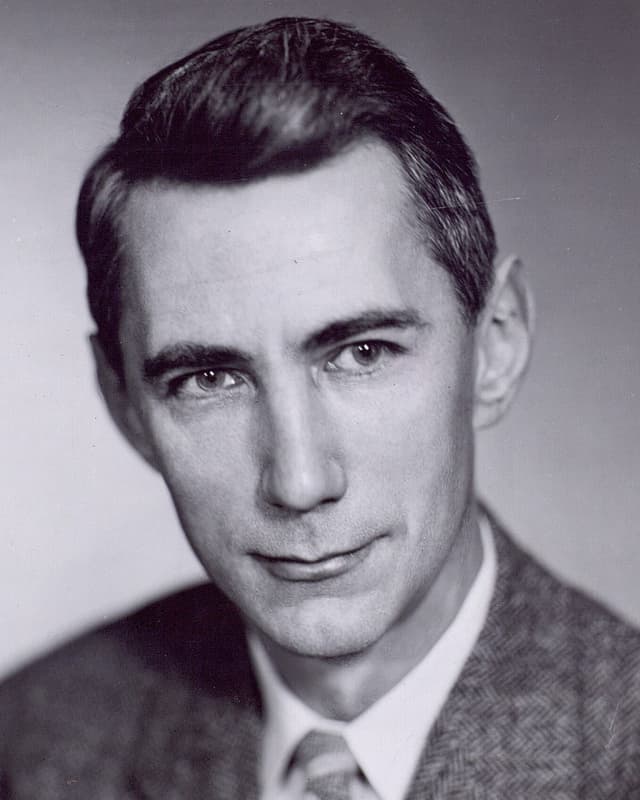
Claude Shannon
Bell Labs
A pioneering figure in information theory, Claude Shannon revolutionized the fields of communication and cryptography during his tenure at Bell Labs. His groundbreaking work on Project X, a classified cryptographic system known as SIGSALY, played a crucial role in secure communications during World War II, showcasing his ability to blend deep concentration with innovative problem-solving. Shannon's principle of collecting diverse experiences and allowing genuine interests to guide his pursuits led him to explore various disciplines, ultimately establishing a framework that continues to inspire entrepreneurs and business builders today. With a notable quote reflecting his polymathic approach, he stated, "I just developed different interests. As life goes on, you change your direction," emphasizing the importance of adaptability and curiosity in achieving lasting success.
Core Principles
finance
When investing or evaluating companies, focus on fundamentals like the quality of leadership and the strength of the product rather than mathematical formulas or market timing.
Shannon's investing approach contradicted Wall Street conventional wisdom. He argued that complicated formulas and market timing mattered far less than understanding a company's people, products, and earnings potential. He believed it was easier to choose companies that would succeed long-term than to predict short-term price movements. This philosophy, applied part-time with his wife, generated returns that beat professional investors working full-time.
“Complicated formulas mattered a great deal less than a company's people and the product. It's easier to choose companies which are going to succeed than to predict short-term variations.”
focus
Reject fields or domains that have too many isolated facts and too few general principles. Seek work where ideas can be unified under overarching rules.
Shannon disliked fields like chemistry that seemed to him like collections of isolated facts without organizing principles. He preferred domains where he could abstract upward and build models. This is why he gravitated toward mathematics, logic, and information theory, where underlying principles could unify diverse phenomena. This principle shaped which problems he pursued and which he abandoned.
“It always seemed a little dull to me. Too many isolated facts and too few general principles for my taste.”
Value deep, sustained thinking in solitude over constant communication and social engagement. Protect your mental space from distractions to do your best work.
Shannon was famously withdrawn and preferred working alone in his office or at home. He was phobic about crowds and uncomfortable with people he didn't know well. He would only engage in conversation if others initiated, but would reciprocate. His most important work, including the paper on information theory, came during periods of deep withdrawal. The authors note he was comfortable being alone with his own thoughts and reasoning, believing in that reasoning without needing outside validation.
“A man of closed doors and long silences, who thought his best thoughts in Spartan bachelor apartments and empty office buildings.”
innovation
Avoid specialization and cultivate broad, deep knowledge across multiple domains. Genius comes from combining insights from different fields, not from narrow expertise.
Vannevar Bush believed specialization was the death of genius and rejected it in his own work. Shannon embodied this philosophy by becoming expert in mathematics, engineering, cryptography, investing, game theory, and juggling. He would systematically study successful investors, read broadly across disciplines, and applied mathematical thinking to any problem that interested him. His information theory work benefited directly from this multi-disciplinary approach.
“I've been working on three different ideas simultaneously. And strangely enough, it seems a more productive method than sticking to one problem.”
Understand that valuable scientific and business insights often come from simple curiosity and pursuing interesting problems, not from attempts to solve immediately practical ones.
Shannon's most important contribution, information theory, emerged from his curiosity about the differential analyzer and how thought could be automated. It wasn't assigned as a problem to solve. His cryptographic work at Bell Labs led to insights about information structure that he later applied to his broader theory. His investing success came from treating markets as mathematical problems worthy of curiosity rather than schemes to get rich quick.
“I think the history of science has shown that valuable consequences often proliferate from simple curiosity.”
Extend and build upon the work of those who inspired you rather than trying to invent everything from scratch. Understanding what came before multiplies your ability to innovate.
Shannon's information theory was built on the foundation of Ralph Hartley's work in communication. Shannon acknowledged that reading Hartley was an important influence on his life and research. Rather than dismissing prior work, he took Hartley's core ideas and extended them far beyond what Hartley or anyone else had imagined. This pattern of building on foundational work appears across history with Buffett building on Singleton, Jobs learning from Land, and Bezos studying Walton.
“Reading the work of Ralph Hartley was an important influence on my life.”
Connect logical systems across different domains. The same principles that govern one system often apply powerfully to another.
Claude Shannon observed the telephone circuit system at Bell Labs, then connected those principles to Boolean logic from 90 years prior. He realized that electrical on-off switches could execute logical operations the same way mathematical equations could. This connection became the foundation of all digital computers, demonstrating how cross-domain thinking unlocks breakthroughs.
“It is possible to perform complex mathematical operations by means of relay circuits.”
Understand that knowledge from one field can be applied to seemingly unrelated problems. Build bridges between domains by looking for structural similarities and analogies.
Shannon's breakthrough work on information theory emerged from studying the differential analyzer and logic gates, then applying those insights to communication problems. His cryptographic work later informed his thinking on information structure. His experiences with juggling and investing became mathematical puzzles. Few people had Shannon's ability to see how insights from one domain could solve problems in another.
“There were links from field to field, and Shannon understood the bridges between his work in information theory and his work on robotics and investing in computer chess.”
leadership
Optimize for freedom and control over your own work rather than prestige, money, or status. The ability to choose what you work on matters more than external rewards.
Shannon turned down numerous prestigious offers and positions because they didn't align with his need for intellectual freedom. He chose Bell Labs over other opportunities because it offered unheard-of freedom in research direction. Later, he left Bell Labs for MIT partly for the freedom and flexibility of academic life. Throughout his life, he consistently chose autonomy over status.
“I had the freedom to do anything I wanted from almost the day I started. They never told me what to work on.”
mindset
Choose activities and work that are autotelic, meaning they have value and purpose in themselves rather than as means to external ends. Build activities you'd do regardless of reward.
Shannon's life was structured around activities he found intrinsically rewarding: tinkering, juggling, unicycling, solving mathematical puzzles, and investing. He made no distinction between his scientific work and his hobbies because both were driven by the same curiosity. When asked about his approach, he said he pursued interests without much regard to financial value or value to the world. He spent tremendous time on what others would call useless endeavors because they interested him.
“I've always pursued my interests without much regard to financial value or value to the world. I spend lots of time on totally useless things.”
Grant yourself freedom to follow your genuine interests rather than forcing artificial focus. A polymathic approach allows you to make novel connections others miss.
Shannon had varied interests including chess, juggling, unicycles, and the stock market. Rather than viewing this as unfocused, he allowed himself to pursue whatever fascinated him, which led to breakthroughs in multiple fields.
“I just developed different interests. As life goes on, you change your direction.”
Follow your natural drift and curiosity rather than trying to become a specialist in a single field. Indecision about what to focus on can become a strategic advantage.
Shannon couldn't decide between mathematics and engineering in college, so he pursued both degrees. This dual training proved essential to his later breakthroughs in information theory. Similarly, his refusal to specialize allowed him to apply insights from cryptography, juggling, investing, and chess to his scientific work. He was indifferent to seeming contradictions in his fields of interest.
“I think one tends to get into work that you find easy for yourself.”
Pursue work because it genuinely interests you, not for financial gain, fame, or external validation. Money and recognition will follow curiosity more reliably than direct pursuit of them.
Shannon never made financial gain his primary motivation, yet achieved exceptional investment returns part-time that beat professional managers working full-time. He accumulated numerous awards without caring about them, and celebrity status without seeking it. His daughter noted that his investment activities were treated playfully, as puzzles to solve rather than means to wealth. His curiosity-driven approach resulted in breakthroughs that proved far more valuable than anything money-motivated could achieve.
“I don't think I was ever motivated by the notion of winning prizes. I was more motivated by curiosity, never by the desire for financial gain.”
Believe in your own reasoning and be indifferent to others' opinions of your work. Don't seek validation or argue defensively when others don't understand your ideas.
Shannon was immune to scientific fashion and completely insulated from others' opinions. He never argued his ideas, and if people didn't believe in them, he ignored those people. He could neither explain himself to others nor cared to. This allowed him to pursue unconventional research paths without being derailed by criticism or lack of immediate recognition.
“He never argued his ideas. If people didn't believe in them, he ignored those people.”
simplicity
Reduce complex problems to their essential core through abstraction and model-building rather than getting lost in details. The ability to chisel away unnecessary complexity is more valuable than raw computational power.
Ed Thorpe noted that Shannon thought with ideas more than formulas, approaching problems like a sculptor removing excess stone. Shannon had a talent for getting to the heart of simplicity in any issue. Rather than memorizing isolated facts, he looked for underlying principles that could be abstracted and applied elsewhere. This was evident in how he described information theory as a simple technical tool for engineers.
“A new problem was like a sculptor's block of stone, and Shannon's ideas chiseled away the obstacles until an approximate solution emerged.”
Frameworks
Curiosity-Driven Problem Selection
Rather than working on problems assigned by others or chosen for their practical value, select work based on genuine intellectual interest. Ask yourself what problems you naturally want to understand. This framework led Shannon from mathematics to logic gates to information theory to investing, with each domain chosen because it interested him. The resulting work often proved far more valuable than conventional approaches because of the depth of engagement.
Use case: Deciding what research to pursue, what business problems to focus on, or how to allocate your intellectual time. Useful when you have the freedom to choose your own direction.
Model-Based Problem Reduction
Approach complex problems by building models and abstracting away unnecessary details until you reach the essential core. Like a sculptor removing stone to reveal the form inside, systematically identify what matters and eliminate what doesn't. Shannon applied this to switches, signals, markets, and juggling, each time finding simple underlying structures in apparent complexity.
Use case: Breaking down business problems, designing products, or understanding market dynamics. Useful when facing complex adaptive systems that seem unpredictable or overwhelming.
Cross-Domain Insight Synthesis
Systematically study solutions from unrelated fields and look for structural similarities that can be applied to your current problem. Shannon studied successful investors, game theory, logic, and cryptography, then applied insights from each to his other work. Build bridges between domains by asking what underlying principles connect seemingly different problems.
Use case: Innovation and problem-solving. Useful when you're stuck and need fresh perspectives, or when building something new that combines elements from different industries.
Freedom-First Career Design
Prioritize autonomy and intellectual freedom above prestige, wealth, or status in your career decisions. When evaluating opportunities, weight how much control you'd have over your work higher than compensation or recognition. Shannon chose positions and left positions based on whether they preserved his freedom to pursue his interests.
Use case: Major career decisions, choosing between job offers, deciding when to stay or leave a role. Most important for people driven by internal motivation rather than external rewards.
Cross-Domain Principle Transfer
A framework for innovation that involves identifying a principle, system, or solution proven in one domain and applying it with new context to another domain where it hasn't been applied. The mechanism works because fundamental truths about how systems work often transcend their original context. Shannon applied Boolean logic to circuits, Case applied consumer marketing principles to software services, and Rock applied investment principles across geography.
Use case: Generating breakthrough ideas, solving problems by borrowing from unrelated fields, and identifying arbitrage opportunities between industries
Stories
Shannon worked on Project X, a classified cryptographic system called SIGSALI during World War II alongside Alan Turing. The work involved concealing messages with random noise. Shannon later said thinking about how to hide information in noise provided key insights into information theory, his greatest invention.
Lesson: Seemingly unrelated projects in your past can provide unexpected insights into your future work. Maintain a learning mindset across all experiences.
Shannon's investment in Hewlett-Packard stock from a merger gave him a handsome profit that convinced him real money could be made in stocks. Later, he invested in Henry Singleton's Teledyne at $1 per share. By 1967, the stock hit $24 per share, generating enormous gains that fueled his market research.
Lesson: Early investing wins can seed confidence for future investments. Successful outcomes from individual stocks can motivate deeper market study and larger commitments.
As a boy, Shannon built a barbed wire telegraph by running insulation made of whatever was available (leather straps, glass, corn cobs) along a half-mile fence between his house and a friend's house. He created keypads at each end to create a private long-distance communication system. This project, built with whatever materials were at hand, exemplified resourcefulness and curiosity.
Lesson: Resourcefulness and making do with available materials appears to be a common trait among high achievers. Starting with limitations forces you to be creative and think about solutions rather than waiting for ideal resources.
A flight instructor at MIT tried to ban Shannon from flying, believing Shannon was too much of a genius to risk in an accident. The instructor wrote to the MIT president asking him to prevent Shannon from the cockpit. The president's response was level-headed: he doubted the wisdom of preventing a young man from pursuing an interest based on intellectual ability alone, saying it wouldn't be good for his development.
Lesson: Intellectual development requires freedom to pursue diverse interests and take reasonable risks. Overprotecting talented people from normal life experiences can be harmful to their growth. The best approach is to give talented people freedom to explore.
While working at the differential analyzer at MIT, Shannon was shut in a room with a machine designed to automate thought. From this experience came his realization that there was a more powerful way to automate thought through logic and digital computation rather than analog machines. This insight became foundational to information theory.
Lesson: Immersive experience with a problem, combined with deep thinking, can lead to breakthrough insights. Sometimes the best ideas come from the ordinary conditions of your work rather than dedicated brainstorming.
Shannon and his wife treated investing like a family hobby and intellectual puzzle. Their daughter noted that much of the home conversation revolved around stocks, and they taught her to read the Wall Street Journal early. They set up a small personal computer to track quotes and eventually achieved investment returns that beat professional managers, all part-time.
Lesson: When you treat challenging domains as playful problems to solve rather than means to wealth, you often achieve better results. Family engagement in intellectual pursuits can both improve decision-making and strengthen relationships.
After feeling stale after 15 years at Bell Labs, Shannon accepted a position at MIT partly because he believed a change of scene and colleagues would be stimulating. The move proved successful, resulting in some of his most creative and whimsical endeavors, including the flame-throwing trumpet, customized unicycles, and juggling robots.
Lesson: When you feel unproductive or stale in your environment, changing your physical location and social context can reignite creativity. Sometimes the best response to diminishing returns in one situation is to move, not to push harder.
Claude Shannon observed the phone system's circuit design at Bell Labs, then realized those same principles could execute Boolean logic using on-off switches. This connection between two unrelated systems became the theoretical foundation for all modern computers.
Lesson: Breakthroughs come from connecting unrelated ideas. Shannon's genius wasn't inventing something new, it was recognizing that the same principles governed both systems.
Notable Quotes
“I just developed different interests. As life goes on, you change your direction.”
Explaining why he left information theory after pioneering the field. Demonstrates his philosophy of following genuine interest rather than external expectations.
“You know the economists talk about the efficient market where everything is equalized out and nobody can make any money. Really, it's all luck and so on. I don't believe that's true at all.”
On the efficient market hypothesis. Shannon rejected the prevailing academic orthodoxy and believed skilled investors could outperform.
“I had the freedom to do anything I wanted from almost the day I started. They never told me what to work on.”
Describing his experience at Bell Labs and why he valued that position so highly. Freedom to choose his own research direction was more important to him than prestige or compensation.
“I think one tends to get into work that you find easy for yourself.”
Reflecting on why he gravitated toward mathematics as a field of study. His interest came easily to him, and he followed that signal rather than forcing himself into difficult domains.
“I've been working on three different ideas simultaneously. And strangely enough, it seems a more productive method than sticking to one problem.”
Describing his approach to productivity and work. Contrary to popular focus advice, he found that working on multiple projects simultaneously was more productive than specialization.
“It always seemed a little dull to me. Too many isolated facts and too few general principles for my taste.”
On why he disliked the field of chemistry. He preferred domains where underlying principles unified diverse phenomena rather than collections of isolated facts.
“I don't think I was ever motivated by the notion of winning prizes. I was more motivated by curiosity, never by the desire for financial gain.”
Late in life, explaining what actually drove his work. Despite winning numerous prestigious awards and becoming wealthy, these were byproducts of following curiosity, not goals in themselves.
“After I'd found the answers, it was always painful to write them up or publish them.”
On the difference between discovery and communication. The joy for him came from solving the problem, not from sharing the solution with others.
“I've always pursued my interests without much regard to financial value or value to the world. I spend lots of time on totally useless things.”
Summarizing his life philosophy. He made no distinction between supposedly serious work and frivolous hobbies because both came from the same curiosity.
“I think the history of science has shown that valuable consequences often proliferate from simple curiosity.”
On why fundamental research and pursuing interesting questions matters more than trying to solve immediately practical problems. The most valuable discoveries often come from playful investigation.
Frequently Asked Questions
What are Claude Shannon's key business principles?▼
Claude Shannon's core principles include: When investing or evaluating companies, focus on fundamentals like the quality of leadership and the strength of the product rather than mathematical formulas or market timing.. Reject fields or domains that have too many isolated facts and too few general principles. Seek work where ideas can be unified under overarching rules.. Value deep, sustained thinking in solitude over constant communication and social engagement. Protect your mental space from distractions to do your best work.. Founder Almanac has cataloged 22 total principles from Claude's career.
What can entrepreneurs learn from Claude Shannon?▼
Key lessons from Claude Shannon include: Seemingly unrelated projects in your past can provide unexpected insights into your future work. Maintain a learning mindset across all experiences.. Explore 8 stories and 5 frameworks from Claude's experience.
What is Claude Shannon known for in business?▼
A pioneering figure in information theory, Claude Shannon revolutionized the fields of communication and cryptography during his tenure at Bell Labs. His groundbreaking work on Project X, a classified cryptographic system known as SIGSALY, played a crucial role in secure communications during World War II, showcasing his ability to blend deep concentration with innovative problem-solving. Shannon's principle of collecting diverse experiences and allowing genuine interests to guide his pursuits led him to explore various disciplines, ultimately establishing a framework that continues to inspire entrepreneurs and business builders today. With a notable quote reflecting his polymathic approach, he stated, "I just developed different interests. As life goes on, you change your direction," emphasizing the importance of adaptability and curiosity in achieving lasting success.
More Finance & Investing Founders
Want Claude's advice on your business?
Our AI has studied Claude Shannon's biography, principles, and decision-making frameworks. Ask any business question.
Start a conversation