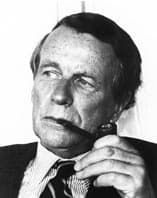
David Ogilvy
Ogilvy and Mather
A pioneer in the advertising industry, David Ogilvy founded Ogilvy and Mather, which became one of the most successful advertising agencies in the world. He believed that advertising should serve as a medium of information designed to sell products, emphasizing deep research to uncover compelling selling ideas. This principle was exemplified when he took on the Rolls-Royce account, where his research revealed that the loudest noise at 60 miles per hour came from the electric clock, a fact he leveraged to craft a memorable campaign. Ogilvy's focus on client service over personal accolades has left a lasting impact on entrepreneurs and business builders today, reinforcing the value of understanding one's product and audience. His famous quote, "I wish I had written that," reflects his respect for effective communication and compelling ideas in advertising.
Core Principles
competitive advantage
Distinguish your product by being different, not necessarily by being superior, and convey that your product is positively good rather than implying superiority to competitors.
Ogilvy observed that most advertisers assume they must convince consumers their product is superior to competitors. However, he found that if consumers felt certain a product was good while uncertain about competitors, they would buy the advertised brand regardless of actual quality differences.
“If the consumer feels certain that your product is good and feels uncertain about your competitors, he will buy yours.”
Become indispensable by developing expertise no one else possesses. When you master your craft, you become immune to dismissal even in downturns.
Ogilvy learned this lesson from a head chef in Paris. By becoming the world expert in advertising effectiveness through research and experience, he built security and influence that protected him even during industry shifts. Rare talent is nearly irreplaceable.
“If you can make yourself indispensable to a client, you will never be fired.”
culture
Write down your principles and purposes to guide organizational decision-making, ensuring that daily actions align with stated values even in a complicated enterprise.
Ogilvy drafted written principles for his agency with Marvin Bauer of McKinsey. Initially, he listed profit first, but Bauer rejected this, arguing that any service business prioritizing profit over client service deserved to fail. Ogilvy relegated profit to seventh place and found written principles invaluable for keeping his complicated enterprise on course.
“Writing it down have proved invaluable in keeping a complicated enterprise on course.”
Set and communicate non-negotiable standards for quality and client service. Use repetition to weave principles into organizational culture.
Ogilvy gathered his entire staff annually to discuss operations, profits, and the behaviors he admired. He called these principles 'Ogilvy-isms' and repeated them constantly. Rather than imposing culture top-down, he reinforced values through storytelling and example, which created alignment without coercion.
“In the best establishments, promises are always kept, whatever it may cost in agony and overtime.”
Enforce high standards for employee behavior and work ethic. Hard work, intellectual honesty, lack of pretense, and craftsmanship are the foundation of strong teams.
Ogilvy annually listed the behaviors he admired: hard work, intelligence combined with honesty, absence of nepotism and sycophancy, work with gusto, self-confident professionals, people who hire strong successors, builders of talent, and kind people. These were not suggestions but culture.
“I admire people who work hard, who bite the bullet. It's more fun to be overworked than to be underworked.”
Set remarkably high standards for yourself and your organization. Small details matter because they reflect your commitment to excellence and make employees feel they are part of something great.
Ogilvy learned this from Chef Escoffier-style kitchen management in Paris. The head chef fired a chef for pastries that would not rise straight. Ogilvy realized this extreme standard made other chefs feel they were working for the best kitchen in the world. He applied this to his agency, insisting on excellence in every task, no matter how small. Employees became missionaries, not mercenaries.
“What is not perfect is bad.”
Build an enduring institution with clear values and mission that everyone understands, from the boardroom to the mailroom. Create a culture where people feel they are on a mission, not just earning a paycheck.
Ogilvy studied how McKinsey, under Marvin Bauer, created a firm where everyone understood the values and mission. Inside both organizations, people knew how things were done. Ogilvy wanted his agency to be the best, not the biggest. He wrote that any service business giving higher priority to profits than serving clients deserves to fail. This culture attracted missionaries, not mercenaries.
“Never content with just writing ads, Ogilvy's larger goal was to create an enduring institution.”
customer obsession
Focus on serving clients and helping them sell more of their products, not on winning awards or gaining personal recognition.
Ogilvy dismissed the importance of campaigns that found favor at cocktail parties in New York and San Francisco. He took comfort in the fact that he had sold more merchandise than all the award-winners combined. His entire business orientation was around client service and measurable results.
“I comfort myself with the reflection that I have sold more merchandise than all of them put together, meaning the people that just win awards.”
Define advertising's true purpose as selling products at scale, not winning creative awards. All creative decisions should be measured against whether they drive consumer action.
Ogilvy repeatedly emphasizes that beautiful, clever ads that don't sell products are failures. He positions advertising as 'salesmanship at scale' and rejects the artistic school that prioritizes aesthetics over results. This clarity of purpose guided every decision at his agency.
“You cannot bore people into buying your product. You can only interest them in buying it.”
Invest heavily in research and consumer insight before creating advertising. Understanding what consumers want and what drives their behavior is the foundation of effective campaigns.
Ogilvy's work with George Gallup at the Gallup Poll taught him the power of research. He studied consumer behavior, conducted extensive testing, and made decisions based on data rather than intuition. This gave him a competitive edge over agencies that relied on creative gut feel alone. Gallup himself said Ogilvy and Raymond Rubicon were the only people who made practical use of research.
Always identify and appeal to the decision maker's personal interests. If you are selling a stove to a household with a cook, the cook holds the casting vote, not the owner.
Ogilvy taught door-to-door salesmen to focus on the cook's interests, appealing to the extra hour in bed and a kitchen as clean as a drawing room. He emphasized buttering up the decision maker and using them as your best advocate after the sale.
“If there's a cook in the house, she's bound to have the casting vote over a new cooker. Butter her up. Never go above her head.”
finance
Recognize that profit is a function of time, and accelerating decision cycles by reviewing progress frequently significantly increases the speed of business growth.
Ogilvy cited Jerry Lambert's breakthrough with Listerine, where dividing time into months and reviewing progress every 30 days accelerated the entire process of market success and fortune-building compared to slower evaluation cycles.
“When Jerry Lambert scored his breakthrough with Listerine, he sped up the whole process of marketing by dividing time into months. He reviewed progress every 30 days with the result that he made a fortune in record time.”
Understand that pricing decisions are typically made through guesswork rather than scientific methods, and higher prices tend to increase perceived desirability regardless of actual quality differences.
Ogilvy noted that marketers rarely used scientific methods for pricing. A University of Iowa study of 679 food brands found almost zero correlation between price and quality, yet consumers perceived higher prices as quality signals.
“Pricing is guesswork. The higher you price your product, the more desirable it becomes in the eyes of the consumer.”
Treat advertising as part of the product cost rather than a selling cost, meaning it should not be cut during difficult periods any more than you would reduce other essential product ingredients.
Ogilvy reframed advertising not as overhead or selling expense but as an integral component of product delivery. This perspective prevented the common business mistake of cutting advertising during downturns, which would be like cutting product ingredients.
“I have come to regard advertising as part of the product, to be treated as a production cost, not a selling cost.”
Align incentives between your agency and clients. Commission-based compensation creates conflicts; flat fees align both parties toward client success.
Ogilvy was one of the first to challenge the standard 15% commission system because it incentivized agencies to recommend expensive ad placements regardless of effectiveness. He argued that agencies can only give candid advice when they profit from client success, not from ad spending volume.
“No manufacturer ever got rich by underpaying his agency. Pay peanuts and you get monkeys.”
Pay generously for talent. Underpaying your best people is false economy and produces mediocre work. Compensation reflects how much you value excellence.
Ogilvy's famous maxim was 'Pay peanuts and you get monkeys.' He argued that clients who haggled over agency fees were looking through the wrong end of the telescope. The leverage is in the creative work produced, not in shaving the agency fee.
“Pay peanuts and you get monkeys. No manufacturer ever got rich by underpaying his agency.”
focus
Concentrate time, brains, and advertising money on successful products rather than spending disproportionate effort trying to revive problem products that show no promise.
Ogilvy observed that most marketers spent too much effort trying to resurrect failing products while neglecting opportunities to make successful products even more successful. Back your winners and abandon your losers.
“Back your winners and abandon your losers.”
Become exceptionally good at one thing rather than mediocre at many things. Depth of mastery in your craft creates sustainable competitive advantage and unique opportunities.
Ogilvy tried many careers before finding advertising at age 38. Once committed, he became arguably the world's best advertising practitioner, which directly enabled his business success. He notes that being 'very, very, very good at one thing' distinguishes you from competitors who remain permanently superficial.
“I am a miserable duffer in everything except advertising. But when it comes to advertising, Advertising Age says that I am the creative king of advertising.”
hiring
Talent in creative fields is most likely found among nonconformists, rebels, and misfits. Conventional thinkers cannot produce original work.
Ogilvy believed most businessmen are incapable of original thinking because they are trapped by reason and convention. The best talent comes from people willing to argue with authority, question norms, and think differently. Organizations must recruit and protect these outliers.
“Talent, I believe, is most likely to be found among nonconformists, dissenters, and rebels, misfits. The majority of businessmen are incapable of original thinking because they are unable to escape from the tyranny of reason.”
Frameworks
The Research-Based Positioning Framework
Begin with deep product knowledge through professional research, then study consumer thinking to identify the right appeal and promise. Determine product positioning by defining what it does and who it is for. Finally, test and validate promises through consumer research before launching. This framework ensures advertising addresses genuine consumer needs rather than product features.
Use case: Launching new products, repositioning existing brands, or entering competitive markets where differentiation is needed
The Direct Response Validation Method
Study what direct response advertisers do because they must prove measurable sales per dollar spent. Observe their techniques: longer copy, off-peak time slots, specific benefits, pricing inclusion, and clear calls to action. Apply these measurable-result principles to brand advertising even if you cannot track every sale. This reveals what genuinely works versus what merely sounds creative.
Use case: Evaluating advertising effectiveness, designing campaigns that drive sales, or training creative teams on accountability
The Written Principles System
Create a written set of principles and purposes for your organization, prioritizing them clearly and referencing them regularly to guide decisions. Ogilvy's framework put client service at the top and profit at the bottom, ensuring daily decisions aligned with values. This prevents drift toward short-term gains that undermine long-term mission.
Use case: Scaling organizations, maintaining culture during growth, or resolving conflicting priorities in decision-making
The Copywriting Fundamentals Framework
Structure copy with benefit-driven headlines that promise specific outcomes, then deliver proof through long, accessible sentences and short paragraphs. Address readers individually as if writing a letter, use everyday language, include pricing, and tell what the product will do for the reader specifically, not what it is. This framework bridges interest and action.
Use case: Writing advertisements, sales pages, marketing copy, or any communication designed to drive consumer action
The Continuous Specialization Strategy
Become the most informed person on your assigned account or industry by reading books, studying trade journals, visiting facilities, and talking to customers. Develop expertise that exceeds your boss within one year. This competitive advantage through knowledge accumulation creates value that cannot be easily replicated.
Use case: Career advancement, account management, consulting, or establishing expertise in competitive fields
The Sales Meeting Framework
Rehearse thoroughly but speak conversationally, never from prepared text. Listen more than you talk, letting the prospect reveal their needs. Disclose weak points first to build credibility for your strong points. Focus the conversation on the value delivered (selling power) rather than the price of your service. This transforms sales from pitch delivery to collaborative discovery.
Use case: Business development, client pitches, partnership negotiations, or any scenario where building trust and fit is critical
The Established Agency Lifecycle
Agencies begin with hunger, creativity, and hard work. As founders grow rich and tired, creative fires dim. The agency coasts on momentum and old successes, producing dull routine campaigns. Dry rot sets in as vital new competitors with fresh hunger take accounts. Eventually the agency becomes an extinct volcano. This pattern repeats across industries whenever success reduces urgency.
Use case: Diagnosing why established companies lose market position to younger competitors, and as a warning against complacency after early success.
Research-Driven Campaign Development
Study mail order advertising to understand what actually drives consumer behavior (they can measure results precisely). Learn the principles that make mail order work. Apply those same principles to brand advertising, even though results are harder to measure. Ground all creative decisions in evidence, not guesswork.
Use case: Building advertising campaigns, marketing strategies, or any customer-facing work where data can inform creative direction.
Progressive Client Acquisition
Identify five ideal clients you want to serve. Create and send regular valuable information (progress reports, insights, analysis) unsolicited to hundreds of people across your target industries. Make personal visits and pitches to non-agency companies. Plant seeds broadly and harvest relationships when they're ready. Move with energy but expect the timeline to be measured in years, not weeks.
Use case: Building a new business or gaining clients for a new service offering when you lack established brand reputation.
The Mentorship Learning Framework
Identify the giants in your field who have already solved the problems you face. Study their work systematically, seek them out personally, and learn from their frameworks. Have lunch with them once a week if possible, listen more than you talk, and extract their accumulated wisdom. Then apply these lessons to your own work while maintaining the fundamentals across your entire career.
Use case: When entering a new field or industry where you lack expertise, use this framework to accelerate learning by standing on the shoulders of giants rather than starting from scratch.
Stories
When assigned the Rolls-Royce account, Ogilvy spent three weeks researching the car and discovered that at 60 miles per hour, the loudest noise comes from the electric clock. He used this fact as his headline followed by 607 words of factual copy. For Mercedes later, he sent a team to Stuttgart to tape interviews with engineers, creating a campaign that increased sales from 10,000 to 40,000 cars per year.
Lesson: Deep professional research into product details and customer perspectives reveals unique selling propositions that intuition alone cannot generate, and the resulting long-form copy drives measurable sales increases.
Ogilvy conducted a consumer study on Old Crow whiskey where participants were given identical samples but told they were different brands including Jack Daniels. Participants reported tasting significant differences based on the brand name and perception. The same product tasted completely different to consumers depending on their brand expectations.
Lesson: Brand image and consumer perception determine perceived value far more than actual product differences. Humans are tasting images, not just ingredients, which means effective marketing shapes how consumers experience products.
Ogilvy noted that his partner was asked by a client to remake a 15,000 dollar commercial for 100,000 dollars, and after the expensive remake, sales went down. Similarly, the founder of Tuft & Needle found that rough, low-budget ads performed better than highly produced commercials.
Lesson: High production costs do not correlate with sales effectiveness. Simpler, more authentic executions often outperform expensive, overproduced campaigns because production cost does not equal persuasive power.
When Ogilvy pitched the Hathaway shirt company, he had the idea of putting a fake eye patch on the model in advertisements. No one in their right mind would have suggested this without research, but consumer research revealed the eye patch drew attention and increased readership and sales.
Lesson: Research can validate wild, counterintuitive ideas that pure intuition would reject, revealing opportunities for competitive advantage that seem risky but actually work.
When testing French tourism headlines with French text first followed by English translation versus all English, research revealed the French headlines were far more effective despite seeming counterintuitive. Partners told him he was crazy until the data proved him right.
Lesson: Research reveals unexpected truths about consumer preferences that contradict expert opinion, and willingness to test bold hypotheses often reveals competitive advantages.
At age 38, Ogilvy was an obscure tobacco farmer in Pennsylvania. He had been a chef, door-to-door salesman, social worker, researcher, and farmer. With no clients and little money, he hung out his shingle in 1948 writing, 'We are starting on a shoestring, but we are going to make it a great agency before 1960.' Within 12 years, his five target clients (General Foods, Bristol Myers, Campbell Soup, Lever Brothers, Shell) all became clients. Billings reached $55 million.
Lesson: Ambitious goal-setting gives direction to execution. When you write down specifically what you want, you can organize effort toward it. Presumption combined with systematic effort and refusal to accept current circumstances enables rapid advancement.
Ogilvy observed a chef in Paris managing 37 cooks who worked with 'white-hot morale.' The head chef, Mr. P, praised very seldom but held exorbitant standards. When Ogilvy mentioned being out of a dish, Mr. P almost fired him, saying 'In a great kitchen, one must always honor what one has promised on the menu.' Mr. P would call other restaurants to source missing ingredients rather than disappoint a customer.
Lesson: Great leaders set impossibly high standards and take full responsibility for meeting customer promises. Praise is more powerful when rare. The example of unwavering commitment to promises ripples through the entire organization.
When Lever Brothers asked seven agencies to submit policy papers on television (then new), six agencies submitted 5-6 page papers. A young Ogilvy employee worked day and night for three weeks and submitted a 177-page analysis with every conceivable statistic. Colleagues sneered at him as a compulsive worker. One year later, he was elected to the board of directors.
Lesson: Extraordinary work on assigned tasks creates rapid advancement. Most people won't invest the effort to become the expert on their account. The willingness to do 25x more work than competitors is itself a competitive advantage that cannot be copied.
Ogilvy was rejected for several account pitches early in his agency's history. He responded by identifying 600 people across industries and sending them regular progress reports, insights from his research, and unsolicited strategic advice. Sam Bronfman, founder of Seagrams, later quoted back two specific paragraphs from a 16-page speech Ogilvy had sent him without solicitation. Bronfman then became a client.
Lesson: Generosity in providing value, before asking for business, builds trust and creates opportunities. Persistence in planting seeds across a wide network eventually yields harvest. The person who gives value first has advantage over those who immediately ask for it.
As a scholarship student at private school, young David was humiliated when the headmistress Mrs. Wilkes refused to let him buy a peach, shouting in front of the whole school that his father was so poor they were obliged to keep him there for almost nothing. Decades later, as a successful adult, Ogilvy returned to give a speech at the school where he confronted this memory head-on, telling students he was a dud who hated school, then proceeded to tell the school they were doing education wrong.
Lesson: Early humiliation and poverty can be transformed into fuel for achievement. The way to overcome shame is not to hide from it but to eventually achieve enough to confront it directly and even reshape institutions that caused it. This is the blueprint mentality: using pain as motivation.
Notable Quotes
“I wish I had written that.”
Responding to Leo Burnett's statement about the importance of service over size
“Advertising has a responsibility to behave properly.”
Expressing the ethical obligation of advertisers to operate with integrity
“Ad writers forget that they are salesmen and try to be performers. Instead of sales, they seek applause.”
Criticizing copywriters who prioritize creative recognition over sales effectiveness
“It is not uncommon for a change in headline to multiply returns from five to 10 times over.”
Demonstrating the enormous impact of testing and refining headline copy
“I don't regard advertising as entertainment or an art form, but as a medium of information. When I write an advertisement, I don't want you to tell me that you find it creative. I want you to find it so interesting that you buy the product.”
Opening statement of the book, establishing his core philosophy that advertising must drive sales, not win awards
“I comfort myself with the reflection that I have sold more merchandise than all of them put together, meaning the people that just win awards.”
Dismissing the importance of industry acclaim and creative awards, emphasizing results over recognition
“You don't stand a tinker's chance of producing successful advertising unless you start by doing your homework. The more you know about it, the more likely you are to come up with a big idea for selling it.”
Explaining the critical importance of professional research as the foundation for effective advertising
“Customers don't care about your product. They care about what change your product makes to them.”
Explaining why benefit-driven messaging outperforms feature-driven advertising
“Have humility in the presence of a good idea. It is horribly difficult to recognize a good idea. I shudder to think how many I have rejected.”
Quoting Albert Lasker on the importance of intellectual humility when evaluating ideas
“Whenever you can, make the product itself the hero of your advertising. If you think the product's too dull, I have news for you. There are no dull products, only dull writers.”
Explaining that product-focused advertising fails due to writer incompetence, not product limitations
Frequently Asked Questions
What are David Ogilvy's key business principles?▼
David Ogilvy's core principles include: Distinguish your product by being different, not necessarily by being superior, and convey that your product is positively good rather than implying superiority to competitors.. Become indispensable by developing expertise no one else possesses. When you master your craft, you become immune to dismissal even in downturns.. Write down your principles and purposes to guide organizational decision-making, ensuring that daily actions align with stated values even in a complicated enterprise.. Founder Almanac has cataloged 30 total principles from David's career.
What can entrepreneurs learn from David Ogilvy?▼
Key lessons from David Ogilvy include: Deep professional research into product details and customer perspectives reveals unique selling propositions that intuition alone cannot generate, and the resulting long-form copy drives measurable sales increases.. Explore 10 stories and 10 frameworks from David's experience.
What is David Ogilvy known for in business?▼
A pioneer in the advertising industry, David Ogilvy founded Ogilvy and Mather, which became one of the most successful advertising agencies in the world. He believed that advertising should serve as a medium of information designed to sell products, emphasizing deep research to uncover compelling selling ideas. This principle was exemplified when he took on the Rolls-Royce account, where his research revealed that the loudest noise at 60 miles per hour came from the electric clock, a fact he leveraged to craft a memorable campaign. Ogilvy's focus on client service over personal accolades has left a lasting impact on entrepreneurs and business builders today, reinforcing the value of understanding one's product and audience. His famous quote, "I wish I had written that," reflects his respect for effective communication and compelling ideas in advertising.
More Advertising & Marketing Founders
Want David's advice on your business?
Our AI has studied David Ogilvy's biography, principles, and decision-making frameworks. Ask any business question.
Start a conversation