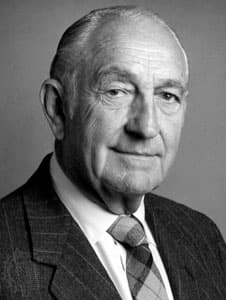
David Packard
Hewlett-Packard
A pioneer in the technology industry, David Packard co-founded Hewlett-Packard in 1939, which grew from a garage startup to a multinational corporation with revenues exceeding $70 billion by the time he retired. His belief that profit reflects customer value rather than greed shaped HP's culture, emphasizing efficiency and innovation in product development. Packard insisted on hands-on involvement in all aspects of the business, understanding that such experiences provided invaluable lessons for entrepreneurs. His foresight in navigating financial prudence helped HP avoid common pitfalls, as he recognized that overextending resources often leads to failure. Notably, he famously stated, "Profit is the measure of our contribution to our customers," underscoring his commitment to delivering value.
Core Principles
competitive advantage
Win price competition through superior product quality and lower costs, not through cutting corners. Deliver genuine value that justifies customer selection over established competitors.
Walt Disney chose HP's audio oscillator over General Radio's offering because HP's product cost less than $100 while General Radio's cost $400, yet HP's was a good product. This wasn't a race to the bottom; HP invested in design and manufacturing excellence that allowed them to underprice premium competitors while maintaining quality.
“We enabled Disney to buy a good product at a price considerably less than our competitors.”
culture
Every organization develops its own unique philosophy, set of values, traditions, and customs that guide decision-making and define how people work together.
Packard recognized that HP's distinctive management approach, later formalized as the HP Way, emerged from deeply held beliefs that served as a foundation for corporate objectives, plans, and practices. This cultural framework guided the company for decades.
“Any group of people who have worked together for some time develops a philosophy, a set of values, a series of traditions and customs. These in total are unique to the organization.”
Celebrate employees who pursue entrepreneurial ventures, even when they leave your company, as their success reflects well on your culture and their adoption of your values elsewhere.
HP employees went on to found over a dozen companies employing more than 40,000 people. Rather than viewing departures as losses, Packard and Hewlett took pride in former employees' entrepreneurial success and their application of HP principles in their own ventures.
“Are we upset that they left us? On the contrary, Bill and I understand and respect the entrepreneurial spirit. We are pleased and proud that they once worked with us and have done so well.”
Continuous education and skill development are mandatory organizational requirements because techniques relevant today become obsolete tomorrow.
Packard emphasized that rapid progress in technical businesses requires the most capable people available in each role and ongoing programs to keep their knowledge current. People must constantly seek new and better ways to do their work or risk becoming ineffective.
“Techniques that are relevant today will be outdated in the future, and every person in the organization must be continually looking for new and better ways to do his or her work.”
Choose partners you like, admire, and trust. This partnership quality becomes more important as the business grows and faces inevitable challenges.
Packard chose to keep his own salary artificially low during World War II because he didn't think it fair that his compensation exceed Bill Hewlett's Army salary. This decision reflected his deep respect for his co-founder and commitment to equity. Such choices are only possible with genuine trust and admiration between partners.
“I kept my salary at a lower level than it should have been because I did not think it was fair for my salary to be higher than Bill's army salary.”
Work with people who don't see you as competition but as fellow travelers pursuing aligned goals. Share knowledge freely and help each other improve.
Charlie Litton, technically a competitor, became a crucial supporter of HP's early growth. He allowed them to use his equipment, conducted seminars to share ideas and business philosophy, and provided mentoring. Litton never viewed HP as a competitive threat but as a compatriot in building an industry. This collaborative approach benefited everyone.
“He never saw us as competitors, but always as compatriots. He also thought it was very important for them to get together and share ideas.”
customer obsession
Test market assumptions directly with potential customers rather than relying solely on internal judgment.
HP's first product, the audio oscillator, was created with no guarantee of demand. They took pictures and mailed a two-page sales brochure to about 25 potential customers. To their surprise, they received several orders with checks within weeks of January, validating the product-market fit before scaling production.
“In the first couple weeks of January, came back several orders, and some were accompanied by checks.”
Customer satisfaction must be the non-negotiable standard for organizational performance. Every team member should understand how their work directly serves customer needs.
Packard made customer satisfaction second to none his only acceptable goal. He didn't shy away from demanding accountability, believing that if leaders could not drive their organizations toward this standard, they should find someone who could. This principle permeated every level of HP.
“Customer satisfaction second to none is the only acceptable goal. If you cannot lead your organization to achieve that goal, well, find somebody who can.”
Ask customers what else they need beyond what they currently buy from you. This reveals adjacent opportunities and demonstrates genuine commitment to serving their full range of needs.
When selling instruments to the Naval Research Laboratory during World War II, Packard asked what other instruments they might need. This simple question led to HP developing numerous complementary products. The same principle applies today, as evidenced by early Amazon founder Jeff Bezos asking customers what else they'd buy, which revealed opportunities beyond books.
“We were interested in selling them our standard products, but also interested in finding out what other instruments they might need.”
finance
Profit is not a measure of greed but a measure of customer value and the efficiency of how resources are combined and delivered.
Packard defines profit as the difference between what customers pay and the actual cost of production and distribution. This represents the value added to resources utilized. Without profit, a company cannot sustain its mission or meet other objectives.
“Profit is the measure of our contribution to our customers. It is the measure of what customers are willing to pay us over and above the actual cost of an instrument.”
More businesses fail from taking on too much debt and overextending than from lack of revenue.
A banker once told Packard that more businesses die from indigestion than starvation, warning against over-leveraging. This advice, combined with Packard's observations during the Great Depression when debt-burdened companies lost assets while debt-free companies survived intact, shaped HP's pay-as-you-go financing philosophy.
“More businesses die from indigestion than starvation.”
Avoid long-term debt by financing growth from earnings whenever possible, as debt creates vulnerability to economic downturns and forces assets to be foreclosed.
Packard's father was a bankruptcy referee during the Great Depression, and Packard observed that firms with mortgaged assets lost everything when banks foreclosed, while debt-free firms survived with assets intact. He applied this observation by building HP on a strict pay-as-you-go basis for over 50 years.
“Those firms that did not borrow money had a difficult time, but they ended up with their assets intact and survived during the depression years that followed.”
Profitability from the start establishes financial discipline and confidence in business viability.
HP achieved profitability in its first full year of operation in 1939, with sales of $5,369 and profits of $1,563. The company then showed a profit every year thereafter, establishing a pattern of financial responsibility from inception.
“At the end of 1939, our first full year in business, our sales totaled $5,369 and we had made $1,563 in profits. We would show a profit every year thereafter.”
Shop around for financial partners. A local bank that understands your business and sees potential may offer better terms and more valuable relationships than large institutional lenders.
Bank of America rejected HP's credit application. Packard then approached Palo Alto National Bank's president Jud Crary, who listened carefully, asked questions, and approved a loan. This began a long partnership. When HP's needs exceeded Palo Alto National's legal lending limits, they introduced HP to their associate bank, Wells Fargo. The lesson was finding bankers who believed in the business.
“That little leap of faith on Crary's part was the beginning of a long and happy relationship between us.”
focus
Maintain narrow focus on complementary products within your core competency rather than pursuing every opportunity that comes along.
During WWII, HP declined large military production contracts outside their core expertise in electronic measurement and testing instruments. Packard believed sustaining a focused strategy was crucial to long-term success, even when customers offered lucrative but misaligned work.
“All were designed to measure and test electronic equipment. This decision to focus our efforts was extremely important, not only in the early days of the company, but later on as well.”
Maintain focused product strategy by building complementary products rather than pursuing unrelated opportunities. This builds cumulative expertise and competitive advantage.
During World War II, HP developed various instruments for the Naval Research Laboratory. While they appeared different on the surface, all measured and tested electronic equipment. This complementary focus allowed HP to deepen expertise while avoiding scattered efforts across unrelated markets. Packard believed this decision to concentrate efforts was extremely important to success.
“I believe this decision to focus our efforts was extremely important. I felt that we should take on no more than we could reasonably handle, building a solid base by doing what we did best, designing and manufacturing high quality instruments.”
hiring
Complementary abilities in co-founders create stronger outcomes than identical skill sets.
Hewlett excelled in circuit design while Packard had superior manufacturing process experience. This combination proved particularly valuable in designing and manufacturing electronic products, preventing either founder from becoming a bottleneck.
“Our abilities tended to be complementary. Bill was better trained in circuit technology, and I was better trained and more experienced in the manufacturing process.”
Create hiring programs that connect your company to top talent at leading universities. Offer career development opportunities (such as graduate education) as a competitive advantage in recruiting.
HP established the Honors Cooperative Program with Stanford, allowing qualified engineers to pursue advanced degrees while working for HP on full salary with tuition paid. This program enabled HP to recruit top engineering graduates from universities across the country, providing over 400 employees with master's or doctorate degrees. This became a significant factor in HP's long-term success.
“This program made it possible for us to hire top-level young graduates from around the country with the promise that if they came to work for us and we thought it appropriate, they could attend graduate school while on full HP salary. The company would pay all of their tuition.”
Hire and develop teammates with exceptional determination and resilience. These qualities, combined with technical skill, enable extraordinary achievement.
Packard's father taught him resilience by not allowing him to quit when thrown from a difficult horse at age 11. Later, Packard learned from his high school coach that among equally skilled teams, the one with the strongest will to win prevails. He embedded this principle in HP's culture by seeking people with exceptional determination.
“My father wouldn't let me quit, however, so I finally learned how to handle the horse.”
innovation
Create and deploy products that represent real technological contributions and innovation, not copies of what competitors have done.
When discussing HP's approach to new product development in the 1990s, Packard emphasized that spending on product development should produce products that genuinely advance technology rather than mimicking existing solutions. This standard had guided the company since its 1939 founding.
“By new products, I mean products that make real contributions to technology, not products that copy what someone else has done.”
Do not allow criticism to kill ideas prematurely; sometimes mavericks who persist despite management rejection create significant value.
Engineer Chuck House was told to abandon his display monitor project, but he showed prototypes to potential customers during vacation, got their positive feedback, and convinced his manager to pursue it anyway. HP sold over 17,000 units representing $35 million in revenue. Packard later presented Chuck with a medal for extraordinary defiance.
“I presented Chuck with a medal for extraordinary contempt and defiance beyond the normal call of engineering duty.”
Never become a me-too company that merely copies existing products. Differentiation through innovation must be a core identity, not an occasional effort.
Packard explicitly rejected the trap of copying competitors' products. Instead, HP committed to designing unique instruments that advanced the state of the art. This philosophy applied even to wartime contracts where HP could have manufactured standard products; instead, they developed new capabilities to meet customer needs.
“Bill and I knew we didn't want to be a Me Too company, merely copying products already on the market.”
leadership
In early stages, founders must be willing to do everything themselves, from product development to sweeping floors, as these hands-on experiences provide invaluable business lessons not found in books.
Packard and Hewlett personally handled invention, manufacturing, pricing, packaging, shipping, customer relations, sales, accounting, and basic facility maintenance during HP's founding years. This forced versatility became a foundation for their management principles.
“In those early days Bill and I had to be versatile. We had to tackle almost everything ourselves. Many of the things I learned in this process were invaluable and not available in business books.”
Apply steady, gentle pressure when managing organizational change rather than aggressive force, as pushing too hard causes resistance and chaos while insufficient pressure leads to regression.
Packard learned from cattle ranching that the most effective approach was gentle, consistent pressure that eventually gets one person to move through a gate, after which others follow naturally. He applied this insight throughout his management career when navigating organizational transitions.
“Pressing them too hard and they'd panic, scattering in all directions. Slack off entirely and they just head back to their old grazing spots. This insight was useful throughout my management career.”
Personal communication and direct involvement with execution are essential. Written instructions alone are insufficient; leaders must spend time on the factory floor and work directly with teams to understand and solve problems.
At General Electric, Packard discovered that quality failures in mercury vapor rectifier tubes stemmed from a communication gap between engineering and manufacturing. By moving to the factory floor and working directly with workers to identify failure causes, he achieved 100% pass rates. This lesson became the foundation for HP's management by walking around philosophy.
“Personal communication was often necessary to back up written instructions.”
Distinguish between insubordination and entrepreneurship by examining intent. Employees who break rules to better serve customers and company interests deserve recognition, not punishment.
Engineer Chuck House was instructed to abandon a display monitor project. Instead, he continued development, showed prototypes to customers during vacation, and ultimately persuaded his manager to rush it to production. The monitor sold 17,000 units for $35 million in revenue. Years later, Packard presented House with a medal for extraordinary defiance, recognizing that his intent was to serve HP, not defy authority.
“I was not trying to be defiant. I really just wanted a success for HP. To this young engineer's mind, the difference lay in the intent.”
Apply gentle, steady pressure when leading people through change. Excessive pressure causes panic and resistance; insufficient pressure results in inertia and return to old patterns.
From his experience as a rancher, Packard learned that moving cattle through a gate required steady, gentle pressure from behind. Pressing too hard caused stampedes and scattering in all directions; relaxing pressure caused cattle to return to grazing. He applied this insight throughout his management career, recognizing the balance required for effective organizational change.
“Applying steady, gentle pressure from the rear worked best. Press them too hard and they'll panic, scattering in all directions. Slack off entirely and they just head back to their old grazing spots. This insight was useful through my management career.”
Frameworks
The HP Way
A comprehensive management philosophy built on a foundation of core values and deeply held beliefs that guide decision-making and organizational behavior. The framework consists of four elements: values (deeply held beliefs), corporate objectives (day-to-day decision guides), plans (strategic direction), and practices (operational methods). This integrated system creates a unique organizational culture that is distinctive to the company and can be transmitted to employees and even to founders who leave to start their own companies.
Use case: Establishing and maintaining organizational culture across growth stages, ensuring consistent decision-making and employee behavior aligned with founder vision
Gentle Pressure Model
A management approach to organizational change that applies steady, consistent pressure rather than force. The model recognizes three states: insufficient pressure (leading to regression to old patterns), excessive pressure (causing panic and chaos), and optimal pressure (encouraging voluntary adoption of new directions). Once one key person or group adopts the change, others naturally follow, creating sustainable transformation without resistance.
Use case: Managing organizational transitions, implementing new strategies, or shifting culture without provoking resistance or unintended consequences
Management by Walking Around
Leadership approach where managers spend significant time on factory floors and with team members executing work, not just reviewing reports. Personal communication and direct observation of work processes reveal problems that written instructions cannot address. This practice emerged from Packard's experience at GE discovering that engineering department instructions were inadequate without direct collaboration with factory workers.
Use case: When quality problems persist despite clear written procedures, or when communication gaps exist between leadership and execution teams. Particularly valuable in manufacturing and operations environments.
The Complementary Product Strategy
Instead of pursuing unrelated product opportunities, develop a portfolio of products that share common underlying capabilities, serve related customer needs, or build on existing expertise. This approach deepens competitive advantage in core domains rather than spreading resources thin across disconnected markets. HP applied this by focusing all wartime development on instruments that measured and tested electronic equipment.
Use case: During growth phase when multiple product opportunities emerge. Helps companies build defensible market positions by deepening rather than broadening expertise.
Profit-Based Growth Model
Finance business expansion primarily through reinvested earnings rather than external debt. This approach requires disciplined cost management and realistic growth rates but preserves company independence and resilience. HP demonstrated ability to grow 100% annually through retained profits. Rooted in observation that businesses with debt were foreclosed during Great Depression, while debt-free businesses survived with assets intact.
Use case: Particularly valuable during economic uncertainty or downturns. Provides financial flexibility and independence from creditor demands. Most suitable for capital-efficient business models.
Intent-Based Accountability
Distinguish between rule-breaking that harms the organization versus rule-breaking that serves customer interests and company goals. Judge actions based on underlying intent rather than surface compliance. When intent is to better serve customers or advance company mission, recognize and reward such initiative even if it violates explicit instructions.
Use case: Establishing culture of entrepreneurship within larger organizations. Critical for maintaining innovation and initiative as company scales. Helps retain talented people who think independently.
The Gentle Pressure Leadership Approach
Apply steady, consistent pressure toward organizational change without overwhelming pace that triggers panic and resistance. Insufficient pressure allows people to revert to old patterns; excessive pressure causes chaotic rejection. The optimal approach is persistent, measured forward momentum that allows people to adapt gradually while remaining committed to direction.
Use case: Managing organizational change, implementing new processes, shifting company culture, or redirecting strategy. Particularly applicable when dealing with established groups that have invested identity in current practices.
Quality Standards Through Peer Learning
When encountering partners or competitors achieving vastly superior results, study their methods intensively and adopt them across your organization. HP's Japanese division achieved 400X better quality results by prioritizing accuracy over speed. Rather than defending existing standards, the company examined why such improvement was possible and embedded new standards across all operations.
Use case: When competitive gaps appear or when benchmarking reveals industry leaders using different approaches. Useful for overcoming organizational resistance to raising standards, since comparative data provides credibility.
The University-Company Talent Pipeline
Establish formal partnerships with leading universities to create recruitment advantages. Offer career development opportunities (such as graduate education sponsorship) as part of employment proposition. This approach connects company with top academic talent early and provides competitive advantage in recruiting engineering talent globally.
Use case: For technology and engineering-driven companies seeking to maintain talent advantage. Requires commitment to employee development and proximity to universities. HP's Honors Cooperative Program operated for decades and trained 400+ advanced degree holders.
Stories
During HP's founding, a General Electric manager named Mr. Boring told Packard that electronics had no future and recommended he focus on generators and motors instead. Years later, HP became larger than GE was at the time of his discouraging advice. Packard often reflected on the irony of receiving this dismissive counsel from an executive at a supposedly superior company.
Lesson: Criticism from established authorities and supposed experts often lacks genuine insight into future possibilities. Founders should trust their own judgment and pursue their vision despite discouragement from those with institutional credentials.
Engineer Chuck House was instructed by management to abandon his display monitor project. Instead of complying, he took a vacation to California, visiting potential customers with a prototype to gather feedback. Their positive response convinced him to continue development despite the discontinuation request, resulting in 17,000 units sold and $35 million in revenue. Packard later awarded him a medal for extraordinary defiance.
Lesson: Talented individuals sometimes see opportunities that management misses. Create space for persistence and direct customer validation, as it can override internal assumptions and unlock significant value.
Packard's father served as a bankruptcy referee during the Great Depression. Examining bankruptcy records, young Packard observed that companies with mortgaged assets lost everything when banks foreclosed, while debt-free companies, though struggling, retained their assets and survived. This observation directly shaped HP's founding principle of avoiding long-term debt and financing growth through retained earnings.
Lesson: Personal observation of others' failures, especially during economic crises, provides invaluable lessons about financial resilience. Debt avoidance, while potentially limiting short-term growth, provides survival advantages during downturns.
In 1970, faced with a 10% decline in orders, HP implemented a nine-day, two-week work schedule with corresponding pay cuts across all employees and executives rather than conducting layoffs. Within six months, order recovery allowed a return to full schedules. Employees appreciated the long weekends despite the temporary hardship, and HP retained its experienced workforce when business improved.
Lesson: Distributing hardship broadly during downturns maintains organizational cohesion and preserves institutional knowledge for recovery. This approach builds employee loyalty and positions companies to capitalize on rebounds faster than competitors who conducted layoffs.
HP's first product, the audio oscillator, was born when Packard and Hewlett took a prototype to a radio engineers conference in Portland, Oregon, and received positive feedback. They then mailed a two-page sales brochure with photos to roughly 25 potential customers with little expectation of response. Within weeks, they received several orders accompanied by checks, validating the concept before scaling.
Lesson: Start with tangible validation from actual customers rather than extensive planning. HP's first product validation came through direct demonstration and customer response, not market research or internal consensus.
By 1990, HP's structure had accumulated numerous management layers, committees, and bureaucratic processes that slowed decision-making to weeks or months. The Computer Business Executive Committee, created to improve coordination, instead created paralysis. Stock fell to $25 per share. Packard and Hewlett visited facilities, identified the problem, systematically removed layers and committees, and restored divisional autonomy. Stock recovered to $70 by 1993.
Lesson: Monitor organizational structures continuously for accumulating bureaucracy, as creeping centralization and committee proliferation can quietly destroy agility. Regular dismantling of unnecessary coordination mechanisms is essential in fast-moving industries.
At age 11, Packard's father gave him a difficult horse that would buck, rear, and scrape him off against fences. His father refused to let him quit and made him continue until he learned to handle the horse. Years later, his high school coach taught him that equally matched teams are separated by will to win.
Lesson: Resilience and determination are foundational to leadership. Failure to develop these qualities early limits future capability. The willingness to persist through difficulty, rather than natural talent, determines achievement.
At General Electric, a supervisor told Packard there was no future in electronics and urged him to focus on heavy industrial components instead. Decades later, HP's electronics business alone exceeded GE's total size at the time of that advice.
Lesson: Expert pessimism about emerging fields is unreliable. Following your genuine interest rather than expert advice about market potential often proves more valuable, especially in nascent industries where experts cannot predict scale.
At General Electric, Packard was responsible for quality control of mercury vapor rectifier tubes that were failing frequently. Rather than blame manufacturing, he moved to the factory floor, worked with workers to conduct tests, and identified all possible failure causes. Every tube in the batch then passed testing without failure.
Lesson: Quality problems typically reflect communication gaps between engineering and execution, not lack of worker capability or willingness. Direct personal involvement and collaboration solve problems that procedures alone cannot.
Packard's wife Lucille remembered the moment she dropped his resignation letter into the mailbox. That mailing cut their financial ties but also represented hope and excitement about the future. Packard had spent nearly a year planning the company while still employed at GE before taking the leap.
Lesson: The psychological commitment to becoming an entrepreneur requires acknowledging both the real financial risk and the genuine excitement about creating something new. Preparation allows bold action without recklessness.
Notable Quotes
“Profit is the measure of our contribution to our customers. It is the measure of what customers are willing to pay us over and above the actual cost of an instrument.”
Speaking to HP managers circa 1960 about how profit should be understood not as greed but as evidence of customer value creation
“More businesses die from indigestion than starvation.”
Recalling advice from a banker when HP was seeking financing, referring to the danger of overextension through debt
“Our abilities tended to be complementary. Bill was better trained in circuit technology, and I was better trained and more experienced in the manufacturing process.”
Explaining how his co-founder partnership with Bill Hewlett benefited from complementary rather than identical skill sets
“Those firms that did not borrow money had a difficult time, but they ended up with their assets intact and survived during the depression years that followed.”
Reflecting on bankruptcy records he observed as a youth, observing that debt-free companies survived the Great Depression while leveraged companies lost everything
“This decision to focus our efforts was extremely important, not only in the early days of the company, but later on as well.”
Discussing HP's strategy to concentrate on complementary test and measurement products rather than pursuing unrelated opportunities despite customer pressure
“In those early days Bill and I had to be versatile. We had to tackle almost everything ourselves. Many of the things I learned in this process were invaluable and not available in business books.”
Describing HP's founding years when Packard and Hewlett personally handled all functions from engineering to shipping to accounting
“Any group of people who have worked together for some time develops a philosophy, a set of values, a series of traditions and customs. These in total are unique to the organization.”
Explaining the emergence of organizational culture and values that become the foundation of the HP Way
“Pressing them too hard and they'd panic, scattering in all directions. Slack off entirely and they just head back to their old grazing spots. This insight was useful throughout my management career.”
Reflecting on lessons from cattle ranching about applying the right pressure during organizational change
“Are we upset that they left us? On the contrary, Bill and I understand and respect the entrepreneurial spirit. We are pleased and proud that they once worked with us and have done so well.”
Responding to HP employees who left to start their own companies, celebrating rather than resenting their departures
“Techniques that are relevant today will be outdated in the future, and every person in the organization must be continually looking for new and better ways to do his or her work.”
Emphasizing the requirement for continuous education and skill development in a technical organization
Frequently Asked Questions
What are David Packard's key business principles?▼
David Packard's core principles include: Win price competition through superior product quality and lower costs, not through cutting corners. Deliver genuine value that justifies customer selection over established competitors.. Every organization develops its own unique philosophy, set of values, traditions, and customs that guide decision-making and define how people work together.. Celebrate employees who pursue entrepreneurial ventures, even when they leave your company, as their success reflects well on your culture and their adoption of your values elsewhere.. Founder Almanac has cataloged 30 total principles from David's career.
What can entrepreneurs learn from David Packard?▼
Key lessons from David Packard include: Criticism from established authorities and supposed experts often lacks genuine insight into future possibilities. Founders should trust their own judgment and pursue their vision despite discouragement from those with institutional credentials.. Explore 10 stories and 9 frameworks from David's experience.
What is David Packard known for in business?▼
A pioneer in the technology industry, David Packard co-founded Hewlett-Packard in 1939, which grew from a garage startup to a multinational corporation with revenues exceeding $70 billion by the time he retired. His belief that profit reflects customer value rather than greed shaped HP's culture, emphasizing efficiency and innovation in product development. Packard insisted on hands-on involvement in all aspects of the business, understanding that such experiences provided invaluable lessons for entrepreneurs. His foresight in navigating financial prudence helped HP avoid common pitfalls, as he recognized that overextending resources often leads to failure. Notably, he famously stated, "Profit is the measure of our contribution to our customers," underscoring his commitment to delivering value.
More Technology Founders

Want David's advice on your business?
Our AI has studied David Packard's biography, principles, and decision-making frameworks. Ask any business question.
Start a conversation