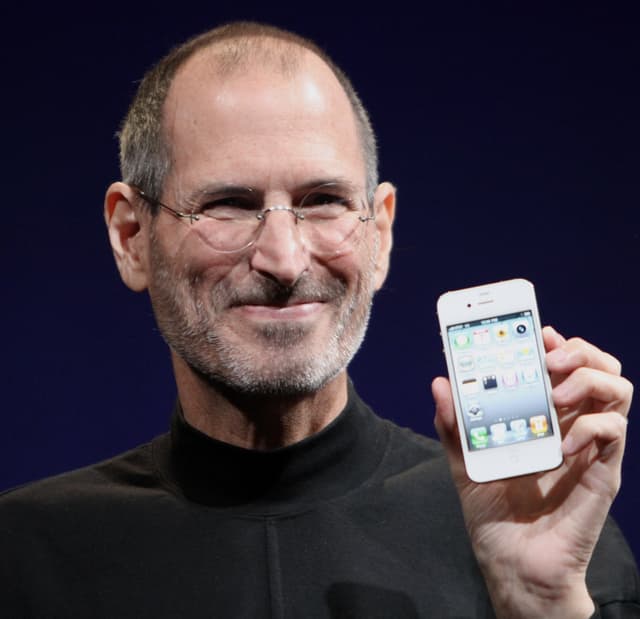
Steve Jobs
Apple
A visionary in the technology industry, Steve Jobs co-founded Apple Inc. in 1976, revolutionizing personal computing and consumer electronics with products like the Macintosh, iPod, iPhone, and iPad. Known for his principle of creating complete, integrated products, Jobs emphasized control over every aspect of design and functionality, leading to a unified user experience that set Apple apart in a competitive market. His relentless pursuit of excellence attracted top talent, fostering a culture where only A-players thrived, and he famously practiced radical focus by prioritizing simplicity—exemplified in his belief that "simplicity is the ultimate sophistication." Under his leadership, Apple achieved a market capitalization of over $700 billion, transforming it into one of the most valuable companies in the world.
Core Principles
competitive advantage
Understand that success breeds arrogance that blinds you to competitive threats, making humility and continued vigilance essential even during periods of dominance.
During the early 1980s, Jobs and Marcula were dismissive of IBM's entry into personal computers, claiming Apple had superior distribution, installed base, and software library. They believed nothing could knock them off their position. This arrogance would contribute to Apple's struggles when IBM-compatible computers emerged, demonstrating that even dominant companies are vulnerable.
“We're the guys in the driver's seat. We're the guys with one third of a million installed base. Short of World War III, nothing is going to knock us off the box.”
Study your competition obsessively and let it sharpen your vision. Competition that you think is inferior should inspire you to prove yours is demonstrably better.
Jobs bought an IBM PC as soon as it came out and concluded it sucked. This judgment was not defensive criticism but rather a clear vision of how Apple would do better. His disdain for the competition wasn't arrogance, it was clarity about what he was inventing.
“He saw himself as an enlightened zen warrior fighting the forces of ugliness and evil.”
Persistence and incremental improvement eventually overcome innovation and elegance if the competitor keeps pushing. Products don't compete, companies do.
Windows was initially a crude copy of the Macintosh interface that reviewers mocked. But Microsoft's persistence in improving it eventually made it dominant, despite Apple's superior design. This taught Jobs that the best product doesn't always win in the marketplace.
Spot markets full of second-rate products and commit to making something significantly better. This requires training yourself to see what others ignore and to act before the opportunity becomes obvious.
In 1983, Steve noticed that while great designers were focused on automobiles and buildings, computers were being designed poorly. He recognized that people would spend more time interacting with computers than with cars, yet no world-class designers were working on the industry. This insight drove his commitment to making the Macintosh beautiful and functional.
Consolidate control of hardware, software, and operating system to take full responsibility for user experience. Vertical integration enables differentiation competitors cannot match.
Jobs emphasized that Apple's unique capability was owning the entire stack. This allowed Apple to make decisions other companies couldn't because they had to coordinate across different vendors. This integration was a sustainable competitive advantage.
“We're the only company that owns the whole widget, the hardware, the software, and the operating system. We can take full responsibility for the user experience.”
culture
Avoid formality and unnecessary bureaucracy in feedback and employee management. Direct, ongoing feedback is more valuable than formal reviews and processes that create false work.
Steve never conducted formal annual reviews. Lead programmer Avi Tevian explained: 'Steve didn't believe in reviews. He disliked all the formality. His feeling was I give you feedback all the time, so what do you need a review for?' When offered a 360-degree review coach, Steve rejected it as waste.
“I give you feedback all the time, so what do you need a review for?”
Care deeply about protecting the culture and values of acquired or partnered companies. Culture is fragile and intentional preservation requires explicit agreements and sustained attention.
When Disney acquired Pixar for $7.4 billion, Steve and Bob Iger negotiated that Disney would never change or cancel any of 75 cultural touchstones that Ed Catmull had listed, including the cereal bar, paper airplane contests, and freedom to customize office spaces. This protected Pixar's creative culture.
Build a company that fulfills emotional and psychological needs for employees, creating a culture where people find purpose beyond compensation.
Apple's early culture filled emotional needs for employees, particularly young people. When one teenage employee graduated high school early, almost the entire company took the afternoon off to celebrate. Apple became a family replacement for some, creating bonds stronger than typical employer-employee relationships.
“Apple definitely replaced my family.”
Professional pride is non-negotiable. Demand that people care about the quality of their work and do better when standards aren't met.
When there was a color mismatch in the iMac doors and the engineer pushed back on fixing it due to time constraints, Jobs asked, Don't you think you owe it to yourself and to me to do better? The engineer said yes and went back and fixed it. Jobs understood that you can't deliver excellence without people who take pride in their work.
“Don't you think you owe it to yourself and to me to do better?”
There are no shortcuts around quality, and quality starts with people. Build a culture where talented individuals feel surrounded by equally talented colleagues and their work is bigger than themselves.
Jobs learned this from Akio Morita at Sony and applied it consistently. He created environments where the work itself was compelling, not just the compensation. This approach, combined with a clear vision, made elite talent want to work for him.
“There are no shortcuts around quality and quality starts with people.”
customer obsession
Design products for what customers will want before they know it themselves. Do not rely on market research to lead innovation.
Jobs believed that customers could not tell you what they wanted because they didn't know until shown. He referenced Henry Ford's quote about customers wanting faster horses, and applied this philosophy to the iPhone and iPad, creating categories people didn't know they needed.
“Our job is to figure out what they're going to want before they do. People don't know what they want until you show it to them. That's why I never rely on market research.”
Do not assume you understand a market's purchasing process without direct investigation. Complex organizations like universities have Byzantine decision-making structures with multiple stakeholders across departments, budgets, and approval hierarchies.
Jobs believed he could sell to universities by taking the president to lunch and offering to sell a thousand computers for a million dollars. In reality, university purchasing required approval from computer center directors, deans, associate deans, academic vice presidents, university councils, and faculty committees. Jobs lacked the skill and patience for this collective process and never successfully navigated it.
“Jobs did not have a clear understand a clear idea of what universities needed nor did he understand the collective nature of university decision making.”
Put yourself in your customer's shoes, not in the technical specifications, when designing products.
Steve Jobs frequently referenced a busy mom juggling multiple priorities to illustrate why products must be simple and intuitive from the first experience. He believed nobody would stand over customers explaining features, so the product itself must communicate clearly. This led Apple to strip away non-essential features relentlessly.
Every interaction a customer has with your company increases or decreases their opinion of it. Prevent negative experiences as aggressively as you facilitate positive ones.
Steve understood that buying a song from iTunes, receiving support, or opening a product box were all part of the Apple experience. One bad interaction could undo dozens of positive ones. This led Apple to obsess over every touchpoint, recognizing that excellence must be consistent across all customer moments.
“A corporation could accumulate or withdraw credits from its reputation.”
Answer the fundamental question: Why should customers care? Frame every pitch around the improvement to their lives, not technical specifications.
Jobs consistently began by identifying customer pain points, then showed how his product solved them. For the iMac, he highlighted that existing computers were slow, ugly, and complex. Only then did he present the solution. This approach forces clarity about actual customer value.
Frameworks
Four-Quadrant Product Matrix
A 2x2 framework dividing products into consumer/pro and desktop/portable categories. Jobs drew this on a whiteboard when returning to Apple, committing to make only four great products, one for each quadrant. This forced ruthless focus and eliminated dozens of confusing product lines.
Use case: When a company has too many products and needs to refocus on core offerings. Use when entering a market or restructuring a bloated product line.
End-to-End Integration Model
Complete control over hardware, software, content, and distribution to create a seamless user experience. Rather than licensing or partnering, Apple manufactures every component and controls the entire value chain. This allows for simplicity, security, and unified design.
Use case: When quality and user experience are paramount and you have resources to control the entire system. Trades flexibility for coherence. Applied successfully in iPhones, iPads, and Macintosh computers.
The Reality Distortion Field
The ability to convince people that difficult or impossible things are achievable through charisma, conviction, and rhetorical skill. Jobs could talk people into believing his vision was possible even when engineering or market data suggested otherwise. The effect wore off when he wasn't present but was extremely powerful in meetings.
Use case: A cautionary framework about leadership and influence. Jobs used this to push teams beyond what they thought possible, but it could also lead to unrealistic schedules and burnout. Named from Star Trek episode where aliens create reality through mental force.
The Digital Hub
A strategic vision that positions a company's core product as the center of an ecosystem of interconnected devices and services. For Apple, the computer was the 'hub' for managing music, video, photos, and other digital content. This framework shaped product development, marketing, and retail design.
Use case: Strategic positioning of core products, retail design, ecosystem thinking, and product sequencing decisions
Aspiration Through Analogy
A marketing technique where a young company positions itself against prestigious established brands by using accessible analogies and aspirational language. At 22, Jobs compared Apple to Rolls-Royce and took apart Chevys as analogies. Later, he positioned Pixar as a peer of Disney Animation despite having made one film.
Use case: Early-stage marketing, fundraising narratives, brand positioning, and stakeholder communications
Landscape-Aware Negotiation
Strategic negotiation grounded in careful study of competitive dynamics, personality conflicts, and shifting power relationships. Identify moments when your leverage has changed (like Pixar after Toy Story's success), and press your advantage with clarity on both parties' true interests.
Use case: Partnership negotiations, acquisition discussions, distribution deals, and board relations
Reality Distortion Field
A technique where a founder projects such strong conviction and faith that others begin to believe in outcomes that seem implausible based on current evidence. Jobs would convince teams they were building another Apple II and working in a garage despite contradictory evidence. This creates psychological commitment and overrides rational objections.
Use case: When leading early-stage teams with limited resources who need motivation to achieve ambitious goals beyond what seems rationally possible
Finding the Customer in the Mirror
The product designer becomes the first and primary customer, developing products he personally wants to own rather than designing based on market research or committee input. This approach trusts founder intuition about where technology and market needs intersect, creating products with authentic appeal.
Use case: Product design in consumer technology where the founder has strong intuition about future needs and can serve as a valid proxy for target market preferences
The Bozo Explosion
Rapid hiring that exceeds the company's ability to maintain culture and average employee quality, causing the workforce to become diluted with less capable people. Apple experienced this growth from 600 to 1,200 employees in three months, dramatically lowering average team quality and creating organizational drag.
Use case: Understanding the limits of scaling as a warning about hiring velocity and the importance of managing growth intentionally rather than chasing every opportunity
The Vector Nudge Framework
A metaphor for understanding leverage in early-stage companies. You must move the vector a little bit in its first inch, and the swing will be enormous by the time it gets to be three miles long. This illustrates why early strategic decisions have outsized consequences. Small adjustments to direction in early stages create massive divergence over time. This principle explains why early focus and clarity matter more than raw execution later.
Use case: Understanding why early market positioning, customer selection, and product direction decisions are disproportionately important and why founders should spend more time getting these right than optimizing execution.
Stories
Jobs and Wozniak discovered the phone phreaking article, built a blue box device that could make free long-distance calls, and successfully demonstrated it before a robbery attempt in a Sunnyvale pizza parlor. Though a gunman stole the prototype, Jobs and Wozniak gained confidence they could solve technical problems and put products into production.
Lesson: First projects, even if not profitable, teach founders how to work together and solve problems. The blue box gave Jobs and Wozniak the confidence and partnership template that led to Apple. Failure and risk are part of learning entrepreneurship.
Paul Terrell of the Byte Shop wanted fully assembled computers rather than circuit boards, willing to pay $500 each. This single customer interaction showed Jobs that the market wanted complete, integrated products, not hobbyist kits. This insight shaped Apple's entire strategy going forward.
Lesson: Sometimes a single customer interaction reveals more truth about markets than months of research. Listen to what sophisticated customers actually want, not what you assume they want.
Ross Perot watched a PBS documentary on Steve Jobs and NeXT, called Jobs the next day offering to invest, and ended up putting $20 million into the company. Perot had regretted missing out on Microsoft with Bill Gates and didn't want to make the same mistake twice.
Lesson: Visibility and media exposure can attract investors and partners who recognize the pattern of innovation. A single documentary reached the right person at the right time. Entrepreneurs should consider how their work gets visibility.
The CFO of Lucasfilm planned to arrive late to the meeting with Jobs to establish pecking order. But Jobs started the meeting on time, and by the time the CFO arrived, Jobs was already in control. Jobs' presence and charisma allowed him to take charge despite not being the official authority.
Lesson: Leadership is often about presence and initiative rather than title. In any room, the person who starts first and takes charge often ends up in control. Don't wait for permission to lead.
At a Stanford class visit, Jobs asked students if they were virgins and if they'd taken LSD. He complained that modern students were more materialistic and careerist than his generation. He viewed the 1960s counterculture as formative to his worldview.
Lesson: Founders are shaped by the cultural currents of their formative years. Jobs' anti-materialist values persisted even as he became a billionaire. Understanding a founder's origins helps explain their later philosophy.
Bill Gates visited NeXT's headquarters and kept saying no to developing software for it. When Jobs made his sales pitch, Gates was brutal: 'This machine is crap. The optical disk has too high latency. The case is too expensive.' They had a screaming match in a conference hallway that exemplified their fundamental disagreement about computing philosophy.
Lesson: Sometimes the smartest people in the industry will be wrong about your product. Gates' resistance to NeXT's potential was based on sound business logic (compatibility beats integration) but missed the bigger vision. Strong conviction matters more than unanimous agreement.
Wendell Weeks of Corning told Jobs he couldn't make gorilla glass in the quantities needed within six months. Jobs stared at him and said, 'Don't be afraid. Get your mind around it. You can do it.' Weeks was stunned, but the team did it anyway, converting a Kentucky facility almost overnight.
Lesson: Belief and conviction can move mountains. Jobs' reality distortion field pushed Corning to believe they could accomplish the impossible. At the same time, Weeks' initial skepticism was justified, and the achievement required genuine engineering innovation, not just wishful thinking.
Jobs turned down a $400 million stock grant from Ed Woolard in 1997 because he didn't want people thinking he returned to Apple to get rich. Instead, he took $1 per year in salary. He had plenty of money from his youth already and didn't need more.
Lesson: Leaders can use symbolic gestures to signal their true motivations. By refusing wealth, Jobs signaled that he cared about the work, not the money. This builds trust that he's making decisions based on product quality, not profit.
At 22, Steve Jobs gave a 224-word extemporaneous speech at a 1977 computer fair that demonstrated remarkable ability to demystify technology. He used accessible analogies (Chevys, cameras, typewriters), acknowledged customer fears about computers taking over, and positioned the Apple II as both domesticated and aspirational (like Rolls-Royce). He claimed Apple was 'the largest personal computer company in the world' despite being months old.
Lesson: Verbal mastery and the ability to make complex products accessible through analogy are learned skills that can be developed early. Aspiration and confidence in storytelling can elevate a young company's perception beyond its actual status, but must be backed by genuine product quality.
During NeXT's IBM negotiations, Steve Jobs displayed immature behavior that sabotaged a potentially transformative deal. He arrived late to meetings, insulted IBM's user interface, undermined his team's careful strategy, and when new leadership arrived, overplayed his hand by demanding more money. IBM's executive simply stopped taking calls, killing the deal and NeXT's last real chance at scale.
Lesson: Being right about your product does not compensate for poor negotiation behavior and lack of follow-through. Ego and immaturity can destroy business relationships that are critical to company survival. Professional execution matters as much as product quality.
Notable Quotes
“Simplicity is the ultimate sophistication.”
Apple's design mantra, widely credited to Leonardo da Vinci
“A players like to work only with other A players, which means you can't indulge B players. The Macintosh experience taught me that you have to be ruthless if you want to build a team of A players.”
Justifying the firing and reassignment of Lisa team members when merging divisions
“We were no longer aiming for the handful of hobbyists who liked to assemble their own computers. For every one of them, there were a thousand people who would want the machine to be ready to run.”
Realizing the importance of complete, integrated products after Paul Terrell wanted fully assembled computers rather than components for the Byte Shop
“It is a good thing to have in the world. That was when I decided to go back on a temporary basis to help them hire a CEO.”
Explaining to Andy Grove why he decided to return to Apple as interim CEO, realizing he cared about the company's future despite the personal cost
“Our job is to figure out what they're going to want before they do. People don't know what they want until you show it to them. That's why I never rely on market research.”
Explaining his philosophy on product innovation and customer insight
“I made a promise to myself that I'm not going to let this money ruin my life.”
Reflecting on becoming a billionaire at age 25 and how he maintained a simple lifestyle despite enormous wealth
“The reason Apple resonates with people is that there's a deep current of humanity in our innovation.”
Explaining why great design and engineering alone weren't enough, that products needed human meaning
“I don't think I run roughshod over people, but if something sucks, I tell people to their face. It is my job to be honest.”
Defending his brutal honesty as necessary for maintaining product quality and team excellence
“We couldn't have done it without you.”
Message sent to Wendell Weeks on the day the iPhone launched, acknowledging Corning's contribution of gorilla glass
“My passion has been to build an enduring company where people were motivated to make great products. Everything else was secondary.”
Reflecting on what drove his life's work at Apple
Frequently Asked Questions
What are Steve Jobs's key business principles?▼
Steve Jobs's core principles include: Understand that success breeds arrogance that blinds you to competitive threats, making humility and continued vigilance essential even during periods of dominance.. Study your competition obsessively and let it sharpen your vision. Competition that you think is inferior should inspire you to prove yours is demonstrably better.. Persistence and incremental improvement eventually overcome innovation and elegance if the competitor keeps pushing. Products don't compete, companies do.. Founder Almanac has cataloged 30 total principles from Steve's career.
What can entrepreneurs learn from Steve Jobs?▼
Key lessons from Steve Jobs include: First projects, even if not profitable, teach founders how to work together and solve problems. The blue box gave Jobs and Wozniak the confidence and partnership template that led to Apple. Failure and risk are part of learning entrepreneurship.. Explore 10 stories and 10 frameworks from Steve's experience.
What is Steve Jobs known for in business?▼
A visionary in the technology industry, Steve Jobs co-founded Apple Inc. in 1976, revolutionizing personal computing and consumer electronics with products like the Macintosh, iPod, iPhone, and iPad. Known for his principle of creating complete, integrated products, Jobs emphasized control over every aspect of design and functionality, leading to a unified user experience that set Apple apart in a competitive market. His relentless pursuit of excellence attracted top talent, fostering a culture where only A-players thrived, and he famously practiced radical focus by prioritizing simplicity—exemplified in his belief that "simplicity is the ultimate sophistication." Under his leadership, Apple achieved a market capitalization of over $700 billion, transforming it into one of the most valuable companies in the world.
More Technology Founders

Want Steve's advice on your business?
Our AI has studied Steve Jobs's biography, principles, and decision-making frameworks. Ask any business question.
Start a conversation