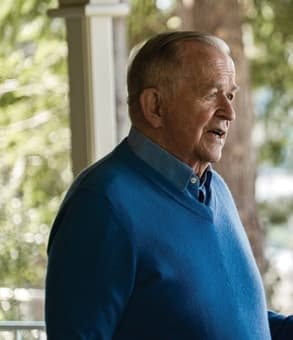
Dee Hock
VISA
As the founder of Visa, Dee Hock revolutionized the finance and investing industry by introducing a decentralized payment system that now serves over 3.2 billion cards globally. His journey began in a moment of desperation when he found himself unemployed at age 36, facing the daunting task of providing for his family. Hock's principles emphasized the importance of confronting challenges head-on and designing organizations based on ideals rather than existing structures. He believed that true fulfillment in business transcends power and profit, stating, "Business, power, and money are not what your life is about." His vision continues to inspire entrepreneurs and business builders today, encouraging them to focus on purpose and innovation.
Core Principles
culture
Healthy organizations educe behavior (bring out and develop potential), while unhealthy ones compel it. Educed behavior is constructive; compelled behavior is destructive.
Dee Hock contrasted healthy organizations that attract people through hope, vision, values, and liberty to cooperatively pursue them with unhealthy ones that compel behavior through necessity or force. He believed this distinction was critical to organizational success.
“Healthy organizations are a mental concept of relationships to which people are drawn by hope, vision, values, and meaning, along with liberty to cooperatively pursue them. Healthy organizations educe behavior. Educed behavior is inherently constructive.”
Institutions create a false divide between institutional behavior and human wholeness. Recognize this gap and refuse to shed your humanity at institutional doors.
From age six onward, Dee Hock observed that school and church required people to abandon wholeness and humanity, creating institutions unlike anything in nature. He carried this distaste into his organizational design.
“It was as though everyone began to shed wholeness and humanity at the doors of institutions.”
Avoid conforming just to gain acceptance from external authorities. Most people will accept substantive work done modestly. False prestige signals waste resources and betray your values.
Dee wanted open-plan headquarters reflecting his philosophy of equality, but convinced himself regulators and bank officials would never accept VISA in modest quarters. He abandoned his natural inclination, built palatial executive offices, and after he left, the entire company reverted to the hierarchical structure he opposed. His fear of others' judgment caused him to copy acquired behavior rather than lead according to conviction.
“What is now clear is that I lacked ability and courage to lead in the direction of my natural inclination rather than copying acquired behavior.”
Ethical behavior cannot be forced through external rules; it arises from within and must be cultivated through education and example. This is rare in leadership but essential.
Hock observed that most leaders rely on control mechanisms when the real work is internal development. This insight deepened after he left business to study philosophy and ethics.
“Constructive, humane behavior cannot be achieved by external force. It arises from within. It can be adduced, but cannot be compelled. It is a rare leader who understands this simple fact, let alone puts it into practice.”
When disagreeing with people you love, address only the present moment. Avoid resurrecting the past or speculating about the future.
Hock learned this through his long marriage and applied it to all relationships. This principle preserves connection while addressing conflict.
“When disagreeing with those you love, deal only with the moment, neither resurrecting the past nor anticipating the future.”
innovation
Learn from archetype systems and improve upon them; do not simply emulate. Study to understand, then innovate.
Dee Hock concluded that VISA itself, despite its success and demonstration of chaordic principles, should not be emulated as a model. Instead, it should be studied as an archetype to learn from and improve upon.
“It is no more than an archetype to study, learn from, and improve upon.”
Harness nature as your model for organization. Nature exhibits complexity, diversity, interconnection, and self-organization without command and control.
From childhood spent in nature, Dee Hock observed that nothing in nature functions like school or church institutions. Blackbirds do not have principals; forests do not line up saplings to tell them how to grow. This inspired the chaordic model.
“There's no blackbird principal pecking away at the rest of the flock. There's no super frog telling the others how to croak. There's no teacher tree lining up the saplings and telling them how to grow. Something's crazy. Is it me?”
Complex adaptive systems exist on the edge of chaos with just enough self-organization to create order. Design for this balance.
Dee Hock read the book Complexity and recognized that the spontaneous order he observed in nature, combined with self-organization, created patterns that could not be explained by studying individual parts. This inspired the chaordic organizational model.
“They speculate that all complex adaptive systems exist on the edge of chaos with just enough self-organization to create the cognitive patterns we refer to as order.”
Originality and creativity emerge from consciousness at play, not from calculated effort. Create the conditions for open minds, not rigid systems.
Hock rejected the notion that innovation comes from forcing ideas. He believed it emerges naturally when people are free and engaged.
“Originality and creativity do not result from calculated effort, but from the natural state of consciousness, an open mind at play.”
Think from first principles and question everything, even foundational assumptions like the nature of money itself. This outsider perspective enables you to see solutions others cannot.
Dee grew up poor in rural Utah, didn't attend prestigious schools, and worked manual labor jobs. These experiences kept him outside the banking establishment's conventional thinking. When analyzing the credit card problem, he broke it down to ask: what is money really? This led him to realize money was just alphanumeric data, enabling him to envision a global electronic exchange system decades before it seemed possible.
“He thought from first principles and questioned everything, even down to the nature of money itself.”
leadership
Organizations die not from external defeat but from losing excitement and hope about the future. Pessimism and despair are fatal.
Dee Hock observed that businesses, nations, and tribes collapse when they become despairing and lose excitement about their future, not necessarily when they face external competition or suppression. This is why maintaining a compelling vision is essential.
“Businesses, as well as nations, races, and tribes, die out not when defeated or suppressed, but when they become despairing and lose excitement and hope about the future.”
Never go to a wise person for an elegant answer. Go for a beautiful question that opens new ways of thinking.
Hock valued inquiry over instruction. The best leaders help others ask better questions rather than provide ready-made answers.
“Never go to a wise man for an elegant answer. Go for a beautiful question.”
In business, be alert, cautious, and quiet. Speaking is a craft that requires restraint; listening is an art that requires attention.
Hock developed this wisdom through 35 years in business, particularly building Visa into a global payments system. He believed measured communication prevented errors and conflicts.
“When one has fallen among wild beasts and serpents, it is best to be alert, cautious, and quiet. This is particularly true in business. To speak is craft. To listen is art.”
Great leadership whispers possibility, not demands obedience. Tyranny shouts you must; leadership suggests perhaps we should.
Hock built Visa as a non-hierarchical organization based on voluntary association rather than command and control. This principle reflected his core belief about how to inspire excellence.
“Tyranny shouts, you must. Leadership whispers, perhaps we should.”
Do not attempt to work with or extract value from people of poor character, regardless of financial upside. The ethical compromise will ultimately cost more than any gain.
After five years growing a failing investment company to profitability, Dee's owner refused to honor profit-sharing agreements, claiming prior losses negated the profits. Rather than pursue legal action or resentment, Dee walked away with pity and contempt, recognizing the man's greed had destroyed him.
“The beast, greed, had devoured him completely.”
Frameworks
Chaordic Organization
A self-organizing system that harmoniously blends characteristics of chaos and order, creating spontaneous patterns without command and control. Based on natural systems rather than industrial-age hierarchies. It exhibits complexity, diversity, interconnection, and self-organization, allowing purpose-driven behavior to emerge from principles and freedom rather than compulsion.
Use case: Designing organizations that need to scale across many independent units (like VISA's thousands of banks) while maintaining coherence and adaptability
Four Ways of Seeing
A perspective framework with four lenses: how things were (historical), how they are (current state), how they might become (possible futures), and how they ought to be (ideal vision). Design work should begin with the ought to be perspective and work backward, rather than starting with current constraints.
Use case: Strategic planning, product design, and organizational transformation when you need to break free from path dependency
The Four Beasts
Ego, envy, avarice, and ambition are the four forces that inevitably devour their keeper. The framework trades these for humility, equanimity, time, and liberty. Recognizing and containing these beasts is essential for sustained ethical leadership and personal well-being.
Use case: Personal accountability for leaders; understanding why even successful founders often feel empty or become corrupt
Purpose-Process-Procedure Balance
A diagnostic tool for organizational health. Track how much time is spent on senseless rules versus productive work, and how much energy is wasted interpreting or enforcing procedures that don't serve the core purpose. When procedure overwhelms purpose, the organization is diseased.
Use case: Auditing mechanistic organizations to expose waste and misalignment; designing new organizations with purpose primacy
Four Ways of Looking at Situations
To influence the future, you must master four perspectives: how things are, how they were, how they might become, and how they ought to be. Starting with 'ought to be' provides the north star for decision-making. This framework helps distinguish between problem-solving (as is) and vision-setting (ought to be).
Use case: Strategic planning, organizational design, and facing seemingly impossible problems. Use when current systems are failing and you need to reimagine the fundamental purpose.
Chaordic Organization
A self-organizing, self-governing system that harmoniously blends characteristics of chaos and order, mirroring natural systems. Built on purpose rather than procedure, it enables thousands of autonomous entities to coordinate without centralized command. Features include distributed authority, alignment around shared purpose, and systems that evolve rather than dictate.
Use case: Organizing competing institutions toward shared goals, creating global systems, building decentralized networks. Applicable to open-source projects, payment systems, multi-stakeholder ecosystems, and any system requiring coordination without control.
Purpose-First Analysis
Strip away form to understand function. Ask: What is the true nature of what I am building? What problem am I actually solving? What is the essential purpose? Only after answering these can you design proper procedures and structures. This inverts the typical organizational approach.
Use case: Product design, business model innovation, organizational restructuring. When you're solving the wrong problem efficiently, or when conventional solutions feel inadequate.
The Outsider's Advantage in Innovation
Those without deep ties to industry orthodoxy can see what insiders cannot. By questioning everything from first principles, avoiding prestigious credentials and institutions, and maintaining genuine curiosity, you access perspectives unavailable to specialists. This is a competitive advantage, not a limitation.
Use case: Entering established industries with fundamental innovations. Use when you sense convention is limiting thinking but need to understand why outsiders have clearer vision.
The Journey to Self-Knowledge Before Leadership
Before you can lead others effectively, you must confront and reconcile with your own limiting beliefs, fears, and insecurities (your 'giant'). Leadership begins with honest self-assessment and acceptance of your nature. This foundation enables authentic rather than performative leadership.
Use case: Personal development for founders, leadership transitions, building authentic organizational culture. Use when you notice yourself copying behaviors that contradict your values.
Persistence Through Impossible Odds
When pursuing something objectively impossible, rational analysis becomes counterproductive. Instead, anchor to hope, faith, determination, and a sense of deeper meaning. This is not optimism but a commitment to attempt regardless of probability. Use nature, solitude, and reflection to restore perspective when despair threatens.
Use case: Any venture where conventional metrics suggest failure is inevitable. When everyone says it can't be done and you must decide whether to believe in what ought to be over what is.
Stories
At age 36, unemployed and desperate with two children and a pregnant wife, Dee Hock was forced to apply for unemployment insurance. Sitting in his car outside the unemployment office, he could not bring himself to get out, experiencing severe depression despite his entitlement to the compensation. He drove home without applying, beginning a frantic search that led to three jobs and eventually the events that led to VISA.
Lesson: Psychological struggles, depression, and moments of paralysis are part of the founder journey, even (or especially) at critical junctures. Success is not a straight line and internal barriers can be as powerful as external ones.
Early in his career, Dee Hock was given a trivial task to find signage for an executive office. His friend Dick Simmons, a brilliant but cynical man trapped in a bureaucratic company, showed him how to manipulate the system. For weeks, Simmons extracted conflicting opinions, created procedural loops, and induced endless bickering over office space and furnishings until nothing got done, all while maintaining perfect integrity and never telling a lie.
Lesson: Intelligent people in mechanistic organizations will use their talents to game broken systems rather than contribute substantively. The flaw is in the system's design, not the person. This pattern is widespread and represents massive waste.
After 16 years of successful but unorthodox management in financial services, Dee Hock was repeatedly fired despite delivering strong results. His last venture left him investing a company from near-failure to profitability, only to be denied promised profit sharing by a wealthy owner using accounting tricks. The owner claimed years of losses negated any profits, despite the company being sold at a huge premium.
Lesson: Success within broken organizational systems will not be rewarded. Unorthodox managers are threats to command and control structures regardless of results. After repeated failures to change the system from within, eventually you must leave it.
Reading the book Complexity while in his late 50s, Dee Hock realized that scientists were claiming to discover self-organization and complexity that philosophers, poets, theologians, and mystics had understood for thousands of years. The concepts he saw in nature had always existed; science was late to recognize them.
Lesson: The principles for better organizations already exist in nature and human wisdom traditions. Modern discoveries are often rediscoveries. Look to nature and historical philosophy, not just contemporary management theory.
Dee Hock fought the Department of Justice on the duality issue, correctly predicting that banks would immediately seek dual membership in both VISA and MasterCard, leading to monopoly. He was overruled. Banks achieved duality in six months instead of his predicted two years, and today only two systems dominate. To this day, Hock regrets not fighting on, unsure if death threats and stress affected his judgment.
Lesson: Even when you are right and have sound reasoning, institutional and political power can force retreat. Founders must live with the consequences of compromises made under pressure, and this can become a lasting regret.
Early in his career at a finance company, Dee's boss assigned him to solve a visitor confusion problem about executive office locations. What should have required a phone call to a sign company turned into weeks of committee meetings, sketches, supplier quotes, and conflicting opinions. Dee's mentor Dick Simmons deliberately prolonged the non-problem to teach Dee how large institutions actually work: procedure over purpose, method over results.
Lesson: In mechanistic organizations, procedure becomes more important than purpose. This wastes 50-80% of employee time on senseless rules. Leaders must relentlessly distinguish between purpose and procedure, starting with purpose.
After five years growing a failing investment company to profitability, Dee's owner refused to honor the promised profit-sharing agreement, claiming losses from before Dee's arrival offset the profits. Rather than litigate, Dee looked into the man's dead, expressionless eyes and said, 'Keep the money. You apparently need it more than I do.' The man never blinked.
Lesson: Do not extract value from people of poor character. Greed had completely devoured this man. Warren Buffett and Charlie Munger's advice is correct: you cannot make a good deal with a bad person.
At 25, newly married, with two toddlers and another baby on the way, Dee lost his job. Desperate and broke, he drove to the unemployment office but couldn't open the car door. Despite telling himself it was ridiculous false pride, something deep inside said no. Instead, he launched a frantic search that led to three miserable jobs, working day and night to eliminate debt and build a cash reserve within 18 months.
Lesson: Desperation can clarify values. Rather than accept perceived shame, Dee chose to fight his way out. His refusal to give up in that moment shaped his entire approach to adversity.
Facing decades of failure in corporate jobs, at 36 Dee was offered a low-paid, menial trainee position at National Bank of Commerce. Logically impossible, but his heart recognized these as good, decent people. He abandoned reason and took the position on intuitive faith. Within months, the opportunity arose that led to VISA.
Lesson: Use your brain but follow your heart. Sometimes the emotionally right decision appears logically insane. Trusting your intuition about people and purpose can position you for unexpected opportunities.
During the depths of solving VISA's system collapse, with hundreds of millions in losses and no clear path forward, Dee walked alone into forested hills despite no trespassing signs. He climbed for hours, licking his wounds until a sense of perspective would slowly seep into his bones. He would face the next week with renewed determination. This practice sustained him through years of depression and opposition.
Lesson: Nature provides the perspective and solitude necessary for problem-solving and resilience. When institutional stress becomes unbearable, return to natural systems that restore your sense of scale and possibility.
Notable Quotes
“Business, power, and money are not what your life is about. Founding Visa and being its chief executive is something you needed to do, but it's only preparatory.”
Speaking to himself about the inner voice that compelled him to leave VISA at its pinnacle in 1984, despite the apparent irrationality of giving up success and prestige
“The hubris of science is astonishing. It will come as quite a surprise to countless poets, philosophers, theologians, humanists, and mystics who have thought deeply about such things for thousands of years that complexity, diversity, interconnectedness and self-organization are either new or a science.”
Reflecting on reading Complexity while realizing that nature has always organized itself according to these principles that science was only now discovering
“In 1984, I severed all connections with business for a life of isolation and anonymity, convinced I was making a great bargain by trading money for time, position for liberty, and ego for contentment.”
Explaining his decision to walk away from VISA at age 55 and spend nearly a decade in relative isolation on the Pacific coast
“I could not get out of the car. Something deep inside said, no, take me there and I will die.”
Describing a moment of severe depression and paralysis at age 36 when he was unable to collect unemployment despite desperation and entitlement
“What Simmons was trying to teach the lamb was not then ready to learn. It took him decades to synthesize the lesson. In industrial age organizations, purpose slowly erodes into process.”
Reflecting on how he misunderstood Dick Simmons' manipulation of bureaucracy as destructiveness, when it was actually a lesson about systemic dysfunction
“Did I think banks worldwide could be brought together in such an effort? No. Did I think laws would allow it? No. Did I think anyone would seriously listen to such notions or allow them the light of day even if they did? No. But did I believe it was what ought to be? Ah, that was another question indeed, powerful enough to draw me on.”
Explaining why he persisted in founding VISA despite facing seemingly impossible structural, legal, and political barriers
“Had we power, capital, position, or influence, we would have undoubtedly have used them in the command and control style in which we had been so admirably indoctrinated. Without them, we were forced to change of consciousness to conceiving larger, better ideas.”
Explaining why VISA's lack of traditional resources forced the creation of a chaordic organizational model instead of reproducing industrial-age hierarchies
“Businesses, as well as nations, races, and tribes, die out not when defeated or suppressed, but when they become despairing and lose excitement and hope about the future.”
Identifying the internal threat to organizations: loss of purpose and vision, not external competition
“Healthy organizations are a mental concept of relationships to which people are drawn by hope, vision, values, and meaning, along with liberty to cooperatively pursue them. Unhealthy organizations are no less a mental concept of relationship, but one to which people are compelled by accident of birth, necessity, or force.”
Contrasting two fundamental organizational models and their behavioral consequences
“It is no more than an archetype to study, learn from, and improve upon. Do not emulate.”
Concluding his reflections on VISA, advising others not to copy the system but to learn its principles and create better approaches
Frequently Asked Questions
What are Dee Hock's key business principles?▼
Dee Hock's core principles include: Healthy organizations educe behavior (bring out and develop potential), while unhealthy ones compel it. Educed behavior is constructive; compelled behavior is destructive.. Institutions create a false divide between institutional behavior and human wholeness. Recognize this gap and refuse to shed your humanity at institutional doors.. Avoid conforming just to gain acceptance from external authorities. Most people will accept substantive work done modestly. False prestige signals waste resources and betray your values.. Founder Almanac has cataloged 30 total principles from Dee's career.
What can entrepreneurs learn from Dee Hock?▼
Key lessons from Dee Hock include: Psychological struggles, depression, and moments of paralysis are part of the founder journey, even (or especially) at critical junctures. Success is not a straight line and internal barriers can be as powerful as external ones.. Explore 10 stories and 10 frameworks from Dee's experience.
What is Dee Hock known for in business?▼
As the founder of Visa, Dee Hock revolutionized the finance and investing industry by introducing a decentralized payment system that now serves over 3.2 billion cards globally. His journey began in a moment of desperation when he found himself unemployed at age 36, facing the daunting task of providing for his family. Hock's principles emphasized the importance of confronting challenges head-on and designing organizations based on ideals rather than existing structures. He believed that true fulfillment in business transcends power and profit, stating, "Business, power, and money are not what your life is about." His vision continues to inspire entrepreneurs and business builders today, encouraging them to focus on purpose and innovation.
More Finance & Investing Founders
Want Dee's advice on your business?
Our AI has studied Dee Hock's biography, principles, and decision-making frameworks. Ask any business question.
Start a conversation