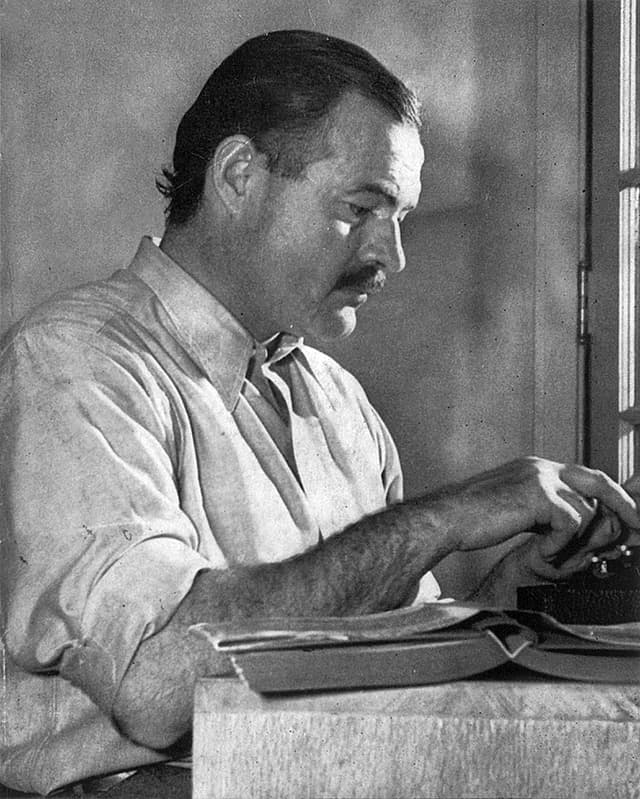
Ernest Hemingway
A defining figure in 20th-century literature, Ernest Hemingway revolutionized writing with his concise prose and compelling storytelling, producing iconic works such as "The Old Man and the Sea," which won the Pulitzer Prize in 1953. His disciplined work ethic, coupled with a commitment to individualism and self-reliance, allows entrepreneurs today to appreciate the importance of maintaining boundaries between work and leisure in pursuit of creative excellence. Hemingway's experiences during the Spanish Civil War exemplified his courage and readiness to act, as he prioritized direct engagement and support for others in crisis. Through his life and work, he demonstrated that resilience and independence are vital to overcoming adversity, echoing his belief that "a man can be destroyed but not defeated."
Core Principles
culture
Seek deep personal friendships forged through shared intense experiences rather than casual social networks.
Hemingway's closest and most meaningful relationships were formed in extreme circumstances: Spain during the civil war, WWII combat, and dangerous expeditions. His lifelong friendship with Colonel Buck Lanham, forged in combat, exceeded any other relationship. He valued people who shared his willingness to risk everything for something important.
“He had never been closer to anyone as a friend than to Buck, nor had he admired anyone more.”
discipline
Maintain a disciplined work ethic despite lifestyle excess. Separate productive work time from leisure with strict boundaries.
Hemingway woke before dawn and wrote uninterrupted for six to seven hours every morning, regardless of how much he drank at night or partied. He then lived fully for the rest of the day, fishing, gambling, and socializing. This rhythm allowed him to produce masterpieces while living an adventurous life.
independence
Value the individual over the group. Maintain independence even when working within larger structures.
Hemingway refused to join formal organizations or fully commit to group ideologies. He preferred loose associations with fellow misfits and irregulars where he could maintain autonomy. Even when working as a war correspondent, spy, or military collaborator, he insisted on freedom to come and go as he pleased.
leadership
Build loyalty and focus through clear expectations and attention to detail, even in unconventional operations.
When Hemingway ran his intelligence network in Cuba, the Crook Factory, he inspired loyalty in his team by demanding detail-oriented work and thorough debriefing. He would stay up all night carefully editing reports before delivering them to embassy contacts. His leadership was effective precisely because he maintained standards despite the informal nature of his operation.
lifestyle
Place a premium on rugged self-reliance and choose environments that support independence and non-conformity.
Hemingway deliberately chose to live in remote places like Key West and Cuba where rules were loose, society was informal, and he could live on his own terms. These locations allowed him to avoid conventional social expectations and maintain the freedom he valued above almost everything else.
mindset
Read voraciously and maintain a personal library as a foundation for understanding and decision-making.
Hemingway accumulated over 7,500 books in his Cuba home. He understood that breadth of reading provided perspective and knowledge that personal experience alone could not supply. He read constantly across many subjects and considered the inability to read one of the worst consequences of his later depression and illness.
Pay attention to physical embodiment and combat as a way to balance mental work. Alternate between solitude and intense physical activity.
Hemingway alternated between hours of concentrated writing and vigorous physical pursuits: fishing, hunting, shooting, boxing, drinking, and traveling. Like Theodore Roosevelt, he believed getting into the body and away from the mind through exhausting physical activity was essential for mental health and creativity.
Treat life as an adventure, not as a spectator activity. Participate fully rather than merely observing.
Hemingway was not content to watch or report from the sidelines. Whether as a war correspondent, fisherman, or fighter, he always engaged directly. He refused to be merely a spectator in any situation, constantly inserting himself into the action and taking risks that most people would avoid.
“Hemingway was not there just to observe.”
Understand that rules do not apply uniformly and that exceptional people operating outside conventional constraints can accomplish unique results.
Hemingway consistently broke rules and operated outside normal structures without apologizing. As a war correspondent, he carried weapons and fought. As a civilian, he conducted intelligence operations. As a writer, he inserted himself into combat. This willingness to disregard conventional boundaries allowed him to achieve things others could not.
“Another trait he shared with other spies was an assumption that everyday rules did not apply to him.”
Avoid intense ideology as it corrupts judgment. Maintain critical thinking even when aligned with a cause.
Hemingway supported the Spanish Republic against fascism but later acknowledged he had become too righteous and politically naive. He never joined the Communist Party despite pressure from ideological recruiters. His friend Regler, who fled both Nazi Germany and Soviet Russia, tried to educate him about how all authoritarian systems were fundamentally similar, a lesson Hemingway only partially learned.
product
Do not broadcast your work while creating it. Protect creative projects from external interference and premature judgment.
While writing For Whom the Bell Tolls, Hemingway kept the manuscript close, hiding it from others, and refused to discuss it. He understood that early feedback and opinions could corrupt the creative process. The work needed space to develop without outside judgment.
“He was like an animal with his manuscript, keeping it close to him or hiding it in a drawer under other papers. He never willingly showed it to anyone and would not talk about it.”
Immerse yourself in real-world experiences to create authentic, resonant work. Direct experience beats secondhand research.
Hemingway's greatest works came from lived experience, not imagination. He went to Spain during the civil war, watched D-Day from a boat, fought alongside soldiers in WWII, and lived in the places he wrote about. His novels were powerful because he had actually experienced the situations he described.
resilience
Be willing to pay the price for your convictions. Accept consequences rather than compromise core values.
Hemingway consistently risked his life, reputation, and career for causes he believed in. He stood up against fascism in Spain, volunteered for dangerous wartime missions, and spoke out against McCarthyism despite pressure. He did not require approval and was willing to be controversial.
“He is not cowardly by any means and is willing to make sacrifices and pay the price if there are going to be consequences for his actions.”
simplicity
Write to be read, not for critics or academic admiration. Prioritize clarity, brevity, and compelling storytelling over ornate prose.
Hemingway believed his job was to communicate with readers, not to impress other writers or academics. He used sparse prose, simple language, and precise detail to create powerful narratives. His approach to writing contrasted sharply with his contemporaries who seemed to write for critical acclaim rather than readership.
“Writing is something that you can never do as well as it can be done.”
strategy
Combine recklessness with caution, knowing when to seize fleeting opportunities before they disappear forever.
Hemingway displayed what others called a rare combination of advised recklessness and caution. He took enormous risks but made calculated decisions about when to act. He understood that certain moments are unique and will not return, and that great results require acting on these moments even when conventional wisdom would hold back.
“The rare combination of advised recklessness and caution so a combination of recklessness and caution that knows how properly to seize a favorable opportunity which once lost is gone forever.”
Frameworks
The Adventure Mindset
Viewing life not as a predetermined path to follow but as a broad canvas for creating experiences. Actively participating in situations rather than passively observing them. Making choices that maximize learning and sensation while accepting corresponding risks. This mindset rejects the conventional prescription of a safe, narrow life in favor of pursuing a full, expansive one.
Use case: When facing career choices between safety and growth, when considering whether to take risks, when designing a personal development strategy
The Work-Life Rhythm Separation
Creating strict boundaries between deep work and full living. Dedicating specific hours (typically early morning) to focused creative or intellectual work with zero distractions. Reserving the remainder of the day for physical activity, relationships, leisure, and indulgence. This prevents either work or life from consuming the whole and allows for sustainable high performance.
Use case: Managing productivity while maintaining lifestyle quality, preventing burnout, integrating multiple life interests
Experience-Driven Creation
Building creative or intellectual work on a foundation of direct, lived experience rather than research or imagination alone. Immersing oneself in the actual environments and situations one aims to understand or describe. Creating work that resonates because it carries the authenticity of firsthand knowledge and emotional truth.
Use case: Developing products or content that must resonate authentically, building expertise in a new domain, creating compelling narratives
The Irregular Leadership Model
Leading through a loose confederation of independent, talented individuals united by shared purpose rather than formal hierarchy. Maintaining personal autonomy and decision-making authority while coordinating diverse personalities toward a common goal. Effective when working with highly skilled, self-motivated people who resist formal structure.
Use case: Leading creative teams, managing distributed operations, coordinating with strong-willed collaborators
Selective Ideological Engagement
Supporting causes or movements without surrendering independent judgment to ideology. Remaining willing to see flaws in aligned groups and truths in opposed ones. Maintaining moral clarity about specific issues while avoiding the trap of total ideological commitment that blinds judgment.
Use case: Navigating polarized environments, maintaining integrity while collaborating across difference, avoiding echo chambers
Stories
While covering the Spanish Civil War with other journalists, a German shell struck a truck carrying wounded youth. Hemingway immediately jumped out to provide first aid while the other reporters took notes. He shouted at them to get out of the way. When a colleague argued reporters had no legal right to carry weapons or engage in fighting, Hemingway rejected the distinction entirely: he was not merely a reporter, he was a writer and participant.
Lesson: Skin in the game matters more than credentials or positions. True commitment means personal risk, not comfortable observation. Breaking arbitrary rules for what matters is sometimes the only honest response.
During WWII, while dining with Colonel Lanham in an old farmhouse under German artillery bombardment, a shell came through one wall and out the other without exploding. While others scrambled for shelter, Hemingway calmly continued cutting his steak. Lanham took off his helmet in response. When officers called it brave, Lanham settled the matter: it was a foolhardy test of fate, but it cemented their friendship.
Lesson: Shared willingness to embrace danger and absurdity creates unbreakable bonds. The best friendships form between people who understand each other's values so deeply they can communicate through action rather than words.
After leaving Spain, deeply depressed despite having slept perfectly during the actual fighting, Hemingway returned to Key West and began experiencing nightmares every night. He realized his conscience was a strange thing, affected neither by security nor by death. He concluded that the adrenaline and meaning of combat had been essential to his mental health, while the safety of home produced psychological torment.
Lesson: Humans need meaningful challenges and stakes to thrive psychologically. Safety and comfort can be sources of profound depression if they lack purpose. Understanding your own psychological needs is critical to building a sustainable life.
Critics uniformly dismissed Hemingway's book published before The Old Man and the Sea, declaring him finished and over the hill. Two years later, he published his masterpiece, which won the Pulitzer Prize and earned him the Nobel Prize for Literature. The same critics were forced to acknowledge their error, but their early judgments had been completely wrong.
Lesson: Critics and consensus often misread creative work, especially when the creator is evolving. Your obligation is to your craft, not to external validation. The ability to ignore interim criticism and continue developing your work is essential to reaching mastery.
Hemingway formed a ragtag intelligence network called the Crook Factory in Cuba, recruiting bartenders, pelota players, priests, exiled counts, and bullfighters. Stationed throughout the island in bars, restaurants, and hotels, they gathered information on German activity. Despite the unconventional recruitment, Hemingway maintained rigorous standards for detail and analysis, staying up all night carefully editing reports before delivering them to embassy contacts.
Lesson: Effective leadership does not require formal structure or prestigious backgrounds. It requires clear standards, attention to detail, and the ability to inspire people to exceed what they thought possible. The best people often come from unexpected places.
Hemingway retrofitted his fishing boat with weapons and spent months prowling Cuban waters hunting German U-boats. Once, he spotted what appeared to be an aircraft carrier but was actually a submarine. Crew broke out submachine guns and hand grenades. They pursued but the U-boat accelerated and escaped. Hemingway wrote that he and his crew would have happily gone to Valhalla for eternity, happy as goats, had they succeeded.
Lesson: Purpose and meaning matter more than success. The willingness to risk everything for something believed in, regardless of outcome, is what creates a life worth living. This is not recklessness but profound commitment.
Notable Quotes
“A man can be destroyed but not defeated.”
Said by Santiago in The Old Man and the Sea. Represents Hemingway's central theme about personal courage and the triumph of spirit over circumstance.
“Writing is something that you can never do as well as it can be done.”
Statement about the perpetual incompleteness of writing and the necessity of continuous improvement. Reflects his standard of excellence.
“The laws of prose writing are as immutable as those of flight, of mathematics, of physics.”
Hemingway explaining why brevity and precision matter in writing. He was not being ornate or breaking rules but following natural laws like any engineer.
“It wasn't by accident that the Gettysburg Address was so short.”
Supporting his argument for brevity and precision in writing. The greatest works of communication are necessarily short because they contain no wasted words.
“The only thing about a war once it has started is to win it. That is what we did not do. The hell with war for a while. I am not killed so I have to work.”
Written while working on For Whom the Bell Tolls, immediately after returning from Spain. Shows how he processed trauma and disappointment through work.
“I have the black ass all the time.”
Hemingway's term for depression, which he suffered from intensely after leaving combat zones and returning to civilian life, despite having slept well during the fighting.
“I'm no fucking traitor.”
Hemingway's response when questioned about his intelligence work and associations. Despite his complex political views, he never doubted his loyalty to the United States.
“Always so much fun to be with a man who was literate, articulate, and completely brave during a fight. He was absolutely intact.”
Hemingway describing Colonel Lanham. The ideal friend combined intellectual sophistication with physical courage and psychological wholeness.
Frequently Asked Questions
What are Ernest Hemingway's key business principles?▼
Ernest Hemingway's core principles include: Seek deep personal friendships forged through shared intense experiences rather than casual social networks.. Maintain a disciplined work ethic despite lifestyle excess. Separate productive work time from leisure with strict boundaries.. Value the individual over the group. Maintain independence even when working within larger structures.. Founder Almanac has cataloged 15 total principles from Ernest's career.
What can entrepreneurs learn from Ernest Hemingway?▼
Key lessons from Ernest Hemingway include: Skin in the game matters more than credentials or positions. True commitment means personal risk, not comfortable observation. Breaking arbitrary rules for what matters is sometimes the only honest response.. Explore 6 stories and 5 frameworks from Ernest's experience.
What is Ernest Hemingway known for in business?▼
A defining figure in 20th-century literature, Ernest Hemingway revolutionized writing with his concise prose and compelling storytelling, producing iconic works such as "The Old Man and the Sea," which won the Pulitzer Prize in 1953. His disciplined work ethic, coupled with a commitment to individualism and self-reliance, allows entrepreneurs today to appreciate the importance of maintaining boundaries between work and leisure in pursuit of creative excellence. Hemingway's experiences during the Spanish Civil War exemplified his courage and readiness to act, as he prioritized direct engagement and support for others in crisis. Through his life and work, he demonstrated that resilience and independence are vital to overcoming adversity, echoing his belief that "a man can be destroyed but not defeated."
More Publishing & Writing Founders



Want Ernest's advice on your business?
Our AI has studied Ernest Hemingway's biography, principles, and decision-making frameworks. Ask any business question.
Start a conversation