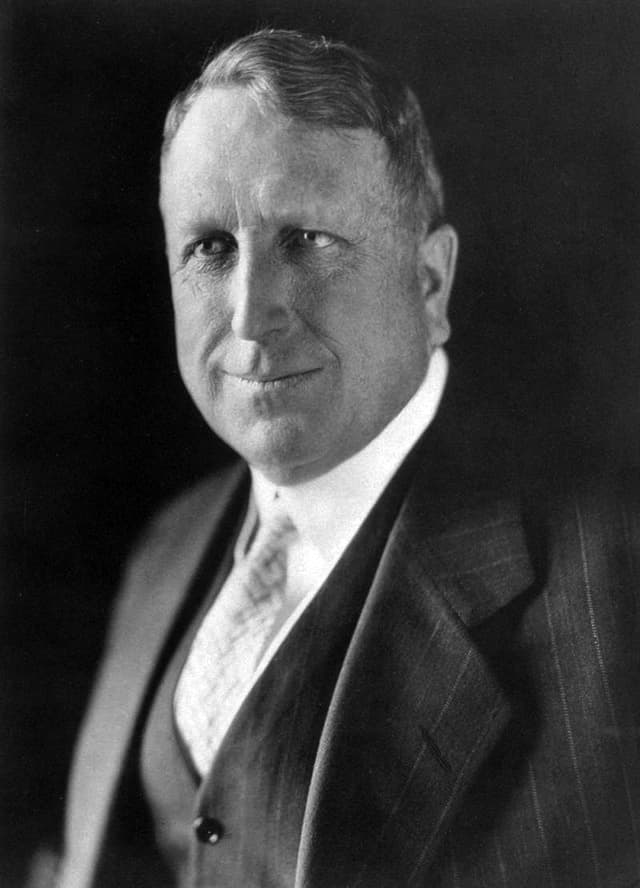
William Randolph Hearst
Hearst Corporation
A pioneering figure in the publishing industry, William Randolph Hearst transformed the media landscape by founding the Hearst Corporation and revolutionizing newspaper management. Notably, he initiated the practice of offering multi-year contracts to attract and retain top talent, which was groundbreaking for the time and helped establish the quality of his publications. Hearst also successfully expanded his market reach by launching advertising campaigns and soliciting local advertisers for the Harvard Lampoon, rather than relying on family wealth to sustain the publication. His approach of adapting successful models to his own context continues to resonate with entrepreneurs today, particularly in navigating competitive landscapes and securing valuable human resources. Hearst famously expressed his deep connection to his publications, stating, "I've begun to have a strange fondness for our little paper, a tenderness like unto that which a mother feels for a puny or deformed offspring."
Core Principles
customer obsession
Avoid using your media platform to pursue personal vendettas and political crusades that alienate customers, as this reduces circulation and advertising revenue.
Hearst's anti-communist and anti-Roosevelt campaign alienated readers during the Depression. Voters chose Roosevelt twice at the ballot box and Hearst at the newsstands by switching papers. His controversial positions, while expressing his authentic views, damaged his business fundamentals at a critical time.
“Readers forced to choose sides between the president and the publisher had voted twice, at the ballot box for Roosevelt and at the newsstands against Hearst.”
finance
Maintain financial discipline by reducing spending proportionally when revenues decline, rather than hoping the economy will rebound and maintaining spending levels.
During the Depression, Hearst's newspapers suffered losses from circulation decline and advertiser boycotts due to his controversial political positions. Instead of cutting costs, he maintained or increased spending on art, antiques, real estate, and newspapers, betting the economy would magically rebound. This accelerated his financial crisis and forced creditors to seize control.
“Hearst, hoping that the economy would magically rebound, refused to listen.”
Avoid unconstrained spending and material accumulation, as the desire for endless possessions creates financial vulnerability and distorts decision-making.
Hearst spent decades accumulating art, antiques, real estate, and possessions across multiple continents without constraint. He compared himself to an alcoholic unable to refuse catalogs of items for sale. At age 70, this compulsive spending combined with debt refinancing forced him to liquidate his empire, losing control for eight to ten years.
“I'm afraid I'm a dipsomaniac with a bottle. They keep sending me these catalogs and I can't resist them.”
Do not confuse debt as a permanent tool for building wealth; understand that lenders will eventually refuse to refinance when debt grows beyond the cash flows that service it.
For 50 years Hearst believed debt was magical, a tool to build empires. He constantly refinanced old debts with new debt, avoiding hard choices about cost-cutting. When advertising revenues fell during the Depression and his newspapers stopped generating sufficient income, bankers refused to refinance because they no longer believed in his ability to repay.
“A penny saved might be a penny earned, but a penny borrowed was worth even more.”
hiring
Recruit and retain the best talent by offering multi-year contracts and job security, which was revolutionary for newspapers at the time.
While Pulitzer rapidly cycled through staff, Hearst offered experienced reporters and editors multi-year contracts with guaranteed security. This allowed him to poach Pulitzer's best talent and build a stable, high-performing newsroom that could execute his vision consistently.
“To persuade experienced newspaper men to join a venture everyone was convinced would fail, Hearst had to offer more than just big salaries. He had to guarantee security in the form of large multi-year contracts.”
Pay for top talent early and aggressively, even if your business is not yet profitable, because quality people are the only sustainable competitive advantage.
As a young man, Hearst repeatedly told his father that cheap labor had been entirely ineffectual and that quality talent required high salaries. He convinced his father to hire experienced journalists and editors away from Pulitzer, which transformed the Examiner from a provincial paper into a cosmopolitan publication.
“The paper must be built up and that cheap labor has been entirely ineffectual. The paper requires a head that has ability enterprise and experience. Naturally, such a man commands a high salary and you must reconcile yourself either to paying it or to giving up the paper.”
leadership
Do not delegate financial responsibility to subordinates while refusing to hear their warnings about unsustainable debt and spending patterns.
Hearst told his accountant Edward Clark to 'just find the money' to cover his obligations, similar to Howard Hughes Sr.'s approach. He ignored pleas from financial advisors to reduce spending, institute economy measures, and sell unprofitable assets. By refusing to engage with financial reality, he made the eventual crisis far more severe.
Maintain a calm, even-tempered demeanor with employees even during stress, as consistency and courtesy build loyalty and enable long-term working relationships.
Hearst was described by a 16-year employee as never showing signs of irritation or losing his temper, always offering congratulations for good work. This stood in sharp contrast to Pulitzer's fiery temperament and enabled Hearst to maintain multi-decade relationships with key staff who would not tolerate his predecessor's volatility.
“William remained calm, polite and well-mannered in the extreme. Not once did he ever show signs of irritation or lose his temper.”
Build a succession plan and share power before crisis forces it, as waiting until age 74 to address governance creates vulnerability when creditors demand change.
Hearst ruled autocratically for 50 years, trusting no one and refusing to name a successor or delegate decision-making. When bankruptcy approached, banks and paper mills refused to loan money as long as he controlled the company. He was forced to surrender control at age 74, losing autonomy during his final decades.
“For 50 years, Hearst had ruled his empire as autocratically as his heroes Julius Caesar and Napoleon had theirs. He had trusted no one, rejected suggestions that he share power or delegate decision making and refused to name his successor.”
marketing
Use visual design and illustrations to attract readers when newspapers are sold on the street where headlines and images compete for attention.
Hearst reduced column density, doubled headline size, and inserted large illustrations across multiple columns, following Pulitzer's innovations. This made the Examiner stand out from competitors when newsboys sold papers on street corners, directly increasing sales.
“Illustrations do not simply embellish a page. They attract the eye and stimulate the imagination.”
mindset
Resist the temptation to use newfound wealth to satisfy every impulse, as material possessions require ongoing maintenance costs and create obligations that constrain future freedom.
Hearst accumulated castles, art collections, and real estate across two continents, warehousing items he never examined. These properties generated enormous maintenance and construction costs that consumed capital needed to weather business downturns. His compulsive acquisitions ultimately forced him to liquidate at unfavorable times.
Operate from an inner scorecard focused on your own judgment rather than worrying about external criticism and social expectations.
Unlike his mother who cared deeply about society's opinions, Hearst maintained complete indifference to public opinion. He dated across social classes, avoided society functions, and spent nights in nightclubs with chorus girls, never adjusting his behavior to meet upper-class expectations. This freedom allowed him to operate according to his own vision.
“Complete indifference to public opinion”
operations
Prioritize speed and urgency over perfection when trying to establish market dominance, as delays allow competitors to recover.
Hearst told employees that hesitation or stepping back would be fatal, emphasizing that all improvements had to happen at once so that the improvement would be very marked and noticeable. This created a sense of urgency that prevented competitors from adapting to his strategy.
“If we hesitate a moment or fall back a step, we are lost and we can never hope to make up anything out of the examiner while it remains in our hands. Delay would be as fatal as neglect.”
strategy
Use syndication and licensing agreements to access quality content you cannot yet afford to produce yourself.
Unable to afford European correspondents, Hearst contracted with the New York Herald to syndicate their cabled articles from Paris and other international locations into the Examiner. This gave the paper a cosmopolitan feel without requiring the capital investment in a foreign reporting infrastructure.
Expand your addressable market geographically when facing intense local competition rather than fighting for share in a saturated market.
San Francisco had three strong morning papers competing for the same 350,000-person audience. Instead of battling for circulation within the city, Hearst expanded the Examiner's distribution north to Sacramento and south to Santa Cruz and San Jose, creating new markets where he faced no competition.
Create synergy by repurposing content across multiple media properties to maximize the value extracted from each story and reduce per-unit costs.
Decades before synergy became a corporate buzzword, Hearst directed his magazine editors to buy stories that could be rewritten into screenplays for his film studio, serialized in newspapers and magazines, broadcast over radio, and pictured in newsreels. A single story could generate revenue across six different formats.
Use other people's successful models as a starting framework, then adapt and expand them for your own context rather than trying to innovate from scratch.
Hearst spent his college evenings studying Joseph Pulitzer's New York World instead of trying to invent his own approach. He then imported Pulitzer's techniques to San Francisco and expanded upon them with better circulation strategy, syndication agreements, and visual design. This allowed him to rapidly transform a failing newspaper into a success without reinventing journalism.
“I'm going to take Pulitzer's playbook. It obviously works. I'm going to adapt it to my business and then see if I can expand on it.”
Use unethical shortcuts and crony capitalism to gain unfair advantages, though this creates long-term vulnerability and reputational risk.
When facing distribution difficulties with the Central Pacific Railroad, Hearst asked his father to leverage his Senate position to get California's senior senator Leland Stanford to intercede. This gave him an unfair advantage but demonstrated his willingness to use family connections and federal power to bypass normal competition.
Frameworks
Inner Scorecard vs. Outer Scorecard
Warren Buffett learned from his parents that operating from an inner scorecard (making decisions you can justify to yourself) creates sustainable happiness, while an outer scorecard (worrying constantly about others' opinions) leads to anxiety. Hearst operated from an inner scorecard, indifferent to social expectations. His mother operated from an outer scorecard, constantly worried about how his behavior reflected on the family.
Use case: Deciding whether to follow conventional wisdom or forge your own path; understanding what drives your decision-making under pressure
Multi-Media Content Syndication
Rather than selling a story once, identify all the formats where that story can be repackaged and sold: newspapers, magazines, radio broadcasts, newsreels, films, books. A single narrative can generate revenue across six or more distribution channels, dramatically improving unit economics and content ROI.
Use case: Maximizing revenue from intellectual property in multi-channel media environments; reducing cost per unit distributed
Geographic Market Expansion as Competitive Strategy
When facing saturation in a local market with multiple competitors fighting for the same audience, expand distribution geographically to reach customers in adjacent markets where competitors have not yet established presence. This avoids head-to-head competition and creates new revenue sources.
Use case: Breaking out of saturated local markets; identifying white space in adjacent geographies
Talent Acquisition Through Long-Term Contracts
When entering a competitive market as an underdog, offer multi-year employment contracts and job security that competitors cannot match. This reverses the traditional advantage of established players and allows you to poach experienced talent.
Use case: Building a team quickly in a competitive industry; competing against better-funded incumbents
Stories
As business manager of the Harvard Lampoon, Hearst rejected the tradition of subsidizing the magazine through family money. Instead, he launched advertising and marketing campaigns, solicited local merchants for ads, and enlisted his mother to sell subscriptions. He expanded circulation 50 percent, increased advertising revenues 300 percent, and converted a $200 deficit into a $650 surplus.
Lesson: Resourcefulness and business-building instincts emerge early. Rather than accepting inherited advantage, he chose to build sustainable economics through revenue generation, setting a pattern he would repeat (unsuccessfully on the financial side) throughout his career.
At Harvard, Hearst studied Joseph Pulitzer's New York World every evening, learning its techniques and innovations. Upon taking over the San Francisco Examiner, he explicitly modeled his strategy on Pulitzer's approach, importing journalism techniques to the Pacific Slope and rapidly transforming a failing paper into the city's dominant publication.
Lesson: You don't need to invent everything from scratch. Learning from successful models and adapting them to your context is a legitimate and effective strategy. Hearst's willingness to study and copy what worked for Pulitzer, then expand upon it, accelerated his success.
As a war correspondent covering the Spanish-American War, Hearst was present when his reporter James Creelman was shot and nearly killed by Spanish soldiers. As Creelman lay wounded and in pain, Hearst's immediate response was enthusiasm about the quality of the conflict and the opportunity to scoop competitors: 'But wasn't it a splendid fight? We must beat every paper in the world.'
Lesson: Extreme focus on business objectives can override normal human empathy. While Hearst's competitive drive was admirable in business contexts, this moment reveals how single-minded pursuit of dominance can become callous when people are suffering.
George Hearst refused to bail his son out when he struggled at Harvard, writing: 'Tell him to stand in like a man and stick to his studies to the end.' Despite his father's refusal to respond to most letters, Hearst eventually convinced him to fund the San Francisco Examiner by demonstrating a clear plan for profitability. His father's response was remarkable: after losing $250,000 on the paper and then seeing his son's results, George conceded he now believed the Examiner was worth over $1 million.
Lesson: A parent's initial refusal to fund ventures isn't necessarily harmful. George Hearst's tough love forced William to develop persuasion skills and demonstrate results rather than expecting subsidies. However, the subsequent willingness to fund projects unconditionally may have enabled the financial recklessness that followed.
During the Depression, Hearst's newspapers lost circulation and advertising due to his anti-Roosevelt crusade. His financial advisors presented him with devastating numbers: $9 million owed to Canadian paper mills, $78 million owed to banks, and $39 million in debt due within 12 months. Despite the crisis, he continued buying art, antiques, and real estate on credit, admitting: 'I'm afraid I'm a dipsomaniac with a bottle. They keep sending me these catalogs and I can't resist them.'
Lesson: Compulsive spending patterns can become so ingrained that external warnings and objective financial data fail to change behavior. Hearst's inability to stop despite knowing he was bankrupt illustrates how addiction-like psychological patterns can override rational self-interest.
At age 74, with his empire collapsing, Hearst was forced to surrender control of his finances to creditors. For eight to ten years, he was reduced to taking a salary and was called 'a hired editorial writer' in the press. The film Citizen Kane was released during this period, depicting a version of his life that was circulated globally, adding public humiliation to financial loss.
Lesson: The longer you delay addressing financial reality, the more loss of control becomes inevitable. Hearst's decades of denial meant that when the crisis finally hit, he lost autonomy over his entire empire rather than making difficult choices proactively.
In his final years, as Hearst recovered financial control and creditors finally allowed him to continue operating, his doctors demanded he leave San Simeon castle due to a heart condition and move to Los Angeles for specialized care. As Marion drove him down the five-mile hill from the castle he loved for the last time, tears streamed down his face. When Marion tried to comfort him, he said: 'We'll come back. You'll see.' They never did.
Lesson: A life built primarily on accumulation and control eventually demands a reckoning. Despite regaining financial control, Hearst couldn't stay in the place that meant the most to him. The costs of his financial choices ultimately extended beyond money to the life he was able to live.
Notable Quotes
“I've begun to have a strange fondness for our little paper, a tenderness like unto that which a mother feels for a puny or deformed offspring. And I should hate to see it die.”
Writing to his father about the San Francisco Examiner, explaining his vision for transforming it
“The paper must be built up and that cheap labor has been entirely ineffectual. The paper requires a head that has ability enterprise and experience. Naturally, such a man commands a high salary and you must reconcile yourself either to paying it or to giving up the paper.”
Lecturing his father on why he should hire experienced talent for the Examiner
“I intend to work a revolution in the sleepy journalism of the Pacific slope by importing the journalistic techniques strategies and innovations that Pulitzer had pioneered in New York City.”
Stating his strategy for transforming the San Francisco Examiner
“If we hesitate a moment or fall back a step, we are lost and we can never hope to make up anything out of the examiner while it remains in our hands. Delay would be as fatal as neglect.”
Communicating urgency to his newspaper staff about the need for rapid improvement
“Illustrations do not simply embellish a page. They attract the eye and stimulate the imagination.”
Explaining why visual design was critical to newspaper success when papers were sold on the street
“Any kind of success arouses envy and hatred. The best punishment is to succeed more.”
Reflecting on his competitive philosophy and how to respond to critics
“I feel like hell myself. I sit all day in one place in half a trance and stare at a spot. I'm afraid my intellect is giving away.”
Expressing depression to his mother about comparing himself unfavorably to Theodore Roosevelt
“I'm sorry you're hurt. But wasn't it a splendid fight? We must beat every paper in the world.”
Leaning over his wounded reporter James Creelman during the Spanish-American War
“I'm afraid I'm a dipsomaniac with a bottle. They keep sending me these catalogs and I can't resist them.”
Admitting his compulsive spending addiction to his advisors during the financial crisis
“A penny saved might be a penny earned, but a penny borrowed was worth even more.”
Expressing his philosophy that debt was a tool for building empires
Frequently Asked Questions
What are William Randolph Hearst's key business principles?▼
William Randolph Hearst's core principles include: Avoid using your media platform to pursue personal vendettas and political crusades that alienate customers, as this reduces circulation and advertising revenue.. Maintain financial discipline by reducing spending proportionally when revenues decline, rather than hoping the economy will rebound and maintaining spending levels.. Avoid unconstrained spending and material accumulation, as the desire for endless possessions creates financial vulnerability and distorts decision-making.. Founder Almanac has cataloged 18 total principles from William's career.
What can entrepreneurs learn from William Randolph Hearst?▼
Key lessons from William Randolph Hearst include: Resourcefulness and business-building instincts emerge early. Rather than accepting inherited advantage, he chose to build sustainable economics through revenue generation, setting a pattern he would repeat (unsuccessfully on the financial side) throughout his career.. Explore 7 stories and 4 frameworks from William's experience.
What is William Randolph Hearst known for in business?▼
A pioneering figure in the publishing industry, William Randolph Hearst transformed the media landscape by founding the Hearst Corporation and revolutionizing newspaper management. Notably, he initiated the practice of offering multi-year contracts to attract and retain top talent, which was groundbreaking for the time and helped establish the quality of his publications. Hearst also successfully expanded his market reach by launching advertising campaigns and soliciting local advertisers for the Harvard Lampoon, rather than relying on family wealth to sustain the publication. His approach of adapting successful models to his own context continues to resonate with entrepreneurs today, particularly in navigating competitive landscapes and securing valuable human resources. Hearst famously expressed his deep connection to his publications, stating, "I've begun to have a strange fondness for our little paper, a tenderness like unto that which a mother feels for a puny or deformed offspring."
More Publishing & Writing Founders


Want William's advice on your business?
Our AI has studied William Randolph Hearst's biography, principles, and decision-making frameworks. Ask any business question.
Start a conversation