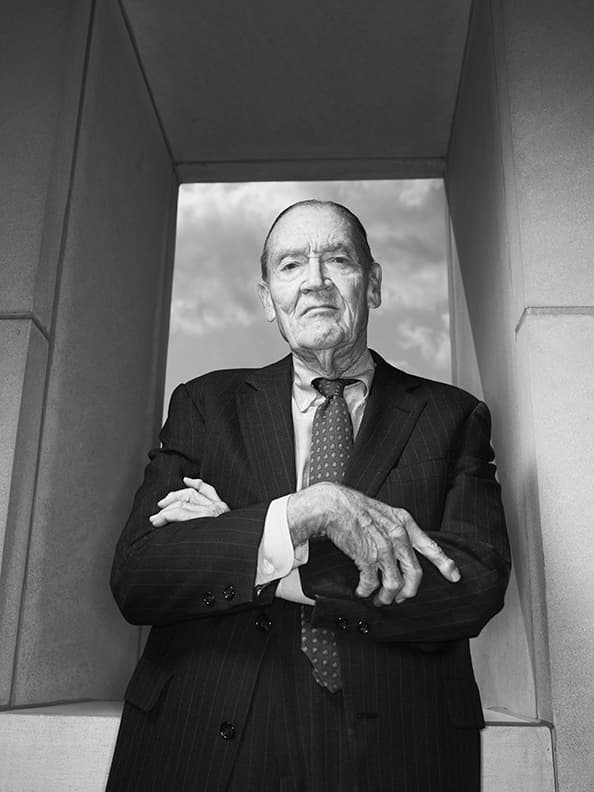
John C. Bogle
Vanguard
A pioneer in the finance and investing industry, John C. Bogle founded Vanguard in 1975 and revolutionized mutual fund management by eliminating the middleman. His innovative approach saved investors nearly a quarter trillion dollars through the power of compounding, demonstrating the profound impact of a simple idea consistently applied over decades. Bogle's early experiences with adversity shaped his character, instilling the resilience and discipline necessary for long-term success. His belief that mutual funds could effectively manage themselves led to a transformative shift in the investment landscape, making him a guiding figure for entrepreneurs and business builders seeking sustainable practices.
Core Principles
culture
Build companies on trust and shared values rather than measurement targets and process. Market share should be a measure of success, not the objective that drives daily decisions.
Vanguard prioritized doing right by clients ahead of earnings targets, allowing market share to grow organically. Bogle posted an aphorism throughout Vanguard's offices: 'For God's sake, let's always keep Vanguard a place where judgment has at least a fighting chance to triumph over process.'
“For God's sake, let's always keep Vanguard a place where judgment has at least a fighting chance to triumph over process.”
A family or organizational motto should capture the value you intend to live by. Persistent repetition of core principles sustains you through difficulties.
Bogle's family motto was 'Press On Regardless.' He applied this consistently over 60 years at Vanguard, even posting it on company walls. This simple phrase sustained him through market crashes, industry criticism, and personal challenges.
“Nothing in the world can take the place of persistence. Talent will not. Genius will not. Education will not. Persistence and determination alone are omnipotent.”
Not everything that matters can be measured, and not everything measurable matters. Over-reliance on quantification creates blindness to unquantifiable sources of lasting value.
Bogle referenced Einstein's office sign and applied it to business: trust and character cannot be reduced to metrics, yet they determine whether a company sustains customer relationships and ethical behavior. Vanguard succeeded by trusting clients rather than optimizing metrics.
“Not everything that counts can be counted, and not everything that can be counted counts.”
finance
The way you measure performance and the way you want people to act must align. Conflicting measurement systems incentivize the wrong behaviors, as Adam Smith observed 200 years ago.
Bogle showed how accountants serving as business consultants to audit clients, and security analysts paid by the firms they monitor, create inevitable conflicts of interest. These misaligned incentives led to Arthur Anderson's collapse and Enron's fraud.
“Managers of other people's money rarely watch over it with the same anxious vigilance with which they watch over their own.”
Show me the incentives and I will show you the outcome. Structure compensation and ownership so that stakeholders profit from long-term customer success, not short-term extraction.
Bogle quoted Charlie Munger to explain why financial institutions misbehave: their incentive structures reward quarterly performance and individual enrichment over multi-year sustainability. Founder-led companies naturally align incentives better than professional management.
“Show me the incentive and I will show you the outcome.”
Short-term speculation masquerades as investing but is actually a loser's game. The future is unpredictable, making historical probability analysis unreliable for financial decisions.
Bogle extensively analyzed how market participants use past data to predict future returns, ignoring that markets are fundamentally non-linear. Black Monday produced a bull market, contradicting all historical expectations, proving the futility of predictive models.
“In the financial markets, the improbable is, in fact, highly probable. Or as Taleb also notes, the highly probable is utterly improbable.”
The tyranny of compounding costs overwhelms the magic of compounding returns. Small percentage differences in fees compound into massive wealth destruction over decades.
Bogle demonstrated mathematically that a 2 percent annual fee reduces a 184,000 dollar investment return to just 74,000 dollars, and after taxes and inflation, drops to 37,000 dollars. This 'tyranny of costs' became the foundation for his life's work.
“Clearly the wonderful magic of compounding returns has been overwhelmed by the powerful tyranny of compounding costs.”
innovation
The most transformative business innovation can come from a simple idea applied consistently over decades. Bogle's single concept of eliminating the middleman in mutual fund management saved customers nearly a quarter trillion dollars through compounding effects.
Bogle founded Vanguard on the radical idea that mutual funds should manage themselves rather than hire outside managers, eliminating unnecessary fees. By 2018, this simple concept compounded into approximately 217 billion dollars in savings for customers.
“Why should our mutual funds retain an outside company to manage their affairs, the modus operandi of our industry then and now, when they could manage themselves and save a small fortune in fees?”
leadership
Founding a transformative company requires both an idealist's conviction and a street fighter's tenacity. Stubbornness paired with practical scrappiness enables you to challenge entrenched industries.
Bogle described himself as having 'the stubbornness of an idealist and the soul of a street fighter' when launching Vanguard. He needed both qualities to overcome fierce industry resistance to his fee-reduction model.
“The stubbornness of an idealist and the soul of a street fighter”
mindset
Happiness comes from autonomy, connection with others, and exercising your competence. Money provides only transitory happiness once basic needs are met.
Late in his life, Bogle reflected that sustained happiness depends on three factors: control over your own life, meaningful relationships, and the opportunity to develop and use your talents. This is independent of wealth accumulation.
Distinguish between creating value and extracting value. True professionals build businesses that add value to society, while extractive industries merely transfer wealth.
Bogle argued that the finance industry primarily extracts value through fees and complexity rather than creating value. He contrasted this with entrepreneurs and manufacturers who create tangible products that improve lives.
“I will create value for society rather than extract it.”
Inherited wealth without earned experience creates vulnerability. Adversity and the necessity to work from a young age build character, resilience, and the discipline needed for long-term success.
Bogle's family lost their wealth, forcing him to work as a boy. He reframed this as the 'priceless advantage of having to work for what I got,' developing initiative, discipline, and engagement with others that sustained his career.
“I grew up with the priceless advantage of having to work for what I got.”
resilience
Fighting for what is right mathematically, philosophically, and ethically sustains you through years of opposition. Idealism paired with persistent effort can reshape entire industries.
Bogle spent his entire career battling the financial industry's extractive practices. He framed this not as ego gratification but as alignment with mathematical truth, philosophical principle, and ethical obligation, which sustained him even when outnumbered.
“What I'm battling for, building our nation's financial system anew in order to give our citizens and investors a fair shake is right, mathematically right, philosophically right, ethically right.”
Transform your obstacles into opportunities by refusing to accept limitation. When facing adversity, the force of your mind and will can overcome every impediment.
Bogle was inspired by a quote about Samuel Johnson during his junior year at Princeton: 'The force of his mind overcame every impediment.' He applied this principle throughout his career, particularly when launching Vanguard against industry opposition.
“The force of his mind overcame every impediment.”
simplicity
Simplicity and common sense create sustainable competitive advantage. A career built on recognizing and implementing the obvious outperforms complexity.
Bogle stated his career was 'a monument, not to brilliance or complexity, but to common sense and simplicity.' His index fund concept, while revolutionary, was fundamentally simple: match market returns while minimizing costs.
“My career has been a monument, not to brilliance or complexity, but to common sense and simplicity.”
strategy
A superior company is distinguished not by technology or financial resources, but by its unconventional thinking about what it wants to be and the values that organize it. Dream first, then organize.
Bogle quoted Robert Greenleaf to explain that the best companies have a liberating vision about their purpose. They then organize everything, including priorities and structure, to serve that dream rather than financial targets.
“What distinguishes a superior company from its competitors is its unconventional thinking about its dream, what this business wants to be, how its priorities are set, and how it organizes to serve.”
Opportunities for value creation often exist in plain sight within your own domain. Recognize the obvious diamonds in your backyard rather than chasing mythical opportunities elsewhere.
Bogle repeatedly referenced an ancient Persian fable about a farmer who abandoned his estate seeking distant diamond mines, only for the new owner to discover vast diamonds on the original property. This parable shaped his philosophy of finding solutions within existing systems.
“Your diamonds are not in far distant mountains, are in yonder seas. They're in your own backyard if you but dig for them.”
Market behavior cannot be reliably predicted from historical patterns. Past performance, no matter how consistent, provides no statistical certainty about future outcomes.
Bogle analyzed Black Monday (1987) versus Black Thursday (1929) to show that identical market events can precede vastly different consequences. The laws of probability do not apply to financial markets in ways most assume.
“Please, please, please don't count on it.”
Young talent flows toward whichever industries offer the highest compensation, regardless of whether those industries create or destroy value. Incentive misalignment wastes human capital.
Bogle and Munger lamented that finance employs approximately 8 percent of jobs but captures 40 percent of profits, attracting disproportionate talent into value extraction rather than creation. This distortion has consequences for society's overall productivity.
“Most money-making activity contains profoundly antisocial effects.”
Frameworks
The Tyranny of Costs Framework
A mathematical model demonstrating how small percentage fees compound into massive wealth destruction over decades. Begin with gross returns, subtract annual fees as a percentage, factor in taxes, and adjust for inflation. The resulting net return reveals the devastating impact of seemingly small costs.
Use case: Evaluating the true impact of operational expenses on customer value and long-term business sustainability. Particularly valuable for identifying and eliminating hidden costs in any industry.
The Diamonds in Your Backyard Framework
A decision-making tool based on the Persian fable of the farmer seeking distant diamond mines. Before pursuing distant opportunities, thoroughly examine existing assets, relationships, and capabilities. Opportunity often exists within current constraints.
Use case: Startup strategy and resource allocation. Prevents wasted effort chasing mythical markets while neglecting high-potential existing customers or capabilities.
The Three Pillars of Happiness
A framework identifying three non-monetary factors that determine sustained happiness: autonomy (control over one's life), connectedness (relationships with others), and competence (using and developing talents). Money satisfies basic needs but not these deeper sources of fulfillment.
Use case: Personal life planning and organizational culture design. Helps leaders understand that compensation alone will not create satisfied employees or satisfied lives.
The Trust vs. Count Spectrum
A spectrum describing corporate cultures ranging from trust-based (prioritizing judgment, relationships, and unquantifiable values) to count-based (relying on metrics, processes, and measurable targets). Most organizations lean too far toward counting.
Use case: Diagnosing organizational culture problems and identifying whether operations over-rely on metrics at the expense of judgment and human values.
The Incentive Alignment Audit
A diagnostic process examining whether compensation structures, ownership arrangements, and performance metrics align the interests of managers with customers and long-term company health. Misalignment surfaces through role conflicts (accountants as consultants, analysts paid by firms they cover).
Use case: Preventing catastrophic failures in regulated industries and financial institutions. Identify where stakeholder interests diverge and restructure incentives to create unity.
The Company Dream Framework
A strategic planning tool based on articulating what a company wants fundamentally to be (its dream or mission), then organizing all decisions, priorities, and structures to serve that dream. Distinguished from approaches that begin with financial targets.
Use case: Founding or repositioning companies to have clear purpose beyond profit. Helps teams make consistent decisions during ambiguous situations.
Stories
Bogle's family, initially wealthy, lost their fortune. His father struggled to hold employment while his peers played, forcing young John and his brothers to work year-round delivering newspapers, working in bowling alleys, and supporting the family. Rather than resent this, Bogle reframed it as the 'priceless advantage' that taught him responsibility, initiative, and the joy of engagement with others.
Lesson: Adversity in childhood, when reframed positively, becomes a competitive advantage. The discipline and work ethic developed through necessity create resilience that privileged peers never acquire.
While at Princeton, Bogle read an essay on Samuel Johnson containing the phrase 'the force of his mind overcame every impediment.' This sentence inspired him during a period of personal struggle and became a touchstone throughout his career, particularly when launching Vanguard against industry opposition.
Lesson: A single sentence from a great thinker can reshape your mindset. Ideas absorbed at formative moments in your life continue to influence decisions decades later.
Joseph Heller and Bogle attended a billionaire's party on Shelter Island. Bogle noted that the billionaire probably made more money in one day than Heller's masterpiece 'Catch-22' earned in its entire history. When Bogle asked how this felt, Heller replied: 'I've got something he can never have. The knowledge that I've got enough.'
Lesson: True wealth is not measured in absolute dollars but in the peace that comes from sufficiency. An artist with modest means who is satisfied possesses something a billionaire chasing more may never achieve.
Bogle's great-grandfather, Philander Bannister Armstrong, led the charge against inefficiency in fire and life insurance industries in the 1800s. In 1868, he declared 'gentlemen, cut your costs.' His 1917 manifesto against life insurance abuses was titled 'A License to Steal' and concluded the industry was 'cancer in the blood' requiring an undertaker.
Lesson: Crusades against industry inefficiency and extraction run in families and across generations. The archetype of the reformer who fights entrenched practices is created by exposure to principled ancestors.
Bogle calculated that over 50 years, gross stock returns averaged 11 percent annually, turning 1,000 dollars into 184,000 dollars. However, after accounting for 2 percent annual fees, taxes, and inflation, the actual customer return was just 37,000 dollars. This mathematical demonstration became the foundation for launching Vanguard.
Lesson: Small percentage differences in costs compound into catastrophic wealth destruction over decades. A single mathematical insight, if act upon persistently, can reshape an entire industry.
Black Monday (1987) saw the Dow Jones drop 25 percent in a single day, a shock unprecedented in market history. Yet rather than preceding depression as Black Thursday (1929) had, Black Monday preceded the greatest bull market in recorded history. This contradiction proved that historical patterns cannot predict future market behavior.
Lesson: The future is fundamentally unpredictable. Betting that past patterns will repeat is a fool's game in complex systems. Humility about what we cannot know should guide long-term strategy.
Bogle quoted a 2,500 year old challenge from Socrates to Athens: 'Why do you who are citizens of this great and mighty nation care so much about laying up the greatest amount of money and honor and reputation and so little about wisdom and truth and the greatest improvement of man?' Bogle applied this ancient wisdom to modern business.
Lesson: Fundamental tensions between material accumulation and intellectual or ethical development are ancient, not modern. Every generation must re-answer Socrates' challenge.
Bogle referenced Arthur Anderson, once a Big Eight accounting firm, which developed lucrative consulting services alongside audit functions. This created an incentive to overlook client malfeasance. When Enron collapsed in 2003, Anderson collapsed with it, destroyed by the very conflicts its business model created.
Lesson: Incentive misalignment destroys institutions from within. When you profit from overlooking problems, you will eventually overlook catastrophic problems. Separate roles to prevent conflicts.
Notable Quotes
“Why should our mutual funds retain an outside company to manage their affairs when they could manage themselves and save a small fortune in fees?”
The founding principle of Vanguard, a radical idea that eliminated the middleman and saved customers 217 billion dollars over 44 years.
“Clearly the wonderful magic of compounding returns has been overwhelmed by the powerful tyranny of compounding costs.”
Mathematical summary of how small annual fees destroy investment returns over decades, the core insight driving his career.
“We engage in the folly of short-term speculation and eschew the wisdom of long-term investing. We ignore the real diamonds of simplicity, seeking instead the illusory rhinestones of complexity.”
From the introduction to 'Enough,' his summary of modern business failures and the thesis for the book.
“Not everything that counts can be counted, and not everything that can be counted counts.”
Sign that hung in Einstein's office, which Bogle applied to business to argue that trust matters more than metrics.
“For God's sake, let's always keep Vanguard a place where judgment has at least a fighting chance to triumph over process.”
Aphorism posted throughout Vanguard offices to reinforce that human judgment should not be subordinated to measurement systems.
“My career has been a monument, not to brilliance or complexity, but to common sense and simplicity.”
Reflection on his life's work, emphasizing that sustained success comes from recognizing and implementing obvious principles.
“Please, please, please don't count on it.”
Final summary after analyzing unpredictability in markets, cautioning against reliance on historical patterns to predict futures.
“What I'm battling for, building our nation's financial system anew in order to give our citizens and investors a fair shake is right, mathematically right, philosophically right, ethically right.”
Bogle reflecting on why he spent his entire career fighting industry practices, grounding his crusade in principle.
Frequently Asked Questions
What are John C. Bogle's key business principles?▼
John C. Bogle's core principles include: Build companies on trust and shared values rather than measurement targets and process. Market share should be a measure of success, not the objective that drives daily decisions.. A family or organizational motto should capture the value you intend to live by. Persistent repetition of core principles sustains you through difficulties.. Not everything that matters can be measured, and not everything measurable matters. Over-reliance on quantification creates blindness to unquantifiable sources of lasting value.. Founder Almanac has cataloged 19 total principles from John's career.
What can entrepreneurs learn from John C. Bogle?▼
Key lessons from John C. Bogle include: Adversity in childhood, when reframed positively, becomes a competitive advantage. The discipline and work ethic developed through necessity create resilience that privileged peers never acquire.. Explore 8 stories and 6 frameworks from John's experience.
What is John C. Bogle known for in business?▼
A pioneer in the finance and investing industry, John C. Bogle founded Vanguard in 1975 and revolutionized mutual fund management by eliminating the middleman. His innovative approach saved investors nearly a quarter trillion dollars through the power of compounding, demonstrating the profound impact of a simple idea consistently applied over decades. Bogle's early experiences with adversity shaped his character, instilling the resilience and discipline necessary for long-term success. His belief that mutual funds could effectively manage themselves led to a transformative shift in the investment landscape, making him a guiding figure for entrepreneurs and business builders seeking sustainable practices.
More Finance & Investing Founders
Want John's advice on your business?
Our AI has studied John C. Bogle's biography, principles, and decision-making frameworks. Ask any business question.
Start a conversation