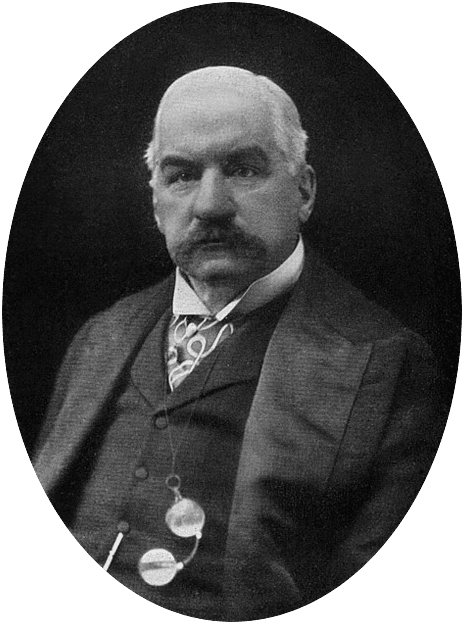
J.P. Morgan
J.P. Morgan & Co.
A pivotal figure in American finance, J.P. Morgan founded J.P. Morgan & Co. and played a crucial role in the consolidation of major industries during the late 19th and early 20th centuries. His strategic approach to capital flow and financial leverage allowed him to influence the direction of the U.S. economy, exemplified by his orchestration of the 1901 merger that created U.S. Steel, the world’s first billion-dollar corporation. Morgan understood the importance of maintaining power from a position of strength, famously stating, "I have come to the conclusion that the business must be sound before I invest in it." Despite facing burnout and wanting to retire at 33, his father's insistence led him to continue building his empire until age 75, demonstrating the value of resilience and delegation in sustainable business operations. Today, his principles still resonate with entrepreneurs seeking to navigate the complexities of finance and corporate governance.
Core Principles
finance
Build your power base from positions of financial strength, not weakness. Those in poor financial positions become dependent on external capital providers and lose control of their own operations.
J.P. Morgan's influence derived from the fact that most railroad operators had mismanaged their finances and needed his capital to survive. The well-run Burlington Railroad under James J. Hill, financially independent and profitable, had no need for Morgan's involvement and therefore remained outside his control. Morgan drew power from weakness in others.
“Financial strength is kryptonite to Morgan.”
Control capital flows to control outcomes. Financial leverage over operations can be maintained without owning a majority of shares if you control who holds the voting proxies.
Morgan had effective control of Northern Pacific without owning a majority of shares because he controlled the proxies. This was common practice among railroad executives and their bankers. It allowed Morgan to exert influence over companies without legal ownership, a practice that created legal vulnerabilities when others like Harriman challenged it.
leadership
In crisis, use physical proximity and control of the meeting space to force resolution. Lock the room, control communication, and make it psychologically costly to leave without agreement.
During the 1907 financial panic, Morgan locked the library doors, put the key in his pocket, and refused to let the trust company presidents leave until they committed to providing their share of a $25 million rescue loan. He presented the document and gestured to a pen, forcing immediate action.
“No one could leave. He had locked the library's doors and put the key in his pocket.”
Recognize that legitimate grievances from workers should be addressed, but do so from a position of control and clarity about ownership of outcomes. Do not allow workers to negotiate directly with government without understanding who controls capital.
When coal miners appealed to Roosevelt for help during the strike, he had limited power because Morgan had financed the mines. When miners tried the same appeal with Morgan, he made clear that the mines were not the owners' to manage independently but belonged to his investors. Morgan resolved the strike by making clear who was in control.
mindset
Accept that inheritance of position and parental influence shape leaders more than they often acknowledge. The strongest leaders may be creations of paternal direction rather than self-made individuals.
J.P. Morgan's father, Junius, set him on his path and steered his career. Even as an adult, Morgan deferred to his father and never challenged him, though his father could be overbearing. The creator of the largest companies in the world was himself created by his father's influence.
Avoid perfectionism that leads to burnout and dissatisfaction. Control everything personally only until sustainable operations are achieved, then delegate.
J.P. Morgan wanted to retire at age 33 due to strain from dealmaking and perfectionism, stating he wanted to do everything himself or personally supervise everything. His father refused to let him quit, and Morgan continued working until age 75, living a life of constant stress despite immense success.
“I am never satisfied until I either do everything myself or personally supervise everything done.”
Expect that rivals will become allies when circumstances require it, even if personal dislike and mutual distrust remain. Pragmatism often overcomes antagonism in matters of mutual interest.
After Roosevelt's antitrust victory against Northern Securities, Morgan still donated to Roosevelt's re-election campaign. Years later, during the panic of 1907, they again worked together despite their conflict. Morgan's pragmatism meant he maintained influence even with an adversary if doing so protected his interests.
operations
Maintain decision velocity by concentrating intensely for brief periods, making quick decisions, and moving to execution immediately. This creates power but can isolate leadership and lead to exhaustion.
Morgan was known for his ability to concentrate intensely for short bursts, arrive at a decision quickly, dispatch instructions, and move on. This focus was his genius but operated like a monarch rather than a democrat, keeping him isolated and sometimes exhausted. He famously said he could do a year's work in nine months but not in twelve.
“Morgan said he could do a year's work in nine months, but not 12.”
strategy
Maintain control through limiting information availability to competitors. Operate in secrecy, announce actions after they are already committed, and avoid explaining decisions publicly.
Morgan preferred to operate in secrecy and negotiate through private backroom deals sealed with handshakes. He never explained his actions publicly and had an aristocrat's disdain for public sentiment. This approach worked until Roosevelt changed the rules by announcing the antitrust prosecution to the press before informing Morgan privately.
Laws written without enforcement mechanisms or without the force to overcome entrenched power are ineffective. Assume that established powers will use legal structures to evade intent, not comply with it.
The Sherman Antitrust Act was passed with strong support, but clever legal minds immediately devised workarounds. The holding company, invented by New Jersey, allowed corporations to hold stock in other corporations, circumventing the spirit of antitrust law. Morgan used this structure for Northern Securities, believing laws did not apply to him.
Frameworks
Control Through Capital Structure
Maintain control of operations without legal ownership by controlling voting proxies, holding debt instruments, or providing essential capital. Structure investments to maximize influence over decision-making while minimizing visible ownership stakes. Create dependencies on capital provision that persist even when legal structures change.
Use case: Building influence in industries where capital is scarce and consolidation is needed
The Efficiency Defense
Argue that consolidation, integration, and centralized control are necessary for efficiency and national competitive advantage. Frame opposition to consolidation as economically inefficient and harmful to the nation's standing. Use economic efficiency as a moral justification for concentration of control.
Use case: Defending consolidation and reduced competition to regulators and the public
Forced Resolution Through Physical Control
In situations requiring immediate agreement, control the physical space and communication channels. Prevent departure, eliminate alternatives, and force commitment before releasing control. Make the psychological cost of non-agreement exceed the cost of agreement.
Use case: When time pressure is critical and normal negotiation has stalled
Stories
J.P. Morgan tried to retire at age 33 due to strain and burnout from his perfectionist approach to dealmaking. His father refused to let him quit. Morgan continued working until age 75, never achieving the respite he sought, despite accumulating vast wealth and power.
Lesson: Excellence through personal perfectionism and control is unsustainable. Those who build power through obsessive involvement risk never escaping that trap, and inherited obligation can prevent you from leaving even when you recognize the cost.
Notable Quotes
“I have come to the conclusion that the business must be sound before I invest in it.”
After profiting during the Panic of 1873, Morgan articulated his new strategy of dealing exclusively with elite, well-managed companies and avoiding speculation entirely.
“I could sit down at the clerk's desk, take up his work where he left off and go on with it. I don't like being at any man's mercy.”
Explaining his obsessive need to know every job in the bank and inability to delegate authority. Control and knowledge as sources of power and security.
“A man always has two reasons for the things he does, a good one and the real one.”
Capturing his cynical philosophy that everyone has both public justifications and hidden real motives for their actions. Revelation of his belief in universal dishonesty.
“I am pressed beyond measure. So far as my time is concerned, I have no leisure whatsoever. If it were simply my own affairs that were concerned, I would very soon settle the question and give it up. But with the large interest of others on my shoulders, it cannot be done.”
Expressing his repeated desire to retire but inability to do so due to responsibility to others. A man imprisoned by duty and obligation despite his own wishes.
“I assume something that is still more important, and that is the moral responsibility which has to be defended so long as you live.”
Testimony before Congress explaining why he took board seats and control of companies he financed. Positioning himself as moral guardian rather than mere creditor.
“Very likely, Andrew.”
Response when Andrew Carnegie complained that he had sold U.S. Steel too cheaply by at least $100 million. Morgan's brevity and acceptance, neither gloating nor negotiating further.
“The longer I live, the more apparent becomes the absence of brains.”
His cynical assessment of most people's intelligence. Revealing his contempt for those he considered beneath him intellectually.
“If I've been able to succeed in the station in life in which I've been cast, I attribute it more than anything to the endorsement of my father's friends.”
Acknowledging his debt to his father Junius. Rejecting the self-made man narrative and crediting paternal guidance and connections.
“Your roads, your roads belong to my clients.”
Response to a railroad owner complaining about Morgan's interference, showing Morgan's view that he effectively owned all properties financed by his investors
“I am never satisfied until I either do everything myself or personally supervise everything done.”
Description of Morgan's personality and approach to control, showing his perfectionism and inability to delegate
Frequently Asked Questions
What are J.P. Morgan's key business principles?▼
J.P. Morgan's core principles include: Build your power base from positions of financial strength, not weakness. Those in poor financial positions become dependent on external capital providers and lose control of their own operations.. Control capital flows to control outcomes. Financial leverage over operations can be maintained without owning a majority of shares if you control who holds the voting proxies.. In crisis, use physical proximity and control of the meeting space to force resolution. Lock the room, control communication, and make it psychologically costly to leave without agreement.. Founder Almanac has cataloged 10 total principles from J.P.'s career.
What can entrepreneurs learn from J.P. Morgan?▼
Key lessons from J.P. Morgan include: Excellence through personal perfectionism and control is unsustainable. Those who build power through obsessive involvement risk never escaping that trap, and inherited obligation can prevent you from leaving even when you recognize the cost.. Explore 1 stories and 3 frameworks from J.P.'s experience.
What is J.P. Morgan known for in business?▼
A pivotal figure in American finance, J.P. Morgan founded J.P. Morgan & Co. and played a crucial role in the consolidation of major industries during the late 19th and early 20th centuries. His strategic approach to capital flow and financial leverage allowed him to influence the direction of the U.S. economy, exemplified by his orchestration of the 1901 merger that created U.S. Steel, the world’s first billion-dollar corporation. Morgan understood the importance of maintaining power from a position of strength, famously stating, "I have come to the conclusion that the business must be sound before I invest in it." Despite facing burnout and wanting to retire at 33, his father's insistence led him to continue building his empire until age 75, demonstrating the value of resilience and delegation in sustainable business operations. Today, his principles still resonate with entrepreneurs seeking to navigate the complexities of finance and corporate governance.
More Finance & Investing Founders
Want J.P.'s advice on your business?
Our AI has studied J.P. Morgan's biography, principles, and decision-making frameworks. Ask any business question.
Start a conversation