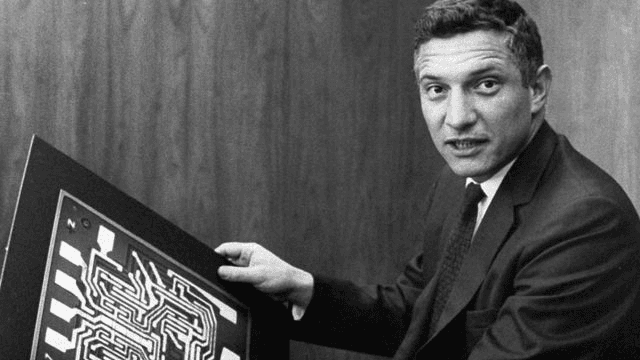
Robert Noyce
Intel Corporation
A pioneer in the semiconductor industry, Robert Noyce co-founded Intel Corporation in 1968, which became a cornerstone of the modern computing revolution. Under his leadership, Intel introduced the first commercially available microprocessor, the 4004, in 1971, significantly advancing technology and shaping the future of personal computing. Noyce's management philosophy emphasized hiring for talent and culture fit, fostering autonomy among teams, and trusting employees to execute without micromanagement. His ability to foresee paradigm shifts and champion innovative ideas, even against skepticism, positioned him as a mentor to many, including Steve Jobs, who sought his guidance during a challenging period in his career. Noyce's legacy continues to inspire entrepreneurs today, highlighting the importance of vision and empowering teams to drive change.
Core Principles
competitive advantage
Never underestimate competitors who are patient, observant, and learning from you. Arrogance and dismissal of rivals is a strategic weakness.
American semiconductor companies laughed at Japanese competitors in the 1960s who contributed little to technical conferences. But the Japanese came to listen and photograph, studying every slide. Years later, this humility and systematic learning allowed them to catch up and overtake American companies in quality and market share. The Americans did not laugh anymore.
“We didn't come to talk, they came to listen and to photograph. Every time a slide would go up, all of these Japanese cameras in the room would go off all at once.”
Being first to market allows you to define the target. Late arrivals find the market already defined by someone else.
In semiconductors, being first allowed Intel to shape customer expectations and define the standard. Later competitors had to compete on Noyce's terms, fighting against established preferences and relationships.
culture
Build competitive culture where people push each other hard, then respect them after the competition. Separate the contest from the person.
Noyce lived for competition and was happy to beat people soundly. But after winning, he would help them up, slap them on the back, and tell them how well they had done. This created an environment where people could compete intensely without fear of permanent damage to relationships or careers.
“Bob Noyce was happy to beat the hell out of you. He lived for competition, so much that it often put both him and others at risk. But after he did, he helped you up, slapped you on the back, and told you how well you had done.”
People given enough freedom will choose to do the right thing. Trust is more powerful than control.
Noyce believed fundamentally that creative people, when given autonomy and clear objectives, would self-organize toward excellence. This belief shaped his creation of flat hierarchies at Fairchild and Intel, where researchers had freedom to pursue ideas as long as they drove toward the company's mission.
Being valued and appreciated provides diminishing returns. Money motivates, but appreciation inspires long-term excellence.
Noyce understood that a personal note from the CEO thanking someone for their work could feel like a 100 percent raise. He recognized that while compensation matters, humans have a diminishing return on financial rewards but no ceiling on the value of appreciation and recognition.
Compete fiercely in the market but never compete internally with your team. Internal competition destroys morale and collaboration.
In stark contrast to Shockley, who pitted employees against each other, Noyce united his teams against external competition. He would tell Shockley directly that Fairchild would bury his company, but he never pitted his own team members against each other.
customer obsession
Be honest about problems with customers. Admit mistakes clearly and explain exactly when you'll fix them. Straightforwardness defuses anger.
When Intel faced product issues, Noyce would tell customers directly: We know what the problem is. We're fixing it. Here's when we'll get it fixed. We goofed up. This honesty made it harder for upset customers to stay angry than if he'd tried to hide the issue.
finance
Use financial success from one venture to seed and accelerate the next. Invest early in founders you believe in, before others recognize the opportunity.
Mike Markkula accumulated over $1 million in Intel stock options during Intel's early years and IPO. He used $250,000 of that to fund Apple's first production run. His Intel wealth and Intel network (mostly from Fairchild and Intel people) became the seed capital for Apple's transformation from a garage hobby company to a world-class manufacturer.
Cap your downside, but leave your upside uncapped. In venture investing, you can only lose 100 percent, but the multiples on success are fantastic.
As Noyce became an angel investor, he applied this principle consistently. He looked for bets where losses were limited but wins could be exponential, understanding that one massive success paid for many failed investments.
“You can only lose 100 percent, but the multiples on the upside are fantastic.”
hiring
Hire for talent and culture fit, then trust people to do the right thing without micromanagement. Suggest what needs doing and let smart people execute.
Noyce operated on the principle that if you suggested to people what the right thing to do would be, they would be smart enough to pick it up and do it. He built Intel around recruiting the best technical talent and creating an environment where performance mattered more than politics or hierarchy.
“Bob operated on the principle that if you suggested to people what the right thing to do would be, they'd be smart enough to pick it up and do it.”
innovation
Build a learning organization that can adapt and recover from setbacks. The ability to learn is the meta-skill that saves companies through cycles of disruption.
Intel faced cycles of booms and busts in the microprocessor industry. When the Japanese threatened American dominance through quality and government support, Intel responded by learning new methods. The book notes Intel had learned to learn, an ability that allowed it to recover from mistakes and remain at the center of the global economy for decades.
“Intel had learned to learn. That ability would save the company many times in the year ahead, even as other companies succumb to their mistakes.”
Know the science cold, then forget about it. Great ideas come through exploration, not grinding. Move from why won't this work to what can we build.
Noyce didn't believe in rigorous, methodical slogs toward ideas. Instead, he mastered the fundamentals deeply, then allowed his mind to wander and connect concepts freely. He compared this to Picasso's process: I do not seek, I find.
“Know the science cold and then forget about it.”
In the earliest stages of innovation, ask two questions: Why won't this work? And what fundamental laws will it violate? If an idea sits within physical possibility, it's worth exploring.
Noyce used this framework to evaluate new technical directions. Rather than asking whether something had been done before or was conventional wisdom, he focused on whether it violated laws of physics. If it didn't, it deserved exploration regardless of conventional thinking.
Thinking in little steps will take you there. Break complex problems into logical sequences, test each step, back up if you hit a wall, then refine.
Noyce's approach to inventing wasn't a eureka moment but iterative logical progression. He would think through what comes next, test whether it works, and adjust. This methodical but flexible approach proved far more effective than heroic breakthroughs.
“Thinking in little steps will take you there.”
leadership
Be willing to step away from hands-on work when scaling grows bureaucratic. Recognize when your management style no longer aligns with company needs and succession plan accordingly.
Noyce left Fairchild because as the company grew larger, he enjoyed his daily work less and less. He missed the small-team environment focused on inventing new products. Though he would later build Intel into a massive company, he understood the tension between personal fulfillment and organizational growth, and he eventually stepped down to let Andy Grove take the CEO role.
“As Fairchild has grown larger and larger, I have enjoyed my daily work less and less. Perhaps it is partly because I grew up in a small town, enjoying all the personal relationships of a small town.”
Leadership impact comes not from formal authority or titles, but from how you make people feel. Warm, visceral confidence in a shared vision is more powerful than cold intensity.
Noyce's appeal was warm and made people feel that vital things could be accomplished if everyone steeled their courage and moved forward together. This contrasted with Steve Jobs' cold, ethereal reality distortion field that invited people to accept his vision or be jettisoned. Both succeeded, but Noyce's vision was more sweeping: not just a company, but ushering in the digital age.
“Noyce made you feel that important vital things could be accomplished if everyone could just steal their courage, ignore the risks, and move forward together toward a difficult but achievable goal.”
Mentor younger founders by modeling how to live with integrity and be beloved, not by giving specific tactical advice. Presence and character can be more valuable than expertise.
Steve Jobs sought out Noyce not for technical advice about computers, but for a vision of how to succeed in the valley and be beloved rather than hated. Jobs was thrilled by Noyce's presence, would show up unannounced, call late at night, and crash in his corner. Noyce did not try to advise Jobs on business strategy; instead, he modeled a different way of being powerful and respected.
Problems are just opportunities in work clothes. Remain calm when disasters strike because that's when your best thinking happens.
When researchers panicked over losing a critical process at Fairchild, Noyce responded with complete relaxation and confidence: We'll figure it out. His calm demeanor under pressure became a signal to his team that problems were solvable, not catastrophic.
Lead through questions and suggestions, not commands. The anti-Shockley approach: ask why don't you try or have you considered rather than issue directives.
Noyce's management style at Fairchild and Intel stood in stark contrast to Shockley's authoritarian approach. Rather than commanding people to do his bidding, Noyce would pose questions and suggestions that invited collaboration, making employees feel they worked with him rather than for him.
mindset
Understand that success and achievement, no matter how impressive, do not guarantee happiness or mental well-being. Do not sacrifice relationships and health for external validation.
Noyce invented the integrated circuit, founded two multi-billion dollar companies, was a champion skier and pilot, and received the National Science Medal. Yet he was deeply depressed, having damaged his family through divorce and seeing two children struggle with drugs and mental illness. He told an entrepreneur at a dinner that he had screwed up his family and advised him to stay put rather than chase bigger houses.
“You've got a nice family. I screwed up mine. Just stay where you are.”
Play to win from the start, even as a child. Intentionally losing or settling teaches the wrong lessons about what's possible in life.
Noyce was devastated as a child when his mother suggested his father let him win at ping pong. He took this as a fundamental lesson about competitive drive and excellence, carrying it throughout his life as a relentless pursuer of success in every domain.
“That's not the game. If you're going to play, you play to win.”
Envision yourself at the next level before you arrive there. Mental rehearsal and visualization create a roadmap that your actions naturally follow.
Before diving competitions, Noyce would mentally rehearse each dive in slow motion until he could see himself executing them perfectly. He called this habit envisioning himself at the next level and applied it to his career, inventions, and skill development throughout his life.
“Envisioning myself at the next level.”
Skip the beginner stages and aim high immediately. If you're going to pursue something, assume you'll eventually reach the advanced level, so start there.
When learning to ski, Noyce didn't start on bunny slopes. He began on intermediate runs, reasoning that since he would end up there soon enough anyway, why waste time on easier terrain. This pattern defined his entire approach to learning and growth.
Frameworks
Horizontal Council Coordination
A flat organizational structure where cross-functional teams meet at the working level to solve problems rather than routing issues up a hierarchy. Councils are temporary, focused on specific problems, have no formal governing power, and dissolve once the issue is resolved. Members represent affected divisions but act as individual contributors, not departmental representatives.
Use case: Scaling companies while maintaining speed and autonomy. Coordinating between functional areas in fast-moving, technical organizations where hierarchy would slow decision-making.
The Reality Distortion Field
A leadership phenomenon where charisma and conviction enable a founder to maintain belief in a vision even when external evidence suggests it is impossible. Different types include warm, visceral versions (Noyce) that inspire collective movement, and cold, ethereal versions (Jobs) that demand acceptance of a singular vision.
Use case: Pioneering revolutionary products with no existing market. Maintaining organizational morale during long periods of customer skepticism and low external validation.
Organizational Scaling Through Delegation
As a founder leads a growing company, they identify and delegate to strong second leaders who handle the difficult or unpopular decisions, while the founder maintains relationships and vision. The founder stays clean while the organization does what must be done. This preserves the founder's likability and allows harsh management to coexist with culture.
Use case: Building high-performance cultures that require both discipline and trust. Separating visionary leadership from operational rigor.
Price as Technology
Use aggressive pricing to drive volume growth. Price below cost if necessary to establish market dominance, assuming that economies of scale and learning curves will eventually enable profitability. Volume growth reduces per-unit costs, enabling profits at lower prices.
Use case: Scaling new technology platforms where establishing dominant market share is more valuable than immediate profitability. Especially powerful in hardware and manufacturing.
Two Foundational Questions for Innovation
When evaluating new technical directions, ask only two questions: Why won't this work? And what fundamental laws will it violate? If an idea remains within the realm of physical possibility, regardless of conventional wisdom, it's worthy of exploration and investment.
Use case: Early-stage R&D when deciding which ideas to pursue and which to abandon. Useful for filtering noise and focusing on true technical barriers rather than social or conventional objections.
Iterative Stepping Stones
Break complex problems into logical sequences of small steps. Test each step, back up if you hit a wall, then find a path conceptually all the way through to the end. Once you have the complete path, return and refine. This approach replaces eureka moments with methodical progress.
Use case: Product development, invention, and any complex problem requiring creative breakthrough. Especially useful when you lack a clear end state but can identify the next logical step.
Quick and Dirty vs. Pretty Method
Researchers and teams can pursue work in two ways: the pretty method, which uses exact measurements and definitive answers, consuming vast time; or the quick and dirty method, which moves forward as soon as rudimentary tests indicate something will probably work. Choose quick and dirty when speed matters more than perfection.
Use case: Startup operations and fast-moving markets where being first to market outweighs being perfect. When resources are limited and time is precious, embrace imperfection in pursuit of speed.
Hierarchy of Knowledge
Separate organizational hierarchy from knowledge hierarchy. In technical decisions, the person with the most knowledge should have the final say, regardless of their title or position in the company. This inverts command-and-control and enables better decisions.
Use case: Building technical organizations where you want the best ideas to win regardless of who proposes them. Essential for retaining top talent and getting their best thinking.
Selling as an Engineering Problem
Treat market adoption of new products as an engineering problem. Identify and systematically eliminate each potential customer objection until you find the true barrier. Don't assume the first objection you hear is the real one.
Use case: Taking new products to market when adoption is slow. Forces you to think systematically about adoption barriers rather than assuming marketing will solve the problem.
Daily Steering vs. Long-term Planning
Maintain strategic goals and direction, but steer the boat a little every day rather than committing rigidly to long-term plans. This provides optionality and allows you to respond to unexpected market conditions, new information, and emerging opportunities.
Use case: Operating in uncertain environments where detailed long-term plans become obsolete quickly. Preserves the flexibility to capitalize on opportunities and adapt to threats.
Stories
Steve Jobs was driven out of Apple in his late twenties and founded NeXT, which failed to gain traction. Desperate and lost, Jobs sought out Noyce as a mentor and father figure. Noyce treated him like a kid, letting him crash at the house, feeding him, and inviting him to ski in Aspen. Once, Noyce's plane nearly crashed when he locked the wheels landing on a lake; Jobs pictured the headline Bob Noyce and Steve Jobs killed in a fiery plane crash. Despite Jobs showing up unannounced at midnight, Noyce kept taking his calls.
Lesson: True mentorship is about presence, modeling character, and making someone feel valued during their darkest moments, not about giving tactical advice. Noyce showed Jobs how to be beloved in the valley, which Jobs later emulated with his own focus on relationships and culture.
Noyce wrote a resignation letter from Fairchild explaining that as the company grew, he enjoyed his work less and less. He missed the small-town feel, the personal relationships, and the creative product work. He wanted to find or build a small company focused on developing technology nobody had yet done. Months later, he and Moore founded Intel.
Lesson: The most successful founders are driven by the work itself, not just wealth or status. Recognizing when an environment no longer serves your creative needs and being willing to start over is a sign of integrity, not failure. Success in scaling does not always align with personal fulfillment.
By the late 1960s, the calculator industry exhibited classic bubble behavior: vertical growth, price stability, performance improvement, and massive competition. Over 100 calculator companies entered the market. Established firms raced to add features or drive costs down, while new entrants flooded the market. The inevitable shakeout came, and only five or six companies survived.
Lesson: Consumer tech booms follow predictable patterns: high growth attracts many competitors, competition commoditizes margins, leading to consolidation. Understanding this cycle helps distinguish real innovations from hype-driven bubbles. The same pattern appeared in the 1990s dot-com bubble and continues today.
During the 1979-1981 memory chip shortage, scrap chips were stolen from loading docks with the help of hookers. Employees with gambling debts were blackmailed to leave back doors unlocked. At least one person was murdered over a chip deal. Asian businessmen with briefcases of cash arrived at San Francisco airport. Two traders took adjacent hotel rooms and engaged in a slapstick tug-of-war, each gripping briefcases through an open door, unable to trust the other with the money or goods first.
Lesson: Tech booms with prospect of overnight riches produce criminality and desperation. Humans under extreme incentives behave in unusual ways. Industrial espionage, drug abuse, theft, and even violence erupted during the boom. This illustrates that scarcity and high stakes reveal human nature in ways that normal conditions do not.
In the 1960s, American semiconductor engineers laughed at Japanese competitors who contributed little to technical conferences. Japanese presenters had limited English and papers of minimal value. Americans joked that every time a slide appeared, Japanese cameras would go off in unison. Years later, when American companies felt the competitive threat, the joke stopped. The Japanese had come to listen and learn, not to talk.
Lesson: Arrogance and dismissal of competitors is a strategic vulnerability. Patient observation, systematic learning, and humble adoption of better methods can overcome initial disadvantage. Cultural willingness to learn from others is a long-term competitive advantage.
Noyce's personal letter to the Fairchild board expressed his desire to return to a small company focused on building new products rather than managing a large organization. Years later, after building Intel into a global company with 14,000 employees and operations on multiple continents, he continued to grow it as large as possible, never showing inclination to stop. This contradiction between his stated values and his actions reveals the complexity of his personality.
Lesson: Great founders often have contradictory natures. They may long for simplicity while building complexity, dismiss hierarchy while maintaining power, want to be loved while making hard decisions through deputies. Understanding these contradictions helps explain how they achieve outsized results: they contain multitudes.
After becoming famous for inventing the integrated circuit, founding Fairchild and Intel, becoming a champion skier and pilot, and receiving the National Science Medal (only 130 people in U.S. history), Noyce was deeply depressed. His children struggled with drugs and mental illness. One was hit by a car and was in a coma for six months. At a dinner, he told an entrepreneur quietly: You've got a nice family. I screwed up mine. Just stay where you are.
Lesson: Extraordinary external achievement does not guarantee internal peace or happiness. Family relationships damaged in pursuit of business success are difficult to repair. The most important victories may be personal ones: staying present with family, maintaining relationships, protecting mental health.
IBM approached Intel for chips for the IBM PC. Memory chip business was booming, and Intel managers feared dividing focus and resources. Noyce and others recognized the strategic value beyond the immediate revenue opportunity. IBM adopted Intel's 8086 chip and Microsoft's MS-DOS. IBM clones proliferated, Windows became dominant, and game publishers created a software ecosystem. Intel and Microsoft became the two largest beneficiaries, selling not just to IBM but to all clones and competitors.
Lesson: Recognizing ecosystem value requires seeing beyond current revenue metrics. The right partnership can position a company at the center of a network that generates exponential returns for decades. Strategic decisions often look risky in the moment but create options that dwarf the original business.
Noyce nearly got expelled from college for stealing a pig as a prank. The farmer was the mayor and wanted to press charges. Expulsion would have meant no other college would accept him, ending his physics aspirations before they started. The charges were eventually dropped, but the lesson stayed with him.
Lesson: One bad decision can unravel your entire life, especially when you're young. This near-catastrophe taught Noyce that consequences are real and that you must be intentional about risk, even with small decisions.
Noyce sat in his car in the Intel parking lot for five or ten minutes every evening, idling the motor and wishing there was somewhere he could go that was not his house. Despite tens of millions in wealth and building one of the most important companies in history, his marriage was breaking apart.
Lesson: Success in business does not guarantee success in life. You can build great companies and still fail at what matters most. Money and achievement cannot fix a broken home, and the trappings of success ring hollow without people to share them with.
Notable Quotes
“You've got a nice family. I screwed up mine. Just stay where you are.”
Late-night conversation with an entrepreneur who expressed desire to move to a bigger house once his business succeeded. Noyce shared his regret about prioritizing work over family.
“The reason for my resignation is more basic. As Fairchild has grown larger and larger, I have enjoyed my daily work less and less.”
Resignation letter from Fairchild Semiconductor explaining his decision to leave and start a new company focused on innovation rather than management.
“Now let's see if you can top that one.”
Said during a television interview about his invention of the integrated circuit, directly addressing viewers at home with confident, friendly challenge.
“That's not the game. If you're going to play, you play to win.”
Responding to his mother's suggestion that his father let him win at ping pong when he was five years old. Established his lifelong commitment to genuine excellence.
“You can't really understand what is going on now unless you understand what came before.”
As quoted by Steve Jobs, describing how Noyce mentored him and provided perspective on the semiconductor industry and business history.
“The job of the manager is an enabling, not a directive job.”
Defining his management philosophy, which focused on removing barriers and empowering people rather than controlling them.
“Coaching and not direction is the first quality of leadership.”
Explaining his leadership approach of guiding and supporting rather than commanding and controlling.
“Get the barriers out of the way to let people do things they do well.”
Core principle of his management style, focusing on enabling rather than controlling.
“The selling of new ideas is really an engineering problem.”
When integrated circuits were not selling despite technical superiority, he approached adoption as a problem to be systematically solved rather than a marketing issue.
“Use money to buy time because money is cheaper than time.”
Strategic principle for both business operations and life, recognizing that time is the truly scarce resource.
Frequently Asked Questions
What are Robert Noyce's key business principles?▼
Robert Noyce's core principles include: Never underestimate competitors who are patient, observant, and learning from you. Arrogance and dismissal of rivals is a strategic weakness.. Being first to market allows you to define the target. Late arrivals find the market already defined by someone else.. Build competitive culture where people push each other hard, then respect them after the competition. Separate the contest from the person.. Founder Almanac has cataloged 30 total principles from Robert's career.
What can entrepreneurs learn from Robert Noyce?▼
Key lessons from Robert Noyce include: True mentorship is about presence, modeling character, and making someone feel valued during their darkest moments, not about giving tactical advice. Noyce showed Jobs how to be beloved in the valley, which Jobs later emulated with his own focus on relationships and culture.. Explore 10 stories and 10 frameworks from Robert's experience.
What is Robert Noyce known for in business?▼
A pioneer in the semiconductor industry, Robert Noyce co-founded Intel Corporation in 1968, which became a cornerstone of the modern computing revolution. Under his leadership, Intel introduced the first commercially available microprocessor, the 4004, in 1971, significantly advancing technology and shaping the future of personal computing. Noyce's management philosophy emphasized hiring for talent and culture fit, fostering autonomy among teams, and trusting employees to execute without micromanagement. His ability to foresee paradigm shifts and champion innovative ideas, even against skepticism, positioned him as a mentor to many, including Steve Jobs, who sought his guidance during a challenging period in his career. Noyce's legacy continues to inspire entrepreneurs today, highlighting the importance of vision and empowering teams to drive change.
More Semiconductors Founders
Want Robert's advice on your business?
Our AI has studied Robert Noyce's biography, principles, and decision-making frameworks. Ask any business question.
Start a conversation