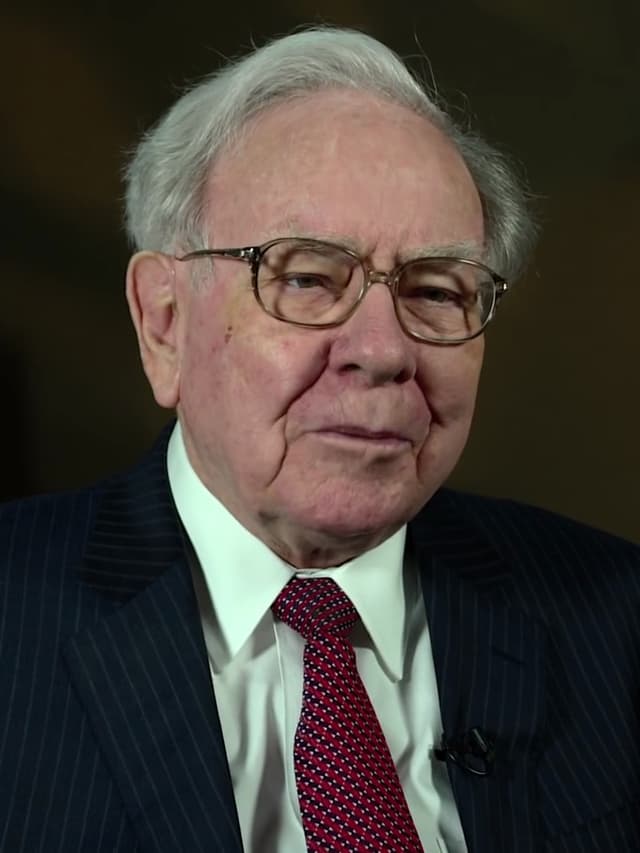
Warren Buffett
Berkshire Hathaway
A leading figure in the finance and investing industry, Warren Buffett founded and has long managed Berkshire Hathaway, amassing a net worth of over $100 billion, making him one of the wealthiest individuals globally. Known for his principles that prioritize rational decision-making and financial prudence, Buffett famously cautioned against the "institutional imperative," which leads companies to resist necessary change. His investment philosophy emphasizes the importance of a brand's defensibility, illustrated by his confident backing of Coca-Cola, a company he believes is virtually untouchable by competitors. Buffett's approach not only advocates for building a financial fortress through strong liquid assets and conservative debt but also inspires entrepreneurs today to maintain a position of strength in their ventures.
Core Principles
career
Do something you enjoy and can be enthusiastic about. Life is too short to spend it on work that does not excite you.
Buffett deliberately designed his life and business to be enjoyable. He refuses commitments that do not align with his interests, prioritizing enthusiasm over profit maximization.
“We're here on the earth only one time. So you ought to be doing something that you enjoy as you go along and you can be enthusiastic about.”
competitive advantage
Test brand strength by asking if a competitor with a massive checkbook could replicate the moat. If not, it is truly defensible. Coca-Cola is so entrenched that even a company with tens of billions could not knock it off.
Buffett uses this test for Coca-Cola and other brands. If you gave him 10, 20, or 30 billion dollars, he could not create a competitor to Coke. This is the ultimate test of a strong moat. Most brands fail this test.
“If you gave me $10, $20, or $30 billion to knock off Coca-Cola, I couldn't do it.”
In undifferentiated commodity businesses, exceptional management becomes the primary competitive advantage. Cost structure and operational discipline determine survival.
Insurance is a commodity product, a standardized promise with no patents, trademarks, or location advantages. Buffett realized that in such businesses, managerial competence and cost discipline become the only real moats, which is why he obsessed over low-cost operators like GEICO.
“Insurance companies offer standardized policies which can be copied by anyone. There are no important advantages from trademarks, patents, location.”
The lowest possible costs are a powerful competitive advantage. Study competitors relentlessly to understand cost structures and identify where you can operate more efficiently.
Buffett recognized that Geico could only make money by having the lowest possible costs in the insurance industry, since it offered the cheapest prices. This insight about cost leadership became central to how he evaluated businesses and built Berkshire.
“Geico sold insurance at the cheapest price, the only way it could make money was to have the lowest possible costs.”
The best businesses have high returns on capital, require little incremental investment to grow, and possess sustainable competitive advantages that make it difficult for competitors to enter the market.
Warren defines truly great businesses through the metaphor of a moat, or durable competitive advantage that protects excellent returns on invested capital. He contrasts this with gruesome businesses like airlines that require massive capital investment but generate little profit.
“A truly great business must have an enduring moat that protects excellent returns on invested capital.”
In commodity-like businesses where meaningful differentiation cannot be made, being the low-cost producer is the only path to sustained profitability.
Warren contrasts See's Candy, where customers buy the brand, with sugar and similar commodities where customers care only about price. When forced to compete in commodities, you must achieve lowest-cost advantage or exit the market. John D. Rockefeller built an empire in oil by becoming the lowest-cost producer and showing competitors his books to demonstrate his cost superiority.
“When a company is selling a product with commodity-like economic characteristics, being the low cost producer is all important.”
culture
Avoid the institutional imperative. Companies resist change in direction, soak up available capital just to use it, copy peers mindlessly, and justify poor decisions with studies created by subordinates.
Buffett identified four elements of the institutional imperative: resistance to change, projects that materialize to use available cash, leadership whims supported by subordinate-prepared studies, and mindless peer imitation. Berkshire's culture explicitly rejects these tendencies. This is why capital allocation decisions are made by founders who own the company, not by managers optimizing for something other than shareholder value.
“Rationality frequently wilts when the institutional imperative comes into play.”
Reward long-term shareholders and discourage short-term traders by being transparent about philosophy and expectations. Build a shareholder base aligned with your strategy.
Buffett explicitly communicated that Berkshire was designed for long-term holders who understood and approved of the policy. He attracted a stable, knowledgeable shareholder base rather than speculators, which allowed for consistent long-term strategy execution.
“We prefer owners who like our service and menu and who return year after year.”
Protect the reputation and integrity of your organization fiercely. Your shareholders, employees, and the public must believe in your good faith.
While not explicitly detailed in these early letters, Buffett's treatment of managers and stakeholders emphasized keeping promises and building trust. This foundation allowed him to attract future deals and partnerships based on reputation alone.
Intensity and relentless focus are the price of excellence. Seek out partners and employees who share an obsessive passion for doing their work well.
Buffett was attracted to business owners like Ben Rosner, who would leave a black-tie event to investigate a supplier's toilet paper count when prices didn't add up. This intense attention to detail reflected Buffett's own philosophy that mediocrity comes from divided focus.
“Intensity is the price of excellence.”
Build your business as an extension of your personality and values. The most sustainable competitive advantage comes from authentic alignment between founder and company culture.
Berkshire Hathaway's structure reflects Buffett's personality: his obsession with compounding, his distrust of debt, his love of learning, his contrarian thinking, his focus on capital allocation. The company couldn't have been built by someone with different values.
“The organization of a founder's business really is tied into their personality.”
customer obsession
Customer loyalty is a powerful moat that cannot be easily overcome through price or operational improvements alone. Understanding why customers stick with competitors teaches you about competitive advantage.
Buffett owned a gas station in college and lost to an established competitor despite efforts to attract customers. He realized the competitor had built loyalty through years of relationships and service. This taught him the immense value of brand loyalty in business.
“That's when I learned the power of customer loyalty. The guy had been in business forever and he had clientele. Nothing we could do was going to change that.”
Obsess over customers and their satisfaction. Businesses with millions of happy customers can introduce new offerings and create extensive competitive advantages.
Buffett observed Amazon's customer satisfaction creating a moat that threatened numerous industries. The foundation of this competitive advantage was Bezos's relentless customer focus.
“In the end, nobody that's ever taken good care of the customer has ever lost.”
finance
Build a financial fortress before pursuing growth. Maintain strong liquid assets and conservative debt to operate from a position of strength, never weakness.
From Berkshire's earliest letters, Buffett established a principle of maintaining what he calls a 'Gibraltar of capital' with substantial buffers. This allowed Berkshire to secure advantageous deals and navigate cyclical downturns without panic selling or desperation moves.
“It has always been among the goals of Berkshire Hathaway to maintain a strong financial condition. Indeed, it has been this practice that has enabled the company to survive in light of the highly cyclical nature of the business.”
Use float from insurance premiums as interest-free capital to invest in other businesses. This compounds returns and reduces cost of capital.
By maintaining profitability discipline in underwriting, Buffett received premiums upfront that could be invested before claims were paid. Over decades, this created enormous pools of capital to deploy into acquisitions and securities, effectively getting paid to borrow.
“Float is money that they don't own, but they can invest because they're getting the money up front from their premiums.”
When stock market valuations become irrational, buyback your own shares at a discount to intrinsic value. This rewards remaining shareholders.
Buffett praised share repurchases as superior to high-premium acquisitions, since stock markets often allow finely run companies to buy their own shares at 50 percent or less of what an acquisition of similar earnings power would cost.
“The auction-like nature of security markets often allows finely run companies the opportunity to purchase portions of their own business at a price under 50% of that needed to acquire the same earnings power through negotiated acquisition.”
Avoid excessive debt and size-maximizing acquisitions. Optimize for sleep, not for maximum return on equity. Comfort with your financial structure matters.
Buffett explicitly stated that Berkshire's conservative approach to debt and leverage penalized short-term returns on equity, but this trade-off was worthwhile because he could sleep at night and maintain optionality during crises.
“Our return on equity is penalized somewhat by this conservative approach, but is the only one which we feel comfortable.”
Measure company performance by return on equity capital and total capitalization, not earnings per share or ranking by revenue size.
Buffett criticized the focus on EPS as misleading and noted that other companies optimized for size rather than profitability. Genuine economic performance requires measuring returns on the capital actually employed.
“The primary test of managerial economic performance is the achievement of high earnings rate on equity capital employed without undue leverage, accounting gimmickry.”
Frameworks
The Institutional Imperative Test
A framework to identify and avoid four destructive patterns in organizations: resistance to change, project bloat to absorb available capital, subordinate-created justifications for poor decisions, and mindless peer imitation. Use it to audit your culture and decision-making processes.
Use case: Organizational design, capital allocation decisions, cultural assessment, avoiding wasteful acquisitions and projects.
Four Investment Selection Criteria
When evaluating potential equity investments or acquisitions, apply these four tests: first, does the business have favorable long-term economic characteristics; second, is management competent and honest; third, is the purchase price attractive compared to intrinsic value to a private owner; fourth, does it operate in an industry you understand and can judge long-term. Only invest if all four conditions are met.
Use case: Capital allocation decisions, whether buying partial or full ownership stakes in businesses
Capital Allocation Hierarchy
Prioritize capital deployment in this order: first, fund organic growth in existing excellent businesses; second, acquire other excellent businesses at fair prices; third, if internal returns exceed cost of capital and no acquisition targets exist, return capital to shareholders via buybacks or dividends. Avoid acquisitions at premium prices and avoid deploying capital in businesses with poor economics.
Use case: Strategic decision-making when deploying cash reserves from profitable operations
Float Management
In insurance and similar businesses with upfront cash collection, measure the quality and permanence of float (customer deposits or prepayments). Superior float has lower cost of capital than debt. Deploy float conservatively in safe investments while excellent businesses with durable float can deploy it into equities and acquisitions. This creates compounding advantages unavailable to non-float businesses.
Use case: Valuing and managing insurance companies and similar cash-collecting businesses; understanding capital efficiency
Moat Identification in Commodity Businesses
In undifferentiated commodity industries (like insurance or textiles) where no brand, patent, or location advantage exists, search for these moats: durable cost advantage, which requires relentless cost discipline; brand loyalty and pricing power; regulatory or structural barriers. If no durable moat exists and the industry faces structural headwinds, exit.
Use case: Evaluating whether to enter, stay in, or exit commodity-like industries
Organization Design for Scale
Structure the organization with centralized capital allocation and corporate oversight paired with extreme decentralization of operating decisions. Keep corporate headquarters minimal (20 people, 1,500 square feet for hundreds of thousands of employees). Hire exceptional managers, give them near-complete autonomy, and resist bureaucratic control. This allows attraction of world-class talent while maintaining strategic alignment and cost discipline.
Use case: Structuring acquisitions and managing large conglomerates; avoiding bureaucratic bloat
Financial Fortress Defense
Always maintain what Buffett calls a 'Gibraltar of capital' by: holding substantial liquid reserves; keeping debt moderate and well-structured; ensuring the balance sheet can weather severe downturns without forced asset sales; never dealing from a position of weakness. This structural advantage allows opportunistic acquisitions and calm decision-making during crises.
Use case: Setting financial policy and balance sheet strategy; preparing for inevitable downturns
Market Behavior Exploitation
Recognize that stock markets price securities based on short-term sentiment and behavioral patterns ('manic depressive lemmings'). Value-oriented investors can exploit this irrational volatility by maintaining patience, a strong balance sheet, and conviction in intrinsic value. Buy when markets panic and prices fall far below business value. Sell when euphoria prices securities above intrinsic value.
Use case: Equity investing and portfolio management; understanding why patient capital has an edge
Inner Scorecard vs. Outer Scorecard
Inner scorecard people make decisions based on their own judgment and principles, regardless of others' opinions. Outer scorecard people are driven by others' perceptions and approval. Buffett argues that inner scorecard thinking is essential for both business success and happiness. This framework helps explain why contrarian investors can hold unpopular positions with conviction.
Use case: Decision-making during unpopular market conditions, evaluating business culture, understanding personal motivation, managing public criticism
Circle of Competence
Define the boundaries of what you truly understand and will invest time and capital in. Stay within this circle to limit mistakes and focus expertise. Expand the circle slowly by studying and learning, but respect its limits. Buffett refused to invest in Intel and other companies outside his circle despite their potential.
Use case: Investment decisions, hiring for new business areas, evaluating acquisitions, risk management, knowing when to say no
Stories
At age 7, while recovering from a mysterious illness in the hospital, Buffett filled a page with numbers representing his future capital. He told his nurse these numbers showed he would be rich someday and would have his picture in the newspaper. This conviction about his future wealth emerged from his father's bank failure during the Great Depression.
Lesson: Childhood trauma and scarcity can become the fuel for extraordinary drive. Buffett's loss became his motivator. But more importantly, he did not dwell on the loss. He converted it into a vision of abundance and a concrete plan.
At 11, Buffett bought three shares of Citi Services at $38 per share. The stock dropped to $27, and he sweated it out. When it recovered to $40, he sold for a $5 profit. Immediately after he sold, Citi Services climbed to $200. He called it his first lesson in patience.
Lesson: Early failures and missed opportunities are tuition in the market. Buffett learned that patience and discipline matter more than perfect timing. The lesson stuck with him for decades.
A classmate described Buffett in high school saying: Most of us are trying to be like everyone else. I think he liked being different. He was what he was and he never tried to be anything else. This was his strategy for standing out and avoiding the trap of conformity.
Lesson: Authenticity and refusal to fit in are competitive advantages. Buffett succeeded because he was unmoved by social pressure and comfortable being misunderstood by his peers.
After learning that his mother had spent two entire hours on the phone berating his son for not calling more often, and his son was reduced to tears, Buffett said softly: This is just a hell of a statement. Listen to this. Now, you know how I felt every day of my life. His son Peter later wondered if Buffett's obsession with becoming rich was driven partly by the urge to escape the emotional toxicity of his childhood home.
Lesson: Negative childhood environments can drive exceptional achievement, but at a cost. Buffett's single-minded focus on work was partly a fortress against emotional pain. Success alone does not heal trauma.
Buffett traveled to GEICO's headquarters on a Saturday morning, found a security guard, and asked if anyone was working. The guard took him to Lorimer Davidson on the sixth floor. The two talked for four hours. Davidson later said: After we talked for 15 minutes, I knew I was talking to an extraordinary man. He asked searching and highly intelligent questions.
Lesson: Initiative and intense curiosity can open doors that credentials cannot. Buffett showed up uninvited and demonstrated his intelligence through the quality of his questions. Davidson was so impressed he remembered the conversation decades later.
A New York investor named David Strassler met Buffett and felt confident about his Harvard and MIT credentials. Buffett started asking him about his family's business, which was mostly private. Strassler realized Buffett knew the balance sheet better than he did. Strassler was shocked and invested with Buffett on the spot.
Lesson: Deep knowledge of a business is more impressive than credentials from prestigious institutions. Buffett's preparation and research demonstrated competence that pedigree could not match.
Buffett realized American Express might fail based on a scandal involving a vegetable oil fraudster named DeAngelis. Instead of panicking with the crowd, he visited steakhouses, banks, and travel agencies to observe whether customers were still using AmEx products. He found normal business activity. He invested a quarter of his assets in AmEx stock when others were fleeing.
Lesson: Fieldwork and primary research reveal truths hidden from the crowd. Buffett's personal observations contradicted the consensus and proved profitable.
Buffett acquired Nebraska Furniture Mart from Rose Blumpkin for $60 million. She made a mark at the bottom of a one-page agreement since she could not write in English. Days later, she told Buffett: We're going to put our competitors through a meat grinder. She continued running the store for decades.
Lesson: Great businesses are often run by founders with owner-like care and determination. These people are rare, hard to find, and impossible to replace. Giving them autonomy after acquisition is more valuable than replacing them.
Buffett took a Dale Carnegie course to overcome his fear of public speaking, even though he was an introverted stock analyst. Why? Because he aspired to be a teacher. He went on to teach a night class on investment principles at the University of Omaha while working as a broker.
Lesson: Identify the skill gaps preventing you from your true mission and address them head-on. Buffett's communication skills ultimately became central to his success and influence.
When Buffett bought Ben Rosner's company, Rosner planned to retire. Buffett asked him to stay on for six months. Decades later, Rosner told Buffett: I'll tell you why it worked. You forgot you bought the business and I forgot I sold it. By neither party focusing on the transaction, they avoided the friction that typically accompanies acquisitions.
Lesson: After an acquisition, allow founders to maintain autonomy and pride in their creation. This alignment of incentives and preservation of culture creates stability and long-term performance.
Notable Quotes
“Rationality frequently wilts when the institutional imperative comes into play.”
On how organizational dynamics undermine rational decision-making.
“If you gave me $10, $20, or $30 billion to knock off Coca-Cola, I couldn't do it.”
On the ultimate test of whether a competitive moat is truly defensible.
“If a statue is ever erected to honor the person who has done the most for American investors, the hands-down choice should be Jack Bogle. In his crusade, Jack was frequently mocked by the investment management industry. Today, he has the satisfaction of knowing that he helped millions of investors realize far better returns.”
Buffett's endorsement of Bogle, which carries enormous weight given Buffett's own credibility and his consistent promotion of Vanguard index funds to retail investors.
“I'd be a bum in the street with a tin cup if the markets were efficient.”
On the efficient market hypothesis. Buffett dismisses the theory that markets cannot be beaten through skill.
“Rational people don't risk what they have and need for what they don't have and don't need.”
From Berkshire Hathaway annual letter on debt strategy. Relevant as warning about McLean's later strategy: highly leveraged companies vulnerable when credit vanishes.
“When stock market valuations become irrational, buyback your own shares at a discount to intrinsic value.”
Share repurchases are superior capital deployment compared to high-premium acquisitions because securities markets price irrationally
“It has always been among the goals of Berkshire Hathaway to maintain a strong financial condition. Indeed, it has been this practice that has enabled the company to survive in light of the highly cyclical nature of the business.”
From 1965 shareholder letter, establishing the principle that financial strength is the foundation for long-term survival and deal-making capability
“The emphasis continues to be on underwriting at a profit rather than volume simply for the sake of size.”
Insurance philosophy: prioritizing profitable deals over growing market share, a principle that guided Berkshire's insurance expansion throughout the 1970s
“One of the lessons your management has learned, and unfortunately sometimes relearned, is the importance of being in businesses where tailwinds prevail rather than headwinds.”
From shareholder letters: the critical insight that industry dynamics matter more than managerial skill. Textiles had structural headwinds; insurance had tailwinds.
“When a management with a reputation for brilliance tackles a business with a reputation for poor fundamental economics, it is the reputation of the business that remains intact.”
Core principle explaining why turnarounds rarely work. Even excellent managers cannot overcome broken business fundamentals. Better to buy quality at fair price.
Frequently Asked Questions
What are Warren Buffett's key business principles?▼
Warren Buffett's core principles include: Do something you enjoy and can be enthusiastic about. Life is too short to spend it on work that does not excite you.. Test brand strength by asking if a competitor with a massive checkbook could replicate the moat. If not, it is truly defensible. Coca-Cola is so entrenched that even a company with tens of billions could not knock it off.. In undifferentiated commodity businesses, exceptional management becomes the primary competitive advantage. Cost structure and operational discipline determine survival.. Founder Almanac has cataloged 30 total principles from Warren's career.
What can entrepreneurs learn from Warren Buffett?▼
Key lessons from Warren Buffett include: Childhood trauma and scarcity can become the fuel for extraordinary drive. Buffett's loss became his motivator. But more importantly, he did not dwell on the loss. He converted it into a vision of abundance and a concrete plan.. Explore 10 stories and 10 frameworks from Warren's experience.
What is Warren Buffett known for in business?▼
A leading figure in the finance and investing industry, Warren Buffett founded and has long managed Berkshire Hathaway, amassing a net worth of over $100 billion, making him one of the wealthiest individuals globally. Known for his principles that prioritize rational decision-making and financial prudence, Buffett famously cautioned against the "institutional imperative," which leads companies to resist necessary change. His investment philosophy emphasizes the importance of a brand's defensibility, illustrated by his confident backing of Coca-Cola, a company he believes is virtually untouchable by competitors. Buffett's approach not only advocates for building a financial fortress through strong liquid assets and conservative debt but also inspires entrepreneurs today to maintain a position of strength in their ventures.
More Finance & Investing Founders
Want Warren's advice on your business?
Our AI has studied Warren Buffett's biography, principles, and decision-making frameworks. Ask any business question.
Start a conversation