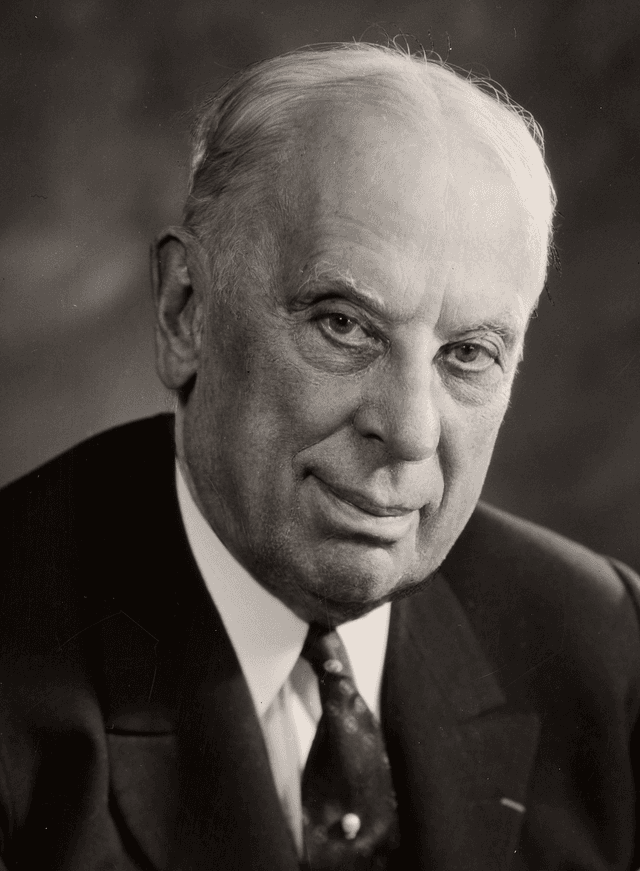
Alfred Sloan
General Motors
A pioneer in the automotive industry, Alfred Sloan transformed General Motors into the world's largest automaker by implementing innovative management practices and a focus on brand differentiation. Under his leadership from 1923 to 1946, GM's annual sales skyrocketed from $1.5 billion to $12 billion, reflecting his belief in growing businesses through retained earnings rather than external capital. Sloan championed the idea of concentrating on a few key business interests, which allowed GM to achieve superior results in a competitive market. His insights on ambition and financial discipline continue to resonate with entrepreneurs today, as he famously noted that maintaining a high standard of leadership is often more challenging than achieving it.
Core Principles
customer obsession
Consumer preference drives purchasing more than objective superiority: different customers value different things.
As the automobile market matured and competition intensified, consumers began purchasing based on personal taste and style rather than utility alone. Two products of equal engineering quality could perform differently based on design aesthetics that appealed to different customer preferences.
“Selling had begun to focus on personal preferences of the consumer, especially in matters of style.”
finance
Debt increases returns in good times but fragilizes the business in downturns: maintain ability to survive without it.
Sloan observed that Durant's heavy use of debt during the 1918-1920 expansion created vulnerability. Sloan's philosophy was to remain debt-free when possible, relying on retained earnings. This allowed GM to survive the Great Depression (72 percent sales decline from 1929 to 1932) while staying profitable.
“Debt enhances the return on the stockholder investment while at the same time increasing the risk involved.”
Implement centralized cash management: pooled cash is corporate-level asset, not division-level asset.
When Sloan took over, each GM division maintained separate cash accounts and hid cash balances from headquarters, creating chaotic and inefficient capital allocation. Sloan centralized cash controls, allowing corporate to deploy funds where they were needed most, dramatically improving efficiency.
Build growth through reinvestment of company profits rather than through stock issuance and financial speculation. Profit-based growth is more stable and sustainable.
Hyatt Roller Bearing grew through reinvestment of profits. This contrasted sharply with Durant's approach of financing GM's growth through constant stock issuance and personal financial engineering. Sloan was convinced that too much of GM's growth under Durant had been financed through stock and Billy's personal charm rather than through cash and hard assets.
Profit is not greed, it is survival: without profit, your company becomes dependent on external funding sources and loses control of its destiny.
Sloan maintained relentless focus on profitability not for personal wealth, but because it allowed GM to be independent from banks and investors. During the 1920 crisis, unprofitable companies became hostages to lenders' whims, while GM's profitability gave it flexibility to survive.
Financial controls are crisis insurance: implement them before crisis hits, not after.
Sloan developed rigorous cash management and financial reporting systems during the relatively stable mid-1920s. When the Great Depression hit in 1932 with sales down 72 percent, these systems allowed GM to retreat in an orderly fashion and maintain profitability while competitors faced disaster.
“The need for financial controls grew out of crisis. Controls were brought in to ensure that the crisis did not recur.”
focus
Maintain high personal focus on your business: give your craft 95 plus percent of your attention, not 50 percent.
Sloan devoted his entire career to GM and one industry. This singular focus allowed him to understand nuances and develop deep expertise that someone splitting attention across multiple ventures could never achieve. This contrasted sharply with Durant's scattered focus.
“I resolved in my own mind that I would take any personal sacrifice for the cause and I'd pour forth all the energy, experience and knowledge I had.”
A CEO cannot run a large corporation part-time, especially when most of their day is consumed by personal financial speculation and stock trading.
Sloan observed that Durant kept 20 telephones in his office with private wires to brokers across the country, spending his days buying and selling stocks while GM faced organizational crisis. Sloan believed the operating head of a corporation had no right to devote themselves to the market, even if the corporation's stock was involved.
“It did not seem to me that the operating head of a corporation had any right to devote himself to the market, even if the stock of the corporation was involved.”
Singular focus on a few key business interests creates superior results compared to juggling many ventures simultaneously.
Unlike Billy Durant who invested in and ran numerous companies, Sloan maintained singular focus on General Motors and Hyatt Roller Bearing for his entire career. This allowed him to develop deep expertise and sustained excellence over decades.
“General Motors and the Hyatt Roller Bearing Company have been almost the sole interests of my business life.”
innovation
Value innovations are financed by customers eager for the benefits: understand what customers will pay for.
In early automobiles, customers were so eager for reliable transportation that they financed experimentation and failures. Few industries have enjoyed such customer investment. Identifying what customers value enough to finance is key to identifying transformative opportunities.
“American motorists cheerfully paid the bills for it. In their enthusiasm for individual transportation, they bought the cars, reliable or unreliable, and thus provided the source of a substantial portion of the risk capital for experimentation.”
leadership
Professional management focused on systems, data, and perpetuation of the enterprise is essential for scaling beyond the founder. Distinguish between creation and administration.
Sloan coined the term professional manager to describe his approach. He understood that once a company reaches a certain scale, it requires someone focused on systems, organizational structure, and stability rather than visionary deal-making. This is why he could succeed where Durant failed.
“Mr. Durant was a great man with a great weakness. He could create but not administer.”
Understand and respect the accomplishments of predecessors, even while correcting their mistakes in execution.
Sloan acknowledged Billy Durant's pioneering vision of integrated vertical manufacturing and multi-brand strategy, but recognized that Durant lacked the execution discipline and financial controls necessary to sustain the business through economic cycles. Sloan built on Durant's concepts with superior management.
“Durant's pioneer work has yet to receive the recognition it deserves. His philosophy was an emerging one in the Model T era and was afterward to be realized not by him, but by others, including myself.”
Sell ideas through persuasion and explanation, not through command authority, to achieve superior execution.
Despite holding centralized power at GM, Sloan rarely used direct commands. He invested time in explaining rationale and persuading leaders to align with strategy, which produced better implementation than dictatorial approaches could achieve.
“I got better results by selling my ideas than by telling people what to do.”
Committees should set policy, but individual accountability is essential for administration and execution.
Sloan used committees to gather expertise and debate strategy thoroughly, but he never delegated final accountability. He believed groups could make good policy decisions, but only individuals could bear responsibility for implementing them.
“A group can make policy, but only individuals can administer policy.”
Maintaining success over the long term is harder than achieving initial success. Sustaining an unusually high standard of leadership requires different skills than attaining it.
Sloan recognized that while many entrepreneurs can achieve temporary success, far fewer can maintain it. Billy Durant built multiple successful ventures but lost control of each. Sloan maintained GM's leadership position for three decades, demonstrating the difficulty of perpetuation versus creation.
“The perpetuation of an unusual success or the maintenance of an unusually high standard of leadership in any industry is more difficult than the attainment of that success or leadership in the first place.”
learning
Learn from domain experts with deep experience: apprentice yourself to masters in your field for foundational knowledge.
Sloan studied Henry Leland's precision manufacturing practices, which traced back through generations to Eli Whitney's interchangeable parts work. This intergenerational transfer of knowledge from Whitney to Leland to Sloan to later leaders created a lineage of excellence.
“A fact which suggests a line of descent from Whitney to Leland to the automobile industry.”
marketing
Focus marketing on value per dollar rather than absolute price when you cannot match competitor pricing.
Chevrolet could not undersell the Model T, so Sloan positioned Chevy as superior value per dollar spent. This shifted consumer decision criteria from pure price to features-per-dollar ratio, where GM could compete effectively.
“Chevrolet's internal statement of policy at the time was that it was our objective to get a public reputation for giving more for the dollar than Ford.”
Position products as positively good rather than superior to competitors when quality is comparable across the market.
Once all major automobile manufacturers achieved engineering excellence, competing on superiority claims became unconvincing. Better to convince customers that your product is positively good and create confidence in your brand rather than making comparative claims.
mindset
Dominant market position creates blindness to change: success with an old model makes leaders resistant to acknowledging new signals.
Ford's overwhelming dominance (54 percent market share) made it psychologically difficult to accept that his market position was eroding. With 2 million cars sold annually, it was easy to rationalize away the warning signs of changing consumer preferences.
Follow your natural drift: lean into the unique skills and personality traits that make you effective, rather than forcing yourself into misaligned roles.
Sloan was naturally suited to be a manufacturer, engineer, and manager rather than a supplier. Though he could have become an automobile manufacturer like the Dodge Brothers, his natural drift was toward systematic management and production excellence, which is where he created the most value.
Distinguish between factors within your control and those driven by external economic conditions.
GM's sales growth in the mid-1920s was attributed more to rising economy and industry demand than to internal execution improvements. Sloan recognized this distinction to avoid false confidence, understanding that much of their success was luck and timing rather than pure management excellence.
“Their volume of business had increased after the slump of 1921 could be attributed less to our own wits than to the improvement in the general economy.”
Confidence combined with caution is the winning temperament during economic downturns: remain optimistic about long-term recovery while being disciplined about cash and costs.
In 1920, while many leaders succumbed to pessimism, Sloan maintained confidence in the business cycle's eventual upturn while implementing strict financial controls. This balanced approach allowed GM to weather the crisis without panic decisions.
“Confidence and caution formed my attitude in 1920. I mentioned this because confidence is an important element in business. It may on occasion make the difference between one man's success and another's failure.”
Embrace criticism from people with higher standards and use it to elevate your own. Discomfort signals opportunity to improve.
When Henry Leland dressed down Sloan for imprecise bearing specifications, rather than taking it personally, Sloan recognized it as a lesson. He became determined to match Leland's fanatical standards for precision, fundamentally transforming Hyatt's quality approach.
“A genuine conception of what mass production should really mean grew in me with that conversation. I was determined to be as fanatical as he in obtaining precision in our work.”
operations
Implement decentralized operations with strong financial controls. Allow operating units independence while maintaining tight oversight of capital and reporting.
Sloan's reorganization of GM after taking over involved giving brands like Cadillac operational independence under the GM umbrella while implementing strict financial controls, production standards, and reporting requirements. This balanced Durant's promise of independence to acquired companies with Sloan's need for corporate discipline.
Decentralized operations with centralized financial controls balances autonomy with accountability.
Sloan organized GM's divisions as semi-autonomous operating units with local decision-making authority, but implemented tight corporate-level financial controls over cash, inventory, and profitability reporting. This prevented the chaos of completely decentralized operations while avoiding the inefficiency of complete centralization.
“I approached the matter of organization from the standpoint of a thorough belief in a decentralized organization.”
Frameworks
Product Pyramid Strategy
Organize multiple product lines hierarchically from mass market base to luxury apex. Cadillac at the top serves high-end customers, intermediate brands (Buick, Oldsmobile) serve middle market, Chevrolet at the base dominates volume sales. This structure ensures market coverage across price points while maintaining distinct brand positioning. During economic downturns, the broad base captures customers trading down.
Use case: Multi-brand portfolio strategy for companies serving segmented markets; portfolio rationalization when brand overlap exists
Niche Widening Strategy
Identify an emerging gap between existing market segments and build products to serve the growing preferences in that gap. Rather than attacking dominant competitors directly, expand into underserved adjacent segments where customers have begun shifting but competitors haven't responded. This creates defensible market position with less direct competition.
Use case: Finding competitive advantage in mature markets; product positioning against entrenched competitors; identifying emerging customer segments
Decentralized Operations, Centralized Controls
Give operating divisions autonomy over product development, manufacturing, and sales decisions while maintaining corporate-level controls over finance, cash management, and profitability metrics. This balances entrepreneurial initiative at the unit level with financial discipline and capital allocation efficiency at the corporate level.
Use case: Scaling multi-unit businesses; conglomerate management; balancing growth with financial stability; managing divisional autonomy
Cash Pool Management
Centralize all cash management at the corporate level rather than allowing divisions to maintain separate accounts. This enables efficient capital allocation to highest-return projects and prevents divisions from hoarding cash. Requires robust reporting systems and predictive cash forecasting.
Use case: Multi-division corporations; improving capital efficiency; strengthening financial resilience during downturns; centralizing liquidity management
Value-Per-Dollar Positioning
When you cannot match competitor pricing, shift marketing focus from absolute price to features or quality per dollar spent. This changes customer decision criteria from lowest price to best value, allowing a higher-priced product to win when the value proposition justifies the premium.
Use case: Competing against lower-cost competitors; premium positioning in price-sensitive markets; marketing strategy when cost leadership is impossible
Policy vs. Administration Framework
Use committees to set policy by gathering diverse expertise and perspective, but assign individual accountability for administering that policy. The group debate improves decision quality; individual accountability ensures execution focus and clear responsibility.
Use case: Organizational structure; governance and decision-making processes; balancing collaborative input with individual accountability
Decentralized Autonomy with Centralized Control
Grant operating units significant independence over their own operations, brand, and strategy while maintaining centralized control over finance, capital allocation, and strategic direction. Each business unit operates as if independent but reports through financial controls and organizational discipline. This preserves the talents of strong-willed founders while preventing chaos and indigestion.
Use case: When acquiring or integrating multiple strong-performing businesses into a larger conglomerate, or when scaling a company from single business to multi-brand portfolio. Works when you have capable operators who resist micromanagement.
The Supplier's Dilemma
Suppliers serving one or two major customers face acute risk if those customers backward integrate or switch suppliers. To avoid this trap, either diversify your customer base, develop proprietary products with switching costs, or prepare for acquisition. This framework explains why many suppliers eventually become manufacturers themselves.
Use case: For companies operating as suppliers or in heavily concentrated customer bases. Understanding this dynamic helps leaders decide whether to remain independent or sell to a larger player before their position weakens.
The Ideological Test: Profit-Based vs. Speculation-Based Growth
Two fundamentally different paths to growth exist. Profit-based growth reinvests earnings into the business and avoids external capital needs. Speculation-based growth uses stock issuance and financial leverage to acquire companies and assets. The first is slower but more resilient; the second is faster but requires continuous access to capital and growing valuations to avoid collapse.
Use case: When deciding capital structure and growth strategy. Profit-based growth favors stability and independence; speculation-based growth favors speed but creates vulnerability to capital markets and investor control.
Stories
In 1898, Hyatt Roller Bearing was facing liquidation. Sloan's father and an associate invested $5,000 with the understanding that Sloan would turn it around in six months. Within six months, Sloan generated $12,000 profit through efficiency improvements and volume growth, proving the business could be viable.
Lesson: Turnarounds are possible with focused effort and operational discipline. A small infusion of capital plus focused management can transform a failing business into a successful one.
GM's divisions each maintained separate cash accounts in the early 1920s. Buick, the cash cow, actively hid its cash balances and resisted corporate requests for funds. When headquarters needed cash for dividends or expansion, the treasurer had to guess Buick's available cash and negotiate like a supplier rather than a parent company.
Lesson: Without centralized systems, operating divisions will act as independent fiefdoms protecting their own interests. Financial transparency and centralized controls are necessary for coherent corporate strategy.
From 1929 to 1932, during the Great Depression, GM's unit sales fell 72 percent from 2 million to 526,000 cars. Yet thanks to financial controls and fixed-cost management, GM remained profitable with $165,000 profit, while many competitors faced bankruptcy. Ford, despite being larger, struggled due to operating inflexibility.
Lesson: Financial discipline and operational flexibility created during good times are the insurance that allows a company to survive extraordinary downturns. Crisis reveals the value of foundation building.
Chevrolet sales grew from 500,000 in 1925 to 700,000 in 1926 while Ford's sales dropped from 2 million to 1.5 million. Customers were gravitating toward Chevrolet's increased features and variety despite higher price. Ford's shutdown for retooling in 1927 gave Chevrolet an unopposed field to expand.
Lesson: Market segments can shift as customer tastes evolve. The company that understands and adapts to these shifts wins; the company that clings to an old formula gets displaced.
Billy Durant founded GM with a visionary strategy of vertical integration and product lines at every price point, from luxury (Cadillac) to mass market (Chevrolet). However, Durant's casual management style allowed spending to spiral out of control. When the 1920 recession hit, GM faced crisis. Sloan implemented Durant's vision with superior discipline and financial controls.
Lesson: Strategic vision without execution discipline creates fragility. The same idea succeeds when paired with rigorous operational management. Good ideas need good management to reach their potential.
Ford sold 2 million cars in 1925 with 54 percent market share but was losing market share to Chevy. Ford's dominant position made it psychologically difficult to believe his market was eroding. With so much absolute volume, the percentage decline felt insignificant. Ford continued with Model T strategy until sudden shutdown in 1927.
Lesson: Dominant market position creates psychological blindness to gradual shifts in consumer preference. Absolute growth can mask relative decline and delay necessary adaptation.
Henry Leland found fault with Sloan's Hyatt bearings and called him into his office. He showed Sloan defective bearings piled up in the factory yard and demanded precision to one-thousandth of an inch. Rather than resenting the criticism, Sloan recognized it as wisdom and elevated his standards to match Leland's fanaticism.
Lesson: Seek out criticism from people with higher standards. Discomfort and harsh feedback from mentors who are right should be received as gifts that force you to improve.
When automobiles were still widely seen as impractical toys around 1899, Sloan didn't take seriously the first inquiry from an automobile manufacturer. It wasn't until Elwood Haynes asked specifically if his bearings would improve automobile axles that Sloan's eyes opened to the opportunity in the emerging industry.
Lesson: Humans have no predictive ability about which innovations will matter. The most transformative industries often look like curiosities at first. Pay attention to specific customer needs rather than dismissing entire categories.
When offered early orders from automobile manufacturers, Sloan at first did not see the opportunity, thinking the automobile was merely a toy. Once he received a large order from Oldsmobile that required volume production, the light bulb clicked. He reoriented his entire company to serve automobile manufacturers, recognizing the trend before most understood it.
Lesson: Large customer orders can serve as a leading indicator of market shifts. When a major customer needs something different, pay attention. Market trends often announce themselves through customer requests.
Notable Quotes
“The perpetuation of an unusual success or the maintenance of an unusually high standard of leadership in any industry is more difficult than the attainment of that success or leadership in the first place.”
Explaining why maintaining success over decades is a different and harder skill than achieving initial success. This was Sloan's response to being told how easy it is to start companies.
“It did not seem to me that the operating head of a corporation had any right to devote himself to the market, even if the stock of the corporation was involved.”
Criticizing Durant's practice of spending most of his day buying and selling stocks while running GM. Sloan believed this was a fundamental violation of the CEO's responsibility.
“A genuine conception of what mass production should really mean grew in me with that conversation. I was determined to be as fanatical as he in obtaining precision in our work.”
After being dressed down by Henry Leland for imprecise bearings, Sloan reflecting on how the criticism elevated his own standards rather than defeating him.
“Mr. Durant was a great man with a great weakness. He could create but not administer.”
Sloan's assessment of Durant's fundamental limitation. Durant had genius for founding and visioning but lacked the discipline for long-term management and administration.
“I was a manufacturer and this could be the grandest manufacturing enterprise the world had ever seen. I did not want to leave.”
Explaining why he decided to stay at GM during the chaos under Durant. Sloan identified himself as a manufacturer first, and the opportunity was too great to abandon.
“Everything, if we kept on our course, added up to just one way, ruin.”
Sloan's assessment of the crisis at GM in 1920, explaining the urgency he felt to restructure the company before it collapsed.
“That first Haynes order woke us up. If one automobile manufacturer wanted something better than ordinary greased wagon axles, why not sell to all of them?”
Sloan reflecting on how a single customer inquiry made him recognize the huge opportunity in the emerging automobile industry.
“He suggested rather than directed.”
Characterizing Kettering's approach to guiding others through suggestion rather than command
Frequently Asked Questions
What are Alfred Sloan's key business principles?▼
Alfred Sloan's core principles include: Consumer preference drives purchasing more than objective superiority: different customers value different things.. Debt increases returns in good times but fragilizes the business in downturns: maintain ability to survive without it.. Implement centralized cash management: pooled cash is corporate-level asset, not division-level asset.. Founder Almanac has cataloged 30 total principles from Alfred's career.
What can entrepreneurs learn from Alfred Sloan?▼
Key lessons from Alfred Sloan include: Turnarounds are possible with focused effort and operational discipline. A small infusion of capital plus focused management can transform a failing business into a successful one.. Explore 9 stories and 9 frameworks from Alfred's experience.
What is Alfred Sloan known for in business?▼
A pioneer in the automotive industry, Alfred Sloan transformed General Motors into the world's largest automaker by implementing innovative management practices and a focus on brand differentiation. Under his leadership from 1923 to 1946, GM's annual sales skyrocketed from $1.5 billion to $12 billion, reflecting his belief in growing businesses through retained earnings rather than external capital. Sloan championed the idea of concentrating on a few key business interests, which allowed GM to achieve superior results in a competitive market. His insights on ambition and financial discipline continue to resonate with entrepreneurs today, as he famously noted that maintaining a high standard of leadership is often more challenging than achieving it.
More Automotive Founders
Want Alfred's advice on your business?
Our AI has studied Alfred Sloan's biography, principles, and decision-making frameworks. Ask any business question.
Start a conversation