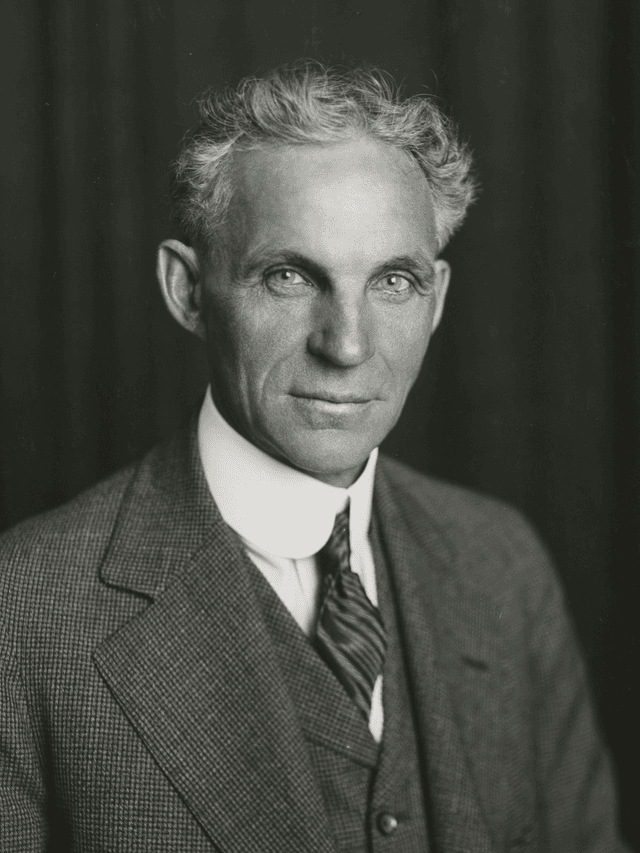
Henry Ford
Ford Motor Company
A visionary in the automotive industry, Henry Ford transformed manufacturing and personal transportation by introducing assembly line production techniques, which dramatically reduced the time to build a car from over 12 hours to just 90 minutes. Rejecting the constraints of his rural upbringing, Ford pursued his passion for engineering, ultimately founding the Ford Motor Company in 1903 and revolutionizing the market with the Model T in 1908, making automobiles accessible to the masses. His belief that control matters more than wealth guided his business decisions, prioritizing autonomy and innovation over financial gain. Ford understood the value of mentorship, famously seeking validation from industry giants like Thomas Edison, which fueled his confidence and ambition. Today, his principles of relentless pursuit of passion and the importance of expertise continue to inspire entrepreneurs around the world.
Core Principles
competitive advantage
Competition is irrelevant if you focus on serving your customers excellently. Focus on doing your work in the best way you know how.
Ford believed that if a company focused on faithful service to customers and did its work excellently, competition naturally took care of itself. The future had a way of taking care of itself when the focus was on serving rather than on beating competitors.
“If we faithfully try to serve, we do not have to worry much about anything else. The future has a way of taking care of itself.”
culture
A business is a collection of people brought together to do work, not a social organization. Departments do not need to know what other departments are doing. Excessive fellowship can harm performance.
Ford believed that when people are truly focused on work, they lack time for other activities. Formal relationships and clear accountability produce better results than artificial camaraderie or constant interdepartmental communication.
“A business in my way of thinking is not a machine. It is a collection of people who are brought together to do work and not to write letters to one another.”
Separate work and play completely. Do not blend them or attempt to create social bonds during work hours. When work is done, work is truly done.
Ford rejected the notion that employees should socialize or build relationships during work time. He believed this distracted from productive output and that creating artificial fellowship could cause people to cover for each other's faults.
“When we are at work, we ought to be at work. When we are at play, we ought to be at play. There is no use trying to mix the two.”
People must be taught to work intelligently. Intelligence applied to work is the escape from drudgery, not just harder physical effort.
Ford believed that workers naturally want to avoid drudgery and that intelligence applied to work was how this happened. His system of organizing work, machine placement, and process design was fundamentally about teaching people to work smarter rather than harder.
“All men do not see the high escape from drudgery and work by putting intelligence into work. They must be taught.”
Avoid letting your best people grow complacent or stale. Those who achieve something and rest on their accomplishments become obstacles to progress, not assets.
Ford observed that the incompetent never rise to positions where they can damage an organization. The real danger comes from successful people who stop striving. When C. Harold Wills became wealthy and successful, he began collecting yachts and jewels, stopped coming to work on time, and eventually drifted from Ford. This lack of continued effort led to his downfall.
“It isn't the incompetent who destroy an organization. The incompetent never get into a position to destroy it. It is those who have achieved something and want to rest upon their achievements who are forever clogging things up.”
Demand that your team maintain focus on work, not on corporate politics, office politics, or status symbols. These distract from the actual job that needs to be done.
As Ford Motor Company grew larger, internal politics and infighting increased. Ford was contemptuous of executives who worried more about title, office size, and office furnishings than about the work itself. In the early days, when these concerns were absent, the organization's energy remained focused on the objective.
“Too often the concern of corporation executives about their titles, even size and furnishings of their offices, deflect thought and energy from the jobs they're supposed to do.”
customer obsession
Business exists to serve humanity and improve lives, not simply to generate profit. Profit is a natural result of excellent service, not the primary objective.
Ford believed that machinery and money are only valuable when they set people free to live better. He deliberately kept prices low (600-750 dollars when competitors charged 2000) to make automobiles accessible to the masses, resulting in sales increasing five-fold.
“Power and machinery, money and goods, are useful only as they set us free to live. They are but a means to an end.”
Place service and work quality first. When service is prioritized, financial resources naturally grow faster than you can deploy them. Fear of failure comes from prioritizing money over work.
Ford's three core conclusions after his first year in business were that finance placed ahead of work kills the business, that thinking of money first creates paralyzing fear, and that service-first thinking opens the way for anyone.
“The way is clear for anyone who thinks first of service, of doing the work in the best possible way.”
The owner, employees, and buying public are the same entity. Cutting wages reduces your own customer base and destroys the business from within.
Ford structured his business around high wages and low prices because he understood that his employees were also his customers. By paying $6 per day minimum when competitors paid much less, he created a virtuous cycle where workers could afford his products, expanding his market.
“The plain fact is that the public which buys from you does not come from nowhere. The owner, the employees, and the buying public are all one and the same. Unless an industry can so manage itself as to keep wages high and prices low, it destroys itself.”
A business designed to serve customers creates sustainable profits and growth, while one designed to enrich owners is unstable and short-lived.
Ford believed the foundation of a business must be service to the customer first. Profits follow from good service and efficient operations, not from extracting value. A business whose only objective is making one person rich lacks the solid foundation needed for longevity.
“A business which exists to make one man or family rich and whose existence is of no moment when this is achieved is not solidly founded.”
A serving corporation's success is measured by how effectively it passes the benefits of its efficiency to consumers through lower prices.
Ford reduced the price of the Model T from $850 to $290 over many years by obsessively eliminating waste and improving processes. This wasn't charity, it was the central measure of whether his corporation was actually serving its purpose.
“The test of the service of a corporation is in how far its benefits are passed on to the consumer.”
finance
Start small and build the business through its own earnings. If a business cannot generate profits, that signals the owner does not belong in that business.
Ford began producing one automobile per day, then gradually increased production to three per day, then hundreds, then thousands. He financed growth through operational success rather than external capital, allowing the market to validate each expansion.
“A business ought to start small and build itself up and out of its earnings. If there are no earnings, then that is a signal to the owner that he is wasting his time and does not belong in that business.”
Money is a tool and part of the machinery of business, not a solution to operational problems. Borrowing money cannot fix mismanagement or waste. Only brains, thought, and discipline can cure these issues.
Ford faced a crisis where he owed 80 million dollars but had only 20 million in bank reserves. Rather than borrowing more, he restructured operations to eliminate waste and mismanagement, generating the required capital through operational efficiency.
“You do not want money for the latter, for the reason that money cannot do the job. Waste is corrected by economy. Mismanagement is corrected by brains.”
Debt creates divided allegiance and enslaves a business to financial scavengers who can extract value or destroy the company for their gain.
Ford warned against using debt to finance business operations because creditors become a second master competing with customers for the business's loyalty. Private equity and financial speculators use debt as a weapon to either control businesses or strip them for parts.
“The debt motive is basically a slave motive. When business goes into debt, it owes a divided allegiance. The scavengers of finance, when they wish to put a business out of the running or secure it for themselves always begin with the debt method.”
Control critical distribution and payment terms to ensure you do not become dependent on external parties for cash flow. Use contractual arrangements to shift financial risk to partners when you have superior bargaining power.
During the 1920 economic downturn, Ford forced dealers to pay for cars in advance even though they had not ordered them. Rather than borrow from banks himself, Ford shifted the financial burden to dealers, who had to secure loans to pay him. This preserved Ford's cash position during the crisis.
“Ford dealers had a strict financial arrangement with their parent company. When they ordered cars, they paid for them in advance rather than as they sold.”
Finance is not business. Many people confuse the two. A business that misuses what it has will continue to misuse what it gets. More money doesn't fix broken systems.
Ford argued that throwing money at a poorly run business doesn't improve it. When he bought the railroad, he found it was mismanaged and wasteful despite generating significant revenue. The solution was not more capital but fixing operations. He applied the same principles that made Ford Motor Company successful.
“Money is only a tool in business. It is just a part of the machinery. If there's trouble inside your business, neither money nor machines can cure it. Only heavier doses of brains and thought and wise courage can cure.”
focus
Narrow your focus to a single core objective and eliminate all activities that don't directly serve that objective.
Ford's company focused exclusively on manufacturing motors and putting them on wheels. Every decision, every input, every process was evaluated against this single goal. When contemplating a railroad acquisition, he didn't ask if railroads were profitable, but whether controlling that railroad would reduce costs for his motor business.
“We are in the motor business and in no other business. Everything that we do gets back to the motor.”
Build your life and company around a single, powerful idea and refuse to dilute it through diversification or competing priorities.
Henry Ford had one idea: a low-cost car for ordinary workers. He repeatedly rejected Charlie Sorensen's suggestions to diversify into other businesses or capture more market share. When Sorensen urged him to pursue 75 percent market share, Ford replied he wanted no more than 30 percent, and welcomed competition. This singular focus enabled him to perfect mass production methods that made his vision possible.
“I don't want any more business. I don't want any more than 30 percent of the market.”
Do not try to be informed about everything just for the sake of information. Information gathering without decision authority becomes a trap that prevents action and creates bottlenecks.
Ford was selective about what information he wanted and deliberately did not try to be informed about every detail. He decentralized information flow to capable people who needed it. If he had insisted on being informed about everything, he would have become a bottleneck and could do nothing but process information.
“He did not want to be informed just for the sake of being informed. For soon, he would be doing nothing but getting information.”
You only need one great idea to build a wildly successful life and business. Focus on developing that one idea deeply rather than pursuing multiple directions.
Henry Ford's single idea was to build an inexpensive car affordable to ordinary people. It took him nearly two decades and multiple failed companies to figure out how to execute it, but this one obsession became the foundation of one of history's most successful businesses.
“Henry Ford had no ideas on mass production. He wanted to build a lot of autos because that's the only way he could get to his one idea. He just grew into it like the rest of us.”
Have one big idea and pursue it relentlessly for decades. Scatter your energy among multiple ideas and you scatter your results.
Ford had one idea: make a high-quality automobile affordable to every person with a good salary. He spent 20 years perfecting this before the Model T. When partners wanted to build multiple models, he fought against it until he owned 51 percent of the company to maintain control of his vision.
“One idea at a time is about as much as anyone can handle.”
hiring
Never employ experts in their peak confidence. Established experts are trained to identify limitations and impossibilities rather than possibilities. They limit vision through accumulated records of failure.
Ford built his company by hiring people willing to try unconventional approaches rather than industry veterans who knew why things could not work. This allowed breakthroughs like the internal combustion engine that experts dismissed as impossible.
“That is why I never employ an expert in full bloom. If ever I wanted to kill opposition by unfair means, I would endow the opposition with experts.”
Hire people new to the industry for innovation roles because they haven't learned what is supposedly impossible within conventional wisdom.
Ford hired people with no previous knowledge of their assigned subject specifically so they wouldn't carry the baggage of industry limitations and assumptions. Experts in a field often know all the reasons something cannot be done, while newcomers find solutions.
“All our new operations are always directed by men who have had no previous knowledge of the subject and therefore have not had a chance to get on really familiar terms with the impossible.”
Only hire people for their capacity to learn, not for what they already know. Seek intellectual curiosity and audacity alongside proven competence.
Ford's hiring philosophy was deliberately contrary to conventional wisdom. Rather than seeking experienced experts in their fields, Ford wanted people who could learn, adapt, and think from first principles. He believed that people who thought they knew everything would resist innovation and become obstacles to progress.
“We at Ford Motor Company rarely selected a man entirely for what he knew. It was for his capacity to learn, particularly the capacity to learn that about which he knew nothing.”
Frameworks
The Outsourced Assembly Model
Rather than building a vertically integrated factory from day one, source component manufacturing from specialized suppliers and focus internal operations on assembly and integration. This minimizes upfront capital, reduces dilution of founder ownership, and allows the company to scale quickly by leveraging others' production capacity. The model works best when the founder has clear specifications for parts and can enforce quality standards.
Use case: When starting a hardware or manufacturing company with limited capital but clear vision for the final product. Also useful when you want to maintain high ownership stakes without raising massive sums for factory infrastructure.
The Founder Buyout Strategy
When hostile shareholders block your vision, announce your departure from the company you founded. Allow share price to fall as confidence erodes. Then quietly have agents approach shareholders to buy their stakes at gradually rising prices. Once you have accumulated sufficient stakes and resolved key holdouts, execute a full buyout of remaining shareholders. The founder's proven ability to create value makes the company worth more than the initial distressed price.
Use case: When a founder owns significant equity but minority control, and other shareholders block critical strategic decisions. Requires the founder to have demonstrated that the company's value depends on their presence and judgment.
Four Principles of Business
Ford's foundational operating philosophy: Absence of fear regarding the future or veneration of the past, disregard of competition in favor of doing things best, putting service before profit, and understanding manufacturing as material transformation rather than speculation. These four principles governed all decisions at Ford Motor Company.
Use case: Foundation for building any business that intends to create real value rather than extract short-term profit
Three Core Conclusions on Business
After his first year running Ford Motor Company, Ford identified three critical insights: Finance placed ahead of work kills the business and destroys service, thinking first of money creates paralyzing fear of failure and competition, and service-first thinking opens the way for success. These insights shaped all subsequent strategy.
Use case: Decision-making framework for evaluating whether business strategy is correctly prioritized
Elimination of Waste as Cost Reduction
A systematic approach to discovering and eliminating every inefficiency, duplicate motion, and unnecessary step in production. Even 10% time savings multiplied across thousands of workers yields massive compounding benefits. This is not about working faster but removing everything that does not add value.
Use case: Scaling production while reducing cost per unit, allowing price reductions that expand market reach
Build Through Earnings Not Capital Raising
Start a business with minimal capital and organic capital through operational profits rather than external funding. If a business cannot generate earnings at its current scale, that signals unfitness for the business. Only borrow for genuine expansion, never to cover mismanagement.
Use case: Startup and growth stage: maintains founder control and ensures capital is deployed only toward profitable growth
The Wage Motive
A comprehensive business strategy that links employee compensation directly to customer purchasing power and market expansion. The framework states that wages must be high enough to enable workers to purchase products, prices must be low enough to be affordable, and this combination expands the market. It requires efficient operations to achieve both simultaneously, creating a virtuous cycle of growth driven by serving both workers and customers.
Use case: Designing compensation and pricing strategy for a manufacturing or product company. Particularly relevant for founders deciding whether to view wages as a cost to minimize or as an investment in customer creation.
The Serving Corporation vs. Profit-First Corporation
A framework for distinguishing business models based on primary objective. A serving corporation starts with a commitment to serve customers, builds efficient operations around that service, and takes profits as a result. A profit-first corporation starts by maximizing short-term returns, which leads to raised prices and cut wages, narrowing the market until collapse. The framework emphasizes that sustainable profitability is a consequence of excellent service, not a primary objective.
Use case: Evaluating business models and company values. Helpful when a founder is torn between maximizing short-term profits and building a sustainable business, or when evaluating whether to sell to a buyer that will strip the company for short-term gains.
Objective-First Design
Start by clearly defining the business objective, then design all systems, methods, and processes to serve that objective. The framework requires working backwards from the end goal, with methods and structures subordinate to purpose. It involves regularly asking why each activity, department, or process exists and how it serves the core objective.
Use case: Establishing company strategy and organizational design. Useful for eliminating activities that consume resources without serving the core mission, and for making decisions about integration, outsourcing, and organizational structure.
The Continuous Improvement Discipline
Treat every process as experimental, not sacred. Establish a relentless focus on one or two key metrics (like production cost and quality), then systematically test improvements. Never change for the sake of change, but adopt every improvement once it is demonstrated to be better. View past achievements not as final states but as starting points for further improvement.
Use case: Managing operations in manufacturing or any business with repeatable processes. Particularly effective in scaling when the volume of operations makes small percentage improvements have large absolute impact.
Stories
Ford arrived at the Edison Illuminating office as an unknown engineer, walked up to Charles Phelps Gilbert, and boldly claimed to know as much about the work as anyone his age. Gilbert, needing someone immediately to replace a man who had died the week before, hired him on the spot for $40 a month. This single chance encounter in a hallway led Ford to learn electricity and eventually meet Thomas Edison himself.
Lesson: Boldness and readiness matter as much as credentials. Ford had no electricity experience and was hired to fill a tragic vacancy. His willingness to step into uncomfortable territory and learn quickly created the conditions for everything that followed.
Ford sat at Edison's table and sketched his spark plug design. Edison examined the drawings, asked detailed questions, and then banged his fist on the table so hard the dishes jumped. 'Young man, that's the thing,' Edison declared. 'You have it. Keep at it.' Ford later said this moment of validation 'meant the world to me' after months of doubt.
Lesson: Validation from the right person at the right moment can crystallize conviction and eliminate self-doubt. Edison was the leading inventor of his era, and his endorsement of gasoline over electric power gave Ford certainty he could not generate alone.
John Anderson's father visited Detroit skeptical and saw only a small warehouse on Mack Avenue with 12 workers assembling parts. The first test drive stalled on a small hill. Despite this underwhelming visit, Dr. Anderson gave his son the $5,000 requested. That initial capital became the seed for a company that generated billions.
Lesson: Early-stage companies look unimpressive to the untrained eye. Belief in the founder and the vision sometimes matters more than the present appearance of the operation. A father's trust in his son's judgment proved more valuable than due diligence.
Alexander Malcolmson funded the Ford Motor Company and negotiated the Dodge Brothers partnership. Years later, as the Model T succeeded, Ford announced a bold plan to build the Rouge plant and cut the Model T price. Malcolmson protested that Ford was destroying profits. Ford, resentful of any investor authority, decided Malcolmson didn't 'contribute' because he didn't manufacture. Malcolmson started a competing car company, which backfired. He sold his stake for $175,000. Had he held it for another decade, it would have been worth $100 million.
Lesson: Success breeds ingratitude. The founder who needed you desperately at the start will discount your contribution once the company succeeds. Expect this. Protect yourself legally and operationally rather than banking on loyalty. Malcolmson's mistake was starting a competing venture instead of staying put.
Ford worked at an electricity plant during the day and spent every night and Saturday night building a gasoline-powered motor in his home workshop for five years. During this time, everyone from fellow workers to his employer at Edison dismissed the project as a waste of time. The Edison Company even offered him a promotion to general superintendent on the condition he abandon the motor work.
Lesson: Conviction about a vision must survive ridicule from conventional wisdom and even rejection from established authorities. The willingness to sacrifice immediate gains for long-term belief is required for breakthrough innovation.
When Ford initially offered automobiles in two models priced at 1,000 and 2,000 dollars, sales were only 1,599 cars in 1905-1906. Ford concluded the problem was not product but price, so he took stock control and changed policy. The next year, he offered three models priced from 600 to 750 dollars. Sales increased to 8,423 cars, nearly five times the previous high.
Lesson: Market signals about what products people actually need often conflict with expert opinion. Dramatically lowering prices reveals demand that conventional pricing psychology masks. The supposed appeal to luxury or exclusivity can be wrong, and mass accessibility can multiply revenue.
Ford faced a crisis where Ford Motor Company owed 80 million dollars but had only 20 million in the bank. Rather than borrow the additional 60 million, he analyzed the business, identified waste and mismanagement, restructured operations, and generated the required capital through operational efficiency improvements.
Lesson: Money cannot fix fundamental problems with a business. Only disciplined thinking about operations, elimination of waste, and management excellence can solve deep challenges. Borrowing delays the reckoning without solving the underlying issue.
Ford deployed tens of thousands of workers in factories. When he offered the vast majority higher pay in exchange for taking on more responsibility and the expanded decision-making that came with it, they declined. Only a small percentage accepted the additional burden, leading Ford to conclude that not all men have equal capacity or ambition.
Lesson: Observed human behavior reveals that ability, ambition, and willingness to take responsibility are genuinely unequal across populations. This is not about moral worth but about capacity and choice.
Ford discovered that his central tool room was costing 25 cents of labor time to distribute 30-cent tools. Rather than just accepting this as overhead, he redesigned the entire system so that tools came to workers instead of workers retrieving them. This eliminated the waste hidden in the overhead allocation.
Lesson: Always calculate the true cost of any process including labor and overhead, not just material costs. Waste hides in unexpected places and requires systematic analysis to find.
Ford reduced his production cycle from 14 days to 3 days and 9 hours through relentless focus on optimization. However, he didn't start with this optimization. He first got the basic process working, then gradually improved it as the volume grew and the return on optimization investments became worth it.
Lesson: Don't over-optimize prematurely. Build the basic system first, then apply relentless optimization once scale justifies the effort.
Notable Quotes
“I think Mr. Edison is the greatest man in the world, and I guess everyone does.”
Ford's public statement in 1914 when announcing plans to manufacture electric cars using Edison's battery technology, reflecting the height of Edison's public reputation even as Ford's own fame and wealth had surpassed his.
“My dear Edison, I'm fitting up a den for my own private use at the factory and I thought I would like to have a photograph of about three of the greatest inventors of this age to feast my eyes on in idle moments. Needless to say, Mr. Edison is the first of the three.”
Ford's 1907 letter to Edison requesting a signed photograph, showing his deep admiration and respect for Edison years before their business partnership began.
“I think Mr. Edison is the greatest man in the world, and I guess everyone does.”
Ford's public statement in 1914 when announcing plans to manufacture electric cars using Edison's battery technology, reflecting the height of Edison's public reputation even as Ford's own fame and wealth had surpassed his.
“My dear Edison, I'm fitting up a den for my own private use at the factory and I thought I would like to have a photograph of about three of the greatest inventors of this age to feast my eyes on in idle moments. Needless to say, Mr. Edison is the first of the three.”
Ford's 1907 letter to Edison requesting a signed photograph, showing his deep admiration and respect for Edison years before their business partnership began.
“All our new operations are always directed by men who have had no previous knowledge of the subject and therefore have not had a chance to get on really familiar terms with the impossible.”
Explaining why he hired industry outsiders for innovation roles.
“The test of the service of a corporation is in how far its benefits are passed on to the consumer.”
Defining how to measure whether a serving corporation is actually serving.
“An unemployed man is an out of work customer. He cannot buy. An underpaid man is a customer reduced in purchasing power.”
Explaining the economic logic of the wage motive and high wages.
“We have no patience with the kind of management that shouts orders and interferes with instead of directing the men at their work. Real leadership is unobtrusive.”
Describing his philosophy of management through systems and design rather than command and control.
“It is not the method, but the objective that controls. The question to ask oneself is not what are the best methods but what am I in business for?”
Emphasizing that business strategy must start with objective, then methods.
“If we faithfully try to serve, we do not have to worry much about anything else. The future has a way of taking care of itself.”
On competition and focus.
Frequently Asked Questions
What are Henry Ford's key business principles?▼
Henry Ford's core principles include: Competition is irrelevant if you focus on serving your customers excellently. Focus on doing your work in the best way you know how.. A business is a collection of people brought together to do work, not a social organization. Departments do not need to know what other departments are doing. Excessive fellowship can harm performance.. Separate work and play completely. Do not blend them or attempt to create social bonds during work hours. When work is done, work is truly done.. Founder Almanac has cataloged 30 total principles from Henry's career.
What can entrepreneurs learn from Henry Ford?▼
Key lessons from Henry Ford include: Boldness and readiness matter as much as credentials. Ford had no electricity experience and was hired to fill a tragic vacancy. His willingness to step into uncomfortable territory and learn quickly created the conditions for everything that followed.. Explore 10 stories and 10 frameworks from Henry's experience.
What is Henry Ford known for in business?▼
A visionary in the automotive industry, Henry Ford transformed manufacturing and personal transportation by introducing assembly line production techniques, which dramatically reduced the time to build a car from over 12 hours to just 90 minutes. Rejecting the constraints of his rural upbringing, Ford pursued his passion for engineering, ultimately founding the Ford Motor Company in 1903 and revolutionizing the market with the Model T in 1908, making automobiles accessible to the masses. His belief that control matters more than wealth guided his business decisions, prioritizing autonomy and innovation over financial gain. Ford understood the value of mentorship, famously seeking validation from industry giants like Thomas Edison, which fueled his confidence and ambition. Today, his principles of relentless pursuit of passion and the importance of expertise continue to inspire entrepreneurs around the world.
More Automotive Founders
Want Henry's advice on your business?
Our AI has studied Henry Ford's biography, principles, and decision-making frameworks. Ask any business question.
Start a conversation