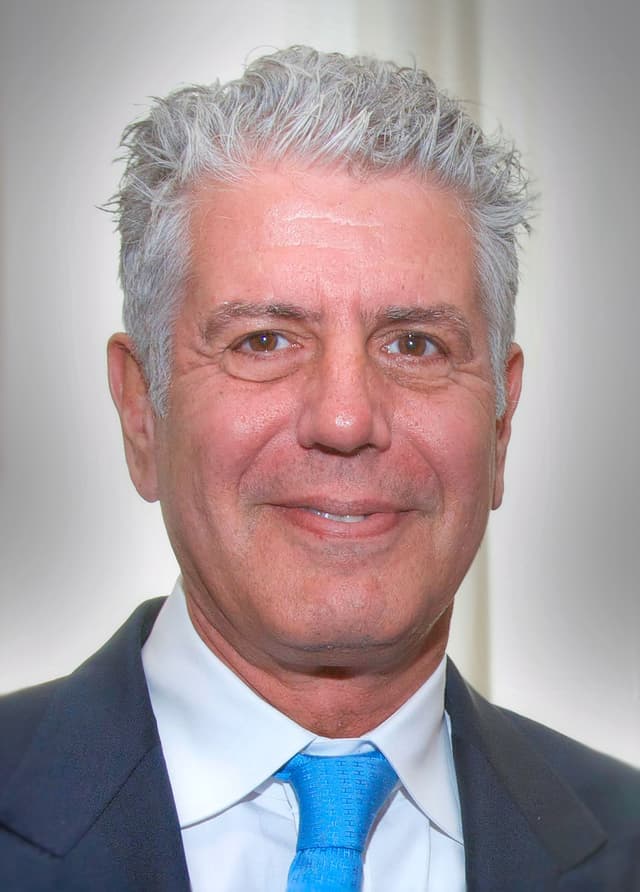
Anthony Bourdain
Bourdain Productions / Travel Channel / CNN
A renowned chef, author, and television personality, Anthony Bourdain transformed the landscape of culinary media through his work at Bourdain Productions and networks like CNN and the Travel Channel. He gained international acclaim with his bestselling book, "Kitchen Confidential: Adventures in the Culinary Underbelly," which sold over a million copies and opened the door to a successful television career focused on global cuisine and culture. Bourdain's commitment to mastering his craft was evident in his voracious reading and deep cultural literacy, which he leveraged to create compelling narratives that resonated with audiences. His philosophy of channeling personal struggles into creative output serves as a powerful reminder for entrepreneurs about the potential for transformation and innovation. Bourdain's famous quote, "Your body is not a temple. It's an amusement park. You should enjoy the ride," encapsulates his belief in embracing life's complexities while pursuing passion and excellence.
Core Principles
culture
Build relationships based on shared values and mutual respect, not just transaction. The people who made you must be acknowledged and appreciated, even after you've moved beyond them.
Bourdain maintained friendships with people from his kitchen days throughout his life. Even as he became famous and moved in celebrity circles, he valued the people who had helped him and understood him. When former friend Sam noted that they had made Tony, Tony disagreed but Sam's point remained valid: the connections forged in struggle are the ones that matter most.
hiring
Pedigree and credentials matter less than competence and work ethic. A dishwasher who cares deeply will eventually outpace a credentialed mediocrity.
Bourdain started as a dishwasher with no culinary credentials. His knowledge came from experience, reading, and obsessive attention to his craft. This is the same path that allowed him to eventually stand alongside Michelin-starred chefs as an equal because his commitment to excellence transcended formal training.
marketing
You must sell and promote relentlessly. Even exceptional work dies without active promotion and visibility. Stay public constantly or your achievement vanishes.
Early in his writing career, a fellow author advised Bourdain that he had to promote, promote, promote. Bourdain embraced this lesson. He did book tours, gave interviews, appeared publicly, and later used television and social media to maintain constant visibility. This differed from many artists who believe the work should speak for itself.
“Stay public. You've got to promote, promote, promote or all of this dies.”
mindset
You can only connect the dots looking backward. When making decisions, you must trust in your instincts, destiny, or fate because you cannot see the future. This trust enables you to take risks others won't.
When Bourdain quit his kitchen job at 40+ years old to pursue writing full-time, he had no idea it would lead to worldwide fame. He was stepping into the abyss. Like Steve Jobs' connecting the dots quote, Bourdain had to trust that one opportunity would lead to another. This willingness to step into the unknown with faith is what differentiates people who live ordinary lives from those who live multiple lifetimes of experience.
“I'm stepping into the abyss, I have no idea what's about to happen next.”
Commit fully to mastery of your craft, regardless of external conditions. Discipline and excellence must apply to both your primary work and your passion projects simultaneously.
While working full-time as a chef managing kitchens of 15-20 people, Bourdain wrote multiple fiction books and eventually Kitchen Confidential. He would wake up, smoke a cigarette without brushing his teeth, and immediately sit at the computer to write. This simultaneous mastery of two demanding crafts demonstrated extreme discipline and built the foundation for his later success.
“I'd wake up in the morning, smoke a cigarette. I wouldn't even brush my teeth. I'd immediately roll out of bed and sit in front of the computer and type.”
Live fully now, not for some imagined future. This life is not a rehearsal or waiting room for something else. Optimize for memorable experiences and meaningful relationships over abstract future goals.
Bourdain traveled 250 days per year for 20 years, ate with fascinating people, drank fine wine, had adventures most people never experience. He lived an extraordinarily full life in just 61 years. His approach was to have epiphanies, to seek extremes of emotion and experience, to risk everything for a life worth living rather than deferring experience to some retirement in the future.
“This life isn't a green room for something else. I'm looking for extremes of emotion and experience. I'll try anything, I'll risk everything.”
When you are consumed with ambition and hunger for success, it shows in everything you do. Desperation for your craft to be seen and recognized is a feature, not a bug.
Early in his writing career, Bourdain sent unsolicited samples to magazines and publishers. His letters were desperate, hungry, and transparent. He wanted to be a writer in the worst way. His mentor Joel Rose noted that his emails were needy and wanted affirmation, but that hunger was genuine and eventually paid off. The key was channeling that hunger into better work, not letting it become discouragement.
“My lust for print knows no bounds.”
product
Read voraciously and build an encyclopedic knowledge base. Your deep cultural literacy becomes a competitive advantage that helps you connect with others and creates richer work.
Bourdain was an early reader who became a writer. His deep knowledge of film, literature, cuisine, and history was evident in all his work. Other chefs at restaurants like Joe Beef clicked with him immediately because he shared obscure knowledge of French culinary history that few peers possessed. This knowledge allowed him to create content that resonated deeply with audiences.
“Tony knew who Auguste Escoffier was. Tony knew the same people we knew. He had this deep historical knowledge. None of our peers have that in-depth historical knowledge of French cooking. It was like, yay, we have another nerd to play with.”
Do not let gatekeepers and committees dilute your vision. Control all creative decisions yourself if possible. The producer, the network, the management all have different incentives than the customer.
When producing No Reservations, Bourdain insisted on controlling music, story, and shots himself. He told his editor to completely ignore the network's preferences. He told the Travel Channel president: if your opinion is based on group consensus, we should not work together. His insistence on controlling the product created something authentic that resonated far more than the network-approved compromises would have.
“If, however, your opinion is going to be based on the output of some clusterfuck group, then we should all bend over right now.”
The aspiration to mediocrity is the greatest sin. Every detail matters. You either operate at the highest level or you don't operate at all.
Bourdain took his television work with extreme seriousness. He approached it the same way he approached cooking in the kitchen, treating the job like his life depended on it. No detail was too small. This uncompromising approach to quality is what set his work apart from other travel shows and food programming.
“The greatest sin is aspiring to mediocrity.”
Master your craft through repetition and failure. Your first attempt will be awkward and uncomfortable, but if you keep at it for 15-20 years, you become exceptional.
The first episode of Cook's Tour shows Bourdain clearly uncomfortable, jittery, and not knowing what he was doing. Compare that to Parts Unknown from 20 years later, where he had refined every element of his craft. The progression from Cook's Tour to No Reservations to Parts Unknown shows a founder who improved continuously without giving up after initial mediocrity.
Authenticity creates unbreakable connections. Blur the line between yourself and your product. Viewers don't follow TV personalities, they follow real people they feel they know.
Bourdain fought the Travel Channel network to keep mature content and his authentic voice in No Reservations. He told editors to ignore the network's preferences about music, shots, and story. This decision to prioritize the viewer's connection to him as a person over network preferences created a devoted global audience. When he died, people mourned a friend they felt they knew, not a television host.
“I'm going to make the show I want to make and the viewer is the person I need to make happy. Everyone else is just trying to make the network happy.”
resilience
Transform addiction and destructive energy into productive obsession. The same intensity that drives self-destruction can fuel extraordinary achievement if redirected.
Bourdain had a heroin addiction for years. When he quit drugs, his addictive personality didn't disappear, it transferred to writing, then work, then jiu jitsu, then relationships. David Chang observed that he would never stop being addicted, he just changed what he was addicted to. This pattern of obsessive focus became the engine of his creative output and television success.
“All the energy I put into trying to destroy myself, I put that into building myself back up. All that negative energy became something else.”
strategy
Embrace flexibility and wing it rather than over-planning. React quickly to opportunities and let instinct guide decisions when rigid strategic plans would slow you down.
Bourdain didn't strategically build a platform or carefully plan the path from Kitchen Confidential to television. When producers asked if he wanted to make a TV show about his travels, he said yes. The show had no format, no game plan, no clarity on where it would go. They winged it based on his instincts. This flexibility led to Cook's Tour, which evolved into No Reservations and Parts Unknown.
“We just kind of... we'll just see what happens. We will wing it. We were following Tony's instincts.”
Small initial opportunities compound. Focus on doing the next thing well rather than having a master plan. Excellence in one opportunity creates credibility for the next.
Bourdain's path was one opportunity leading to another. Getting a dishwashing job led to cooking, which led to being a chef for 20 years, which led to writing fiction, which led to Kitchen Confidential, which led to television. He didn't see the destination at each step. He just did the next thing well.
“If I never got the job as a dishwasher, I would have never became a cook. And if I never became a cook, I would have never became a chef.”
Frameworks
Addiction Transfer Framework
When quitting destructive addictions, the addictive personality doesn't disappear but redirects toward new objects of obsession. The energy and intensity used for self-destruction can be rechanneled toward productive work, creative pursuits, relationships, or physical training. Success comes from recognizing this pattern and deliberately choosing what the addiction will attach to next.
Use case: For people with addictive tendencies who want to redirect their intensity toward productive outcomes. Also useful for understanding personality types that thrive through obsessive focus.
Authenticity Resonance Model
The closer the line between your authentic self and the product you create, the stronger the audience connection. When viewers perceive that a creator is hiding behind a persona rather than being genuinely themselves, they feel the inauthenticity. Maximum impact comes when the creator and creation are almost indistinguishable, making the audience feel they know you personally.
Use case: For content creators, performers, entrepreneurs, or any person whose work is intertwined with their personal brand. Use when deciding whether to compromise your authentic voice for wider appeal.
The Stepping Into the Abyss Framework
Major life transitions require taking action without being able to see the outcome. You connect the dots backward, not forward. The ability to take a risk when the path is unclear is what separates people who live extraordinary lives from those who live safe, ordinary ones. This requires faith in your instincts or destiny.
Use case: For founders considering major career pivots, career changes, or anyone facing a decision where the future is genuinely unknowable. Use to justify taking calculated risks based on instinct rather than perfect information.
The Bermuda Triangle of TV Success
Networks want one thing (ratings and ad revenue), executives want another (group consensus and risk reduction), and your audience wants something different (authenticity and quality). Success comes from identifying which constituency matters most and optimizing for them rather than trying to please all three. Choose the viewer over the network.
Use case: For creators or entrepreneurs navigating institutional pressure to compromise their vision. Helpful when deciding whether to accept network notes, investor feedback, or committee input.
The Winging It Framework
Replace rigid strategic planning with clear instincts and flexible execution. Rather than creating a detailed multi-year plan, establish what you want to accomplish, have solid instincts about how to get there, and allow the execution to be flexible and reactive. This enables faster pivots and better response to opportunities that emerge.
Use case: For founders in rapidly changing industries or those with unclear paths forward. Useful in creative industries where over-planning can limit innovation. Also applicable when building something entirely new with no precedent.
Stories
As a child, while other kids were learning to read, Bourdain was already in the corner reading books fluently. His teacher recommended his parents send him to private school. He read voraciously and his first heroes were writers, not athletes or celebrities. This early love of reading shaped everything that came later, giving him the knowledge base and communication skills that made his television work resonate.
Lesson: Foundational interests and skills developed in childhood often predict the trajectory of your entire life. Early passionate reading created the intellectual infrastructure that enabled Bourdain to succeed in his eventual careers as writer and communicator.
When Bourdain was 14 and learned to cook, he realized that a restaurant kitchen was a pirate ship, a place where misfits and rebels could create something together. The environment attracted people like him who didn't fit into normal society but could excel at intense, collaborative work. This realization locked him in: he would spend 20 years in kitchens before finding his true path.
Lesson: Finding an environment where you naturally belong and can contribute to something bigger is more powerful than finding a specific career. Sometimes you must spend years in an imperfect fit before you understand what you're really meant to do.
Bourdain and his brother visited him in St. Martin after his first marriage ended. Rather than spending family time together, Bourdain would disappear for entire nights, returning at dawn from encounters with prostitutes and wild behavior. He was suicidal at that time, telling his brother he sometimes drove dangerous mountain roads wishing he would die. His brother realized their mother had talked him out of his dream years earlier, which fueled deep resentment.
Lesson: When a person is separated from their dreams and their relationships crumble, the despair can be severe enough to lead to suicidal ideation. Family and relationships matter as much as professional success in determining psychological health.
After Kitchen Confidential became a bestseller, Bourdain expected brief fame and a return to kitchen work. Instead, he received constant offers from networks and producers. He said, 'The brass ring comes around only once. I'm going to grab it with both hands.' He became addicted to learning a new craft, seized every opportunity, and never looked back. His willingness to fully commit to the new opportunity created an entirely different trajectory.
Lesson: When a breakthrough opportunity arrives, fully commit to it rather than hedging bets or maintaining escape routes. Complete commitment signals to others that you're serious and allows you to learn faster than someone keeping one foot in their old world.
In the early days of Cook's Tour, Bourdain felt awkward and uncomfortable on camera. After the Tokyo episode, the producers thought the show was a disaster. But by Ho Chi Minh City, having read extensively about Vietnam's history and culture, Bourdain came alive in the field. He understood that he could have fun, that the show could have meaning. From that moment, he began to improve dramatically.
Lesson: Initial discomfort with a new skill is normal and temporary. The moment you understand the true potential of what you're creating, you gain the energy and insight needed to excel. The breakthrough comes from doing the work first, not from perfect preparation.
Bourdain had an idea in 1979 to do a TV show featuring chefs sitting around kitchens telling stories. He spent the next 20 years in restaurants while this idea germinated in his mind. When the opportunity finally came to make a television show, the seed was fully formed. He didn't wait for permission or ideal circumstances. He held the vision for two decades while doing other work.
Lesson: Great ideas often take years to mature before the timing and circumstances align for their execution. The seed of an idea can incubate for decades while you do the work that builds the credibility and knowledge needed to execute it well.
David Chang and Bourdain had a night at a culinary conference in Spain where they skipped the formal dinner junkets. Instead, they drank giant gin and tonics, ate amazing cheeses and lobsters with their hands, and experienced pure joy. Chang said he'd never met anyone more cynical than Tony, but in that moment, Tony experienced genuine happiness. The meal became one of the most meaningful of Chang's life, not for the food, but for the shared experience.
Lesson: The true value of a life is not measured in professional accomplishments but in the quality of moments shared with people you care about. These memories become immortal in the minds of the people who shared them.
When Bourdain started writing fiction in the 1980s, he sent unsolicited samples to magazines and publishers. His cover letter said he would write about hard drugs, hot cuisine, and occasional cathartic bloodletting. His mentor Joel Rose said his early letters were needy and desperate, wanting affirmation badly, but there was brilliance behind the hunger. Years of rejection preceded his eventual success.
Lesson: Hunger and desperation for your work to be recognized are not weaknesses. The key is channeling that raw need into better and better work rather than letting rejection destroy your resolve.
After the success of Kitchen Confidential, Bourdain was frequently offered opportunities that didn't align with his interests. Each time he thought about doing nothing and just living on a beach somewhere. He had always dreamed of moving to a foreign country with a beach, working in restaurants, and living simply. Yet each time, he chose to take the next opportunity. He later regretted not pursuing this dream while he still could.
Lesson: Success can become a trap if it prevents you from pursuing the life you actually want. The person who builds a successful career while denying their true dreams will eventually face the consequences of that denial. Regular reassessment of what you actually want is critical.
Notable Quotes
“Your body is not a temple. It's an amusement park. You should enjoy the ride.”
His philosophy on living fully and seeking experiences and pleasure rather than self-denial and restriction.
“I cruelly burned down my previous life in its entirety.”
Describing his transition from his first life as a struggling chef and addict to his second life as a famous writer and television personality after the success of Kitchen Confidential at age 42-43.
“You never know the consequences of getting what you want until you get what you want.”
Reflecting on the unexpected impact of success and fame, and how reality diverged from his expectations.
“I understand there's a guy inside of me who wants to lay in bed and smoke weed all day and watch cartoons and old movies. My whole life is a series of stratagems to avoid and outwit that guy.”
Describing his understanding of his default mode and his strategy to combat self-destructive tendencies through constant work and activity.
“The greatest sin is aspiring to mediocrity.”
Expressing his commitment to excellence and his refusal to accept anything less than his best work.
“I'm looking for extremes of emotion and experience. I'll try anything. I'll risk everything.”
From the intro to Cook's Tour, describing his approach to life and work. The phrase 'extremes of emotion' presaged the bipolar nature of his experience: euphoria and terror with little in between.
“This life isn't a green room for something else.”
Expressing his philosophy that life should be lived fully now, not deferred for some imagined future.
“At the age of 44, I was standing in kitchens, not knowing what it was like to go to sleep without being in mortal terror. I was in horrible endless irrevocable debt. I had no health insurance. I didn't pay my taxes. I couldn't pay my rent.”
Describing his circumstances just before Kitchen Confidential became a bestseller, showing the desperation that preceded his breakthrough.
“I feel like I've stolen a really nice car. I keep looking in the rear view mirror for flashing lights.”
His metaphor for the surreal experience of sudden success and fame after decades of struggling as an unknown writer and chef.
“My regrets will be more along the lines of a sad list of people hurt, people let down, assets wasted, and advantages squandered.”
Revealing that even with all his adventures and accomplishments, his deepest regrets were about the impact of his behavior on relationships and people close to him.
Frequently Asked Questions
What are Anthony Bourdain's key business principles?▼
Anthony Bourdain's core principles include: Build relationships based on shared values and mutual respect, not just transaction. The people who made you must be acknowledged and appreciated, even after you've moved beyond them.. Pedigree and credentials matter less than competence and work ethic. A dishwasher who cares deeply will eventually outpace a credentialed mediocrity.. You must sell and promote relentlessly. Even exceptional work dies without active promotion and visibility. Stay public constantly or your achievement vanishes.. Founder Almanac has cataloged 15 total principles from Anthony's career.
What can entrepreneurs learn from Anthony Bourdain?▼
Key lessons from Anthony Bourdain include: Foundational interests and skills developed in childhood often predict the trajectory of your entire life. Early passionate reading created the intellectual infrastructure that enabled Bourdain to succeed in his eventual careers as writer and communicator.. Explore 9 stories and 5 frameworks from Anthony's experience.
What is Anthony Bourdain known for in business?▼
A renowned chef, author, and television personality, Anthony Bourdain transformed the landscape of culinary media through his work at Bourdain Productions and networks like CNN and the Travel Channel. He gained international acclaim with his bestselling book, "Kitchen Confidential: Adventures in the Culinary Underbelly," which sold over a million copies and opened the door to a successful television career focused on global cuisine and culture. Bourdain's commitment to mastering his craft was evident in his voracious reading and deep cultural literacy, which he leveraged to create compelling narratives that resonated with audiences. His philosophy of channeling personal struggles into creative output serves as a powerful reminder for entrepreneurs about the potential for transformation and innovation. Bourdain's famous quote, "Your body is not a temple. It's an amusement park. You should enjoy the ride," encapsulates his belief in embracing life's complexities while pursuing passion and excellence.
More Media & Entertainment Founders

Want Anthony's advice on your business?
Our AI has studied Anthony Bourdain's biography, principles, and decision-making frameworks. Ask any business question.
Start a conversation