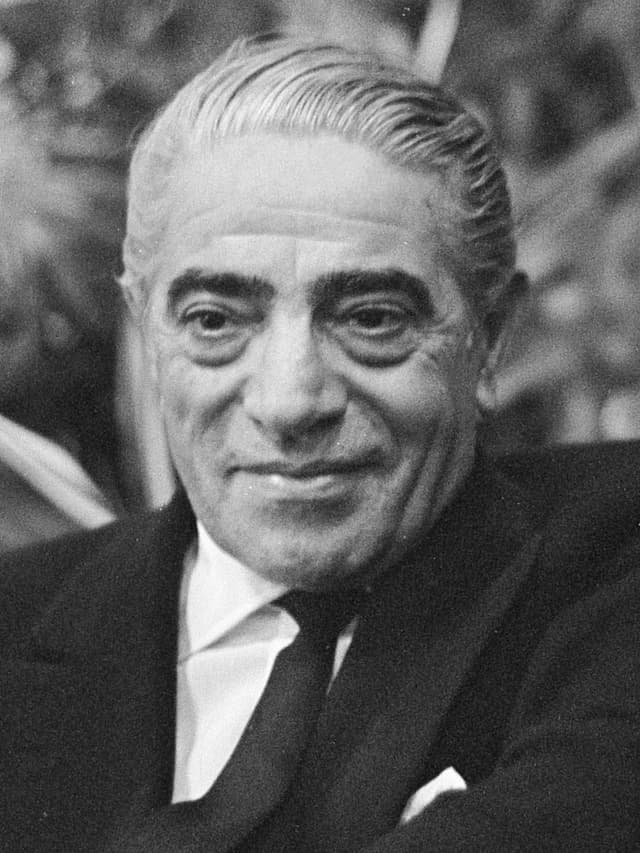
Aristotle Onassis
Onassis Shipping Empire
A visionary in the shipping industry, Aristotle Onassis founded the Onassis Shipping Empire, transforming global logistics from the 1900s until his death in 1975. His keen ability to identify and seize opportunities, even at a young age during the Turkish invasion of Smyrna, showcased his entrepreneurial spirit; he capitalized on the local soldiers' demand for alcohol by negotiating with family and friends to meet this need. Under his leadership, Onassis Shipping became a leader in maritime transport, boasting a fleet of over 100 vessels at its peak. Emphasizing a flexible approach to problem-solving, Onassis believed that constraints were malleable, a principle that resonates with today’s entrepreneurs who aim to innovate and adapt in rapidly changing markets. His famous quote, "Please do not pin me down," epitomizes his relentless quest for freedom and opportunity in business.
Core Principles
competitive advantage
Study the competitive landscape deeply to identify where incumbents are constrained by legacy systems and regulations. Create alternative structures that competitors cannot easily replicate due to historical baggage.
Greek shipping had accumulated centuries of union rules and government regulations. When a sick cook delayed his ship, Onassis registered it under the Panamanian flag, which had no such constraints. This single decision gave him massive operational and cost advantages that became foundational to his dominance.
culture
Design systems and business structures to minimize supervision and maximize individual initiative. People work harder and innovate more when they have autonomy and clear incentives.
Under the Panamanian flag, ship operators could size crews according to actual needs rather than union mandates. This allowed good workers to stay and poor performers to be removed. The freedom to optimize created efficiency that unions under Greek flags could never achieve.
finance
When capital is unavailable through traditional channels, restructure the deal so your customer becomes your collateral. Use contracts from creditworthy counterparties as proof of cash flow to convince lenders.
Banks refused to lend Onassis money for tankers. He reversed the sequence: he secured multi-year charters from oil companies at guaranteed monthly rates, then showed banks the contract. The oil company's payment guarantee became sufficient collateral, opening $2 billion in financing that banks had previously withheld.
Understand the psychological needs of your lenders and structure deals so they feel protected. Framing risk reduction in terms of what they understand makes capital available.
When pitching banks on ship financing, Onassis compared oil company contracts to a wealthy tenant paying rent on a house. Banks understood real estate and tenant creditworthiness. By reframing ships as real estate with a Rockefeller-equivalent tenant, he made the risk comprehensible and acceptable.
“The wealthy and powerful oil companies were in relation to his ships what a tenant was in respect of the house he occupied”
Keep your personal burn rate low in early success to maintain financial flexibility. Resist the urge to upgrade lifestyle immediately after making money. Accumulated capital provides optionality.
After making his first $500 commission (equivalent to a year's salary), Onassis continued working night shifts and renting out his bed. He kept expenses minimal despite having money, allowing him to accumulate capital and fund his tobacco import business without external capital.
Capitalize on market dislocations by acquiring undervalued assets with a long time horizon. Buy when assets trade at pennies on the dollar, hold until conditions improve, and benefit from the margin between acquisition price and normalized value.
During the Great Depression, Onassis recognized ships costing $1 million in 1920 were selling for $30,000 in 1930. He calculated that even scrap value was twice his purchase price, making downside impossible. He acquired ships cheaply and held them idle for years until economy recovery made them profitable.
“You can't go wrong”
focus
Prioritize the most valuable use of your time over maintaining a fixed schedule. Constantly scan for the highest-impact problem to solve rather than following predetermined plans.
Onassis famously avoided strict schedules, traveling unpredictably across continents. He would change plans based on where he could add the most value, managing 85+ companies across multiple countries by staying flexible and responsive to urgent needs.
“Please do not pin me down”
leadership
Make decisions quickly once analysis is complete, but invest heavily in the analysis phase. Separate the thinking phase from the action phase clearly, then execute with full commitment.
Onassis would spend months exploring deals, asking hundreds of questions, and mastering the complicated subjects before making decisions. Once ready, he moved with exceptional speed. This mirrors Charlie Munger's approach at Berkshire Hathaway: long contemplation followed by rapid execution.
“He masters the most complicated subject, then makes his decision quickly”
Reserve all strategic decisions for yourself while delegating routine operations. Avoid outsourcing core investment decisions, capital allocation, and compensation policy, even as the organization scales.
Onassis let attorneys handle paperwork and office staff handle routine matters. However, he personally retained all decisions about where to deploy capital, which ships to acquire, which routes to pursue, and how to structure deals. This mirrors Berkshire Hathaway's approach.
mindset
Recognize that your early trauma and constraints often become your greatest competitive advantages. The adversity that shaped you creates problem-solving skills and resilience that others lack.
Growing up in war, losing his mother and grandmother, being forced into adult responsibilities at 16, and experiencing humiliation when his family questioned his spending all drove Onassis forward. He explicitly stated that anger and frustration from these periods gave birth to the ambition that took him to the top.
“The anger and frustration of this period of his life gave birth to the ambition and drive, which later took him to the top”
Seek out stress and adversity intentionally rather than comfort. Growth occurs under pressure, and avoiding challenges leads to atrophy. Voluntary stress inoculation builds capability.
Onassis grew up in war, lost his mother young, lived in poverty, and voluntarily took on enormous responsibilities at age 16. He could have retired wealthy after his tobacco success but instead entered the capital-intensive shipping industry. He believed stress created strength.
Learn history and classical knowledge deeply. Understanding human behavior through historical patterns enables better relationship building and more effective negotiation across cultures and industries.
Onassis was obsessed with history and politics, reading extensively about Churchill and classical Greece. This knowledge made him interesting to influential people and gave him pattern recognition about how institutions and individuals behaved. He built a deep friendship with Churchill based partly on shared historical interests.
Everything in your environment is malleable and responsive to direct action. Most people accept constraints as fixed, but entrepreneurs recognize that systems are changeable through persuasion, negotiation, and creative pressure.
As a young man in steerage on a ship, Onassis realized he could negotiate with the purser instead of accepting the standard options. He sweettalked his way into better accommodations with a small bribe, demonstrating that social rules are negotiable rather than absolute.
operations
Move faster than competitors through frictionless decision-making. Accept discomfort and uncertainty to maintain velocity, and avoid strict schedules or organizational rigidity that slow down response to opportunities.
Onassis traveled constantly without luggage or advance notice of his location. He changed plans instantly based on emerging needs. This speed allowed him to seize opportunities that slower, more structured competitors missed. His unpredictability was partly a competitive advantage.
Adopt a decentralized organizational structure to avoid becoming so large that government intervention becomes inevitable. Stay deliberately smaller than industry leaders to maintain operational freedom.
When offered a chance to consolidate Argentina's shipping industry, Onassis declined despite the opportunity. He recognized that controlling such a large company would invite government control and political entanglement. He remained decentralized across multiple smaller entities instead, preserving independence.
resilience
Maintain relentless resourcefulness in the face of constraints. When standard paths are blocked, immediately identify adjacent opportunities and alternative approaches rather than accepting defeat.
During the Turkish occupation of his hometown at age 16, Onassis recognized that Turkish soldiers wanted alcohol and were in positions of authority. He sourced scarce supplies and cultivated relationships with military officers, securing protection passes that enabled his survival and his family's eventual escape.
When facing genuine setbacks outside your control, pivot resources to what you can control rather than trying to fight the constraint. Adaptability across multiple business lines creates resilience.
During World War II, German occupation immobilized his European tanker fleet. Rather than despair, Onassis refocused on his American-based ships and pivoted his tobacco business to import from Brazil and Cuba instead of Asia. He executed within his constraints.
sales
In negotiations, leave something on the table for the other party. Playing a long game with repeated interactions creates more value than extracting maximum value from each single transaction.
Despite being described as sometimes 'pugnacious and persistent,' Onassis was noted for acceding to reasonable requests and ensuring counterparties felt they had gained something. This approach to human relations compounded dramatically over decades of dealing with the same banks, oil companies, and partners.
strategy
Approach problems by working backwards from the desired outcome rather than pushing forward through conventional channels. Start with what you need, identify who controls it, and restructure the transaction to appeal to their interests.
When tobacco buyers ignored his samples, Onassis stopped cold-calling purchasing departments. Instead, he stalked the managing director until earning a personal meeting, then was able to say the director sent him. This single frame change resulted in a $10,000 order on his second attempt.
Believe that major industry transformations are inevitable based on economic fundamentals, and position ahead of that shift. Don't be swayed by current opinion about what is 'possible' if the math supports a different future.
While industry insisted ships could not exceed 9,000 tons, Onassis built 15,000-ton vessels, eventually creating 106,000-ton supertankers. He believed bigger ships were inevitable because the economics were superior. He waited for the market to catch up to his vision rather than accepting current limitations.
“For more than a decade, he had been obsessed with the idea that the future of transportation was in bigger and bigger ships”
Develop multiple revenue streams and business lines simultaneously. This provides both defensive protection against industry downturns and offensive options for deploying capital when one sector softens.
Onassis maintained tobacco importing, cigarette manufacturing, shipping, and aviation interests simultaneously. When shipping faced headwinds, he could redeploy capital. When one business failed, others sustained him. This portfolio approach provided optionality throughout his career.
Frameworks
Invert, Always Invert
Rather than attacking a problem head-on through conventional channels, start with the desired outcome and work backwards to identify who controls the solution and what they need. This often reveals simpler, more elegant solutions than the forward approach. When sales calls fail, go directly to decision makers. When banks won't lend, secure customer contracts first to use as collateral.
Use case: Solving sales problems, accessing capital, overcoming institutional barriers
The Charter-Backed Financing Model
Secure long-term contracts from creditworthy customers that guarantee cash flow, then use those contracts as collateral for debt financing. The customer's credit becomes your collateral, and the lender's risk is shifted from your capability to your customer's ability to pay. This unlocks leverage previously unavailable.
Use case: Capital-intensive businesses where traditional lenders are reluctant, asset-light expansion in capital-heavy industries
The Dislocated Asset Acquisition Strategy
Identify assets trading at severe discounts to replacement value due to external shocks (war, depression, industry disruption). Acquire at the bottom with downside protection (ensure scrap value exceeds purchase price), hold passively through recovery, then benefit from normalization. This requires patience and conviction about mean reversion.
Use case: Capital markets with cyclical downturns, industry consolidation, crisis-driven opportunities
Regulatory Arbitrage Through Jurisdiction Selection
When incumbent competitors are constrained by accumulated regulations in their home jurisdiction, structure operations under alternative regulatory regimes with lower friction. This eliminates competitive advantages they've built on legacy status and allows you to operate more efficiently.
Use case: Industries with heavy regulation, shipping, aviation, global businesses competing across jurisdictions
Decentralized Operations with Centralized Capital Allocation
Delegate all routine operations and management decisions to local operators with clear incentives. Reserve only two functions for central control: investment decisions (where capital goes) and compensation policy (what incentives drive behavior). This balances autonomy with strategic control.
Use case: Scaling operations across geographies or multiple business lines, delegation without loss of control
The Personal Stalking Sales Technique
When traditional sales channels fail, identify the decision maker and create persistent, non-threatening contact through visibility at their office and home. After sufficient contact, they will engage out of curiosity. Once engaged directly, reframe the pitch with the decision maker's tacit endorsement to overcome departmental resistance.
Use case: High-value sales with gatekeepers, breakthrough sales when standard channels are blocked
The Sleeping Asset Strategy
Acquire assets during downturns with no intention of operating them immediately. Hold them idle until market conditions improve, generating returns purely from appreciation. This requires differentiating between value creation (operations) and value capture (asset appreciation), and knowing when to hold vs. deploy.
Use case: Industries with significant idle capacity during downturns, asset-heavy businesses with long useful lives
Analyze Deep, Decide Fast
Invest heavily in understanding a problem through questioning, data gathering, and mastery of the subject matter. Once understanding is complete, make decisions quickly without extended deliberation. Separate the research phase from the execution phase temporally.
Use case: Complex investment decisions, strategic pivots, capital allocation
Stories
At age 16, during the Turkish invasion of Smyrna, Onassis recognized Turkish soldiers wanted alcohol and were in positions of authority. He convinced family friends and neighbors to provide hidden supplies, built relationships with military officers, and eventually secured protective passes that allowed him to move freely and ultimately escape alive. His quick thinking turned a life-threatening situation into a survival advantage.
Lesson: In crisis situations, recognize that constraints are often more malleable than they appear. Other people have needs and can be influenced through personality, persistence, and small incentives. What seems like a fixed barrier (military occupation) can be navigated through resourcefulness.
Onassis arrived in Argentina with almost no money and took a job at 25 cents per hour. When offered overtime pay at 1.5x rate, he volunteered to work all night continuously. He slept at the office during days and rented his bed to fellow Greeks during his night shifts. Within a year he was making orders worth ten times his annual salary. He never upgraded his lifestyle despite the earnings.
Lesson: Early success comes from working harder than others and finding ways to multiply your hourly output. More importantly, don't spend your initial gains immediately. Keep your burn rate low and accumulate capital, which gives you optionality to pursue bigger opportunities.
When tobacco buyers ignored Onassis' samples despite multiple sales calls, he stalked the managing director Juan for two weeks, standing silently at his office entrance and home. After ten days of this campaign, Juan's curiosity overwhelmed him and he confronted Onassis. Juan sent him back to the purchasing department with his personal blessing, and suddenly the buyers gave him serious attention, awarding him a $10,000 order.
Lesson: When conventional approaches fail, the problem may not be your product but your sales method. Working backwards by going directly to decision makers and building personal relationships often succeeds where departmental pitches fail. Persistence combined with vulnerability can be disarming.
During the Great Depression, Onassis studied ship economics and calculated that 10-year-old ships trading at $30,000 would fetch $60,000 in scrap value. He reasoned that even if his assumptions were wrong, his downside was capped. Over time, economic recovery made these ships worth 100x his purchase price. He built a massive fleet by acquiring undervalued assets.
Lesson: During market panics, identify assets where scrap value exceeds purchase price. If you can cap your downside while maintaining unlimited upside through mean reversion, the risk-reward becomes asymmetric. Patience is required while you wait for conditions to normalize.
When a single sick cook delayed Onassis' ship due to Greek union rules requiring replacement by a Greek worker, he registered the ship under the Panamanian flag instead of waiting. Panama had no such regulations, allowing him to operate with minimal crew, choose workers based on merit, and trade in any currency with minimal taxes. This single incident became the template for his global competitive advantage.
Lesson: When your home jurisdiction's regulations constrain you while competitors face the same constraints, relocation to a more permissive jurisdiction is viable. Regulatory arbitrage can be the largest source of competitive advantage. A broken system that everyone accepts as normal contains the seed of a breakthrough strategy.
Banks refused to lend Onassis money for tankers, saying shipping was too risky. He reversed the process: he negotiated long-term charters with oil companies like Socony guaranteeing monthly payments of $120,000 for five years, then showed banks the contract. The oil company's credit became his collateral. Banks that previously refused suddenly approved $2 billion in financing.
Lesson: When capital is unavailable through standard channels, restructure the transaction so the lender's risk is transferred to a creditworthy customer. Your customer's cash flow becomes the asset the bank is really financing. This converts a credit problem into a structuring problem.
Onassis was offered a position controlling Argentina's entire consolidated shipping industry, which would have made him vastly wealthier in the short term. He declined because he realized that controlling such a large entity would invite government intervention and political entanglement. He chose to remain deliberately smaller and decentralized across multiple entities instead.
Lesson: There is a maximum efficient size beyond which growth creates more problems than solutions. At some point, being the largest player in an industry attracts government attention and forces you to navigate political constraints. Remaining smaller than that threshold preserves operational freedom.
Onassis' first independent venture manufacturing cigarettes for women grew too quickly to profitability. Rather than continue running a money-losing operation while his attention was needed elsewhere in shipping, he swallowed his pride and closed the factory. He recognized that his time had become more valuable elsewhere.
Lesson: The ability to exit bad investments quickly is a competitive advantage. First-time entrepreneurs often continue losing ventures out of pride or sunk-cost fallacy. Onassis understood his time had become too valuable to waste on failing businesses, even ones he had started.
Onassis grew up losing his mother at age 6, his father imprisoned and nearly executed during war, his grandmother murdered during escape, and his family humiliated him for spending money to save his father's life. Rather than becoming paralyzed by trauma, he channeled the anger and frustration into relentless ambition. He explicitly stated that these painful experiences gave birth to the drive that took him to the top.
Lesson: Childhood adversity, if survived and processed, can become your greatest competitive advantage. The need to prove something to yourself or to overcome shame can drive achievement that comfort never could. Your trauma contains the seed of your greatness.
Notable Quotes
“Please do not pin me down”
In response to questioning about his exact whereabouts and schedule. Reflects his deliberate avoidance of rigid schedules in favor of focusing on the highest-value activities at any moment.
“You can't go wrong”
Referring to his strategy of buying 10-year-old ships for $30,000 when they fetched $60,000 in scrap value. Even if his arithmetic proved faulty, downside was protected by asset value.
“I shall keep no more than $250 of what's left, and I'll emigrate”
At age 16-17, after his family criticized his decision to spend $25,000 on bribes to save his father's life. Demonstrates his desire for independence and his willingness to start over rather than remain in a controlling family situation.
“At a very young age, I had the responsibilities of a chief of a tribe”
Reflecting on being forced to support his family and younger siblings while still a teenager. Describes how adversity and responsibility forced rapid maturation and skill development.
“The anger and frustration of this period of his life gave birth to the ambition and drive, which later took him to the top”
Looking back on the Greco-Turkish War period and his family's criticism of his spending. Shows how psychological pain was transformed into fuel for achievement.
“For more than a decade, he had been obsessed with the idea that the future of transportation was in bigger and bigger ships, and the opposition of the oil companies did nothing to undermine his faith in this new development, which he thought was inevitable”
Regarding his conviction that ships would grow to 28,000+ tons despite industry resistance. Demonstrates his ability to maintain conviction in the face of expert disagreement when the economics supported his thesis.
“He masters the most complicated subject, then makes his decision quickly”
Description from one of his business partners. Shows the separation between extensive analysis and rapid execution once understanding is achieved.
“If I'd known what was coming out of this Monte Carlo business, publicity-wise, I would not have gotten into it”
Regarding his marriage to Jacqueline Kennedy and subsequent notoriety. Shows that his preference was to operate quietly without public attention.
“In the cargo business, it only hurts. It's like having a wonderful laugh that gives you a sore throat”
Describing the negative effects of publicity on his shipping business. Publicity for cargo operations provides no sales benefit while damaging employee and partner relationships.
“If you knew how the food was made you wouldn't care to eat it”
Referring to the mechanics of how business and politics actually function behind the scenes, suggesting similarity between showbiz and political operations.
Frequently Asked Questions
What are Aristotle Onassis's key business principles?▼
Aristotle Onassis's core principles include: Study the competitive landscape deeply to identify where incumbents are constrained by legacy systems and regulations. Create alternative structures that competitors cannot easily replicate due to historical baggage.. Design systems and business structures to minimize supervision and maximize individual initiative. People work harder and innovate more when they have autonomy and clear incentives.. When capital is unavailable through traditional channels, restructure the deal so your customer becomes your collateral. Use contracts from creditworthy counterparties as proof of cash flow to convince lenders.. Founder Almanac has cataloged 21 total principles from Aristotle's career.
What can entrepreneurs learn from Aristotle Onassis?▼
Key lessons from Aristotle Onassis include: In crisis situations, recognize that constraints are often more malleable than they appear. Other people have needs and can be influenced through personality, persistence, and small incentives. What seems like a fixed barrier (military occupation) can be navigated through resourcefulness.. Explore 9 stories and 8 frameworks from Aristotle's experience.
What is Aristotle Onassis known for in business?▼
A visionary in the shipping industry, Aristotle Onassis founded the Onassis Shipping Empire, transforming global logistics from the 1900s until his death in 1975. His keen ability to identify and seize opportunities, even at a young age during the Turkish invasion of Smyrna, showcased his entrepreneurial spirit; he capitalized on the local soldiers' demand for alcohol by negotiating with family and friends to meet this need. Under his leadership, Onassis Shipping became a leader in maritime transport, boasting a fleet of over 100 vessels at its peak. Emphasizing a flexible approach to problem-solving, Onassis believed that constraints were malleable, a principle that resonates with today’s entrepreneurs who aim to innovate and adapt in rapidly changing markets. His famous quote, "Please do not pin me down," epitomizes his relentless quest for freedom and opportunity in business.
More Shipping & Logistics Founders
Want Aristotle's advice on your business?
Our AI has studied Aristotle Onassis's biography, principles, and decision-making frameworks. Ask any business question.
Start a conversation