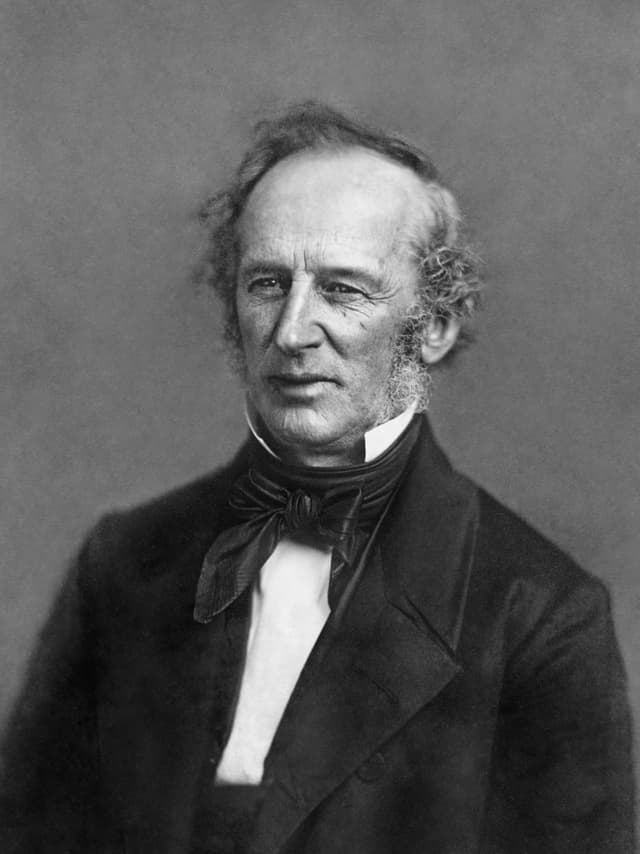
Cornelius Vanderbilt
Vanderbilt Steamboat and Railroad Empire
A titan of the Shipping and Logistics industry, Cornelius Vanderbilt founded and led the Vanderbilt Steamboat and Railroad Empire, transforming transportation in the United States during the 19th century. Known for his fierce competitive spirit and anti-monopoly rhetoric, he strategically built a monopoly in the railroad industry, ultimately controlling over 4,500 miles of track. Vanderbilt's radical frugality allowed him to maintain profitability in price wars, outlasting competitors by keeping expenses low. His business acumen included a calculated approach to entering new markets, compelling rivals to buy him out at inflated prices, thus using the capital to fuel further expansion. Reflecting on his journey, Vanderbilt once noted that the satisfaction of sailing his own boat as a child remained unmatched throughout his illustrious career.
Core Principles
competitive advantage
Never stop at removing a competitor from power, ensure they are economically destroyed. Force them to surrender, not just retreat.
After forcing Morgan and Garrison out of the Accessory Transit Company, Vanderbilt continued his assault. He made deals that cost them millions and left them unable to recover financially, ensuring they could never threaten him again.
“I won't sue you, for the law is too slow. I'll ruin you.”
Compete initially by undercutting on price to establish market dominance and force established players into unsustainable positions. Use the cash flow from victory to consolidate control.
Vanderbilt built his steamboat empire by undercutting competitors' prices until they were forced to buy him out or merge. With the Accessory Transit Company, he halved the price from $600 to $300, then when forced out, halved it again to $150 using his personal yacht, bleeding competitors dry until they eventually sold to him.
finance
Maintain radical frugality as a structural business advantage. Keep expenses so low that you can remain profitable even when competitors cannot, giving you time and capital to outlast them in price wars.
Vanderbilt's iron self-control over personal spending, refusal to use debt, and obsessive cost management across his steamboat operations meant he could absorb losses during competitive battles. Competitors bled money at price points where Vanderbilt still broke even or profited. This frugality was built into his boat designs, which achieved 50% fuel savings compared to rivals.
“He was economical almost to extremes...Frugality was one of Vanderbilt's most potent weapons as he hammered his opponents in this year of desperation.”
Use financial crises and panics as acquisition opportunities. Maintain cash reserves during boom times so you can extend credit to overleveraged competitors, taking their assets as collateral when they inevitably default.
During financial panics when credit dried up, Vanderbilt lent large sums at 6-7% interest, but demanded premium real estate or valuable assets as collateral. When borrowers could not repay during downturns, he took possession of their boats, leases, and property at fractions of their true value. His refusal to speculate or use leverage meant he had abundance of cash precisely when others had none.
“Bankruptcies brought him collateral...he was careful in his agreements, demanding valuable real estate as collateral.”
Keep meticulous mental records of financial details rather than written ones. Know your income and expenditures down to the last cent.
Vanderbilt reportedly wrote nothing down but could state at any moment his exact income and expenditures. This allowed him to maintain control without creating a paper trail that competitors or authorities could follow.
“kept every detail of his business dealings in his head and at any given time knew his income and expenditures down to the last cent”
Wealth compounds exponentially in later life if you build the right foundation early. The first 40-50 years are about foundation building, the last 20 are about massive multiplication.
Vanderbilt was already a multimillionaire by the time gold was discovered in California. Yet the immense wealth he accumulated afterward dwarfed his early fortune many times over. Similar patterns appear in Warren Buffett and John D. Rockefeller's wealth trajectories.
“When gold was discovered in California, Vanderbilt was already a multimillionaire. But the immense wealth he would amass by the time he died was then still only the stuff of dreams.”
hiring
Judge character meticulously before granting trust. The ability to assess people accurately is a decisive competitive advantage.
Vanderbilt was described as a much better judge of character than his rival William Walker. While Walker trusted the wrong people and gave his trust too readily to men who proved to be liars and fools, Vanderbilt carefully selected his allies and partners.
innovation
Embrace new technologies early, but strategically. Invest in innovations that reduce costs or improve efficiency, and build them into the foundation of your operations so they become a lasting competitive advantage.
Vanderbilt recognized the steam engine as the most dramatic technological breakthrough since the printing press. He moved aggressively into steamboats despite his success in sailing vessels. Later, he invested in railroads and coal mining to secure energy sources. The Lexington's hull and engine design saved 50% in fuel costs, by far the largest operating expense. This technological advantage compounded across his fleet.
“Few understood that the steam engine, or more broadly, motorized transportation, was the most dramatic technological breakthrough since the advent of the printing press.”
When direct competition fails, find creative revenue streams. If you cannot compete on one route, find another way to profit from your assets.
When Vanderbilt's steamships were tied up and could not run the Nicaragua route, he made a deal with competitor William Aspinwall to receive $40,000 per month (eventually rising to $56,000) for NOT running ships on the Panama route. Over two years this generated nearly a million dollars.
leadership
Respect strong-minded competitors who use the same ruthless tactics against you. This mutual understanding can transform rivalry into an uneasy partnership based on respect rather than enmity.
When Daniel Drew employed Vanderbilt's own aggressive tactics against him, forcing Vanderbilt to pay for what he already controlled, Vanderbilt found himself forced to pay for the first time in his life. Rather than rage, he admired Drew's cunning. Their relationship became a 'long and peculiar friendship' mixing partnership and rivalry, because each recognized the other as a worthy equal.
“For the first time in Vanderbilt's life, he had been forced to pay for what was already his, and he couldn't help but admiring the man who had done it to him.”
Secure partnerships only when you control them. Accept temporary employment or collaboration with stronger men to learn from them, but structure the relationship so you retain operational control and can extract value for yourself.
Vanderbilt worked for Thomas Gibbons as an employee, but while doing so, he maintained his own separate boatmen business, purchased shares in competing vessels, and built his own steamboats. He learned from Gibbons' strength and resources, but never became dependent. When Gibbons died, Vanderbilt was ready to go independent. He approached all partnerships with the same logic: extract knowledge and capital, maintain autonomy.
“His service, rather than compressing him into another lackey, stretched his stature and business knowledge.”
A man's character and willingness to cross you determines the appropriate response. Legal remedies are insufficient against those willing to operate outside law. Destruction, not negotiation, is the only answer.
Vanderbilt's competitors generally feared him and could be conquered through deals and buyouts. William Walker was different: he was not a businessman and lacked fear of Vanderbilt despite being vastly outmatched. Vanderbilt therefore did not attempt negotiation but instead methodically destroyed Walker through every means available: military, political, and economic.
“Vanderbilt had marked Walker for destruction.”
Loyalty demands are absolute. Those who are loyal to you receive lifelong allegiance and protection. Those who betray you must be destroyed, not merely displaced.
Vanderbilt inspired lifelong loyalty from his closest associates through consistent protection and reward. However, when partners Morgan and Garrison betrayed him during his absence, Vanderbilt did not seek to merely recover his position but systematically destroyed them and took control of the company completely.
marketing
Build a personal brand around competition and anti-monopoly sentiment, even if your ultimate goal is to become a monopolist yourself. Use marketing to shape public perception in your favor during competitive battles.
Vanderbilt created the 'People's Line' and advertised himself as fighting against monopolistic combinations. He appealed to the public's anti-establishment sentiment, lowered prices dramatically to win support, then once competitors agreed to buy him out, he withdrew and raised prices back up. The public later discovered he fought for personal gain, not principle.
“Competition in all things promotes the public convenience. And though the step I've taken may prove advantageous to the public, yet to me, it may be far otherwise.”
mindset
Prioritize control and self-determination above all else. Structure your career and business around eliminating dependence on others and gaining absolute authority over your domain.
From childhood, Vanderbilt's defining obsession was controlling his own destiny. He saved to buy his own boat to escape his father's oversight. He rarely took partners and when he did, like with Gibbons, he maintained effective control. One observer noted: 'The Commodore was determined to have his own way, always, to a greater extent than any man I ever saw. It was his most prominent characteristic.'
“Through all of his later achievements, Vanderbilt recalled, I didn't feel as much real satisfaction as I did on that bright May morning 60 years before when I stepped onto my own boat, hoisted my own sail, and put my hand on my own tiller.”
Your personality and your business philosophy are inseparable. A temperament defined by competitiveness, will to dominate, and disdain for weakness shapes every business decision you make.
Vanderbilt's defining childhood memory was a race at age six. His entire career was marked by the same competitive spirit. He solved disputes through confrontation. He had contempt for authority figures who lacked strength. His distrust of gentlemen he perceived as soft translated into business strategy: he preyed on competitors dependent on family wealth or government protection rather than on merit and efficiency.
“Cornelio's earliest memory, the beginning of his self-image, was a competition and victory.”
Understand that businessmen will choose profit over principle. Use this against them by aligning their interests with yours, then misaligning them.
Walker believed his allies Morgan and Garrison shared his ideological commitment to American expansion in Central America. In reality, they were businessmen who would abandon him the moment profit disappeared, which they did when instability made Nicaragua unprofitable.
Street smarts and practical business knowledge are more valuable than formal education in competitive environments. Direct experience beats credentials.
Vanderbilt left school at age 11 to work on vessels and learned shipping through hands-on labor. Despite lacking formal education, he vastly outmaneuvered William Walker, who had a doctorate by age 18 and impressive academic credentials but failed to understand how the real world actually operated.
“If I had learned education I would not have had time to learn anything else”
Recognize the difference between ideological opponents and business opponents. Business opponents seek profit and can be negotiated with, ideological opponents cannot.
All of Vanderbilt's rivals except Walker were businessmen motivated by profit. They could be bought out or ruined financially. Walker was motivated by ideology and a desire to establish himself as leader of a nation, making him immune to Vanderbilt's normal business tactics.
“The exception was William Walker. He was not a businessman. He achieved his short-lived successes using war and the law as his tools.”
operations
Build decentralized operational structures where individual units (boats, routes, captains) function as semi-independent profit centers. This allows rapid scaling with minimal central overhead.
Vanderbilt organized his empire as a collection of compartmentalized businesses. Each steamboat was managed by its captain handling personnel and daily operations. A single agent at each port handled logistics. This structure gave him scalability without bureaucratic bloat, and allowed rapid adaptation as he entered new markets or technologies.
“The nature of a maritime business gave the enterprise a neatly compartmentalized structure with each captain managing the personnel and daily affairs of his boat.”
Verify critical operational details yourself rather than relying solely on expert reports, especially before major capital deployment.
When his team reported that rapids on the San Juan River were impassable for steamships, Vanderbilt traveled to Nicaragua in secret and personally piloted the vessels over the obstacles using techniques from his 50 years of river navigation experience. He proved what others declared impossible could be accomplished.
Keep all critical business details in your mind rather than committing them to paper. This prevents competitors from understanding your operations and gives you informational advantage.
Vanderbilt never wrote down any business details and kept every transaction and arrangement in his head. He kept only two items on his office desk: a checkbook and a box of cigars. This secrecy about his own operations prevented others from understanding or predicting his moves.
resilience
When forced to be inactive due to injury or circumstance, resist despair by doubling down on your resolve and ambition rather than reflecting on what you have lost. Turn crisis into concentrated purpose.
After a near-fatal railroad accident that left him bedridden for weeks with internal injuries, Vanderbilt's response was not recovery and rest, but a crystallization of ambition. As he healed, the incident took on symbolic weight: 'If I had died in Jersey in 1833, the world would not have known that I had lived.' This motivated his transformation from obscure captain to fearsome Commodore.
“By temperament and necessity he was given not to reflection but to movement...he had to drive forward or be wrecked.”
Refuse to accept defeat even when circumstances appear hopeless. Persist through setbacks by constantly finding new approaches and angles.
When the San Juan River proved impassable, Vanderbilt personally sailed to Nicaragua to see the problem. Rather than accepting the situation as impossible, he found a solution and persisted until the route was operational.
“Cornelius Vanderbilt would see about that. He would not let a few rocks stand in the way of making a fortune in Nicaragua.”
strategy
Enter new markets with the explicit strategy of forcing competitors to buy you out at inflated prices. Scout locations in advance, establish footholds, then extract payments to leave, using that capital to expand elsewhere.
Vanderbilt's standard playbook: identify a lucrative route or market, launch aggressive competition to cut into rivals' profits, force them into negotiations, extract a large buyout payment, then retreat. He then repeated this across multiple routes. With the Stevens brothers, he received $30,000 to abandon a route. With the Albany monopoly, he extracted $100,000 plus $5,000 annual payments.
“He never intended for the dispatch line to last...He had forced his rivals to pay him to go away.”
Scout new opportunities far in advance while your competitors are focused on current battles. Secure strategic positions (leases, docks, routes) before rivals recognize their value.
While engaged in competitive warfare with the Stevens brothers over the dispatch line, Vanderbilt simultaneously scouted distant routes. When he decided to exit the dispatch line dispute, he had already secured a 10-year lease on all docking privileges at a new strategic location. He was two moves ahead while competitors were focused on immediate conflicts.
“He had carefully scouted the passage and spotted a strategic spot for a new landing...he signed a 10-year lease for all docking privileges.”
Sacrifice short-term profit to achieve long-term victory when the stakes demand it. Winning is sometimes worth more than making money.
Vanderbilt pulled all his steamships from the Nicaragua route despite losing immediate revenue, depriving Walker of supplies and reinforcements. This decision puzzled observers and the New York Times criticized him, but it was a calculated move to completely destroy Walker rather than maintain cash flow.
“For Vanderbilt, this was not business. It was personal.”
Engage in asymmetric information warfare. Collect intelligence through spies and networks while keeping your own intentions concealed. Competitors cannot respond to strategies they do not know you are executing.
Vanderbilt was described as combining 'wiliness and directness' with 'intense personal dislikes and sly concealment of his intentions.' While pursuing competition with the Stevens brothers, he was secretly scouting and securing docking rights elsewhere. While negotiating with railroad executives about potential partnerships, he concealed that he ultimately intended to own the entire operation, not partner in it.
“Vanderbilt's peculiar combination of wiliness and directness of intense personal dislikes and sly concealment of his intentions.”
Frameworks
The Buyout Cycle
Enter a new market or route controlled by established competitors. Launch aggressive price competition to cut into their profits and force them into financial distress. Once they can no longer sustain losses, offer to withdraw in exchange for a large payment. Use that capital to identify and secure the next underserved market. Repeat.
Use case: Market entry and expansion when direct acquisition is not immediately possible but competitive pricing can force incumbent consolidation.
Frugality as Competitive Weapon
Maintain operating expenses at radical minimums through personal discipline and structural efficiency. Design products and processes to reduce the largest cost drivers (fuel, labor, materials). This allows you to remain profitable at price points where competitors hemorrhage money, giving you time and capital to outlast them in protracted competitive wars.
Use case: Price wars, market consolidation, scenarios where competitors are overleveraged and cannot sustain losses.
Decentralized Profit Centers
Organize the business as a collection of semi-independent units (boats, routes, locations) each with a manager responsible for personnel and daily operations. Use a minimal central staff to handle aggregate coordination. This structure enables rapid geographic expansion and adaptation without bureaucratic bloat.
Use case: Scaling geographically dispersed operations with limited communication infrastructure. Allows delegation of authority while maintaining profitability checks.
Crisis as Acquisition Engine
Maintain zero debt and accumulate cash reserves during prosperity. During financial panics when credit freezes and competitors become overleveraged, extend credit at modest rates but with valuable collateral. When debtors default, seize their assets. Use accumulated assets to consolidate market position.
Use case: Consolidation during downturns, accumulating strategic assets (routes, leases, vessels) from distressed competitors at deep discounts.
Two-Move Advance
While competitors are focused on current battles, scout and secure positions in markets they have not yet identified as valuable. Use information asymmetry to move ahead of rivals by moving into territories they believe are not worth fighting over, then reveal the value once you control them.
Use case: Strategic positioning, market expansion, maintaining strategic flexibility while appearing to be engaged in existing competitive battles.
The Controlled Retreat Strategy
Appear to accept defeat or retreat from a market while secretly accumulating assets and rebuilding position for a future takeover. Accept settlement offers from rivals to throw them off your true plans, then use the capital received against them in a new campaign. The key is timing your comeback when competitors have lowered their guard and when asset prices have declined.
Use case: When in direct competition with better-capitalized rivals or when you need to reposition without revealing your strategy. Useful in markets where assets are valued by confidence and perception.
The Information Asymmetry Framework
Maintain a public narrative that leads competitors in one direction while executing a completely different private strategy. Use announcements and press coverage to misdirect while taking actions through proxies and intermediaries. The larger the gap between public perception and private reality, the greater your advantage.
Use case: When facing well-resourced competitors with good intelligence networks. Especially useful in publicly traded companies or regulated industries where actions must be disclosed but can be framed ambiguously.
The Multi-Vector Attack
Rather than relying on a single strategy to defeat an opponent, simultaneously pursue many different approaches, including direct competition, financial warfare, legal action, political maneuvering, and resource cutoffs. Launch all vectors in parallel so that when one approach is blocked, others are already advancing.
Use case: When facing a formidable opponent with significant resources and when you have access to multiple domains of influence (political, financial, legal, operational).
The Character Filtering System
Develop rigorous standards for assessing character and trustworthiness before granting responsibility or partnership. Look beyond credentials and accomplishments to understand how people actually behave under pressure, whether they keep commitments, and whether they are motivated by profit or ideology.
Use case: When building a team, selecting partners, or deciding whether to trust a competitor. More critical in industries where betrayal can be costly and where you lack the ability to closely monitor performance.
The Surfing Model
Identify major technological or market waves early and position yourself to ride them. Success comes not from creating the wave but from recognizing it, being prepared, and positioning your assets to capitalize on it as it crests. Vanderbilt surfed the steamship wave, then the railroad wave, and accumulated controlling interest in the most important lines rather than trying to compete in undifferentiated markets.
Use case: Strategic capital allocation and technology investment decisions. Especially useful when deciding whether to double down on existing business or shift to emerging industries.
Stories
At age 11, Vanderbilt's father promised him he could take a boat to New York if he completed a tedious chore: hoeing an entire potato field. When the boy finished, his father revealed he had also arranged for Vanderbilt and a friend to transport hay while they played. The reward became work, but the boy got his day in New York and a few pennies. Vanderbilt later reflected that they were as tired that night as if they had been working.
Lesson: Constraints and deferred gratification are foundational. His father introduced him to the concept of delayed reward and embedded work into leisure. The proximity to New York City, visible from Staten Island, planted seeds of ambition. Commerce and profit-seeking were woven into daily life rather than separated from it.
As a teenager, Vanderbilt scrounged and saved until he could buy his own boat. Rather than use it for pleasure, he immediately sought to make money with it. He discovered 'his hunger for money' and recognized that ownership brought freedom from his parents' control. Even while working for them, he secretly bought shares in other boats whose profits he did not share with his family.
Lesson: Financial independence is the prerequisite for autonomy. The desire for control and self-determination drives wealth accumulation. This was not greed for its own sake but rather greed as the mechanism for escape from dependence on others.
Vanderbilt piloted a steamboat called the Thistle in competition with a rival boat, the Legislator. He raced the other captain, and when he arrived first at the shared pier in New York, he ordered his deckhands to tie up in the middle, blocking the other boat from docking. The harbor master ordered him to move. Vanderbilt refused and sneered at a $250 fine. He continued blocking the other boat whenever possible, prioritizing the battle itself over the legal or financial consequences.
Lesson: For Vanderbilt, the competition itself mattered more than the immediate financial outcome. Dominance and winning were psychological necessities, not merely business calculations. This personality trait shaped his strategy: he would engage in price wars and competitive battles not just to acquire companies, but because the contest itself motivated him.
During a near-fatal railroad accident in 1833, Vanderbilt's rail car jumped the tracks and tumbled down an embankment. He was crushed, bleeding internally, and believed he was dying. As he lay at the bottom of the ditch unable to move, he was forced into weeks of recovery. Rather than reflect on mortality or take a gentler path, the incident crystallized his ambition. He emerged with the thought that if he had died then, the world would never have known he had lived.
Lesson: Proximity to death does not soften ambition but rather concentrates it. Enforced inactivity is psychologically torturous for men of action, serving as a catalyst for even greater drive upon recovery. The incident became symbolically important: proof that his ordinary existence had been unworthy of his potential.
When negotiating with railroad executive McNeil about potential collaboration, Vanderbilt was asked what interest he would have in offering. Vanderbilt replied: 'If I own the road, I'd know how to make it profitable.' McNeil responded sarcastically, 'I suppose you'd own the boats too.' Vanderbilt calmly said, 'Yes,' and said nothing more. McNeil dismissed it as bravado and could not take seriously the idea of one man buying control of a multi-million-dollar railroad.
Lesson: Competitors cannot comprehend ambitions that exceed their own frame of reference. McNeil lacked the imagination to envision one person controlling both rail and maritime assets. Vanderbilt's directness about his intentions was not believed because it exceeded what seemed possible. He let others underestimate the scope of his vision.
When Daniel Drew, another steamboat operator, employed Vanderbilt's own aggressive competitive tactics against him, Vanderbilt was forced for the first time in his life to pay for something he considered rightfully his. Rather than rage or seek revenge, Vanderbilt found himself admiring Drew. The two men recognized in each other a kindred ruthlessness and intelligence. Their relationship transformed from rivalry into an 'uneasy friendship' mixing partnership, rivalry, and mutual respect.
Lesson: Respect is earned by strength and cunning, not by deference. When someone proves themselves your equal through ruthlessness, respect follows. Vanderbilt's admiration for Drew was based on Drew's willingness to employ the same tactics Vanderbilt used on others, revealing that Vanderbilt respected the quality of mind that produced such tactics, not the outcome for himself.
Vanderbilt personally sailed to Nicaragua after learning that the San Juan River rapids were impassable and his steamboat had wrecked. Colonel White declared the dream of conveying passengers up the river to the lake was unrealizable. Vanderbilt's response was simply 'Cornelius Vanderbilt would see about that.' He found a way to make it work.
Lesson: Do not accept expert declarations that something is impossible. If achieving your goal is important enough, persist in finding alternative solutions rather than accepting defeat.
While Vanderbilt was on his first and only extended vacation in Europe aboard his private yacht, rivals Morgan and Garrison manipulated transit company stock, cut off his cash flow, and voted to cease his 20 percent revenue skim. He returned to discover the betrayal and immediately sent them a short letter threatening total destruction.
Lesson: Never trust that competitors will respect your position or agreements while you are absent or distracted. Build safeguards and deputize trusted allies to protect your interests when you cannot directly oversee them.
Walker, as general of Nicaragua, boarded one of Vanderbilt's steamboats and commandeered it as Nicaraguan government property based on a technicality in the contract stating vessels should operate under the Nicaraguan flag. Walker relied on the written law to justify the seizure. Vanderbilt did not care about the law or Walker's arguments.
Lesson: Ideological opponents who rely on legal or moral arguments cannot be defeated using the same rules. They must be fought using asymmetric methods that ignore the constraints they believe in.
Vanderbilt made a deal with competitor William Aspinwall to receive $40,000 monthly for agreeing not to run steamers on the Panama route where Aspinwall operated. When his Nicaragua route was closed by political turmoil, instead of competing directly, he took Aspinwall's money while using other steamers to compete with Morgan in the Gulf of Mexico.
Lesson: When denied one avenue of competition, convert your disadvantage into an asset. Extract payment from competitors for staying out of their market, then redirect that capital to damage other rivals.
Notable Quotes
“Through all of his later achievements, Vanderbilt recalled, I didn't feel as much real satisfaction as I did on that bright May morning 60 years before when I stepped onto my own boat, hoisted my own sail, and put my hand on my own tiller.”
Reflecting on his childhood acquisition of his first boat and the independence it represented. Despite building a vast empire and becoming the wealthiest man in America, Vanderbilt's deepest satisfaction came from the moment he achieved autonomy as a young man.
“I always thought Thomas Gibbons a very strong minded man, the strongest I ever knew. I don't believe any human being could control him. He was a man that could not be led.”
Describing his former employer and mentor Thomas Gibbons. The qualities Vanderbilt most admired were strength of will and resistance to control. He was essentially describing the qualities he most valued in himself.
“If I own the road, I'd know how to make it profitable.”
In response to a question about his interest in partnering on a railroad. When pressed, he added simply, 'Yes,' confirming he intended to own both boats and railroad, though the executive dismissed this as bravado.
“Competition in all things promotes the public convenience. And though the step I've taken may prove advantageous to the public, yet to me, it may be far otherwise.”
From his advertisement for the 'People's Line,' positioning himself as a champion of competition and the common man against monopoly. Later revealed to be strategic marketing, as he withdrew once paid off and raised prices back to monopolistic levels.
“You have no business in this trade. You don't understand it and you can't succeed.”
Vanderbilt's initial dismissal of Daniel Drew's entry into the steamboat business. Drew then employed Vanderbilt's own tactics against him, forcing Vanderbilt to pay for what he already controlled, earning Drew's respect.
“If I died in Jersey in 1833, the world would not have known that I had lived.”
Reflection during his recovery from a near-fatal railroad accident. The incident crystallized his ambition and sense that his ordinary career to that point had been unworthy of his potential.
“My guiding principle was to mind my own business.”
A direct quote capturing Vanderbilt's focus and refusal to be distracted by external concerns. He concentrated capital and attention on competitive advantage rather than external validation.
“I've been insane on the subject of money-making all of my life.”
Direct statement of Vanderbilt's obsession with wealth accumulation throughout his life
“If I had learned education I would not have had time to learn anything else.”
Explaining why he left school at age 11 to work in shipping, contrasting formal education with practical business knowledge
“Gentlemen, you have undertaken to cheat me. I won't sue you, for the law is too slow. I'll ruin you. Yours truly, Cornelius Vanderbilt.”
Response to Morgan and Garrison's manipulation of transit company stock and cash flow cutoffs while Vanderbilt was in Europe
Frequently Asked Questions
What are Cornelius Vanderbilt's key business principles?▼
Cornelius Vanderbilt's core principles include: Never stop at removing a competitor from power, ensure they are economically destroyed. Force them to surrender, not just retreat.. Compete initially by undercutting on price to establish market dominance and force established players into unsustainable positions. Use the cash flow from victory to consolidate control.. Maintain radical frugality as a structural business advantage. Keep expenses so low that you can remain profitable even when competitors cannot, giving you time and capital to outlast them in price wars.. Founder Almanac has cataloged 30 total principles from Cornelius's career.
What can entrepreneurs learn from Cornelius Vanderbilt?▼
Key lessons from Cornelius Vanderbilt include: Constraints and deferred gratification are foundational. His father introduced him to the concept of delayed reward and embedded work into leisure. The proximity to New York City, visible from Staten Island, planted seeds of ambition. Commerce and profit-seeking were woven into daily life rather than separated from it.. Explore 10 stories and 10 frameworks from Cornelius's experience.
What is Cornelius Vanderbilt known for in business?▼
A titan of the Shipping and Logistics industry, Cornelius Vanderbilt founded and led the Vanderbilt Steamboat and Railroad Empire, transforming transportation in the United States during the 19th century. Known for his fierce competitive spirit and anti-monopoly rhetoric, he strategically built a monopoly in the railroad industry, ultimately controlling over 4,500 miles of track. Vanderbilt's radical frugality allowed him to maintain profitability in price wars, outlasting competitors by keeping expenses low. His business acumen included a calculated approach to entering new markets, compelling rivals to buy him out at inflated prices, thus using the capital to fuel further expansion. Reflecting on his journey, Vanderbilt once noted that the satisfaction of sailing his own boat as a child remained unmatched throughout his illustrious career.
More Shipping & Logistics Founders
Want Cornelius's advice on your business?
Our AI has studied Cornelius Vanderbilt's biography, principles, and decision-making frameworks. Ask any business question.
Start a conversation