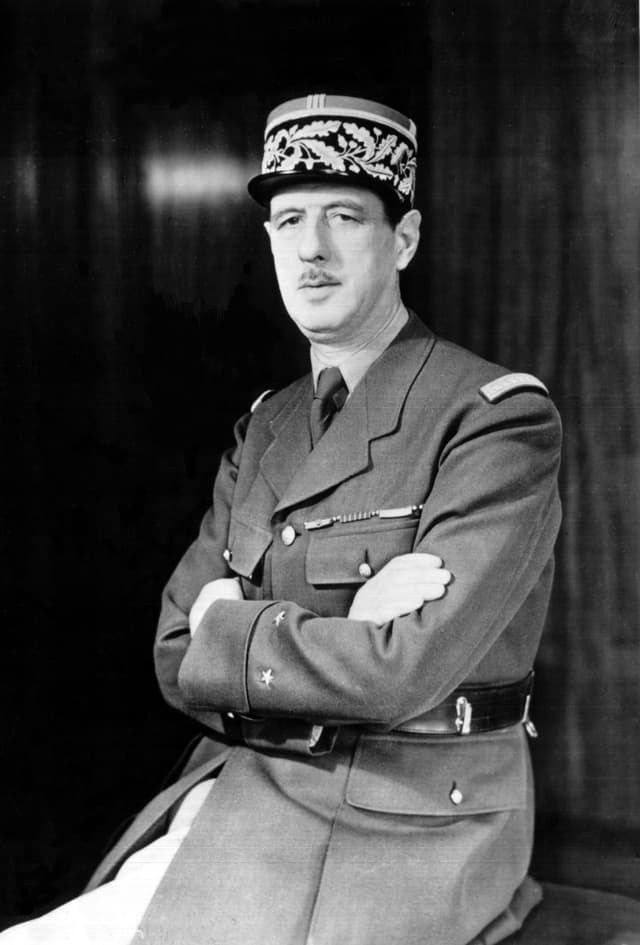
Charles de Gaulle
Free France
A central figure in 20th-century France, Charles de Gaulle founded and led the Free French Forces during World War II, embodying resilience and conviction in the face of adversity. His unwavering belief in "a certain idea of France" guided his leadership and inspired a nation, as he famously declared, "The graveyards are full of indispensable men," emphasizing the importance of perseverance and the will to fight. Despite being wounded in battle just 20 seconds into his first engagement, he refused to accept defeat, rallying troops and ultimately playing a pivotal role in the liberation of France. De Gaulle's ability to articulate a vision and maintain steadfastness in his judgment serves as a powerful lesson for entrepreneurs today, highlighting the importance of clarity of purpose and resilience in overcoming challenges.
Core Principles
focus
Avoid distraction and maintain focus on central strategic issues. De Gaulle criticized democratic leaders who allowed constant interruptions to fragment their attention.
When meeting with French Prime Minister Blum, de Gaulle observed that the telephone rang ten times, preventing any sustained thought. He noted that leadership requires the ability to hold one idea in mind for extended periods, impossible if constantly interrupted by minor administrative matters.
“All that matters is to survive. The rest is just words.”
innovation
Propagate novel ideas about how things should be done rather than accepting conventional wisdom about what is possible.
De Gaulle realized that military thinking was outdated. Generals still used World War I defensive strategies. He recognized that tanks, aggressive movement, and speed had changed warfare forever. He propagated these novel military ideas decades before they were widely accepted.
leadership
Be willing to disobey foolish or cowardly orders from above when the situation demands it, as heroism includes moral courage to act rightly.
De Gaulle lectured at the Military Staff College on the nature of the hero in war, discussing the need for heroes to disobey foolish or cowardly orders from above. This principle guided his later defiance when France fell.
Combine ruthlessness, clarity of purpose, and brilliant execution to overcome opposition and establish your vision when others attempt to block you.
De Gaulle used three formulas to eliminate a rival backed by Britain and America for leadership of Free France: ruthlessness combined with brilliance, combined with being absolutely clear about what he wanted. He succeeded through this combination of traits.
Possess absolute conviction in your judgment and be willing to act on it even when authority figures disagree. De Gaulle's willingness to contradict his mentor Pétain and the French military establishment came from unshakeable self-belief.
De Gaulle wrote extensively about mechanized warfare and the need for professional armies years before World War II, directly contradicting the defensive doctrine of French military leadership. When ghostwriting a book for Pétain, he refused to allow changes to his ideas, telling the most decorated military figure in France that the book was his alone.
“A book is a man. That man, up to me, up to now, was me. If anyone else becomes involved in this, only two things can ensure. Either he will write another book, or he will demolish mine.”
Cultivate distance and mystery as a leader while maintaining confidence in your judgment. De Gaulle deliberately kept himself apart from peers, ate alone, spoke little, and concealed his thinking.
De Gaulle refused to socialize with other officers, would not attend mess dinners, and spent long periods alone in contemplation. This wasn't antisocial behavior but strategic: he believed leaders needed to preserve independent judgment and avoid groupthink that comes from social relationships.
“One does not speak in an operating theater or while piloting a ship. What I have to say as a leader requires calm and reflection. All those who have done something valuable and durable have done so alone and in silence.”
Recognize that belief and morale often matter more than resources or current capabilities. De Gaulle understood that France's defeat came from loss of will, not from lack of military capacity.
De Gaulle studied the collapse of Germany in World War I and noted that German soldiers surrendered despite having intact factories and fertile fields. He concluded that 'She refused to make further sacrifices, hoping to end her suffering,' understanding that will breaks before capability does.
“The victor is the one that wants victory most energetically.”
marketing
Communicate with clarity and conviction about difficult truths. De Gaulle's June 18 radio speech acknowledged France's military defeat while refusing to accept political defeat.
Rather than pretending France could win militarily, de Gaulle admitted that German mechanized forces had overwhelmed French armies. However, he pivoted to the political argument that this military loss did not mean France must surrender its will or accept Hitler's terms, inspiring continued resistance.
“Certainly, we have been overwhelmed by the mechanized forces of the enemy. But has the last word been said? Must hope disappear? Is the defeat definitive? No.”
Build your vision through communication and repetition, creating it first as an idea before manifesting it physically. De Gaulle was 'a voice before he was a face' and used radio to create his myth.
Many of de Gaulle's followers had never seen him in person but knew him through radio broadcasts. He understood that ideas spread faster than physical presence and used this medium to create a powerful symbol of continued resistance that inspired millions.
“De Gaulle was a voice before he was a face. He entered history through a short BBC broadcast from London on the evening of 18 June 1940.”
mindset
Strategic isolation enables clearer thinking because separating yourself from constant social influence allows novel insights to emerge.
De Gaulle made solitude his friend through extensive reading and time alone. Henry Singleton did the same, sitting in his corner office with his Apple II. Isolation from conventional thinking sources enabled both to derive unique insights.
“Solitude was my temptation. It became my friend.”
Maintain absolute commitment to your vision despite personal hardship, depression, and doubt. De Gaulle experienced profound melancholy throughout his life but never let it derail his purpose.
De Gaulle suffered depressive episodes and moments of despair, particularly as a young man in prisoner of war camps. Yet he channeled this darkness into determination rather than allowing it to undermine his mission. He viewed his emotional struggles as part of his character that made him stronger.
“I am one of the living dead”
Have the conviction that your plan is correct before you have the ability to execute it. De Gaulle believed in his destiny to lead France long before circumstances made it possible.
At age 15, de Gaulle wrote an essay projecting himself into 1930 as a French general who had defeated Germany. His father exposed him to military history and battlefields in his youth. This early conviction shaped his entire life and prepared him psychologically for his eventual role.
“There is no moment of my life when I was not certain that one day I would be at the head of France.”
Study history extensively and apply lessons from past centuries to present challenges. De Gaulle's deep historical knowledge allowed him to predict and prepare for events with remarkable accuracy.
De Gaulle would reference figures from the 1600s when advising on contemporary military strategy, having internalized lessons that others missed. He predicted World War II a decade before it began and wrote books that Hitler himself studied and annotated, proving his strategic insights were validated by events.
“History does not repeat, human nature does. Human nature is constant.”
Use your unique perspective and outsider status as strength rather than weakness. De Gaulle's critical distance from the military establishment allowed him to see truths others missed.
De Gaulle's contempt for conventional military thinking and willingness to criticize his teachers created enemies, but it also forced him to think independently. This outsider perspective enabled him to identify mechanized warfare's importance when establishment military thinkers still clung to World War I tactics.
“He spoils incontestable qualities by his excessive self-assurance and his harshness towards other people's opinions. He has an attitude of a king in exile.”
resilience
Refuse to accept an inferior position or outcome when the stakes are existential. De Gaulle viewed the French government's surrender to Germany as treason and refused to accept it as inevitable.
While every other French leader capitulated, de Gaulle declared he alone represented true France and would continue fighting. He used radio broadcasts to build support and positioned himself as the only alternative to defeatism, ultimately proving that will and resolve matter more than current resources.
“Whatever happens, the flame of the French resistance must not be extinguished, and it will not be extinguished.”
Demonstrate intransigence as an asset when you are weak because refusing to change your position becomes your only weapon.
De Gaulle recognized that after France's fall, his weakness necessitated intransigence. By refusing to compromise on his vision for France, he became the only consistent symbol of French resistance when everything else was uncertain.
Never accept defeat or loss of will to fight, regardless of circumstances. De Gaulle's defining characteristic was his refusal to accept that France was defeated even when the entire government surrendered.
When France signed an armistice with Germany in 1940, de Gaulle fled to London with nothing but two suitcases and limited resources. He positioned himself as the only true representative of France and refused to accept the political and military establishment's capitulation, broadcasting to the nation that the fight must continue.
“Don't turn your back on he who will not accept defeat”
strategy
Think of ideas as more important than people, subordinating personal relationships to the larger mission and vision you serve.
De Gaulle was an intellectual who thought ideas were infinitely more important than people. He viewed individual Frenchmen's role as working for the idea of France. This ideological commitment enabled his strategic clarity but also his ruthlessness.
Adapt strategies to current circumstances rather than blindly following doctrine from past conflicts. De Gaulle criticized the French military for 'fighting the last war' instead of preparing for the next one.
The French high command believed firepower favored defenders based on World War I experience. De Gaulle recognized that mechanized tanks and mobile warfare had changed the fundamentals, making rapid offensive action possible again. He warned repeatedly that new circumstances demanded new thinking.
“Seize the circumstances, adapt to them, exploit them. That was the basis of Napoleon's conduct.”
Prioritize taking offensive action over defensive waiting. De Gaulle constantly criticized French generals for waiting passively for Germany to attack instead of seizing initiative.
De Gaulle warned that by waiting for enemy attack, France allowed Germany to choose the time and place of battle. He advocated for using mechanized forces to strike while maintaining strategic advantage. This philosophy anticipated modern military strategy by decades.
“We are advancing constantly and we're not interested in holding anything except the enemy's balls.”
Keep your core principles granite-like in consistency while remaining flexible in tactics. De Gaulle's fundamental beliefs about France remained constant, but his methods evolved based on circumstances.
Despite his stubbornness about his vision, de Gaulle understood that effective leadership required adaptation. He studied Napoleon specifically for his ability to seize circumstances while maintaining core objectives, modeling this same flexibility-within-conviction approach.
“There seems to be a granite-like consistency to his personality and beliefs.”
Develop and relentlessly repeat a central idea about what you want to build or achieve. De Gaulle spent decades articulating 'a certain idea of France' and returned to this concept consistently throughout his life and career.
De Gaulle believed the most important ideas deserved to be thought about for years, written down, memorized, and repeated until they became foundational to everything he did. He applied this same consistency to his vision for France that he maintained from boyhood through his entire public life.
“The things that I want to be known, that I consider to be important, I think about them for a long time. I write them down. I learn them by heart. This costs me the most terrible effort. They are the only things which count in my eyes.”
Frameworks
A Certain Idea
Develop a singular, crystal-clear vision of what you're building or fighting for, then spend decades thinking about it, refining it, writing it down, and repeating it until it becomes the foundation of everything you do. This vision should be specific enough to guide decisions but enduring enough to outlast circumstances. The 'idea' becomes more powerful than any individual setback.
Use case: Use this when starting an organization or mission that you intend to pursue for decades. Apply it when you need to maintain organizational culture and purpose through multiple crises or leadership transitions.
Adaptive Flexibility Within Granite Principles
Maintain absolute consistency about your core values and objectives while remaining completely flexible about tactics, timing, and methods. Study history and current circumstances to understand what approaches work in present conditions. Change everything except your fundamental purpose.
Use case: Apply when facing unprecedented challenges where existing playbooks no longer work. Useful for founders who need to pivot tactics while staying true to mission, or leaders managing rapid industry change while maintaining company values.
The Solitary Decision-Making Process
Deliberately insulate yourself from social influences and constant communication that prevent deep thought. Create space for extended contemplation on strategic issues. Listen to advice and gather information, but reserve final decisions for yourself alone, made in solitude and with full reflection.
Use case: Use when making high-stakes strategic decisions that require integrating complex information. Critical for founders and leaders who need to maintain independent judgment against groupthink or social pressure.
Offensive Momentum Over Defensive Waiting
Choose to take initiative and control circumstances rather than passively reacting to competitor or market moves. Build organizations around rapid action, movement, and exploitation of advantages. Don't wait for perfect conditions, create them through action.
Use case: Apply in competitive markets where first-mover advantage matters. Use when facing an entrenched competitor or when organizational inertia is the primary threat. Particularly valuable in early-stage ventures where momentum compounds.
Historical Pattern Recognition
Study history extensively across multiple centuries and civilizations. Learn the patterns of how similar situations have been handled. Apply these historical lessons to present circumstances, updating for current conditions but recognizing that human nature and power dynamics remain constant.
Use case: Use when facing novel or ambiguous situations where recent precedent doesn't exist. Critical for strategic planning and understanding competitive dynamics. Helps identify traps that others miss because they only study current-era examples.
De Gaulle's Isolation for Clarity
Create strategic isolation to enable novel thinking by: withdrawing from constant social influence and conventional sources of information, spending significant time reading and thinking alone, developing a unique philosophy that differs from consensus, and recognizing that this isolation may make you less socially warm but more strategically effective.
Use case: Schedule regular periods of isolation for strategic thinking. Separate yourself from constant team interaction and media consumption. Use this time to study history, read deeply, and develop unique perspectives. Accept that isolation may reduce social likeability but increases strategic clarity.
Ruthless Clarity Combination
De Gaulle combined three elements to overcome opposition: ruthless execution of decisions, brilliant analysis of the situation, and absolute clarity about desired outcomes. This combination allowed him to eliminate rivals backed by more powerful nations and establish his vision when compromise seemed necessary.
Use case: When facing opposition to your strategic vision, combine three elements: be absolutely clear about what you want to accomplish, think through the implications brilliantly, and execute ruthlessly without compromise. This combination is more powerful than trying to compromise or persuade.
Stories
De Gaulle was shot in the knee within 20 seconds of his first battle in World War I, causing him to stumble and crawl under fire while four men around him fell. After surviving through luck he couldn't explain, he was later shot again in the hand. Despite these injuries, he returned to service repeatedly and eventually spent most of the war as a prisoner.
Lesson: Physical danger and setbacks do not determine outcome when you have unwavering conviction. De Gaulle's willingness to repeatedly put himself in harm's way came from certainty about his purpose, not from recklessness. Those who refuse to accept defeat eventually find ways to continue.
De Gaulle predicted World War II a decade before it began by writing 'Towards a Professional Army' which detailed how mechanized tank warfare would revolutionize combat. Hitler studied de Gaulle's book and annotated it. When France ignored de Gaulle's warnings and Germany invaded using exactly these tactics, the defeat took six weeks.
Lesson: Deep preparation and study compound over time. De Gaulle's willingness to think through complex problems years in advance meant his solutions were ready when circumstances changed. Founders who do foundational thinking before it's obviously needed gain tremendous advantage when change arrives.
De Gaulle refused to allow changes to a book he was ghostwriting for his mentor Pétain, telling the most decorated military figure in France that the book was 'his alone' or Pétain could write another one. This insolence to a superior officer demonstrated his unshakeable self-belief even as a junior officer.
Lesson: Exceptional people maintain conviction in their judgment even when facing authority figures. De Gaulle's willingness to risk his career over authorship disputes foreshadowed his later willingness to oppose the entire French government. Self-belief that survives authority pressure is a marker of founders who change industries.
De Gaulle fled France in 1940 with two suitcases and limited francs to a country he'd visited once, spoke the language poorly, and knew almost no one. Within four years, he transformed from exile with nothing into the symbol of French resistance and the nation's leader.
Lesson: Clarity of purpose and refusal to accept defeat can overcome any material disadvantage. De Gaulle succeeded not through resources but through the power of his idea and his unwillingness to surrender. Founders with sufficient conviction can build from nothing if their idea is compelling enough.
De Gaulle's staff found him constantly alone: eating alone, taking coffee alone, strolling alone, visiting the front alone. When asked why, he explained that major decisions require calm and reflection impossible in social environments. He believed all valuable and durable work was done in solitude and silence.
Lesson: Isolation is not antisocial behavior, it's strategic thinking protection. De Gaulle's deliberate separation from his peers enabled the independent judgment that made him more insightful than colleagues. Modern leaders often confuse gregariousness with effectiveness.
A military officer discovered de Gaulle in his quarters singing and dancing with his disabled daughter Anne, a stark contrast to the austere, controlled figure the world knew. De Gaulle kept Anne with him despite social convention to institutionalize such children and considered her his greatest source of strength.
Lesson: Apparent emotional coldness can mask profound capacity for love and human connection. De Gaulle's public distance didn't reflect incapacity for affection but deliberate choice to compartmentalize. Founders can maintain personal standards and relationships while operating professionally.
De Gaulle lectured senior military officers at the Staff College two decades before he would use these ideas in reality, discussing the nature of heroism in war and the necessity for heroes to disobey foolish or cowardly orders from above. He later applied this principle when France fell and he resisted the surrender.
Lesson: Study and teach principles in preparation for future application when you cannot yet predict the specific form. De Gaulle's lectures on when to disobey orders became his template for action later.
Notable Quotes
“The graveyards are full of indispensable men.”
When Henry warned that NBC would sue him for massive damages if he quit, Carson rejected the argument that he was irreplaceable. This quote reflects Carson's understanding that no individual is truly indispensable to an institution.
“History does not repeat, human nature does. Human nature is constant.”
Explaining why studying history across centuries remains valuable for understanding present and future
“To be passive is to be defeated”
Criticizing the defensive posture of French military leadership before World War II
“The things that I want to be known, that I consider to be important, I think about them for a long time. I write them down. I learn them by heart. This costs me the most terrible effort. They are the only things which count in my eyes.”
On the process of developing core ideas that would guide his leadership and philosophy for decades
“All my life I've had a certain idea of France”
The opening line of his autobiography, serving as the foundation for every decision and action in his life
“Don't turn your back on he who will not accept defeat”
From the 1940 film about de Gaulle, describing himself and his refusal to surrender
“There is no moment of my life when I was not certain that one day I would be at the head of France. But things worked out in a way that I could not predict.”
Reflecting on his lifelong conviction about his destiny, which began in childhood and shaped all his choices
“All that matters is to survive. The rest is just words.”
Expressing his single-minded focus on perseverance over everything else
“One does not speak in an operating theater or while piloting a ship. What I have to say as a leader, putting my men and my tanks into battle, requires calm and reflection. All those who have done something valuable and durable have done so alone and in silence.”
Explaining why he spent so much time alone and avoided social interaction with other officers
“We must conquer. The victor is the one that wants victory most energetically.”
Emphasizing that will and desire for victory matter more than material circumstances in determining outcomes
Frequently Asked Questions
What are Charles de Gaulle's key business principles?▼
Charles de Gaulle's core principles include: Avoid distraction and maintain focus on central strategic issues. De Gaulle criticized democratic leaders who allowed constant interruptions to fragment their attention.. Propagate novel ideas about how things should be done rather than accepting conventional wisdom about what is possible.. Be willing to disobey foolish or cowardly orders from above when the situation demands it, as heroism includes moral courage to act rightly.. Founder Almanac has cataloged 25 total principles from Charles's career.
What can entrepreneurs learn from Charles de Gaulle?▼
Key lessons from Charles de Gaulle include: Physical danger and setbacks do not determine outcome when you have unwavering conviction. De Gaulle's willingness to repeatedly put himself in harm's way came from certainty about his purpose, not from recklessness. Those who refuse to accept defeat eventually find ways to continue.. Explore 7 stories and 7 frameworks from Charles's experience.
What is Charles de Gaulle known for in business?▼
A central figure in 20th-century France, Charles de Gaulle founded and led the Free French Forces during World War II, embodying resilience and conviction in the face of adversity. His unwavering belief in "a certain idea of France" guided his leadership and inspired a nation, as he famously declared, "The graveyards are full of indispensable men," emphasizing the importance of perseverance and the will to fight. Despite being wounded in battle just 20 seconds into his first engagement, he refused to accept defeat, rallying troops and ultimately playing a pivotal role in the liberation of France. De Gaulle's ability to articulate a vision and maintain steadfastness in his judgment serves as a powerful lesson for entrepreneurs today, highlighting the importance of clarity of purpose and resilience in overcoming challenges.
More Military & Government Founders
Want Charles's advice on your business?
Our AI has studied Charles de Gaulle's biography, principles, and decision-making frameworks. Ask any business question.
Start a conversation