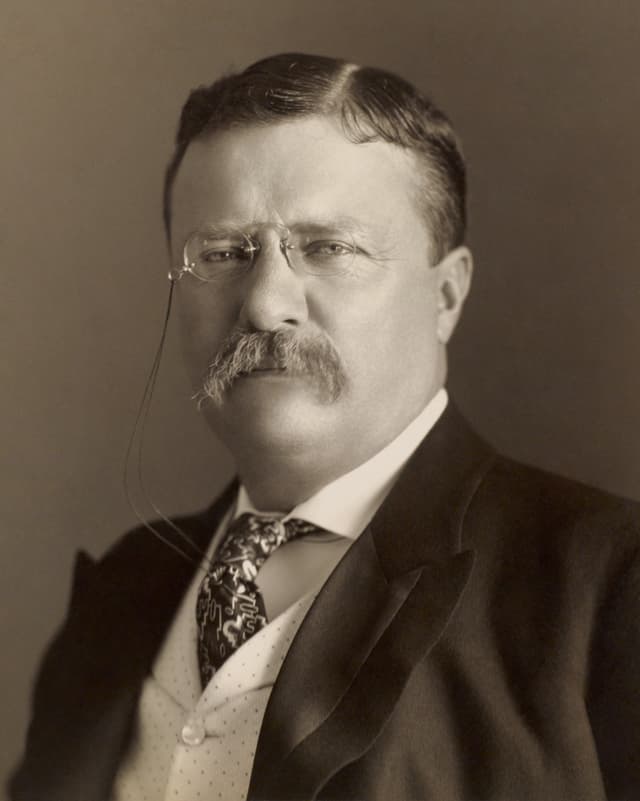
Theodore Roosevelt
U.S. Government
A dynamic leader and reformer, Theodore Roosevelt played a crucial role in shaping modern American governance during his presidency from 1901 to 1909. He championed the expansion of executive power, firmly believing that unprecedented actions in governance must be tested through the courts, a principle that resonates with contemporary entrepreneurs navigating legal complexities. Roosevelt's innovative use of media to communicate directly with the public laid the groundwork for strategic public relations, allowing leaders to build legitimacy and challenge established power structures. His commitment to vigorous physical activity, especially after personal tragedies, serves as a reminder of the importance of resilience and well-being in the face of adversity. Notably, he successfully implemented the Square Deal, a domestic program that aimed to protect consumer rights and regulate corporations, which laid the foundation for modern regulatory practices.
Core Principles
culture
Instill in others the discipline and capability to choose the hard thing for themselves, so that when crisis comes, they will have both the skill and the resolve to survive.
Roosevelt raised Kermit through years of wilderness expeditions, teaching him to read, learn, stay physically fit, hunt, trap, and forage. When Roosevelt lay dying of malaria and infection, Kermit had developed the skills and determination to keep both of them alive by refusing to abandon his father.
“Creating a young man who, given a goal, would fight with everything he had to achieve it.”
Children develop true competence and character through exposure to real danger, failure, and physical challenge, not through protection from difficulty.
Roosevelt raised his sons with the rule that they could go over, under, or through obstacles but never around them. He deliberately exposed them to wilderness dangers to build what he called nerve control: the ability to remain calm and effective in real danger.
“What such a man needs is not courage, but nerve control. Cool-headedness. This he can only get by practice.”
hiring
Expect your team members to be capable of far more than they believe about themselves. Create conditions that reveal their hidden potential.
Roosevelt observed his expedition team displaying remarkable strength, willingness to work, and intelligence under extreme hardship. He marveled at how circumstances forced people to discover capacities they did not know they possessed.
“One could not but wonder at the ignorance of those who do not realize the energy and the power that are so often possessed, that you so often possess, and that may be so readily developed.”
Show admiration and respect for competence, discipline, and character regardless of the person's background or social status. Build teams around merit.
Roosevelt deeply admired Colonel Rondon despite their philosophical differences. Rondon came from extreme poverty and began as an outcast at military school, but Roosevelt recognized and respected his discipline, willingness to face hardship, and principled character. Roosevelt treated him as an equal.
“For Roosevelt, Rondon represented the kind of man he had championed and admired throughout his life: a disciplined officer who thrived on physical challenges and hardship and accomplished great feats through sheer force of will.”
innovation
There is always another way to solve a problem. Do not assume that conventional methods are the only methods, especially when you lack conventional tools.
The Sinta Larga tribe lacked fishing poles and hooks but had developed timbo, a vine extract that paralyzes fish gills, allowing them to harvest abundance where outsiders saw scarcity. The Incas built a great empire without wheels, writing, or iron. Innovation emerges from constraint.
“There's always another way to solve a problem.”
leadership
Only those who cannot be burdened should lead others. Lead from the front by being the first to sacrifice, not the last.
Roosevelt refused to accept food rations larger than his men, refused to sit in chairs they could not access, and was willing to die in the jungle to prevent Kermit from attempting an impossible rescue. He embodied the idea that a leader assumes the greatest burden.
“All for each and each for all is a good motto, but only on condition that each works with might and main to maintain himself as to not be a burden to others.”
Learn from early failures in gaining influence. Recognize when you are isolated in your positions and adjust your approach to work cooperatively with others, calling compromise being practical.
Early in his political career, Roosevelt was ineffective. He shouted, harangued, and would listen to no advice, taking isolated positions on every issue until his people left him. He later learned to compromise, calling it being practical, and began working with people as they were rather than as he wanted them to be.
“I turned in to help them, and they turned to and gave me a hand. And so we were able to get things done.”
In crisis situations where national welfare is at stake, personalities and prior conflicts must be set aside for pragmatic cooperation. Work with adversaries when interests temporarily align.
Despite their intense antitrust battle, Morgan and Roosevelt cooperated to resolve the coal miners' strike that threatened the nation with winter without heat. Morgan brokered agreements while Roosevelt used political pressure. Both men, who despised each other, recognized that the alternative was national disaster.
Reject tourism and comfort-seeking in favor of genuine exploration and scientific discovery. Distinguish yourself by doing the work yourself rather than being carried by others.
Roosevelt had deep disdain for ordinary travelers who take no personal risk and rely on others to do the work. He explicitly chose the most difficult unmapped river rather than a safer itinerary, and refused to accept any special treatment or accommodations that his men did not also have.
“The ordinary traveler who never goes off the beaten route and who on this beaten route is carried by others does not need to show much initiative and intelligence, much more than an express package.”
Lead from the front by refusing to accept privileges, luxuries, or special treatment that the people you lead cannot also access.
When Father Zom demanded to be carried on the shoulders of Indian porters, Roosevelt sided with Colonel Rondon's principles and refused. Roosevelt and Rondon both rejected the only two chairs available and sat on the floor with their men, modeling the sacrifice they expected.
“You will not commit such an affront to my dear Colonel Rondon's principles. As long as he was in the wilderness, he would accept nothing and do nothing that might have an appearance of special attention to his person.”
marketing
Use public communication channels to build legitimacy and bypass traditional gatekeepers. Court the press as an ally to speak directly to the public, even if it offends established power structures.
Theodore Roosevelt used the press as his ally while J.P. Morgan avoided it. Roosevelt's direct communication with citizens through press coverage made him so popular that even his own Republican Party could not stop his re-election bid. He could not be controlled by the political fixers who normally managed candidates.
mindset
Hunger, both literal and metaphorical, has powerful transformative properties. Scarcity forces creativity and reveals what is truly valuable.
As food supplies dwindled on the expedition, Roosevelt began eating monkey meat, which he would have rejected in America. Hunger transformed his perception of value and forced the team to innovate with whatever resources they could capture or forage.
No one is coming to save you. From childhood, develop the self-reliance and discipline to solve problems using whatever resources you have available.
Colonel Rondon's parents died when he was young, leaving him orphaned. Rather than becoming dependent, he developed extraordinary discipline, enlisting in the military at 16 and dedicating his life to exploration and infrastructure. This self-reliance made him the ideal partner for Roosevelt's expedition.
Understand that great achievements require proportional sacrifices. If the goal is easy, everyone would pursue it, and it would not be great.
Roosevelt realized as the expedition began that he would have to pay the full cost of his ambition in a way he had not anticipated. The difficulty of mapping an unknown river was not a bug but a feature of meaningful achievement.
“The scale of that achievement, which is putting the river of doubt on the map, would be directly proportional to the sacrifices it would require.”
Read voraciously across wide domains to maintain mental acuity and develop judgment across multiple fields. Use reading as a tool for managing stress and maintaining perspective.
Roosevelt consumed nearly a gallon of coffee daily while reading extensively. During a nine-week campaign tour, he read 40 books, averaging more than four per week. During the coal crisis when stressed, he turned to reading as a way to manage his mental state alongside physical activity.
“In between stops on this nine-week trip, he read the 40 books he ordered for the trip.”
Struggle and adversity reveal a person's true character more honestly than comfortable circumstances ever can.
As the expedition faced disease, hunger, exhaustion, and fear, the men's true natures became visible. Some showed remarkable resilience; others became selfish or dangerous. Kermit Roosevelt revealed his capacity for loyalty and determination only when his father's life was at stake.
“There is a universal saying to the effect that it is when men are off in the wild that they show themselves as they really are. As in the case with the majority of Proverbs, there is much truth in it.”
resilience
Extract yourself from stress and depression through vigorous physical activity. Keep moving at a pace fast enough to prevent mental despair from taking hold.
After the deaths of his mother and wife on the same day, Roosevelt retreated to the Dakota Badlands and threw himself into ranching, hunting, and physical labor. He wrote that black care rarely sits behind a rider whose pace is fast enough. He maintained this pattern throughout his life, using constant physical exertion to manage stress.
“Black care rarely sits behind a rider whose pace is fast enough.”
Use physical exertion and deliberate hardship as your primary tool to overcome depression, despair, and setbacks rather than seeking comfort or sympathy.
Roosevelt turned to punishing physical challenges throughout his life to process grief and loss. After losing his election and facing social shunning, he chose to explore an unmapped river in the Amazon rather than retreat. This strategy of confronting harsh environments directly shaped his personality and helped him overcome what he called a bruised spirit.
“Black care rarely sits behind a rider whose pace is fast enough.”
strategy
Harness powerful phenomena rather than fight against them. Align your strategy with fundamental forces instead of opposing them.
Rather than fighting the Amazon's current like rubber tappers did, Roosevelt's expedition descended the river to use its power. This decision was a life-or-death gamble that committed them fully to the journey, similar to how Bill Gates recognized the internet as an unstoppable force and committed Microsoft entirely to it.
“This strategy would allow him to harness the river's great strength rather than oppose it.”
Sacrifice total preparedness for speed when facing time-constrained challenges. Moving fast creates momentum and forces adaptation, while excessive baggage slows you down fatally.
Shackleton succeeded because he studied past expeditions and learned that those burdened with equipment for every contingency fared worse than those prioritizing speed. Roosevelt's expedition, however, was slowed by excessive baggage brought at the beginning, which contributed to supply shortages later.
Public action can be used to gain political advantage with voters even while maintaining private relationships with the targeted party. Attack enemies publicly while negotiating privately with them.
Roosevelt prosecuted Morgan and Hill publicly for antitrust violations, gaining massive popular support. Yet Morgan later donated to Roosevelt's campaign, and the two cooperated on the coal crisis. Roosevelt gained votes from people sick of Morgan's power while Morgan maintained practical influence through private channels.
Recognize when institutional power structures are inadequate for modern conditions. Propose that government must assume regulatory authority over activities that cross state lines and operate beyond state jurisdiction.
Roosevelt recognized that old laws and customs were insufficient to regulate the accumulation and distribution of wealth under new industrial conditions. He proposed that national government assume power of regulation and supervision over trusts because trusts operated across state boundaries and state regulation had proven impossible.
“The national government should assume the power of regulation and supervision over the trusts.”
Frameworks
Crisis Cooperation Framework
When a crisis threatens national welfare that neither party can solve alone, set aside antagonism and work pragmatically with adversaries. Identify the shared interest in preventing catastrophe, establish clear divisions of responsibility based on each party's actual power, and execute cooperatively while maintaining the underlying conflict of interests. This framework acknowledges that mutual benefit from crisis resolution does not require mutual respect or agreement on other matters.
Use case: When competing powers must cooperate to prevent systemic harm while pursuing opposing long-term interests
Rule Change Strategy
When established rules limit your power, advocate for new rules that expand authority, then implement them without warning stakeholders who might resist. Announce actions after they are committed rather than seeking consensus. Create situations where others must adapt to your new interpretation rather than negotiate it beforehand.
Use case: When you have legitimate authority to redefine the rules but want to prevent organized opposition before implementation
Struggle as Self-Discovery
Use deliberate exposure to physical hardship, danger, and discomfort as a tool to overcome mental and emotional challenges. Struggle reveals capabilities and character that comfort conceals. By choosing harder paths, you develop resilience and clarity about what matters.
Use case: Overcoming depression, building character, clarifying values, training leaders, personal transformation
Harness Phenomena Rather Than Fight Them
Identify powerful forces in your environment (market trends, technological shifts, natural systems) and align your strategy to ride them rather than oppose them. This commits you fully to a direction but multiplies your effective power.
Use case: Strategic decision-making during market shifts, technology adoption, resource allocation
Speed Over Total Preparedness
In time-constrained situations, optimize for fast progress rather than attempting to prepare for every contingency. Movement creates learning and adaptation, while excessive baggage slows you fatally. Accept that you will face unforeseen difficulties and solve them as they arise.
Use case: Startup growth, responding to market competition, crisis situations, expeditions with limited resources
Lead From the Front
Model the sacrifice and standards you expect from others by refusing special privileges, sleeping in the same conditions, eating the same rations, and being first to take on the hardest work. This builds trust and reveals character.
Use case: Team building, organizational culture, crisis management, motivating through example
The Inversion Approach to Understanding Values
Define what you will not tolerate in yourself or others by studying the opposite. By understanding the traits of lazy, self-interested people (those who demand others carry them, take no risk, show no forethought), you clarify the traits you must cultivate.
Use case: Leadership development, hiring decisions, personal discipline, cultural standards
Childhood Training for Resilience
Build resilience and competence in young people by exposing them to real challenges where they must go over, under, or through obstacles (never around). Teach practical survival skills, physical discipline, intellectual curiosity, and the expectation that they will work hard for their livelihood.
Use case: Child development, organizational succession planning, cultural transmission of values
Stories
Theodore Roosevelt, after the deaths of his mother and wife on the same day, retreated to the Dakota Badlands and threw himself into ranching, hunting, and physical labor. He slept outside, hunted for food and sport, and practiced the diplomacy of silence, barely uttering one word that could be avoided.
Lesson: Extreme grief can be managed through extreme physical activity and withdrawal into nature. Vigorous exertion can blot out despair when intellectual approaches fail. Isolation and silence can be tools for survival in times of deep darkness.
During the coal miners' strike crisis, Roosevelt and Morgan worked together despite their intense antitrust battle. Morgan brokered the Corsair Agreement while Roosevelt used political pressure. The strike lasted 164 days, cost $30,000 daily to maintain the National Guard, and resulted in $74 million in losses to mines and railroads and $25 million in lost wages to miners.
Lesson: Stubborn refusal to compromise by both sides of a conflict creates massive costs for all parties. When two powerful adversaries can both claim victory through negotiation, avoiding agreement is purely destructive. Pragmatism during crisis saves resources and lives.
Roosevelt rose quickly in politics through aggressive action and moral conviction, but his early impetuousness made him ineffective. He shouted, harangued, and refused to listen to advice, taking isolated positions on every issue until his supporters left him. He later learned to compromise and work with people as they were, calling compromise being practical.
Lesson: Moral conviction without political skill creates isolation. Learning to work cooperatively with imperfect allies is essential for achieving lasting impact. Pragmatism is not betrayal of principles but the method of implementing them.
Roosevelt's father told young Theodore at age 11 that he had the power to change his fate through hard work, despite being sickly and asthmatic. Roosevelt accepted the challenge and transformed his body through rigorous physical exertion. This practice became his lifelong method for overcoming depression and despair throughout adulthood.
Lesson: Early training in physical discipline and the belief that you can overcome your circumstances through effort becomes a foundational tool for handling life's challenges. What starts as drudgery can become an empowering practice.
After losing his presidential bid and being shunned by former allies, Roosevelt fell into deep depression (a bruised spirit). Rather than seeking sympathy or retreating, he immediately sought out the harshest physical challenge available: exploring an unmapped river deep in the Brazilian Amazon at age 54.
Lesson: When facing setback and social rejection, the instinct to choose harder challenges rather than comfort accelerates recovery and builds character. The strenuous life is both a response to crisis and a path through it.
Father Zom demanded to be carried on the shoulders of Indian porters, arguing it was an honor to carry a priest. Colonel Rondon refused on principle. When Zom appealed to Roosevelt, Roosevelt sided with Rondon and refused the request, noting that Rondon represented the kind of man he admired. Both Roosevelt and Rondon sat on the floor rather than the only two available chairs.
Lesson: Leading from the front means refusing the luxuries and special treatment that the people you lead cannot access. This is how you build respect and align everyone to shared standards.
Kermit Roosevelt was raised through years of wilderness expeditions where he learned to hunt, trap, forage, stay physically fit, and face real danger. When Roosevelt lay dying of malaria and infection, he told Kermit to leave and save himself. Kermit refused and insisted on staying, declaring he would not abandon his father and demanding the right to save him.
Lesson: Childhood training builds not just capability but character. When you teach someone through example and experience to pursue hard goals with everything they have, they will not abandon those goals or those they love, even when rational self-preservation suggests they should.
The expedition faced constant hunger, leading men to obsess about food, steal from rations, and show their true selves under stress. One man stole food and was discovered and killed by another. Kermit noted that the same pleasant person in dry clothes and full meals becomes a different person when wet, hungry, and exhausted for days.
Lesson: Struggle exposes true character. People reveal themselves honestly when comforts are removed and necessities are uncertain. This is both a risk and an opportunity to understand who you can truly rely on.
The Sinta Larga tribe, with no fishing poles or hooks, had developed timbo, an extract from a vine that paralyzes fish gills. They could then simply scoop up or spear the stunned fish floating to the surface. The Incas built a great empire without wheels, iron, or writing by innovating solutions to each problem.
Lesson: Constraints force innovation. The absence of conventional tools does not prevent achievement; it forces creative problem-solving. Do not assume that the methods available to others are the only methods available to you.
Notable Quotes
“Black care rarely sits behind a rider whose pace is fast enough.”
Explanation for why he stayed in constant motion and vigorous activity, suggesting that depression could not keep up with rapid physical exertion
“I rose like a rocket, but it didn't take long, though, before he sputtered.”
Roosevelt's reflection on his early political career when his aggressive, unbending approach isolated him from allies
“I turned in to help them, and they turned to and gave me a hand. And so we were able to get things done.”
Reflection on learning to work cooperatively with others rather than insisting on his isolated positions
“There is not in the world, a more ignoble character than the mere money getting American insensible to every duty, regardless of every principle bent only on amassing a fortune.”
Political pronouncement expressing Roosevelt's moral opposition to amoral capitalism and the concentration of wealth
“A soft, easy life is not worth living. If it impairs the fiber of brain and the heart and the muscle, we must dare to be great.”
Statement of Roosevelt's philosophy that vigorous exertion and challenge are necessary for a meaningful life
“The old laws and old customs, which had almost binding force of law, were once quite sufficient to regulate the accumulation and distribution of wealth. Since the industrial changes, which have so enormously increased the productive power of mankind, they are no longer sufficient.”
From Roosevelt's first state of the union address, arguing for expanded government regulatory power
“The national government should assume the power of regulation and supervision over the trusts. It has in practice proved impossible to get adequate regulation through state action.”
Roosevelt's policy position that federal government must regulate interstate business because state regulation had failed
“That is the most illuminating illustration of the Wall Street point of view. Mr. Morgan could not help regarding me as a big rival operator who either intended to ruin all his interests or else could be induced to come to an agreement to ruin none.”
Roosevelt's analysis after meeting with Morgan, explaining that Morgan viewed the presidency as a business competition
“He detests me, but I admire him. He will detest me much more before I am done with him.”
Roosevelt's private assessment of James J. Hill after their public conflict over the antitrust prosecution
“My dear sir, let me thank you for the service you have rendered the whole people. If it had not been for you and you're going into the matter, I do not see how the strike could have been settled at this time.”
Roosevelt's letter to Morgan thanking him for resolving the coal miners' strike, showing their ability to cooperate despite antagonism
Frequently Asked Questions
What are Theodore Roosevelt's key business principles?▼
Theodore Roosevelt's core principles include: Instill in others the discipline and capability to choose the hard thing for themselves, so that when crisis comes, they will have both the skill and the resolve to survive.. Children develop true competence and character through exposure to real danger, failure, and physical challenge, not through protection from difficulty.. Expect your team members to be capable of far more than they believe about themselves. Create conditions that reveal their hidden potential.. Founder Almanac has cataloged 27 total principles from Theodore's career.
What can entrepreneurs learn from Theodore Roosevelt?▼
Key lessons from Theodore Roosevelt include: Extreme grief can be managed through extreme physical activity and withdrawal into nature. Vigorous exertion can blot out despair when intellectual approaches fail. Isolation and silence can be tools for survival in times of deep darkness.. Explore 9 stories and 8 frameworks from Theodore's experience.
What is Theodore Roosevelt known for in business?▼
A dynamic leader and reformer, Theodore Roosevelt played a crucial role in shaping modern American governance during his presidency from 1901 to 1909. He championed the expansion of executive power, firmly believing that unprecedented actions in governance must be tested through the courts, a principle that resonates with contemporary entrepreneurs navigating legal complexities. Roosevelt's innovative use of media to communicate directly with the public laid the groundwork for strategic public relations, allowing leaders to build legitimacy and challenge established power structures. His commitment to vigorous physical activity, especially after personal tragedies, serves as a reminder of the importance of resilience and well-being in the face of adversity. Notably, he successfully implemented the Square Deal, a domestic program that aimed to protect consumer rights and regulate corporations, which laid the foundation for modern regulatory practices.
More Military & Government Founders
Want Theodore's advice on your business?
Our AI has studied Theodore Roosevelt's biography, principles, and decision-making frameworks. Ask any business question.
Start a conversation