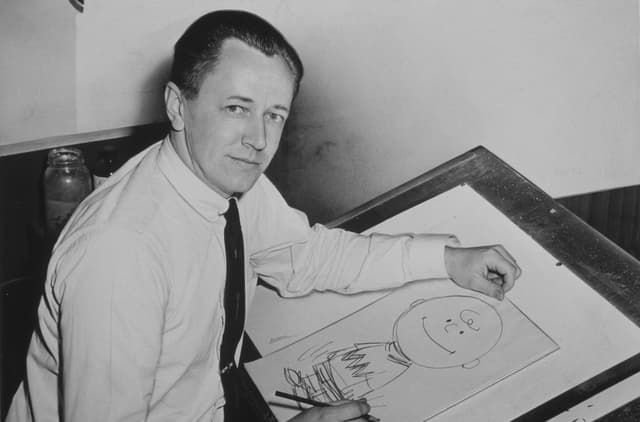
Charles M. Schulz
Peanuts
A pioneering figure in the media and entertainment industry, Charles M. Schulz created the beloved comic strip "Peanuts," which debuted in 1950 and became one of the most widely syndicated strips in history, appearing in over 2,600 newspapers worldwide. Schulz emphasized the importance of mastering a single craft, famously advising young creators to focus on doing one task well and to maintain integrity in their work. His dedication to consistent growth led to the strip’s enduring success for nearly five decades, culminating in the creation of numerous animated specials and merchandise that generated billions in revenue. Schulz's commitment to ongoing submissions and perseverance serves as a valuable lesson for today’s entrepreneurs, illustrating that success often comes from sustained effort and dedication rather than quick wins.
Core Principles
culture
Remember what your parents' lives and challenges were like at your own age. This is the only way to truly understand your children's problems.
Schulz reflected on his father's long barbershop hours and his mother's illness when he was a child. This memory helped him understand the lives of children and adults better, enriching his character development.
“I think it is important for adults to consider what they were doing and what their attitudes were when they were the age their own children are now. There is no other real way of understanding the problems of children.”
customer obsession
The most wonderful part of your work is knowing you are reaching people and communicating with them. This connection makes the work rewarding.
Schulz emphasized that the financial success of Peanuts, while significant, was secondary to the knowledge that millions read his work weekly and felt connection to the characters.
“The most wonderful part of the business is knowing that you are reaching people and communicating with them. This is what makes cartooning such a rewarding profession.”
focus
Be perfectly content to work on the single strip in front of you on your drawing board. Mastery comes from focused daily effort, not scattered ambition.
Rather than planning the next 10 years, Schulz focused entirely on executing the day's strip with excellence. This approach mirrors Henry Singleton's philosophy of steering the boat each day rather than predicting unpredictable outside influences.
“Be perfectly content to work on the single strip that is now in place now in front of you on your drawing board.”
Learn to do at least one task well and do it on a high plane. Do not sell out to the baser elements of your profession.
Schulz's core advice to young people was to master a single skill and maintain integrity in how you practice it. Despite offers to commercialize Peanuts extensively, he remained focused on the quality of the daily cartoon itself.
“If there were but one bit of advice I could give to a young person, it would be to learn to do at least one task well. Following that, I would also say, don't sell out to the baser elements of your profession. Do what you do on a high plane.”
Be willing to accommodate yourself to the task you are uniquely qualified to do. Do not try to be something you are not.
Schulz never pretended Peanuts was great art, nor did he chase other entertainment mediums like film or television. He focused entirely on what he was uniquely qualified for: comic strip cartooning.
“To have staying power, you must be willing to accommodate yourself to the task. I have never maintained that a comic strip is great art. It simply happens to be something I feel uniquely qualified to do.”
innovation
Get ideas by sitting alone in a room doing the work, not by seeking inspiration externally. Isolation and focus produce a cornucopia of ideas.
Schulz emphasized that most comic strip ideas came from sitting in a room alone, drawing seven days a week for 40 years. This mirrors Henry Singleton's approach of dreaming up ideas in a corner office away from distractions.
“Most comic strip ideas are like that they come from sitting in a room alone and drawing seven days a week as I've done for 40 years now.”
leadership
Only one creative mind should be responsible for each successful work. Avoid complex team structures when a single visionary can execute the vision.
Schulz emphasized that invariably there is one creative mind responsible for each successful comic strip. He rejected collaborations and large teams, preferring to maintain singular creative control.
“Beyond this lies one of the great truths of artistic endeavor, the value of a single creative mind turning out a piece of work. Invariably, there is one creative mind responsible for each successful comic strip.”
learning
Imitate first to learn. Study the techniques of masters in your field before developing originality.
As a young cartoonist, Schulz copied Buck Rogers and Walt Disney figures, studied various cartoonist techniques in magazines, and filled scrapbooks with Sherlock Holmes stories converted to comic form. This imitation phase was essential to his development.
“I was drawing cartoons in the early years, but created very few original characters. So he would just copy other ones. This is how we learn, right? We imitate first.”
mindset
You don't work all of your life to do something so you don't have to do it. Work you love should be the destination, not the means to escape work.
Visitors often suggested Schulz work ahead to take time off. He realized this misunderstood the purpose of his work. At 73, he still worked daily because drawing was itself the reward, not a burden to escape.
“You don't work all of your life to do something so you don't have to do it.”
Maintain gratitude for the privilege of doing work you love. Cartoonists have nothing to complain about if they can make a living doing what they always wanted to do.
Despite decades of work and pressure, Schulz reflected on his gratitude: cartoonists can live anywhere, work any hours, and earn money doing what they love. This perspective prevented entitlement and burnout.
“Cartoonists have nothing to complain about. This is all we ever wanted to do all of our lives and we finally have a chance to do it. We can live any place we want to. We can work any hours we want to. And they send us money.”
Your work can serve as a form of stability and spiritual grounding when life feels chaotic. The practice itself becomes a kind of religion.
Schulz described drawing his comic strip as akin to religion in the way a viola player felt about his instrument. The studio was his home, his place of belonging where he could always retreat and feel secure.
“Drawing a comic strip for me became a lot like a religion because it helps me survive from day to day. I always have this to fall back on. When everything seems hopeless and all of that, I know I can come to the studio and think, here is where I'm at home.”
Read widely for enjoyment, not just for research or ideas. Reading expands your mind and provides raw material for creative work.
Schulz read constantly throughout his life, not strategically seeking ideas but genuinely enjoying literature. He later recognized that this broad reading indirectly enriched his creative output.
“I read a lot. I don't read simply for research or to get ideas. I read because I enjoy it.”
Maintain childlike curiosity and avoid growing up. Ask people questions about themselves to stay engaged with life and generate ideas.
At 73, Schulz credited his ability to avoid boredom and stagnation to maintaining childlike curiosity. He advised high school students to ask their parents and grandparents about their lives, using these conversations as sources for deeper cartoon ideas.
“Maybe the real secret to not getting too old is to not grow up. I'm not a complete grown up, really.”
operations
Work in one single place with a regular routine. Create an environment where you feel safe, comfortable, and in control.
Schulz worked in the same small, plain studio for decades. He found that consistency of environment and routine enhanced his creativity and productivity more than fancy facilities or changing locations.
“I found from experience that is best to work in one single place and have a regular routine. I feel more comfortable in a small plain room than I do in a fancy studio.”
Have high standards and never let anyone else work on your core product. Maintain control over the quality and integrity of your output.
Schulz refused to use assistants on the actual comic strips, partly because there was little for them to do given his simple style, but primarily because he had too much pride in his work to compromise control. He personally created all 17,897 strips.
“I have never had anyone work as an assistant on the actual comic strip or comic pages, partly because I feel there would not be much for them to do. The drawing is relatively simple because of the style I have adopted, and I have too much pride to use anyone else's ideas.”
product
Draw inspiration from your own insecurities and human frailties. The characters that resonate most are those that reflect real vulnerability.
Charlie Brown's insecurity, his losses, his desperate hope reflected Schulz's own childhood anxieties. This authenticity made the character universally relatable and beloved.
Please yourself, not a particular audience. Critics cannot possibly know your work better than you do.
Schulz never gave his work to others asking for feedback. He trusted his own judgment about what was funny or effective and sent in work based on his own satisfaction, not audience anticipation.
“I never try to please a certain audience. I think that's disastrous. There's no way in the world you can anticipate what your reader is going to like or dislike.”
resilience
The ability to sustain quality despite personal problems and external difficulties separates good work from weak work. Maturity is required to set aside anger and carry on.
Schulz acknowledged that creating daily work while managing personal struggles, anger, and life's pressures is demanding. The discipline to maintain quality output through these challenges is a mark of professional maturity and excellence.
“I believe the ability to sustain a certain quality, in spite of everything, is one of the elements that separates the good features from the weaker ones.”
Start early by doing the apprenticeship work others avoid. Most aspiring creators want success without putting in years of foundational practice.
Schulz spent years drawing before his first syndicated strip, studying techniques, copying masters, and experimenting. Most aspiring cartoonists wanted to skip to publication without this essential apprenticeship.
“Very few cartoonists are willing to draw set after set of comic strips just for the experience. Most people who have comic strip ambition wish to be able to draw only two or three weeks material and then have it marketed.”
Always have something in the mail working for you. Never let a week go by without submitting your work to potential buyers.
Early in his career, Schulz maintained a constant pipeline of cartoons being submitted to syndicates and publishers. This relentless submission process eventually led to his breakthrough with United Features Syndicate.
“I tried never to let a week go by without having something in the mail working for me.”
simplicity
When stuck, go back to the basics. Never forget what your work is fundamentally about.
On days when Schulz wanted to draw something profound but felt blocked, he would return to cartooning's essence: drawing funny pictures. This reframing removed pressure and unlocked creativity.
“There are days when I would like to draw something very philosophical and meaningful or something to touch the hearts of everyone. And I find it absolutely impossible. One solution I use at these times is simply go back to the basics. Cartooning is, after all, drawing funny pictures.”
strategy
Success comes from slow, consistent growth over decades. Do not interrupt the compounding by quitting early.
Schulz's comic strip grew from 7 newspapers in 1950 to 2,000 by 1984, taking 34 years of steady expansion. This demonstrates the power of compound growth when you never stop working.
Watch out for corporate decision-makers who care only about the bottom line and never read the actual work. Build relationships with people who understand your craft.
After 40 years in the business, Schulz warned cartoonists that somewhere in large syndicate corporations were people who didn't care about the actual work and only cared about profit. Understanding this dynamic is crucial to protecting your interests.
“Someplace up there in these large corporations, there are some people that you will never know exist. They don't care anything about you. They don't even read the comics. They could not possibly care less about what happens to you.”
Do not think too far ahead. Focus on the daily episode in front of you and let new ideas and characters emerge organically.
Schulz cautioned against over-planning the long arc of a comic strip. New characters and storylines emerged unexpectedly when he remained present with the daily work. This allowed the strip to evolve naturally rather than follow a rigid predetermined path.
“One of the main things to avoid is thinking too far ahead of yourself.”
Frameworks
The Daily Strip System
Work on one strip at a time while maintaining a consistent submission pipeline. Schulz had six-week deadlines for daily strips and twelve-week deadlines for Sunday strips, creating a system where he always had work in progress at multiple stages simultaneously. This prevented both rushing and procrastination.
Use case: For creative professionals who need to balance current deadlines with future work, ensuring consistent output without burnout
The Long Game Expansion
Track growth in terms of slow, multi-decade compound expansion rather than rapid scaling. Schulz's growth from 7 newspapers in 1950 to 2,000 by 1984 demonstrates steady increases across 34 years, with significant acceleration only after proven consistency.
Use case: For strategic planning in creative fields or media businesses where audience growth depends on proven quality and sustained execution
The Environmental Control Principle
Create a single, consistent workspace that you optimize for your type of work. Schulz worked in the same small, plain room for decades, finding it superior to fancy studios because it provided control, consistency, and psychological safety.
Use case: For knowledge workers and creatives seeking to maximize productivity and quality by optimizing their physical and psychological environment
The Back-to-Basics Reset
When creative momentum stalls or ambition outpaces execution, return to the fundamental definition of your work. For Schulz, this meant remembering that cartooning is simply drawing funny pictures, which removed pressure and unlocked creativity.
Use case: For overcoming creative blocks and perfectionism by refocusing on core purpose rather than derivative goals
Stories
During high school, Schulz's mother showed him an advertisement for Art Instruction Schools. Despite the school being located in his own city of Minneapolis, he took all lessons by mail rather than attend in person. When asked why, he admitted he was not proud of his early work.
Lesson: Insecurity can drive discipline and self-education, but it can also hold you back. Schulz's willingness to work by mail despite proximity to the school shows how internal doubt motivated private practice. However, his later success came when he stopped letting insecurity prevent him from showing his work to others.
After his breakthrough meeting with United Features Syndicate in New York, Schulz returned to Minneapolis filled with hope and proposed to a woman he cared about. She turned him down and married someone else. He notes matter-of-factly that this rejection was the beginning of Charlie Brown, his loser character.
Lesson: Personal disappointment and failure directly informed his most successful creative work. The universal appeal of Charlie Brown came from Schulz's genuine experience of loss and romantic rejection, which he transformed into relatable art.
Schulz's mother died of cancer when he was 20, before any of his work was published. Decades later, when writing his autobiography at 52, he reflected on being older than his mother was when she died, and the loss remained something he had never fully recovered from.
Lesson: Profound personal loss shapes your creative sensibility and emotional depth in ways that make your work resonant. Schulz's ongoing grief, rather than being an obstacle, became a source of authentic emotional truth in his characters.
Schulz arrived early to a crucial meeting with Jim Freeman at United Features Syndicate. Deciding he hadn't eaten breakfast, he left to get food. By the time he returned, the meeting was over but Freeman had already decided to publish Peanuts, making the offer official.
Lesson: Sometimes casual decisions work in your favor. Schulz's anxiousness about arriving too early and needing breakfast turned into a blessing when Freeman moved forward with the deal while he was gone, removing the pressure of face-to-face negotiation.
Early in his syndication career, Schulz regularly submitted cartoons to major syndicates. One day he received a rejection and the very next day received interest from another. A promised deal fell through at the last minute, forcing him to start over. He persisted with multiple submissions until finally United Features responded positively.
Lesson: Rejection and setbacks are normal in the entrepreneurial journey. What distinguishes successful creators is their willingness to maintain constant submission and remain undiscouraged by individual rejections, trusting that persistence will eventually succeed.
At a networking event with friends in different professions (business, finance, legal), Schulz suddenly felt out of place realizing he only understood cartooning, golf, hockey, and reading. He was 73 years old and one of the most successful people alive, yet still felt insecure around people with different expertise.
Lesson: Success and mastery in one domain do not translate to confidence in all domains. Even the most accomplished people feel imposter syndrome when outside their area of expertise. This is a universal human experience, not a personal failure.
A visitor to Schulz's studio marveled that he could work six weeks ahead on daily strips and twelve weeks ahead on Sunday strips, then asked why he didn't just work hard for a few months and take time off. Schulz later realized this statement reflected a fundamental misunderstanding of why people work.
Lesson: People often view work as an obstacle to escape rather than as an end in itself. If you have found work you love, the goal is not to accumulate time off, but to sustain the work perpetually. The work is the point, not a means to avoid work.
Schulz noted that after nearly 50 years of cartooning, his drawing was better than ever, despite articles claiming he wasn't as good as he used to be and that he should quit before deteriorating. He credited continued improvement to staying healthy, handling the grind, and the fact that professions like cartooning reward longevity.
Lesson: Critics may advise you to quit when you are still improving. If you maintain health and can sustain the work, longevity itself becomes a competitive advantage as your mastery compounds.
Notable Quotes
“If there were but one bit of advice I could give to a young person, it would be to learn to do at least one task well. Following that, I would also say, don't sell out to the baser elements of your profession. Do what you do on a high plane.”
His primary advice to young people entering the cartooning profession, emphasizing both excellence and integrity
“You don't work all of your life to do something so you don't have to do it.”
Responding to suggestions that he work ahead and take time off, he articulated that meaningful work is the destination, not a burden to escape
“Most comic strip ideas are like that they come from sitting in a room alone and drawing seven days a week as I've done for 40 years now.”
Explaining where ideas originate, emphasizing isolation and focused practice over external inspiration-seeking
“I would never let anybody take over. And I have it in my contract that if I die, then my strip dies.”
At 73, responding to questions about whether he would let others continue the strip, demonstrating his commitment to singular creative control
“I never try to please a certain audience. I think that's disastrous. There's no way in the world you can anticipate what your reader is going to like or dislike.”
Explaining his approach to writing, emphasizing trust in his own judgment over audience pandering
“The most wonderful part of the business is knowing that you are reaching people and communicating with them. This is what makes cartooning such a rewarding profession.”
Describing the core satisfaction of his work, the connection with readers
“I think I'm more particular about what I do. My drawing is so much better now, in spite of the fact that I keep reading in articles that I'm not as good as I used to be.”
At 73, countering criticism with evidence of continued improvement
“It took me until last year to realize what an odd statement that really is. You don't work all of your life to do something so you don't have to do it. I could talk about Beethoven knocking out a few fast symphonies so he could take some time off or Picasso grinding out a dozen paintings so he could go away.”
Extended reflection on the philosophical difference between work as burden and work as calling
“Drawing a comic strip for me became a lot like a religion because it helps me survive from day to day. I always have this to fall back on. When everything seems hopeless and all of that, I know I can come to the studio and think, here is where I'm at home.”
Describing how his work functioned as spiritual grounding and refuge during difficult periods
“Be perfectly content to work on the single strip that is now in place now in front of you on your drawing board.”
Advising against thinking too far ahead and emphasizing focus on the present work
Frequently Asked Questions
What are Charles M. Schulz's key business principles?▼
Charles M. Schulz's core principles include: Remember what your parents' lives and challenges were like at your own age. This is the only way to truly understand your children's problems.. The most wonderful part of your work is knowing you are reaching people and communicating with them. This connection makes the work rewarding.. Be perfectly content to work on the single strip in front of you on your drawing board. Mastery comes from focused daily effort, not scattered ambition.. Founder Almanac has cataloged 27 total principles from Charles's career.
What can entrepreneurs learn from Charles M. Schulz?▼
Key lessons from Charles M. Schulz include: Insecurity can drive discipline and self-education, but it can also hold you back. Schulz's willingness to work by mail despite proximity to the school shows how internal doubt motivated private practice. However, his later success came when he stopped letting insecurity prevent him from showing his work to others.. Explore 8 stories and 4 frameworks from Charles's experience.
What is Charles M. Schulz known for in business?▼
A pioneering figure in the media and entertainment industry, Charles M. Schulz created the beloved comic strip "Peanuts," which debuted in 1950 and became one of the most widely syndicated strips in history, appearing in over 2,600 newspapers worldwide. Schulz emphasized the importance of mastering a single craft, famously advising young creators to focus on doing one task well and to maintain integrity in their work. His dedication to consistent growth led to the strip’s enduring success for nearly five decades, culminating in the creation of numerous animated specials and merchandise that generated billions in revenue. Schulz's commitment to ongoing submissions and perseverance serves as a valuable lesson for today’s entrepreneurs, illustrating that success often comes from sustained effort and dedication rather than quick wins.
More Media & Entertainment Founders





Want Charles's advice on your business?
Our AI has studied Charles M. Schulz's biography, principles, and decision-making frameworks. Ask any business question.
Start a conversation