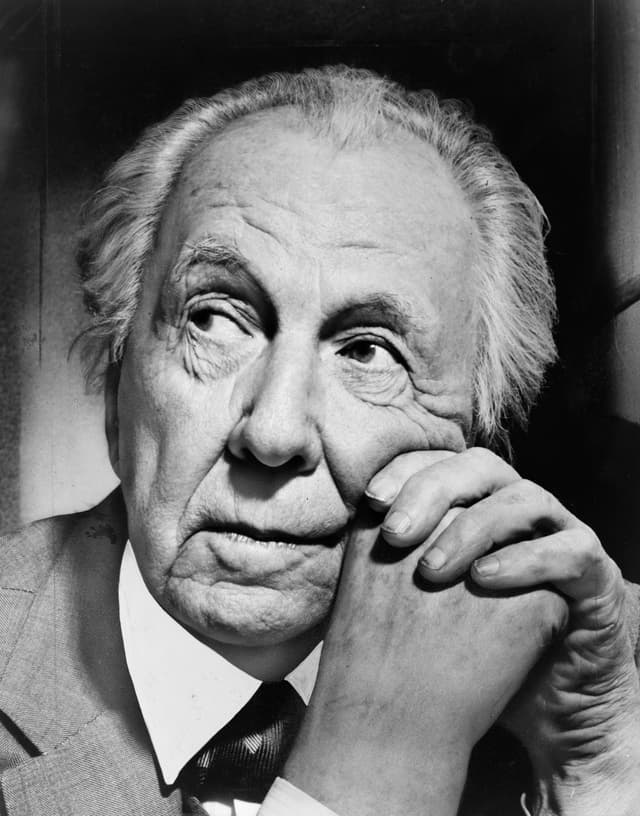
Frank Lloyd Wright
Frank Lloyd Wright Foundation / Taliesin Fellowship
As a pioneering architect and founder of the Frank Lloyd Wright Foundation and Taliesin Fellowship, Frank Lloyd Wright championed the integration of nature and architecture, leaving an indelible mark on modern design. His philosophy emphasized embracing one's unique vision, often prioritizing personal aesthetic satisfaction over client expectations, which led to iconic works such as the Guggenheim Museum in New York City. With over 1,000 structures to his name, Wright's relentless pursuit of innovation and beauty in architecture inspires entrepreneurs and creators to seek authenticity in their own endeavors. His assertion that "nothing is at last sacred but the integrity of your own mind" continues to resonate with those who value originality and passion in their work.
Core Principles
focus
Isolate yourself from the outside world to maintain focus on your vision. Minimize external encroachment and distractions on your creative work.
When Wright worked in Arizona, he deliberately isolated himself and his community. An employee described it as living on the moon with very little exposure to newspapers, magazines, or radio, creating a complete atmosphere of focus.
“It was like living on the moon. We seldom saw newspapers, magazines or radio. You lived in a complete atmosphere with very little encroachment from the outside world.”
innovation
Lean into what makes you eccentric and unique, not away from it. Your unusualness is what makes you interesting and valuable.
Frank Lloyd Wright's radical non-conformism and refusal to follow convention defined his architectural innovations. Rather than hiding his distinctive approach, he embodied it fully, which attracted attention and clients.
Synthesize and metabolize ideas from multiple disciplines and sources, then combine them into something new. Be a world-class assimilator of others' ideas.
Wright took ideas from nature, poetry, philosophy, European modernism, and other disciplines. He studied competing architects while scorning them, then stole and transformed their best ideas into his own superior work that merged organic and functional approaches.
“He married his own ideas about the romantic and the organic to their ideas about the functional machine, and the result was greater than the sum of the parts.”
No one owns ideas. Take the best thinking from predecessors and peers, synthesize it with your own work, and create something greater. This is how human progress works.
Wright's core philosophy about American architecture came from Sullivan, but he amplified it, deepened it, and made it his own. David Senra emphasizes that all great founders do this. It is not theft, it is the natural process of learning and innovation.
learning
Learn from a master mentor early in your career and absorb their best ideas, then synthesize those teachings with your own vision to surpass them.
Wright worked under Louis Sullivan, who taught him that form follows function and advocated for creating American architecture for Americans. Wright absorbed these lessons deeply, but eventually synthesized them with his own organic approach to exceed Sullivan's influence.
“Form follows function.”
marketing
Use your confidence and self-belief as a marketing tool. Boast about your abilities and let your ego fuel public attention and business opportunities.
Wright openly declared himself the greatest architect ever lived and used bombastic self-promotion similar to P.T. Barnum. This showmanship fed press coverage, which increased attention to his buildings and generated more commissions.
“If I said I was the greatest architect in the world I don't think it'd be arrogant.”
mindset
Find something you love doing and pursue it obsessively until the day you die. Do not set artificial limits or retirement dates on your contribution.
Wright designed nearly a third of his total architectural output in his last decade of life, from age 80 to 90. He saw no reason to stop or slow down as he aged, producing some of his most provocative and revolutionary designs including the Guggenheim Museum.
“I cannot get them out fast enough.”
Use your ego and arrogance deliberately, but hide it from the public unless strategically revealing it serves your goals. View vanity as potentially productive.
Wright believed his confidence was productive and deserved recognition. However, he also strategically deployed his arrogance to generate press attention and controversy, understanding that controversy drives interest and opportunity.
“Most people dislike vanity in others, but I give it fair quarter whenever I meet it, being persuaded that it is often productive of good to the possessor.”
Treat your work as a spiritual and sacred endeavor, not merely a commercial activity. Imbue your creations with meaning beyond their functional purpose.
Wright described architecture as the triumph of human imagination and a magic framework of reality. He spoke of his work in religious and spiritual terms, treating it as a form of expression that transcended commerce.
“Architecture is the triumph of human imagination over materials, methods, and men. There could never be great art unless it possessed a spiritual quality.”
Do not honor agreements or rules that you believe constrain your full potential. Break contracts or obligations when personal freedom and self-realization demand it.
Wright signed a five-year exclusive contract with Sullivan but moonlighted on residential projects within a year and a half because his financial needs exceeded the agreement. He viewed rules as applicable only to ordinary people.
“Ordinary people cannot live without rules to guide their conduct. I, Frank Lloyd Wright, am not ordinary.”
Live above your means and prioritize beautiful, luxurious experiences over financial stability. Let the necessities take care of themselves.
Wright spent his entire life purchasing luxury goods (oriental rugs, Japanese prints, subscription opera tickets, dandy clothing) and living far beyond his income. He was chased by creditors constantly but maintained this lifestyle as an expression of his values.
“So long as we had the luxuries, the necessities could pretty well take care of themselves.”
product
Exercise complete control over your product and vision, even at the cost of client relationships. Design for your own aesthetic satisfaction first.
Wright would visit houses he designed years later and rearrange furniture, remove client possessions, and redesign interiors to match his vision. He believed clients were privileged to work with him, not the other way around.
resilience
Do not set limits for yourself based on age, conventional wisdom, or past failures. Never accept that your best work is behind you.
After 20 years of being called a has-been and architectural theorist with nothing to show, Wright used the criticism as fuel. From age 64 to 92, he produced his greatest works, including the Guggenheim, proving all critics wrong.
“My obituaries are all of such nature as to make me want to arise and fight. I must come back.”
simplicity
Hack away at the unessential in your designs and offerings. Strip down to core function and beauty, removing anything superfluous.
Wright revolutionized American houses by removing attics, basements, porches, and closed rooms. He created open floor plans where spaces flowed together, eliminating the Victorian compartmentalization that was standard at the time.
strategy
Bet on yourself by turning down prestigious external opportunities. Choose to build your own vision independently rather than accept someone else's platform.
When the renowned architect Daniel Burnham offered Wright an all-expenses-paid six-year postgraduate education in Paris and Rome, Wright declined. He chose instead to stake his chances on his own visions and independent practice.
When facing financial desperation and professional rejection, create a new business model to survive while maintaining your core mission. Turn constraints into opportunities.
When nearly bankrupt and written off by the architectural establishment, Wright created the Taliesin Fellowship, charging aspiring architects $675-$1,100 to study under him while performing labor on his property. This funded his survival and incubated his next great works.
“Why not start a work school for aspiring architects who would learn at the master's feet while milking his cows and chopping his wood?”
Connect your work to larger philosophical and political ideas. Frame your creations as expressions of deeper principles like freedom, democracy, or human potential.
Wright articulated his house designs as expressions of democratic freedom and individual liberty. He tied his architectural innovations to broader American ideals, giving his work spiritual and philosophical significance beyond mere building.
“The house planted by myself on the good earth of the Chicago prairie was the first truly democratic expression of our democracy in architecture.”
Frameworks
Organic Architecture Philosophy
Buildings should grow from inside out and emerge from the earth like plants and trees seeking light. The design should harmonize with nature and the landscape rather than impose artificial forms upon it. This philosophy influenced Wright's belief that structures should be integrated with their environment and reflect natural principles of growth and form.
Use case: Designing buildings, products, or systems that feel natural, integrated, and aligned with their context rather than forced or artificial.
Democratic Architecture Framework
Architecture should express and enable individual freedom by removing unnecessary barriers and compartmentalization. Open floor plans, flowing spaces, and simplified designs democratize living spaces by making them more functional and beautiful for ordinary people, not just the wealthy. This ties architectural decisions to larger political and philosophical ideals.
Use case: Creating products, services, or spaces that embody and express larger values like freedom, equality, or human dignity. Useful for mission-driven companies and designers.
Spiritual Quality Framework
Great work must possess spiritual quality or it is merely functional material. The work should express meaning, purpose, and connection to something larger than itself. Without this spiritual dimension, the creation remains empty regardless of technical excellence.
Use case: Ensuring that your work carries meaning and purpose beyond commercial success. Helps creators and entrepreneurs infuse their work with deeper significance and resonance.
Comeback Strategy Through Isolation and Fellowship
When facing professional obsolescence and financial ruin, create a teaching fellowship that brings together aspiring practitioners. Charge them to study under your mentorship while having them contribute labor to your projects. This generates revenue, creates a community of believers, and provides the conditions for your next creative resurgence.
Use case: Turnaround situations where an established but struggling founder needs to regenerate both income and creative energy while building a movement.
Stories
Wright's friend and fellow architect wrote to him in his late twenties: 'I've found there's no joy in architecture for me except as I see you do it. It bores me when I try to do it myself.' The friend predicted Wright would achieve the kind of success he wanted, but only because Wright would pay the price in concentrated hard work and human sacrifice that few others would tolerate.
Lesson: Excellence requires obsessive commitment and sacrifice that separates you from your peers. Your dedication and willingness to pay the price is what creates your competitive advantage and unique position.
At age 17-18, Wright left Wisconsin for Chicago with only complete faith in himself and boundless belief that he would become a world figure on architecture's stage within a decade. He had no connections, no money, no credentials, but possessed unshakeable self-belief and giant-sized ambition.
Lesson: Faith in yourself and a clear vision can substitute for external resources, credentials, or connections when you're young. Your belief in your own potential is your most valuable asset when starting out.
From age 48 to 65, Wright completed only 34 projects while being called a has-been and architectural theorist with no real buildings to show. An influential critic wrote that 'As an architectural theorist Mr. Wright has no superior, but as an architect he has little to contribute.' Rather than retire, Wright used this insult as fuel and roared back to create his greatest works.
Lesson: Professional rejection and obsolescence can be reframed as fuel for comeback. The low point is not the end, but potentially the beginning of your greatest work if you refuse to quit.
When nearly bankrupt in 1932, with his wife writing desperately to his sister for $300 and saying 'We are destitute at the present moment,' Wright created the Taliesin Fellowship. Within four years, he had designed the Johnson Wax Building, Fallingwater, and the Jacobs House, works that secured his legacy forever.
Lesson: Extreme financial desperation can force creative problem-solving that leads to your greatest work. Constraints breed innovation when you're unwilling to accept failure.
Wright's youngest son, Robert, wrote as an adult: 'I remember visiting him in a Chicago hotel room when I was about 12 and seeing him stave off an insistent creditor with jocular excuses. To him it was all a joke. To me it was humiliating, and I've been afraid to buy anything on credit ever since.' Robert consciously rejected his father's arrogance, narcissism, and financial recklessness in his own life.
Lesson: Your extreme behaviors and choices create ripple effects across generations. The damage inflicted on family members through neglect or poor modeling can shape their entire approach to life, though often in reaction against your example.
In the last 15 years of his life (age 77-92), Wright designed 350 buildings. In his last decade alone (age 80-89), he produced nearly a third of his entire lifetime output. Some of his most provocative and revolutionary designs, including the Guggenheim Museum, came at the very end of his life.
Lesson: Age is not a limit on creative output or innovation. If you love your work, your best work can come at the end of your life, not the beginning. Retirement is optional for those who love what they do.
Notable Quotes
“Nothing is at last sacred but the integrity of your own mind.”
From the Emerson poem 'Self-Reliance' that Wright insisted be read at his funeral. Captures his core philosophy of prioritizing personal truth over social convention.
“Architecture is the triumph of human imagination over materials, methods, and men to put man into possession of his own earth.”
His philosophical definition of architecture showing how he viewed his work as transcending mere building to enable human freedom and potential.
“If I said I was the greatest architect in the world I don't think it'd be arrogant.”
Demonstrates his extreme self-confidence and refusal to use qualifiers or modesty when describing his abilities. He compared himself to Leonardo da Vinci.
“I cannot get them out fast enough.”
Said at age 85 about his designs, expressing the urgency and volume of his creative output during his late-life renaissance.
“I defy anyone to name a single aspect of the best contemporary architecture that wasn't first done by me.”
Statement at age 85 showing his ego remained undiminished with age and his belief in his own precedence in the field.
“Ordinary people cannot live without rules to guide their conduct. I, Frank Lloyd Wright, am not ordinary.”
Said at a press conference on Christmas Day while defending his decision to abandon his family. Illustrates his belief that social rules did not apply to him.
“So long as we had the luxuries, the necessities could pretty well take care of themselves.”
Reveals his approach to money and spending, prioritizing beauty and cultural experiences over financial stability.
“My obituaries are all of such nature as to make me want to arise and fight. Indeed, I feel for the sake of the cause architecture I must come back.”
Written when critics had written him off as irrelevant. Shows how he transformed professional rejection into motivation for his greatest work.
“There could never be great art unless it possessed a spiritual quality. If there was no spiritual quality in architecture, it would just be plain lumber.”
From his last interview, expressing his belief that great work must transcend function to embody deeper meaning and purpose.
“The house planted by myself on the good earth of the Chicago prairie was the first truly democratic expression of our democracy in architecture.”
Shows how Wright connected his architectural innovations to larger philosophical ideals about American freedom and democracy.
Frequently Asked Questions
What are Frank Lloyd Wright's key business principles?▼
Frank Lloyd Wright's core principles include: Isolate yourself from the outside world to maintain focus on your vision. Minimize external encroachment and distractions on your creative work.. Lean into what makes you eccentric and unique, not away from it. Your unusualness is what makes you interesting and valuable.. Synthesize and metabolize ideas from multiple disciplines and sources, then combine them into something new. Be a world-class assimilator of others' ideas.. Founder Almanac has cataloged 19 total principles from Frank's career.
What can entrepreneurs learn from Frank Lloyd Wright?▼
Key lessons from Frank Lloyd Wright include: Excellence requires obsessive commitment and sacrifice that separates you from your peers. Your dedication and willingness to pay the price is what creates your competitive advantage and unique position.. Explore 6 stories and 4 frameworks from Frank's experience.
What is Frank Lloyd Wright known for in business?▼
As a pioneering architect and founder of the Frank Lloyd Wright Foundation and Taliesin Fellowship, Frank Lloyd Wright championed the integration of nature and architecture, leaving an indelible mark on modern design. His philosophy emphasized embracing one's unique vision, often prioritizing personal aesthetic satisfaction over client expectations, which led to iconic works such as the Guggenheim Museum in New York City. With over 1,000 structures to his name, Wright's relentless pursuit of innovation and beauty in architecture inspires entrepreneurs and creators to seek authenticity in their own endeavors. His assertion that "nothing is at last sacred but the integrity of your own mind" continues to resonate with those who value originality and passion in their work.
More Art Founders
Want Frank's advice on your business?
Our AI has studied Frank Lloyd Wright's biography, principles, and decision-making frameworks. Ask any business question.
Start a conversation