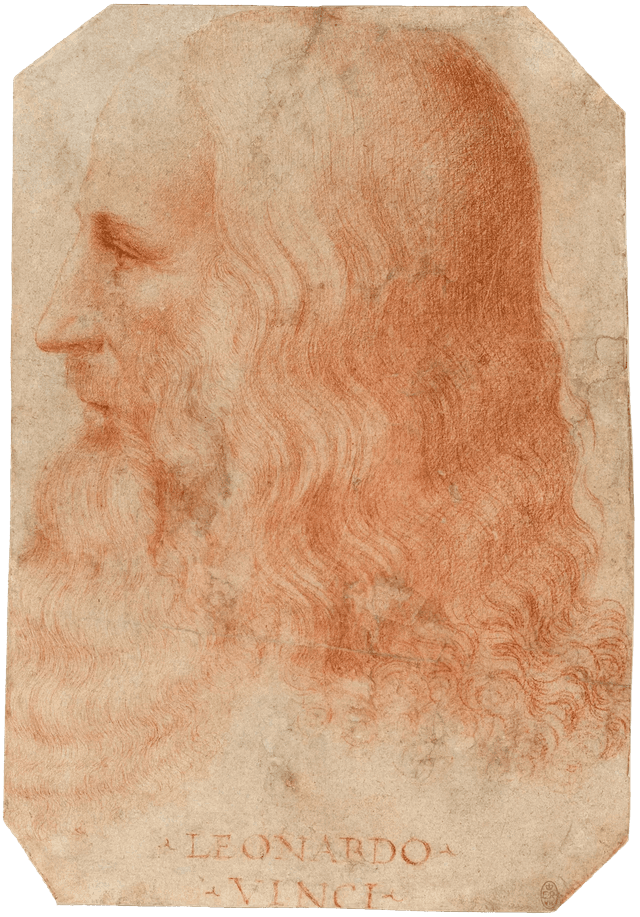
Leonardo da Vinci
A true polymath of the Renaissance, Leonardo da Vinci (1452-1519) revolutionized the art industry through his relentless pursuit of knowledge and hands-on experimentation. His iconic painting, the "Mona Lisa," not only exemplifies his mastery of technique but also showcases his deep understanding of human emotion and expression, making it one of the most celebrated works in history. Da Vinci’s commitment to direct observation and meticulous detail set a precedent for modern innovation, urging entrepreneurs today to embrace experimentation and reflection in their creative processes. By dissecting cadavers to uncover the intricacies of human anatomy, he demonstrated that profound insights often arise from a willingness to delve deep into complex subjects. His belief that "experience rather than the words of others" drives true understanding emphasizes the importance of real-world application for aspiring business builders.
Core Principles
focus
Focus on questions that require empirical observation, not theoretical debate. Don't expend energy on things the mind cannot test or prove through natural evidence.
Leonardo deliberately avoided expounding on religion and theology, stating he would not attempt to write or give information about things the human mind cannot prove through instances of nature. He recognized the limits of pure theory and focused his energy on observable phenomena. This pragmatic approach kept him grounded in reality.
“I would not endeavor to write or give information of those things of which the human mind is incapable and which cannot be proved by an instance of nature.”
innovation
Transcend disciplinary silos. Look for intersections between art and science, technology and humanities. The most creative breakthroughs happen at the boundaries between fields.
Leonardo's knowledge of how light strikes the retina informed the perspective in The Last Supper. Anatomical studies of lips informed the famous smile of the Mona Lisa. He understood that art was science and science was art. Steve Jobs later applied this same principle, ending product presentations with an image of the intersection of liberal arts and technology, identifying Leonardo as his hero.
Combine imagination with intellect and observation. Creativity is the ability to apply imagination to intellect, connecting things seen to things unseen.
What separated Leonardo from merely intelligent people was his creative genius, his facility for combining careful observation with wild fantasy. He could draw a fetus with scientific precision while also depicting impossible machines. This blend of the rational and imaginative is what gave him insight no single mode of thinking could provide.
Be relentlessly and randomly curious about everything. Small, seemingly unrelated observations can lead to major discoveries and creative breakthroughs.
Leonardo's to-do lists mixed practical items with seemingly random curiosities: 'Describe the tongue of the woodpecker,' 'Describe the jaw of the crocodile.' These were not eccentric distractions but focused investigations into biomechanics. The woodpecker's tongue taught him about muscles that push rather than pull. The crocodile's jaw revealed force distribution principles. This curiosity across domains gave him insights no specialist could achieve.
“I am fully aware that my not being a man of letters may cause certain presumptuous people to think that they may with reason blame me alleging that i am a man without learning foolish folk they strut about puffed up and pompous decked out and adorned not with their own labors but by those of others.”
Pursue knowledge through direct experience and experimentation rather than relying solely on received wisdom or theory. Test ideas in the real world to understand patterns and natural forces.
Leonardo rejected formal education and instead became 'a disciple of experience and experiments.' He famously stated that his subjects required experience rather than the words of others. This approach led him to discover arteriosclerosis centuries before medical science formally recognized it, by dissecting cadavers and carefully observing the differences between a centenarian's and a young boy's blood vessels.
“My intention is to consult experiences first and then, with reasoning, show why such experience is bound to operate in such a way.”
mindset
Be driven by curiosity and wonder rather than immediate practical application. The most valuable knowledge often comes from pursuing what fascinates you, not what you think you need.
Leonardo investigated woodpecker tongues, crocodile jaws, and water flow patterns with no immediate practical application to his commissions. Yet these investigations deepened his understanding of biomechanics and fluid dynamics, enriching both his art and his scientific thinking. Pure curiosity often yields more than goal-directed research.
Allow ideas to marinate and mature. Creativity requires periods of contemplation and reflection, not continuous action. Sometimes the most productive work happens when you step back.
While painting The Last Supper, Leonardo would sometimes stare at the work for hours, apply one or two brush strokes, and leave. When confronted by the Duke about his slow progress, Leonardo explained that men of genius accomplish the most when they work the least, because their minds are occupied with perfecting conceptions before giving them physical form. This principle applies to any creative or strategic work.
“Men of lofty genius sometimes accomplish the most when they work least, for their minds are occupied with their ideas and the perfection of their conceptions to which they afterwards give form.”
Seek knowledge for its own sake, not just for immediate utility. Pure curiosity driven by pleasure and wonder creates more connections and insights than goal-directed learning.
Leonardo spent years studying human anatomy, water flow, and fossil formations without needing that knowledge to paint masterpieces. By pursuing knowledge freely, he explored more horizons and discovered more connections than anyone else of his era. This breadth of exposure trained his mind to see patterns across domains.
Think in analogies and patterns. Map observations from one domain onto another to understand universal principles. The microcosm reflects the macrocosm.
Leonardo saw the human body as analogous to the earth: bones as rocks, blood as ocean tides, veins as springs. This analogical thinking allowed him to see patterns in nature that specialists working within single disciplines missed. His ability to draw comparisons across domains strengthened both his art and science.
“The ancients called man a lesser world, and certainly the use of the name is well bestowed, because his body is an analog for the world.”
Be willing to be a polymath and transcend a single specialty. Genius lies not just in depth but in breadth and the ability to see connections across fields.
Leonardo painted masterpieces, designed military fortifications, studied anatomy, investigated water flow, created musical instruments, and choreographed pageants. No one has ever matched his breadth of achievement across so many disciplines. This universal mind allowed him to understand patterns in nature that specialists could never see.
operations
Make lists constantly, and include odd, seemingly random items alongside practical ones. Writing forces clarity and creates a record for future inspiration.
Leonardo filled notebooks with lists mixing anatomical tools, to-do items, and curious observations: spectacles, fire stick, fork, curved knife, charcoal, and then 'Describe the tongue of the woodpecker.' His 7,200+ surviving pages represent roughly one quarter of what he wrote. These notebooks became the most astonishing testament to human observation ever created, providing a documentary record for centuries.
Keep physical notebooks alongside any digital systems. Paper lasts centuries while digital storage may not. Create a lasting record for future generations.
Walter Isaacson notes that Leonardo's 7,200 surviving pages on paper have outlasted the vast majority of Steve Jobs' digital documents from the 1990s, despite Jobs being more recent. Physical paper proves more durable than digital storage as preservation medium. Creators should balance the convenience of digital with the permanence of analog.
product
Develop deep observational skills by breaking complex subjects into their smallest components. Examine details methodically before attempting to understand the whole.
Leonardo's anatomical drawings demonstrate this principle perfectly. He would dissect bodies layer by layer, documenting every muscle, vein, and organ with meticulous care. His method required patience and systematic thinking, as he compared observation to reading a book word by word rather than trying to grasp meaning from the whole page at once.
“If you wish to have a sound knowledge of the forms of objects, begin with the details of them and do not go on to the second step until you have the first well fixed in your memory.”
Never declare a work finished. Continuous refinement and evolution are signs of true craftsmanship. Freezing a work stops its potential growth.
Leonardo carried the Mona Lisa with him for 20 years, continuously refining it even after others considered it complete. He returned to paintings months or years later to add new strokes as he matured. This refusal to finish meant many commissions never formally concluded, but it also meant his work never stagnated.
strategy
Don't fear overreach or fantasy. To be a true visionary, you must sometimes create plans that seem impractical. Innovation requires a reality distortion field.
Leonardo designed flying machines, scuba gear, helicopters, and a scheme to divert the Arno River using massive ditch systems. None came to fruition in his lifetime, yet these fantasies often predicted reality centuries later. His ability to imagine beyond current constraints allowed him to see possibilities others could not. The failure to execute was less important than the willingness to dream big.
Frameworks
Procrastination for Perfection
Allow projects to mature through periods of active work, contemplation, and rest. Gather facts and possibilities, then step back and let ideas simmer. Return periodically to refine with small adjustments informed by deeper thinking. Creativity requires incubation time, not just execution time.
Use case: Creative work, strategic planning, product design, any work where quality depends on refinement over time.
Experience Greater Than Theory
Prioritize direct observation and experimentation over abstract theoretical principles. Begin with facts gathered through personal investigation, then use reason to infer the patterns and natural laws at work. This approach keeps thinking grounded in observable reality and prevents dogmatic adherence to untested ideas. It combines empirical evidence with logical inference to build reliable understanding.
Use case: Product development, scientific research, engineering challenges, any domain where understanding how things actually work matters more than existing theories.
The Microcosm-Macrocosm Analogy
Look for universal patterns by mapping observations from one domain onto another. Human bodies reflect planetary systems; local phenomena reflect cosmic patterns. By studying how things work at different scales and in different contexts, you discover underlying principles that apply across domains. This analogical thinking reveals connections that specialists within single disciplines miss.
Use case: System design, organizational structure, understanding complex systems, creative problem-solving across disciplines.
Layered Observation Method
Break complex subjects into their smallest components and study them systematically, layer by layer, before attempting to understand the whole. Work methodically from surface to depth, documenting each level before moving to the next. This ensures deep understanding and prevents surface-level comprehension.
Use case: Research, product analysis, learning new domains, quality assurance, any work requiring thorough understanding.
Cross-Disciplinary Synthesis
Deliberately expose yourself to knowledge and practice across multiple fields. Look for the intersections where ideas from different domains meet and create novel combinations. The most creative breakthroughs occur when you blend approaches, perspectives, and knowledge from different specialties.
Use case: Innovation, product development, strategy, leadership, any role requiring creative problem-solving.
Continuous Refinement Rather Than Completion
Treat work as always evolving rather than as projects to be finished. Return to previous work regularly to refine it as you grow and learn. Declare something finished only when you must; otherwise, keep it open to improvement. This prevents stagnation and allows quality to improve indefinitely.
Use case: Product management, software development, creative pursuits, any domain where iterative improvement drives quality.
Reality Distortion for Vision
Allow yourself to imagine and design solutions that seem impractical or impossible within current constraints. Fantasies often become paths to reality centuries later. Overreach is necessary to achieve genuine innovation. The failure to execute immediately is less important than the willingness to envision beyond present limitations.
Use case: Strategic vision, innovation planning, long-term product roadmaps, any context where you need to inspire teams to think beyond incremental improvement.
Curious Randomness
Cultivate curiosity across seemingly unrelated topics. Create systems (like lists) that capture diverse interests and investigations. The random, deep dives into odd questions often reveal patterns or insights applicable to your main work. Embrace intellectual tangents as tools for creative thinking.
Use case: Ideation, research, learning, innovation, personal development.
Stories
Leonardo spent his nights dissecting cadavers at a hospital, including a centenarian who had lived without illness. By carefully examining the old man's blood vessels layer by layer and comparing them to those of a young boy, Leonardo documented the process of arteriosclerosis centuries before medical science formally recognized it. He concluded the arterial constriction resembled how orange peels thicken as fruit ages.
Lesson: Deep empirical observation combined with careful analogical thinking can lead to scientific discoveries that outpace official theory. Hands-on investigation by a curious mind can reveal truths that remain hidden to those relying on inherited knowledge alone.
While painting The Last Supper, Leonardo's patron, Duke Ludovico, complained about his slow progress. Leonardo would arrive in the morning and paint continuously without eating or drinking, then on other days stare at the work for hours, contemplate it, make one or two brush strokes, and depart. When confronted, Leonardo explained that men of genius accomplish the most when they work least, for their minds are perfecting conceptions.
Lesson: Periods of apparent inactivity are essential to creative work. The time spent reflecting and allowing ideas to mature is not wasted time but necessary computation. Patrons and leaders must understand that genius requires both action and contemplation.
Leonardo and Michelangelo, both in Florence, became rivals. Michelangelo, 23 years younger, harbored great disdain for Leonardo. When Leonardo suggested Michelangelo might explain a passage from Dante, Michelangelo responded harshly, mocking Leonardo's failed bronze horse monument. The two embodied opposite approaches: Leonardo was colorful, curious, generous, secular. Michelangelo was pious, celibate, dressed in rags, often contentious.
Lesson: Different temperaments and approaches can coexist in the same era without synthesis. Genius is not monolithic. Leonardo's openness and curiosity differed radically from Michelangelo's pious intensity, yet both achieved greatness. Success doesn't require a single personality type.
Leonardo was commissioned by Caesar Borgia, a ruthless tyrant and son of Pope Alexander VI, to design military and engineering projects. Leonardo, possibly at Machiavelli's suggestion, worked on the Arno diversion scheme, calculating it would require 540 men working 100 days to move one million tons of earth. He performed one of history's first time and motion studies, determining that one shovel load of dirt weighed 25 pounds and each wheelbarrow held 20 loads.
Lesson: Genius applies itself to available opportunities, even those involving questionable actors. Leonardo's willingness to work for a morally compromised patron allowed him to pursue grand engineering projects. Pragmatism about patronage can enable ambitious work.
Leonardo created a to-do list that mixed practical anatomical tools, personal reminders, and strange curiosities: spectacles, fire stick, fork, curved knife, charcoal, boards, sheets of paper, white chalk, wax, forceps, glass pane, fine-tooth bone saw, scalpel, inkhorn, penknife, and then 'Describe the tongue of the woodpecker.' This entry later proved crucial as he investigated how woodpecker tongues push rather than pull, revealing biomechanical principles applicable to human anatomy.
Lesson: Seemingly random curiosities on lists are often not random at all but part of a deeper investigative agenda. Random tangents and odd questions, when followed with seriousness, often reveal unexpected connections. The list-making practice itself creates space for discovery.
Notable Quotes
“I am fully aware that my not being a man of letters may cause certain presumptuous people to think that they may with reason blame me alleging that i am a man without learning foolish folk they strut about puffed up and pompous decked out and adorned not with their own labors but by those of others. They will say that because I have no book learning, I cannot properly express what I desire to describe, but they do not know that my subjects require experience rather than the words of others.”
Responding to criticism about his lack of formal education, defending the empirical method and direct observation over received wisdom.
“My intention is to consult experiences first and then, with reasoning, show why such experience is bound to operate in such a way.”
Describing his method of investigation, placing facts before theory, observation before explanation.
“If you wish to have a sound knowledge of the forms of objects, begin with the details of them and do not go on to the second step until you have the first well fixed in your memory.”
Explaining his layered observation method for deep understanding of complex subjects.
“The penis sometimes displays an intellect of its own. When a man may desire to be stimulated, it remains obstinate and goes its own way, sometimes moving on its own without the permission of its owner. When he is awake or sleeping, it does what it desires. Often when the man wishes to use it, it desires otherwise, and often it wishes to be used and the man forbids it. Therefore, it appears that this creature possesses a life and an intelligence separate from the man.”
From his notebooks section 'On the Penis,' observing with humor and curiosity the autonomy of bodily functions.
“Man is wrong to be ashamed of giving it a name or showing it, he added, always covering and concealing something that deserves to be adorned and displayed with ceremony.”
Expressing his lack of religious shame about the human body and sexuality, contrasting with the religious prudishness of his era.
“Men of lofty genius sometimes accomplish the most when they work least, for their minds are occupied with their ideas and the perfection of their conceptions to which they afterwards give form.”
Explaining to Duke Ludovico why he worked slowly on The Last Supper, defending the creative need for contemplation and incubation time.
“The river that is to be diverted from one course to another must be coaxed and not treated roughly or with violence.”
From his notebook describing the Arno diversion project, showing his approach to engineering that worked with natural forces rather than against them.
“I made an autopsy in order to ascertain the cause of so peaceful a death, and found that it proceeded from weakness throughout the failure of blood and of the artery that feeds the heart and the other lower members, which I found to be very dry, shrunken, and withered.”
Documenting his discovery of arteriosclerosis through dissection and careful observation, centuries before medical science formally recognized the condition.
“As a well-spent day brings a happy sleep, so a well-employed life brings a happy death.”
Reflecting on the importance of how time is used, emphasizing that daily effort compounds into meaningful existence.
“He saw beauty in both art and engineering, and his ability to combine them was what made him a genius.”
Jobs identifying the intersection of liberal arts and technology as the source of Leonardo's genius, and the inspiration for Apple's philosophy.
Frequently Asked Questions
What are Leonardo da Vinci's key business principles?▼
Leonardo da Vinci's core principles include: Focus on questions that require empirical observation, not theoretical debate. Don't expend energy on things the mind cannot test or prove through natural evidence.. Transcend disciplinary silos. Look for intersections between art and science, technology and humanities. The most creative breakthroughs happen at the boundaries between fields.. Combine imagination with intellect and observation. Creativity is the ability to apply imagination to intellect, connecting things seen to things unseen.. Founder Almanac has cataloged 17 total principles from Leonardo's career.
What can entrepreneurs learn from Leonardo da Vinci?▼
Key lessons from Leonardo da Vinci include: Deep empirical observation combined with careful analogical thinking can lead to scientific discoveries that outpace official theory. Hands-on investigation by a curious mind can reveal truths that remain hidden to those relying on inherited knowledge alone.. Explore 5 stories and 8 frameworks from Leonardo's experience.
What is Leonardo da Vinci known for in business?▼
A true polymath of the Renaissance, Leonardo da Vinci (1452-1519) revolutionized the art industry through his relentless pursuit of knowledge and hands-on experimentation. His iconic painting, the "Mona Lisa," not only exemplifies his mastery of technique but also showcases his deep understanding of human emotion and expression, making it one of the most celebrated works in history. Da Vinci’s commitment to direct observation and meticulous detail set a precedent for modern innovation, urging entrepreneurs today to embrace experimentation and reflection in their creative processes. By dissecting cadavers to uncover the intricacies of human anatomy, he demonstrated that profound insights often arise from a willingness to delve deep into complex subjects. His belief that "experience rather than the words of others" drives true understanding emphasizes the importance of real-world application for aspiring business builders.
More Art Founders
Want Leonardo's advice on your business?
Our AI has studied Leonardo da Vinci's biography, principles, and decision-making frameworks. Ask any business question.
Start a conversation