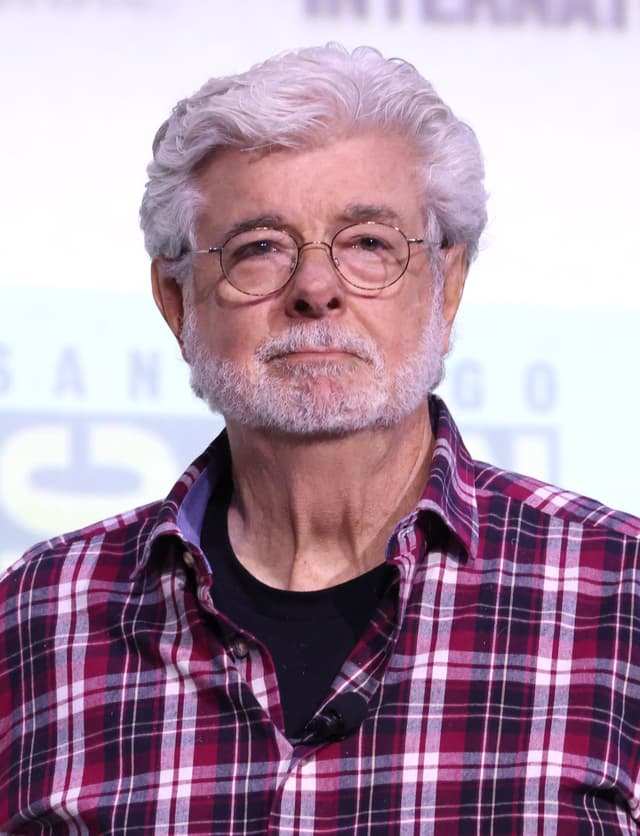
George Lucas
Lucasfilm
A visionary in the Media & Entertainment industry, George Lucas founded Lucasfilm and revolutionized filmmaking with the creation of the Star Wars franchise, which has grossed over $10 billion worldwide. Initially aspiring to be a race car driver, an accident shifted his focus to film, leading him to study the craft obsessively and innovate in special effects and storytelling. Lucas emphasizes the importance of financial independence and creative control, principles that guided him as he navigated the complexities of Hollywood while maintaining a commitment to quality and conservative management. His partnership with Francis Ford Coppola demonstrated his belief in collaboration, as he recognized the unique charisma and vision that great leaders bring to their projects.
Core Principles
culture
Build a network of peer collaborators and friends in your industry who can inspire, challenge, and support your work. These relationships can be competitive and collaborative simultaneously.
Lucas and Steven Spielberg developed a lifelong friendship where they functioned as partners, pals, and inspiration for each other while remaining competitors. The USC Mafia of film students became a self-supporting network that regularly hired, collaborated, and conspired on projects across decades, creating mutual success.
“My partner, my pal, my inspiration, my challenge.”
Build a small, focused team that shares your standards and vision rather than managing large hierarchies. Quality of team matters far more than size.
Lucasfilm began with just Lucas and his wife Marcia in a small house in Mill Valley. He preferred working alone or with a tight group of people who understood his vision and could keep up with his intensity. He became irritated with crew members who could not execute at his level, preferring a competitive environment where everyone was committed.
“I was really incensed at the democratic process of filmmaking. I was into making it a competition. Who can get it done first and best?”
finance
Stay small, be the best, and don't lose money. Conservative financial management protects your independence more than rapid scaling.
Lucas repeatedly counseled Coppola to stay in the black when American Zoetrope was hemorrhaging cash. He applied this principle throughout his career: keeping Lucasfilm lean, reinvesting profits into technology development, and avoiding debt that would give studios leverage over him. This fiscal discipline allowed him to survive failures like THX 1138 and fund ambitious projects like Star Wars.
“Stay small, be the best, don't lose any money.”
Bet on yourself by accepting lower fees in exchange for upside participation. Align your compensation with project success rather than guaranteed income.
When finally given the chance to make American Graffiti, Lucas cut his director fee in half to $50,000 and asked for 40% of profits instead. At the time, it was highly uncertain the film would turn any profit given his track record. But this deal structure aligned his interests with the project's success and eventually made him exponentially more wealthy than a standard director fee could have.
Maintain financial discipline even when successful. Stay conservative with spending, avoid unnecessary debt, and reinvest profits back into the business rather than personal consumption.
Lucas grew up with a self-made, financially conservative father. Throughout his career, even after massive financial success, he reinvested profits into building Skywalker Ranch, funding Pixar development, and expanding Lucasfilm rather than engaging in conspicuous consumption. This approach allowed him to build multiple companies and maintain independence.
“Stay small, be the best, don't lose money.”
Study the structural economics of your industry and identify where value is being captured. Then reorganize your business model to capture more of that value yourself.
Lucas analyzed how the studio system took 60% of profits for distribution while he did the creative work and took risks. He realized he could borrow money directly and handle distribution himself, restructuring the deal to keep 77.5% of profits while Fox received 22.5%. This fundamental restructuring came from understanding where value actually flowed.
“I know what I'm doing for my 50%. I put my heart and soul in this. My whole career is at stake. What are you doing for your 50%?”
focus
Be willing to reject lucrative opportunities if they conflict with your core vision and values. Short-term financial gain should not override long-term control and autonomy.
During the development of American Graffiti, Lucas turned down multiple lucrative directing offers from studios offering $100,000 fees on projects that did not interest him. He was in severe debt but refused to compromise his vision. This commitment to his own projects, even in financial desperation, eventually led to far greater success.
“This was a very dark period for me. We were in dire financial straits. I turned down directing at my bleakest point when I was in debt to my parents, in debt to Francis Coppola, in debt to my agent.”
innovation
Build your own infrastructure and develop proprietary technology to solve problems studios cannot solve, creating competitive advantage through vertical integration.
When Lucas couldn't achieve his creative vision because special effects technology didn't exist, he founded Industrial Light and Magic to build the technology himself. Rather than accept limitations, he made the system serve his vision. This approach gave him control over quality, cost, and innovation while creating a business asset that dominated the industry for decades.
Invest in technology infrastructure that solves real problems in your industry, even if it requires founding entirely new companies. These investments can become more valuable than your primary business.
Lucas founded Industrial Light and Magic to control visual effects, THX to standardize sound quality in theaters, and invested in digital filmmaking technology at Skywalker Ranch. These technology investments became multi-billion dollar enterprises and solved industry-wide problems while giving him the control he demanded.
Build products and services where you are willing to take risks that others avoid. Large companies often cannot afford the risk tolerance required for true innovation.
While major studios were risk-averse and focused on existing genres, Lucas invested heavily in digital filmmaking technology, visual effects capabilities, and animation research. He funded Pixar's development at a time when no other Hollywood studio would take the technological and financial risks Lucas was willing to accept.
“George was the only person to actually invest in filmmaking technology in a serious way. The big studios were too risk-averse.”
Focus on doing things in ways no one has thought of before. This requires questioning conventional wisdom and being willing to look foolish in pursuit of a better approach.
Lucas's entire career was built on doing things differently. He created the first feature film from film school, broke rules to work on equipment after hours, pioneered independent filmmaking through Zoetrope, and created entirely new technologies to solve filmmaking problems. His success came from refusing to accept that established methods were the only way.
“A desire to do something in a way no one had ever thought of before.”
leadership
Seek mentors and relationships with slightly older, accomplished figures in your field. Use these relationships to accelerate learning and gain access to opportunities.
Lucas attached himself to Francis Ford Coppola, who was five years older and had already broken through as a young director. Coppola taught him the importance of writing, modeled how to negotiate with studios, and showed him the blueprint for independent filmmaking through American Zoetrope. These relationships with peers like Spielberg, Coppola, and others created a network that sustained and advanced all their careers.
“That's one of the ways that you learn. You attach yourself to somebody older and wiser than you.”
Establish co-founder relationships with complementary partners, but be prepared to separate when management philosophies diverge fundamentally.
Lucas and Coppola's partnership in American Zoetrope failed because of fundamentally different approaches to money and risk. Lucas was conservative, protective, and debt-averse. Coppola was expansive, willing to spend freely on amenities that didn't serve the core product. Rather than compromise his principles, Lucas separated and founded Lucasfilm to operate according to his values.
“I'm very cautious. I don't borrow money. I'm very protective of the things that I build.”
Learn from mentors who are older and more experienced, then apply those lessons to your own independent work. Attach yourself to someone wiser, learn everything they teach, and move on to your own accomplishments.
Lucas sought out filmmakers like Haskell Wexler and Francis Ford Coppola early in his career, studying their approaches and asking questions. He would later replicate the mentorship relationship he had with these figures as he advanced in his career, creating a pattern of learning from those ahead of him.
“That's one of the ways of learning. You attach yourself to somebody older and wiser than you, learn everything they have to teach, and then move on to your own accomplishments.”
Develop a reputation for saying no to studio interference and maintaining artistic integrity. Your credibility and track record become leverage for future negotiations.
After THX 1138 and American Graffiti were cut by studios, Lucas developed a reputation for fighting studio interference. When negotiating Star Wars and Empire Strikes Back deals, studios knew he would not accept arbitrary changes. This reputation, built on his willingness to battle for his vision, gave him negotiating power to demand final cut and creative control.
“I was not that willing to listen to other people's ideas. I wanted everything to be my way. I fought for many years to make sure no one could tell me what to do.”
mindset
Immerse yourself in the history and knowledge of your industry through repeated, obsessive study of past work rather than superficial one-time consumption.
Lucas amassed a collection of landmark biography books as a child and became addicted to reading history. As a filmmaker, he studied earlier films repeatedly, allowing influences to permeate his work subconsciously. He drew inspiration from decades of film history, fairy tales, and historical narratives when building Star Wars. This deep steeped knowledge in his field distinguished him from casual practitioners.
“I was addicted to those. It started me on a lifelong love of history.”
When you don't know what you want to do, enter an environment where you have control over your curriculum and can explore your actual interests.
Lucas struggled in traditional school but thrived in film school once he could choose his own classes. When his father wouldn't pay for art school, he reframed his goal as cinematography school, which his father accepted. The key was finding an environment where he could direct his own learning rather than follow prescribed paths.
“There was no going back after that. I ate it. I slept it 24 hours a day.”
Leverage fictional characters and stories as mental models for business strategy. Extract principles from narrative examples as guides for your own decisions.
Lucas was fascinated by Uncle Scrooge McDuck's philosophy: work smarter, not harder, through inventive schemes and a desire to do things in ways no one had thought of before. This cartoon character's approach to business, combining honesty with cleverness and innovation, shaped how Lucas approached filmmaking and business building throughout his life.
“Work smarter, not harder was Scrooge's motto.”
Accept that difficult periods of struggle and uncertainty are essential to understanding your true calling. Don't mistake confusion for lack of direction.
Before film school, Lucas was floundering, interested in cars and other pursuits. Once he discovered filmmaking, everything crystallized. He recognized the feeling of having found his life's work. This same pattern appears across great filmmakers like Spielberg: the moment of clarity comes through immersion, not intellectual decision-making.
“I was sort of floundering for something. And when I finally discovered film, I really fell madly in love with it.”
People in cages with open doors choose not to leave because they haven't recognized the cage is optional. Question whether your constraints are real or assumed.
Lucas made THX 1138 to explore the theme of rejecting the status quo and breaking free from self-imposed limitations. The film centered on a hero who dared to leave his anthill existence. Lucas himself was both the filmmaker exploring this theme and living it, refusing to accept industry constraints that others accepted as inevitable.
“People would give anything to quit their jobs. All they have to do is do it. They're people in cages with open doors.”
operations
When existing vendors or services do not meet your quality standards or allow you the control you need, create the capability yourself rather than outsourcing.
Lucas could not hire Douglas Trumbull to do special effects because it would mean handing over an effect after five months with no say in the process. Instead, he founded Industrial Light and Magic to maintain control over every aspect of visual effects, eventually creating one of the most successful technology companies in the industry.
“Either you do it yourself or you don't get a say. It's really become binary.”
Use deadlines as a forcing function to move past perfectionism and ship your work. Without external deadlines, the urge to continuously refine can prevent completion.
Lucas spent years rewriting the Star Wars script and never felt it was perfect. He acknowledged that if he had not been forced to begin filming, he would still be rewriting the script. The deadline imposed by production schedule forced him to commit and move forward, despite his doubts about the work's quality.
“If I hadn't been forced to shoot the film I would doubtless still be rewriting it now.”
When you have insufficient resources, improvise and adapt rather than accepting limitations as final. Resourcefulness and determination can compensate for budget constraints.
During his early government filmmaking job, Lucas faced constant equipment shortages and failures. When lacking a proper dolly for moving camera shots, he and his cameraman mounted the camera on their shoulders and sat on a rolling platform. This resourcefulness impressed hardened military officers and became a defining characteristic of his approach to problem-solving.
resilience
Reject rules and instructions that don't serve your vision. Question authority and find creative workarounds when blocked by institutional constraints.
As a film student, Lucas broke into equipment rooms at night, bypassed professor instructions by adding music to silent films, and resourcefully acquired materials he wasn't officially allowed to use. Later, when London union rules restricted his filming hours, he worked within them rather than compromise his vision. His willingness to work around systemic barriers enabled him to create films no one else could make.
“I broke them all. Whenever I broke the rules, I made a good film.”
Persist through the darkest periods by maintaining focus on your own vision despite debt, rejection, and lack of validation from the market.
Between THX 1138's failure and American Graffiti's financing, Lucas endured years of struggle. He was in debt to his parents, Coppola, and his agent. Studios offered him lucrative directing jobs on other projects, but he rejected them all to remain available for his own screenplay. He survived by taking small jobs and pushing a script nobody wanted until he finally found one believer.
“That was a very dark period for me. We were in dire financial straits.”
Your first film is easier to get made than your second. Use the momentum and proof from early success strategically, but don't rest on it.
After THX 1138 failed, no studio would finance Lucas's next film. They viewed him as damaged goods. This is the paradox: your debut gets made because nobody knows if you can direct, but your second film faces harsh judgment based on your first. Lucas had to fight harder for American Graffiti than he did for THX 1138, despite having proven he could make a film.
“The easiest job you'll ever get is trying to make your first film. After you've done that, then you have a heck of a difficult time.”
Recognize that no one truly knows if a product will succeed. Focus on creating something you believe in and let the market decide, rather than seeking validation before committing.
Lucas received criticism from friends and industry figures about Star Wars being a juvenile, unmarketable space opera. He persevered because he believed in the story and vision. The film eventually became one of the most successful movies ever made, proving that creator conviction matters more than expert consensus.
“I never really thought we were going to make any money at all on Star Wars.”
Frameworks
Bleeding on the Page
When you can't afford to outsource work and money is scarce, take on the task yourself with intense focus and effort. Lucas called it bleeding on the page when he rewrote the American Graffiti screenplay himself, working eight to eight, seven days a week for three weeks. The framework acknowledges that sometimes the cheapest solution is your own labor applied at maximum intensity.
Use case: When you have limited budget and must choose between hiring someone to do mediocre work or doing excellent work yourself with extreme effort.
The Juvenile Delinquent Approach
Recognize that rule-breaking behavior can be productive if directed toward creating value rather than destruction. Lucas broke into equipment rooms, violated film school instructions, and circumvented union restrictions because he was trying to accomplish something better than the rules allowed. The framework separates destructive delinquency from productive rule-breaking.
Use case: When institutional rules block you from doing your best work, find creative ways around them rather than accepting artificial constraints as permanent.
Vertical Integration for Control
When external vendors or service providers cannot meet your standards or timeline, build the capability in-house. Lucas couldn't find special effects that met his vision, so he founded Industrial Light and Magic. The framework turns a constraint (lack of available services) into a competitive advantage (proprietary capability).
Use case: When you repeatedly encounter the same limitation across multiple projects and quality or control is mission-critical.
Notion to Obligation
Transform an idea from a vague notion into a real obligation by securing financing or commitments. Lucas said his idea for Star Wars was only a notion until David Picker agreed to finance it, at which point it became an obligation. This framework emphasizes that ideas remain hypothetical until resources are committed.
Use case: When you have an idea and want to force yourself to execute it, create external accountability through financing deals or public commitments.
The Control Binary
Either you do something yourself and maintain full control, or you outsource it and accept that you lose the ability to shape outcomes. There is no middle ground where you can delegate and retain meaningful control. If control is essential to your work, you must build the capability yourself rather than hoping vendors or partners will execute your vision.
Use case: When evaluating whether to outsource critical functions or build in-house capabilities. Particularly relevant for founders in creative or quality-sensitive industries where execution details matter significantly.
The Independence Model
Build multiple revenue streams and capabilities that give you financial independence from any single customer, investor, or partner. This independence becomes the foundation for creative freedom and negotiating power. Lucas did this by controlling merchandising rights separately from distribution, creating Industrial Light and Magic as a separate profit center, and founding Pixar as another source of revenue.
Use case: Long-term strategic planning for founders who want to maintain control and avoid being dependent on a single dominant customer or investor. Applies particularly well to growing companies that want to diversify revenue and reduce external leverage.
The Mentorship Relay
Seek out successful people slightly ahead of you in their careers, learn everything you can from them, then move on to establish yourself independently. The relationship is temporary and intentional, designed to accelerate your learning. Once you have absorbed their lessons, you should build your own path rather than becoming permanently dependent on the mentor.
Use case: For early-stage founders and professionals seeking to accelerate their learning and network. Understanding that mentorship relationships are typically temporary and have a natural endpoint prevents both mentor and mentee from becoming stuck or resentful.
The Filmmaker Mafia Model
A network of peers from the same cohort who regularly collaborate, compete, and hire one another across decades. Unlike traditional hierarchical organizations, a mafia model is built on mutual respect, shared values, and voluntary association. Members help each other without formal structure, creating network effects that benefit everyone in the group.
Use case: Building sustainable competitive advantage through networks of peers rather than hierarchical control. Works well for knowledge work and creative industries where reputation and peer respect matter more than formal authority. The USC Mafia model demonstrates how peer networks can outperform traditional organizational structures.
The Pre-Launch Market Building Strategy
Before releasing a product, build market enthusiasm through related products or content. Lucas released a novelization and comic book adaptation of Star Wars three months before the film, creating demand and conversation. By February 1977, the novel had sold out 125,000 copies with the movie still three months away. This built momentum that made the theatrical release an event.
Use case: Product launches where you can create related content or derivative products to build market awareness and enthusiasm before the primary product becomes available. Particularly effective for products with passionate fan bases or where storytelling can drive interest.
The Technology-as-Moat Strategy
Build proprietary technology and capabilities that create competitive advantages while solving real industry problems. Lucas founded Industrial Light and Magic, THX, and invested in digital filmmaking not primarily to make money from the technology, but to ensure he had control over the quality and execution of his films. These technologies became billion-dollar businesses as a side effect.
Use case: For founders in industries where technology and execution quality are central to success. Rather than viewing technology infrastructure as overhead, recognize it as a source of competitive advantage and potential separate business value.
Stories
At age 18, Lucas was obsessed with becoming a race car driver and dreamed of driving fast cars. He got into a devastating car crash where his car flipped seven or eight times and wrapped around a tree. He was thrown from the car and survived while the car was destroyed. If he had remained inside, he would have died.
Lesson: Survival creates perspective. Lucas called this 'the start of his second life' and spent time thinking about life, the universe, and his place in it. He realized that life hangs on a thin thread and he wanted to make something meaningful of his life. This near-death experience redirected him from cars toward film, setting his entire career in motion.
When Lucas first met Francis Ford Coppola on the set of Finian's Rainbow, Coppola asked the stone-faced Lucas if he had seen anything interesting. Lucas replied flatly, 'Nope, not yet.' Rather than being insulted, Coppola was intrigued and eventually became Lucas's lifelong friend, mentor, and business partner. The bluntness and confidence impressed rather than offended him.
Lesson: Confidence and honesty can be more valuable than flattery in building relationships with powerful people. Lucas's willingness to be direct and authentic, even when it could have been interpreted as disrespectful, created the foundation for one of the most important relationships of his career. Coppola recognized in Lucas a kindred spirit who shared his standards.
While waiting for a job in the film industry, Lucas attended a filmmaking event where he sat next to John Cordy, an independent filmmaker who had built a successful film facility in a barn at Stinson Beach with privately raised money. Cordy worked with less money, took less risk, and maintained independence from Hollywood. His example directly inspired Lucas and Coppola to create American Zoetrope based on Cordy's model.
Lesson: Observing how others have structured their businesses to achieve independence can provide a blueprint for your own path. Lucas did not need to invent the independent filmmaker model, he needed to see it was possible and adapt it for his own circumstances. Learning from contemporaries and role models is as valuable as formal mentorship.
During film school, Lucas was assigned to make a basic student film but instead created a one-minute short called 'Look at Life' set to music, in direct violation of his professor's instructions. The professor had told him not to worry about the story or add music, but Lucas set it to percussion and barraged viewers with images of social unrest, race riots, and political chaos. He opened with a credit reading 'a film by George Lucas' demonstrating total confidence in his work.
Lesson: Confidence in your own vision is more important than following instructions or pleasing authority. Lucas did not see rules as constraints but as suggestions to evaluate. When he determined that music served his film better than silence, he used it anyway. His professors could not stop him because the work spoke for itself.
Lucas was offered $100,000 directing fees and net profit participation by multiple studios for projects he did not believe in. He turned down every offer despite being in severe debt to his parents, Coppola, and his agent. He continued pushing the American Graffiti script that nobody wanted until he finally got financing for his own vision. It took years of financial hardship before the film was made.
Lesson: Maintaining focus on your true vision, even during periods of financial desperation, is worth the sacrifice. Lucas's refusal to compromise during his bleakest period set him up for extraordinary success when American Graffiti and Star Wars finally succeeded. Taking the wrong project to solve short-term financial problems would have derailed his long-term vision.
After American Graffiti became a massive success and before Star Wars filming began, Lucas financed The Empire Strikes Back entirely himself using Star Wars profits as collateral for a bank loan. Everyone around him warned this was reckless and could lead to bankruptcy. He risked everything he owned on the film. It succeeded, generating over $100 million in profits and cementing his independence.
Lesson: Financial risk-taking in pursuit of creative freedom is worth the danger if you believe in your vision and have executed successfully before. Lucas was not gambling recklessly; he was making a calculated decision based on his track record and deep knowledge of what he wanted to create. The risk bought him permanent independence from studio control.
When showing an early cut of Star Wars to friends and colleagues before the film was complete, Lucas's wife Marcia burst into tears certain it was a disaster. Brian De Palma criticized it viciously throughout dinner at a Chinese restaurant. Only Steven Spielberg loved it and told Lucas he had a hit that would make $50-60 million. Lucas thought it would make only $15-20 million. The film eventually made over $300 million.
Lesson: Expert consensus is frequently wrong about creative work. The people closest to you and most knowledgeable about the industry can have opinions that do not align with market reality. Trust your creator's instinct and the perspective of people who understand storytelling, not just industry mechanics. Spielberg's opinion mattered because he was also a creator, not just a critic.
Lucas could not hire Douglas Trumbull to do special effects for Star Wars because Trumbull would deliver an effect at the end of five months with no input from Lucas. Lucas recognized that outsourcing meant losing control, so he founded Industrial Light and Magic to do the effects himself, ensuring he could direct the work in real time. Industrial Light and Magic became one of the most successful technology companies in the industry.
Lesson: If control is essential to your work, outsourcing critical functions is not a solution, it is an evasion. Rather than accept lost control, build the capability yourself. What starts as a solution to a single problem can become a major business opportunity if you solve it in a generalizable way.
Lucas attended a film school panel discussion where independent filmmaker John Cordy described running his entire operation out of a barn in Northern California, raising $100,000 from friends and actors, shooting locally, and editing on his own equipment. At the premiere, Hollywood executives scrambled to recruit Cordy and distribute his film, but Cordy rejected them all, saying he preferred working independently with less money rather than dealing with producers breathing down his neck in Hollywood.
Lesson: The blueprint for success you need may already exist outside the mainstream. Finding someone who has successfully implemented your vision, even in a different context, provides proof that it's possible and gives you a concrete model to follow.
While working as a camera operator on a studio film for the first time, Lucas was frustrated by being told which shots he could and couldn't take. He realized the only person on a film set who cannot be told what to do is the director. He asked himself whether he wanted to be a cameraman or editor, then concluded he should be a director to maintain creative control and freedom from being bossed around.
Lesson: If you hate being directed by others, the path forward isn't to excel at taking orders better; it's to become the person making the orders. Identify the position that offers the autonomy you need.
Notable Quotes
“Francis has charisma beyond logic. I can see what kind of men the great Caesars in history were.”
Lucas reflecting on what made him tolerate and follow Coppola despite the difficulties of working for him. Charisma as a leadership force.
“Francis calls me a 70-year-old kid, which means that I play it very, very safe. I'm very much a build a concrete foundation and build a house of bricks and don't go higher than...”
Contrasting his approach with Coppola's. Lucas built sustainable wealth through conservative financial management. Coppola maximized risk and artistic output but endured repeated financial crisis.
“You couldn't pay me enough money to go through what you have to go through to make a movie. It's excruciating. It's horrible. You get physically sick. I get a very bad cough and cold whenever I direct. There is an immense amount of pressure and emotional pain. But I do it anyway and I really love to do it.”
On the physical and emotional cost of filmmaking. The pain is real and unavoidable, yet both Lucas and Coppola chose to endure it repeatedly.
“Francis could sell ice to the Eskimos. He has charisma beyond logic. I can see now what kind of men the great Caesars of history were, their magnetism.”
Referenced as the exact description of Arnold's charisma. To be in his presence was to fall under his spell, much like Caesar's magnetism in history.
“We're still going to get there, he would say. Just grab the paddles and let's keep going.”
Comparing the process of building a company to a ship cut in half with its captain overboard, emphasizing forward momentum despite chaos.
“I'll never work in a job where I have to do the same thing over and over again every day. I'm going to be a millionaire before I'm 30.”
Told to his father as a teenager when rejecting the family stationery business. He achieved millionaire status at age 28, two years before his 30-year deadline.
“When I finally discovered film, I really fell madly in love with it. I ate it and slept it 24 hours a day. There was no going back after that.”
Speaking about his experience at USC film school, where he found his calling after years of searching for direction.
“That's one of the ways of learning. You attach yourself to somebody older and wiser than you, learn everything they have to teach, and then move on to your own accomplishments.”
Describing his approach to mentorship and learning from accomplished filmmakers in the industry.
“I don't want money. I said, I don't want anything financial, but I do want the rights to make the sequels.”
Negotiating terms for Star Wars with 20th Century Fox, prioritizing control over merchandise and sequels instead of a higher directing fee.
“In this country, the only thing that speaks is money, and you have to have the money in order to have the power to be free.”
Explaining his philosophy on why financial independence was essential to creative independence and freedom from studio control.
Frequently Asked Questions
What are George Lucas's key business principles?▼
George Lucas's core principles include: Build a network of peer collaborators and friends in your industry who can inspire, challenge, and support your work. These relationships can be competitive and collaborative simultaneously.. Build a small, focused team that shares your standards and vision rather than managing large hierarchies. Quality of team matters far more than size.. Stay small, be the best, and don't lose money. Conservative financial management protects your independence more than rapid scaling.. Founder Almanac has cataloged 30 total principles from George's career.
What can entrepreneurs learn from George Lucas?▼
Key lessons from George Lucas include: Survival creates perspective. Lucas called this 'the start of his second life' and spent time thinking about life, the universe, and his place in it. He realized that life hangs on a thin thread and he wanted to make something meaningful of his life. This near-death experience redirected him from cars toward film, setting his entire career in motion.. Explore 10 stories and 10 frameworks from George's experience.
What is George Lucas known for in business?▼
A visionary in the Media & Entertainment industry, George Lucas founded Lucasfilm and revolutionized filmmaking with the creation of the Star Wars franchise, which has grossed over $10 billion worldwide. Initially aspiring to be a race car driver, an accident shifted his focus to film, leading him to study the craft obsessively and innovate in special effects and storytelling. Lucas emphasizes the importance of financial independence and creative control, principles that guided him as he navigated the complexities of Hollywood while maintaining a commitment to quality and conservative management. His partnership with Francis Ford Coppola demonstrated his belief in collaboration, as he recognized the unique charisma and vision that great leaders bring to their projects.
More Media & Entertainment Founders


Want George's advice on your business?
Our AI has studied George Lucas's biography, principles, and decision-making frameworks. Ask any business question.
Start a conversation