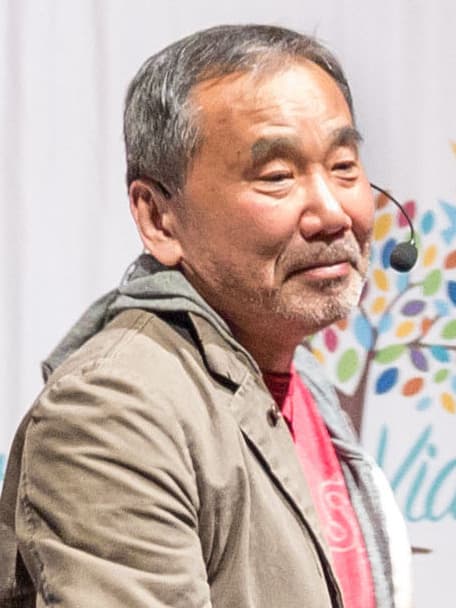
Haruki Murakami
Self (Author/Novelist)
A pivotal figure in contemporary literature, Haruki Murakami founded Self, a platform that emphasizes the importance of routine and consistency in the creative process. After a spontaneous decision to write a novel at a baseball game in 1978, he published his first book, "Hear the Wind Sing," which won the Gunzo Award and launched his prolific career. Murakami's philosophy, centered on maintaining a sustainable pace and aligning work with personal values, resonates deeply with entrepreneurs and business builders today, offering a blueprint for long-term success. His notable works, including "Norwegian Wood" and "Kafka on the Shore," have sold millions of copies worldwide, showcasing his belief that extraordinary accomplishments are achievable through commitment and authenticity.
Core Principles
competitive advantage
Your uniqueness is your greatest asset. The precise way you see the world differently from others, feel differently, and choose words differently is what enables you to create original work that stands out.
Murakami realized that his ability to detect aspects of scenes that others cannot and to feel and express things uniquely are what allowed him to write stories that are his alone. This differentiation is what attracted readers despite critical resistance.
“The fact that I'm me and no one else is one of my greatest assets. Precisely because people are different from others, that they're able to create their own independent selves.”
Differentiation that serves your authentic vision will find its market. Do not pursue mainstream appeal if it contradicts your creative integrity. Your ideal customers will seek you out.
Publishers rejected Murakami's second novel as too unorthodox and wanted something more mainstream. He published it anyway, and readers loved it. Over time, as he continued releasing differentiated work, his audience grew organically from the 10% who truly connected with his vision.
“It seems back then, my notion of the novel was pretty unorthodox. Readers, though, seem to love this new book. And that is what makes me happiest.”
customer obsession
The relationship with your customer or reader is the highest priority in your business model. Organize your entire life to deepen and serve this invisible, conceptual relationship.
Murakami places his relationship with readers above all other considerations. This belief shaped his decision to write what he found authentic rather than what was commercially mainstream, and to organize his life around creating the best possible work for them.
“I place the highest priority on the sort of life that lets me focus on writing. Why? Because I felt that the indispensable relationship I should build in my life was not with a specific person, but with an unspecified number of readers.”
Build your business around serving the customers who love you, not converting those who do not. One devoted customer out of ten is enough to sustain and grow your enterprise.
Murakami learned this principle running his jazz bar, where he realized that if 1 out of 10 customers became repeat customers, the business would survive. He applied the same principle to his novels: focus on serving the 10% who truly connect with his unorthodox work rather than chasing the 90% who do not.
“If 1 out of 10 enjoyed the place and said he'd come again, that was enough. If 1 out of 10 was a repeat customer, then the business would survive. To put it the other way, it didn't matter if 9 out of 10 didn't like my bar.”
focus
Protect your few precious reasons to continue against the infinite excuses to quit. Consciously preserve and polish the core motivations that sustain long-term commitment.
As Murakami became more successful and busy, he recognized that there would always be more reasons not to run than to run. Rather than letting busyness become an excuse to quit, he intentionally kept his few core reasons for running polished and present in his mind.
“I only have a few reasons to keep on running and a truckload of them to quit. All I can do is keep those few reasons nicely polished.”
innovation
The unconscious mind generates breakthrough ideas when properly prepared. Stuff your conscious mind with information, then unhook your rational thought through physical activity or rest to allow insights to surface.
Murakami uses running as a way to quiet his conscious mind and create a void where unconscious insights can emerge. This complements the information he absorbs through reading and conversation, allowing synthesis at a deeper level.
“I run in order to acquire a void. Running gives him a calm and empty mind.”
mindset
No one can tell you what your life's work should be. Authentic commitment emerges from your own internal conviction, not from external advice or persuasion, no matter how well-intentioned.
Murakami had the idea to be a novelist without anyone recommending it or desiring it for him. In fact, people tried to stop him. His success came from pursuing this intrinsic calling despite external opposition.
“Nobody ever recommended or even desired that I'd be a novelist. In fact, some people tried to stop me. I had the idea to be one, and that is what I did.”
Choose work that is authentically suited to your personality and values. You cannot sustain excellence in something for decades unless it genuinely matches who you are.
Murakami chose writing and running specifically because both require no teammates or special equipment, suit his introverted nature, and allow him to work independently. He explicitly avoided team sports and service businesses that demanded constant social interaction.
“Long distance running suits my personality. And of all the habits I've acquired over my lifetime, I have to say that this one has been the most helpful and the most meaningful. I am not much for team sports. That's just the way I am.”
The judge within reigns supreme. What matters in your craft is whether your work meets the standards you have set for yourself, not external metrics like sales, awards, or critics' praise.
Murakami explicitly rejects using copies sold, awards won, or critical praise as measures of accomplishment in literature. He defines success by his own internal standards of quality and achievement, which is why he can ignore the 90% of critics who dislike his work and focus on the 10% who do.
“In the novelist's profession, as far as I'm concerned, there's no such thing as winning or losing. Maybe numbers of copies sold, awards won, and critics' praise serve as outward standards for accomplishment in literature, but none of them really matter. What's crucial is whether your writing attains the standards you've set for yourself.”
A workhorse mindset beats raw talent. Willpower and the ability to sustain physical and mental effort over long periods is the primary asset that compounds into excellence.
Murakami describes himself as more of a workhorse than a racehorse. He succeeded in business because he was willing to work from morning until late at night while others predicted failure. This same relentless consistency is what built his career as a novelist across four decades.
“My only strength has always been the fact that I work hard and can take a lot physically. I'm more of a workhorse than a race horse.”
Pursue work for intrinsic satisfaction, not external validation. Activities done for their own sake, without attachment to outcome, often produce the greatest results.
Murakami wrote his first novel without making a copy, expecting it might be lost forever. He was more interested in having finished the work than in whether it would be published. This autotelic approach freed him from external pressure and allowed his authentic voice to emerge.
“I was more interested in having finished it than in whether or not it would ever see the light of day. There is a name for what he just did, and that name is autotelic. Autotelic is an activity done for the sake of itself.”
operations
Your morning and peak mental hours belong to your most important work. Organize your life so that your highest-value activities happen when your brain is fresh and capable of deep focus.
Murakami discovered he is a morning person. He reorganized his entire life to write from 4-10 a.m., reserving afternoons for low-concentration activities like errands and swimming. He has maintained this schedule for over 40 years.
“People are at their best at different times of the day, but I'm definitely a morning person. That's when I can focus and finish up important work I have to do.”
Never skip the fundamentals or rely on past accomplishments. Success requires returning to basics, rigorous training, and constant recommitment regardless of prior achievements.
Murakami attempted an ultra-marathon without proper training, overconfident in his abilities. He had to walk to finish and violated his own standards. His response was to diagnose the problem: insufficient training, insufficient training, and insufficient training. He recommitted to the basics.
“Not enough training, not enough training, and not enough training. Without knowing it, I had developed an arrogant attitude, convinced that just a fair to middling amount of training was enough for me to do a good job.”
Routine is the engine of long-term projects. Once you establish a consistent pace and rhythm, the momentum sustains itself and allows you to accomplish extraordinary things over decades.
Murakami has maintained the same daily schedule for over 40 years: waking at 4 a.m., writing 5-6 hours, running 10K, swimming, reading, and sleeping by 9 p.m. He describes routine as a form of self-mesmerism that reaches a deeper state of mind.
“To keep on going, you have to keep up the rhythm. This is the important thing for long term projects. Once you set the pace, the rest will follow.”
Focus and endurance are trainable skills developed through daily repetition. Like muscles, they strengthen when you consistently apply them to important work.
Murakami distinguishes between speed, distance, and the consistency of showing up daily without breaks. By sitting at his desk every day and focusing on writing, he built the mental stamina necessary to write long novels, similar to how physical training builds running stamina.
“Focus and endurance can be acquired and sharpened through training. The main thing was not the speed or the distance so much as running every day without taking a break.”
resilience
Physical exertion serves as both a processing mechanism for emotional pain and a method to prevent destructive habits. Vigorous exercise channels difficult emotions into positive transformation.
When Murakami is criticized or misunderstood, he runs longer than usual to physically exhaust his discontent. He also used running to quit smoking, as he could not smoke and run simultaneously. Running became a powerful alternative to destructive coping mechanisms.
“When I'm criticized unjustly from my viewpoint, or when someone I'm sure will understand me doesn't, I go running for a little longer than usual. By running longer, it's like I can physically exhaust that portion of my discontent.”
Emotional pain is the price of independence and authenticity. The ability to withstand criticism and misunderstanding is a necessary cost of doing original work that differs from the mainstream.
Murakami acknowledges that criticism and misunderstanding are painful but unavoidable experiences for anyone creating independent work. Rather than avoiding this pain, he channels it productively through running and other constructive outlets.
“Emotional hurt is the price a person has to pay in order to be independent.”
Beware the trap of over-intensity. Pushing beyond sustainable limits into excess can create burnout and depression, destroying the joy that sustains long-term commitment.
Murakami ran marathons, triathlons, and ultra-marathons, pushing far beyond his normal training. After completing a 60-plus mile ultra-marathon, he fell into runner's blues, losing enthusiasm for running for several years. He eventually returned to a more sustainable approach.
“After this ultra marathon, I lost the enthusiasm I'd always had for the act of running itself. I no longer had the simple positive stance I used to have of wanting to run no matter what.”
Consistency over intensity builds long-term excellence. Stop each day while you still have energy left to continue, creating momentum for the next day rather than burning out.
Murakami deliberately limits his daily 10K runs and writing sessions to 5-6 hours, despite being capable of more. This allows him to maintain the same schedule seven days a week for decades, keeping the exhilaration alive for the next day's work.
“The point being is to let the exhilaration I feel at the end of each run carry over to the next day. This is the same sort of tact that I find necessary when writing a novel. I stop every day right at the point where I feel I can write more.”
strategy
Strategic risk-taking requires full commitment. To succeed in an uncertain endeavor, you must be willing to bet everything on yourself and accept potential failure without hedging.
When Murakami decided to pursue writing full-time, he was earning more from his jazz bar than from novels. He sold the business despite universal opposition because he knew he could not pursue writing half-heartedly. He explained to his wife that if it failed, they were young enough to start again.
“I'm the kind of person who has to totally commit to whatever I do. I had to give it everything I had. If I failed, I could accept that. But I knew that if I did things half-heartedly and they didn't work out, I'd always have regrets.”
Frameworks
The Dual Obsession Framework
Identify and commit to two complementary obsessions where one serves the other. Murakami's writing and running are mutually reinforcing: running provides physical fitness and mental clarity that enable long writing sessions, while his writing discipline transfers to his running practice. Each obsession amplifies the benefits of the other rather than competing for his attention.
Use case: Use this when designing a lifestyle or business model that sustains long-term excellence. Identify activities that strengthen each other and organize your schedule around both.
The 10% Customer Strategy
Focus all energy on serving the 10% of customers who deeply connect with your unique value proposition, rather than trying to convert the 90% who do not. Over time, that 10% grows as it shares your work with others, while the energy spent trying to appeal to the 90% is wasted. Apply a consistent philosophy and maintain it patiently.
Use case: Use this when launching differentiated products or services that are not mainstream. It combats the temptation to dilute your offering to gain broader appeal and instead focuses resources on deepening relationships with your true audience.
The Four-Hour Daily Ritual
Structure your day around uninterrupted focus on your most important work in your peak mental hours, followed by lower-concentration activities, physical exercise, and early rest. Murakami's schedule (4 a.m. write, morning focus, afternoon exercise and errands, early sleep) creates sustainable high performance without burnout.
Use case: Use this to design a daily schedule for knowledge work or creative pursuits. Identify your peak hours, protect them fiercely, and arrange lower-value activities around them.
The Stop-Before-Empty Tank Principle
End each work session, training session, or project phase while you still have energy and momentum remaining. This generates exhilaration that carries into the next day and prevents the sense of depletion that leads to burnout and loss of enthusiasm.
Use case: Use this in long-term projects spanning months or years. It is particularly valuable for creative work where maintaining enthusiasm directly impacts output quality. Hemingway and Murakami both employed this method.
The Void Acquisition Method
Use rhythmic physical activity to create a calm, empty mind where unconscious insights can emerge. Unlike meditation, this method relies on the engagement of physical exertion to quiet the conscious mind while allowing background processing of information and ideas.
Use case: Use this when facing complex problems or creative blocks. Engage in consistent physical activity (running, swimming, walking) after loading your conscious mind with relevant information and conversations. This creates space for synthesis and breakthrough insights.
Stories
At a baseball game on April 1, 1978, Murakami had a sudden thought: I could write a novel. He had no prior ambition to be a writer, only this sudden conviction. Within months, he wrote a 200-page novel by hand, sent it off without making a copy (risking its loss), and forgot about the contest entirely. When the publisher called to tell him he'd won the prize, he was shocked.
Lesson: Authentic callings often arrive as sudden insights rather than gradual plans. Once you recognize a genuine pull toward something, trust it enough to commit fully, even at great risk. The authenticity of your commitment often matters more than its rationality.
Murakami ran a jazz bar successfully for seven years while writing novels. When his writing career began to take off, publishers rejected his second novel as too unorthodox. Rather than pursue mainstream appeal, he published his unorthodox vision, and readers loved it. Over decades, as he continued releasing differentiated novels, his audience grew from the 10% who connected with his authentic voice.
Lesson: Publishers and gatekeepers resist differentiation in favor of proven formulas. Reach your actual customers directly and listen to them, not to intermediaries. Authentic differentiation finds its market when you persist over time.
At age 30, running the successful jazz bar with good income and no debts, Murakami realized he had to choose: continue with guaranteed business success or risk everything on writing. He sold the business, quit smoking through running, and restructured his entire life around writing and running. Within years, his income from writing exceeded what the bar provided.
Lesson: Strategic bets on authentic work sometimes require burning bridges and accepting short-term sacrifice. When you commit fully to what genuinely suits you, the long-term rewards exceed playing it safe with mediocre success.
Confident in his running abilities, Murakami attempted a 60-plus mile ultra-marathon without rigorous training. Midway through, he hit a wall, reduced himself to a mechanical repetition mantra, and barely finished. Afterward, he fell into runner's blues, losing enthusiasm for running for several years. His self-diagnosis was blunt: not enough training, not enough training, and not enough training.
Lesson: Past success creates dangerous overconfidence. Pushing into excess beyond sustainable limits destroys the joy that sustains long-term commitment. Respect the fundamentals and avoid arrogance about your capabilities.
When editors rejected Murakami's unorthodox novel and asked for something more mainstream, he did not comply. Instead, he published what he had written. Readers, not editors, embraced his differentiated vision. This distinction between the resistance of entrenched professionals and the enthusiasm of direct consumers shaped how he understood success.
Lesson: Gatekeepers protect the status quo and resist differentiation. Your actual customers often want exactly what gatekeepers reject. Bypass intermediaries when possible and serve the customer directly.
Notable Quotes
“Pain is inevitable. Suffering is optional.”
A runner's mantra discussed in the book's foreword. The distinction between unavoidable pain and chosen suffering is central to Murakami's philosophy of resilience.
“The point being is to let the exhilaration I feel at the end of each run carry over to the next day. This is the same sort of tact that I find necessary when writing a novel. I stop every day right at the point where I feel I can write more.”
Explaining his principle of consistency over intensity and why he deliberately limits his daily work to maintain momentum.
“To keep on going, you have to keep up the rhythm. This is the important thing for long term projects. Once you set the pace, the rest will follow.”
Core principle of how routine sustains long-term excellence in multi-decade projects.
“That's just the way I am.”
Simple statement of self-knowledge and authenticity. Murakami uses this to acknowledge his introverted nature and his unsuitability for team sports, establishing the foundation for choosing work aligned with his true self.
“In the novelist's profession, as far as I'm concerned, there's no such thing as winning or losing. Maybe numbers of copies sold, awards won, and critics' praise serve as outward standards for accomplishment in literature, but none of them really matter. What's crucial is whether your writing attains the standards you've set for yourself.”
Rejecting external validation as the measure of success. The judge within reigns supreme.
“Running day after day, working day after day, piling up the races. Bit by bit, I raise the bar. And by clearing each level, I elevate myself.”
Explaining how running and writing are parallel processes of incremental self-elevation through consistent effort.
“The fact that I'm me and no one else is one of my greatest assets.”
Articulation of how uniqueness becomes competitive advantage through the ability to see, feel, and express things differently from others.
“If 1 out of 10 was a repeat customer, then the business would survive. To put it the other way, it didn't matter if 9 out of 10 didn't like my bar.”
The core principle of focusing on serving loyal customers rather than converting skeptics. This realization lifted a weight off his shoulders.
“I was more interested in having finished it than in whether or not it would ever see the light of day.”
His intrinsic motivation for writing the first novel, exemplifying the autotelic principle of activity done for its own sake.
“I keep to this routine every day without variation. The repetition itself becomes the most important thing. It is a form of mesmerism. I mesmerize myself to reach a deeper state of mind.”
From a 2004 interview, explaining the psychological mechanism by which consistent routine enables extraordinary output.
Frequently Asked Questions
What are Haruki Murakami's key business principles?▼
Haruki Murakami's core principles include: Your uniqueness is your greatest asset. The precise way you see the world differently from others, feel differently, and choose words differently is what enables you to create original work that stands out.. Differentiation that serves your authentic vision will find its market. Do not pursue mainstream appeal if it contradicts your creative integrity. Your ideal customers will seek you out.. The relationship with your customer or reader is the highest priority in your business model. Organize your entire life to deepen and serve this invisible, conceptual relationship.. Founder Almanac has cataloged 22 total principles from Haruki's career.
What can entrepreneurs learn from Haruki Murakami?▼
Key lessons from Haruki Murakami include: Authentic callings often arrive as sudden insights rather than gradual plans. Once you recognize a genuine pull toward something, trust it enough to commit fully, even at great risk. The authenticity of your commitment often matters more than its rationality.. Explore 5 stories and 5 frameworks from Haruki's experience.
What is Haruki Murakami known for in business?▼
A pivotal figure in contemporary literature, Haruki Murakami founded Self, a platform that emphasizes the importance of routine and consistency in the creative process. After a spontaneous decision to write a novel at a baseball game in 1978, he published his first book, "Hear the Wind Sing," which won the Gunzo Award and launched his prolific career. Murakami's philosophy, centered on maintaining a sustainable pace and aligning work with personal values, resonates deeply with entrepreneurs and business builders today, offering a blueprint for long-term success. His notable works, including "Norwegian Wood" and "Kafka on the Shore," have sold millions of copies worldwide, showcasing his belief that extraordinary accomplishments are achievable through commitment and authenticity.
More Publishing & Writing Founders

Want Haruki's advice on your business?
Our AI has studied Haruki Murakami's biography, principles, and decision-making frameworks. Ask any business question.
Start a conversation