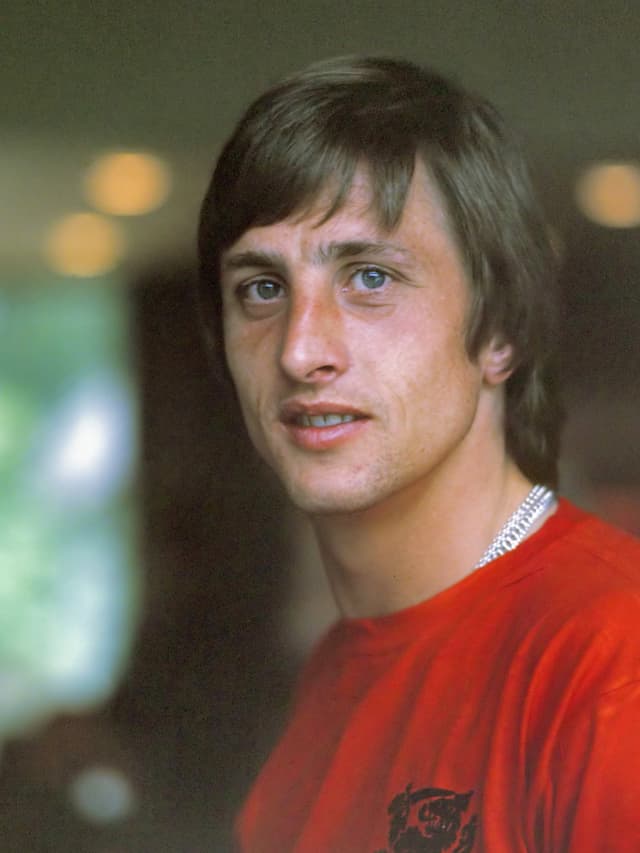
Johan Cruyff
Ajax, FC Barcelona, Washington Diplomats
A visionary in the world of football, Johan Cruyff revolutionized the game through his emphasis on intellectual and tactical superiority over physical prowess. His tenure as manager of FC Barcelona from 1988 to 1996 led the club to four consecutive La Liga titles and a Champions League victory in 1992, establishing a legacy that continues to influence modern football. Cruyff believed in the power of strategy and mental acuity, famously stating, "Football is played with the brain. The legs are just there to help," which resonates with entrepreneurs who strive to turn constraints into opportunities. His early experiences at Ajax, where he began as a young boy assisting injured players, shaped his belief in continuous improvement and innovation, encouraging others to always look forward rather than dwell on past failures.
Core Principles
culture
Family and relationships are the foundation of everything. Invest deeply in family as it shapes who you become and how you lead.
Cruyff opened his autobiography emphasizing family's central role in his life and achievements. He had been married 48 years to his wife Danny, credits his father-in-law and stepdad Hank as father figures, and explicitly connected his family's collaborative nature to Total Football's philosophy. His family provided emotional and practical support throughout his career.
“I have known nothing but love. I think back on my childhood with great fondness. Shaping my family played a part in the origins of total football.”
finance
Be creative within constraints when facing obstacles like high tax rates. Financial engineering and alternative structures can solve seemingly insurmountable problems.
Facing Dutch tax rates of 70%, Cruyff's father-in-law Cor Coster created a pension fund structure and percentage-of-gate-receipts arrangement that allowed him to build wealth legally. Rather than accepting the constraint, they got creative and found a solution that benefited both the player and the club.
“My presence on the team would increase attendance. We proposed that the gate receipts above that baseline would be shared between the club and me.”
focus
If you find work that feels like play, you gain an enormous competitive advantage. Deep passion will outlast any competitor who is faking it.
From age five, Cruyff was obsessed with football, carrying his ball everywhere including into class. He instinctively practiced constantly without even being aware of it. This deep love of the craft made mastery inevitable and gave him an edge no one could match through sheer effort alone.
“From a very young age, I was soon well known as the boy with the ball. Every day, I took my ball into the class with me, placed it under my desk, and passed it between my feet throughout the lesson.”
innovation
Turn disadvantages into advantages by reframing constraints creatively. What appears to be an obstacle can become a strength.
Growing up in the Concrete Village, Cruyff learned to use the physical environment creatively. The concrete curb wasn't an obstacle, it was a training tool that forced him to adjust to unexpected angles, developing his technical skills. This creative thinking became his trademark throughout his career.
“Everything for me started in the street. The area where I lived was nicknamed the Concrete Village. It was here I learned to think about how to turn a disadvantage into an advantage. The curb wasn't an obstacle. You could turn it into a teammate.”
Study other domains and industries for ideas you can adapt and apply. Innovation often comes from borrowing concepts across fields.
Cruyff brought American professional sports organizational models to Ajax, hiring specialists and scouts. He brought an opera singer to teach breathing techniques to improve player stamina. He constantly looked outside football for better ways to do things, recognizing that other fields had solved problems football hadn't yet addressed.
“I suggested that we use Len Delfero, an opera singer who specialized in breathing techniques to help the players get the maximum return on every inhalation and exhalation.”
leadership
Committees and multiple layers of decision-makers destroy execution. Organizations need single leaders with clear accountability.
When Ajax became a publicly traded company with boards, commissioners councils, and member councils, none composed of former players, it became mired in bureaucracy and political conflict. Cruyff repeatedly emphasized that one leader accountable for results was essential, not consensus-building committees.
“There wasn't a single former first team player on the commissioners council, the board, the members council, or the club administration.”
No individual succeeds alone. Actively seek mentors, advisors, and specialists who are better than you at specific things and delegate to them.
Cruyff credits his success to the people around him: his stepdad Hank, his father-in-law Cor Coster who managed his finances, his wife Danny, Rinus Michels as manager, and various trainers. He never pretended to be good at things he wasn't. When he became a coach, he hired specialists for scouting, training, and other functions rather than trying to do everything himself.
“I've never pretended I could do anything I couldn't. I realized that no single person can be the best footballer in every position on the pitch.”
Seek advice from mentors on major decisions, then act with conviction. Trust the process of seeking wisdom and follow through.
After his father died, Cruyff developed a ritual of visiting his father's grave and seeking his advice on major decisions. He never knew how it worked, but after these conversations, he always knew exactly what to do. Later, his father-in-law became this sounding board. He valued counsel from experienced people before committing to big decisions.
“I always went to talk to him to ask his advice every time I had to make a difficult decision in my life. I still have no idea how it worked, but he was there every time I had to make a decision.”
Relentlessly focus on the core mission. Everything in the organization should directly support and serve that mission, not the egos or agendas of leadership.
When managing Ajax, Cruyff insisted that every person, from groundsmen to executives, served the first eleven players. If you weren't directly supporting the team on the pitch, you were overhead. He despised bureaucracy and committee-driven decision-making that distracted from the central purpose of winning.
“Every facet of the club must be supportive of the first 11. Whether you're a trainer or a steward, a director, a groundsman, a commissioner, or a laundry worker. Everyone works in such a way so as to be of service to the first 11.”
mindset
Live fully and authentically. Treat life as an adventure where you extract meaning from both beautiful moments and setbacks.
Even while dying of lung cancer, Cruyff reflected that he had lived a full, intense life, experiencing it as if he lived for 100 years. He took things as they came, including setbacks. He did not live with regrets but rather used every experience, positive or negative, as material for growth.
“I've lived it with authenticity. I've taken things as they've come, including beautiful moments and setbacks. I've lived it so incredibly intense that I felt like I lived for 100 years.”
Always look forward to the next iteration rather than dwelling on the past. Only reflect backwards to extract lessons from mistakes.
Cruyff made progress and continuous improvement his philosophy. He focused on getting better at whatever he was doing rather than celebrating past wins. After every game, win or lose, he immediately thought about what he could do better next time.
“Everything I've done, I've done with a view to the future. Concentrating on progress, which means that the past is not something that I think about too much.”
Money should always come second to the quality of your work. When money becomes the priority, you compromise the integrity of what you do.
Despite high salaries and business opportunities, Cruyff always prioritized football over financial gain. When he tried to become a businessman in ventures unrelated to his expertise, he lost millions on a pig farm. This reinforced his belief that money must never drive decisions ahead of purpose.
“In my view, money is very important in football, but it should always come second to the game. If money comes first, you're doing things the wrong way around.”
Become the best-informed expert in your field. Treat knowledge-building as an obligation, not a luxury.
Cruyff studied football obsessively throughout his life. He claimed there was no one in football who knew more about tactics, technique, and training than him. This wasn't arrogance but the result of decades of focused study, observation, and experimentation. He believed sharing this knowledge through writing and mentoring was his responsibility.
“There is no one in football who knows more about tactics, technique and training than I do.”
Bad habits will produce bad outcomes. You cannot engage in harmful behavior and expect positive results.
Cruyff smoked his entire life despite knowing it caused cancer and heart disease. A heart attack at age 43 from arterial thickening forced him to confront this contradiction. He quit immediately after surgery and regretted not doing so sooner, recognizing that natural consequences follow choices.
“You can't do anything that's bad for you and not expect to be punished. I knew that smoking could cause cancer. I knew it was bad for my heart, and I still kept on fooling myself.”
operations
Train with discipline and intensity so that competition feels easy. The hardest work in training creates the easiest execution in performance.
Cruyff separated training and competition deliberately. During training under manager Rinus Michels, he was far harder on players than during matches. This created muscle memory and conditioning that made actual games feel manageable by comparison. He believed fun was essential but discipline was non-negotiable.
“I was way harder on them in training than I was in the game.”
Small mistakes compound into big problems more often than single large errors. Focus on identifying and eliminating tiny mistakes systematically.
Cruyff taught his teams that problems rarely came from obvious big mistakes but from accumulated small ones. He emphasized careful observation of details that 99% of people miss. By sitting still and watching carefully rather than moving around, he could spot these subtle issues and address them.
“Problems seldom or never come from big mistakes. It's often the small ones that count. Sitting like that, I can analyze something better and see the details more clearly.”
product
Quality and technique matter more than effort. Focus resource allocation on doing things better, not just harder.
Cruyff shifted football's philosophy from pure effort and athleticism to intelligent technique and ball control. He believed if you have possession and use the ball well, the probability of good outcomes increases. This elevated technique training above generic conditioning in importance.
“There's a ball and you either got it or they've got it. If you use the ball well, the chance of a good outcome is greater than the chance of a bad one. This shifts the focus to quality and technique.”
Master fundamentals first before innovating. Building blocks must be solid or advanced techniques fail.
Cruyff emphasized that young talent must master basic football ground rules before attempting complex tactics. He criticized coaches who tried to teach elaborate moves to beginners. Only after players solidified foundations could they build towards the ideal team formation and advanced concepts.
“There isn't much point moving on if you haven't sorted out the foundations. Only then can you start talking about putting the ideal team together.”
resilience
Recovery from failure is not guaranteed. It requires the right mentality, surrounding people, and willingness to learn and move forward.
After his disastrous first retirement and pig farm investment at age 31, Cruyff could have given up. Instead, he treated it as a learning experience, returned to playing, and moved to America for a fresh start. His resilience came from his mindset that setbacks are signs you need to make adjustments, not permanent defeats.
“My brief career as a businessman was one-off. It also gave me an excellent reason to reconsider my decision to stop playing football. Some of the best experiences of my life came after my 32nd birthday.”
simplicity
Simple football is hardest to execute. What appears easy requires absolute mastery to perform flawlessly.
Cruyff's philosophy of Total Football looked simple on the surface: when you have the ball, make the field big; when you lose it, make it small. But executing this consistently required technical mastery, tactical discipline, and intelligent positioning from all players simultaneously. Easy to understand, hard to do.
“Simple football is the most beautiful but playing simple football is the hardest thing. When you have possession, you make the field big. And when you lose the ball, you make it small again.”
strategy
Intellectual and tactical advantage beats physical advantage. Master the mental game, strategy, and positioning rather than relying solely on strength or speed.
Cruyff was never the strongest or quickest player, but he dominated through superior tactical thinking and strategic positioning. He believed his main advantage came from his mind and what he figured out strategically. He applied this to football and later taught it when coaching.
“Kroff was never the strongest or the quickest, but he showed how intelligence could rule the game.”
Simple systems executed with discipline by talented people produce excellence. Complexity and lack of discipline destroy even the best systems.
Total Football was simple in concept but required absolute discipline from all 11 players. Every player had to understand positioning, spacing, and anticipate teammates. One player breaking discipline ruined the entire system. Cruyff later struggled when implementing this at clubs that lacked the organizational discipline to enforce it.
“Total football is aside from the quality of the players mostly a question of distance and positioning. Everything falls into place when you've got the distances and the formation right. It also needs to be very disciplined.”
Observe the history and pioneers of your industry as an obligation. Learn from those who came before to avoid repeating mistakes and to understand what is possible.
Cruyff's father taught him about legendary players like Alfredo Di Stefano and Fausto Wilkes, ensuring he understood the evolution of the game. This historical knowledge informed his own innovations and gave him a foundation to build upon. He believed knowing your industry's history was mandatory, not optional.
“My father told me about players like Alfred Stefano, who understood everything about how to use space on the pitch.”
Stay within your circle of competence. Do not stray into areas where you lack expertise, no matter how attractive the opportunity appears.
After retiring from football, Cruyff invested in a pig breeding venture he knew nothing about, guided only by salesmen who exploited his wealth and fame. He lost millions before his father-in-law intervened and told him to accept losses and return to football. This taught him the crucial lesson to operate only within what he understood.
“It was an area of business I knew nothing about. Plus, it was something I had absolutely no connection with. My ignorance was being exploited. I had money and where there's money, you'll find rats running about.”
Frameworks
The Mistake-Learning Loop
After every attempt, whether successful or failed, immediately analyze what could be improved. Rather than dwelling on past wins or losses, extract lessons and apply them to the next iteration. Success doesn't stop this process; neither does failure.
Use case: Any iterative endeavor where improvement matters more than individual outcomes. Applicable to product development, performance work, and skill mastery where you need rapid learning cycles.
Total Football
A system where all 11 players work as an integrated unit with precise positioning and spacing. Players must anticipate what teammates with the ball will do next. When possessing the ball, players expand the field; when losing it, they contract it. It requires both exceptional individual technique and absolute discipline to positioning and spacing rules.
Use case: Building systems where execution depends on coordination, discipline, and each person understanding how their role supports the whole. Applicable to any organization where quality depends on flawless integration rather than individual talent.
The Advantage Flip
Identifying seemingly negative constraints or circumstances and reframing them as advantages. What appears to be an obstacle becomes a tool for improvement. This requires creative thinking to see how disadvantages can be turned into strengths through a different perspective.
Use case: When facing resource constraints, market disadvantages, or environmental obstacles. Instead of accepting limitations, entrepreneurs can use them as forcing functions that build unique capabilities competitors lack.
The Specialist Delegation Model
Identify areas where you are not the best performer and recruit or hire people who excel in those areas. Delegate fully to specialists rather than trying to be competent across all functions. This applies whether you are managing a team or your personal affairs.
Use case: Scaling operations where no single person can be expert in everything. Particularly valuable for leaders who understand their core competency and intelligently delegate all other critical functions to capable specialists.
The Observation Practice
Sitting still and watching from the sidelines rather than being constantly active. Stillness allows you to see details and patterns that 99% of people miss. It requires patience and discipline but produces insights unavailable to those always in motion.
Use case: Leadership and coaching roles where understanding problems deeply matters more than constant action. Useful when trying to identify small mistakes, system breakdowns, or improvement opportunities that require sustained focus.
Stories
At age five, Cruyff began delivering fruit baskets to injured Ajax players with his father. The groundsman Hank Ange offered him a job helping around the stadium. He started the next day and spent every spare moment there from age five onward, absorbing knowledge from everyone, from cleaning staff to players.
Lesson: Immersion in an environment from a young age creates deep learning. Being present daily, listening, and observing accumulates knowledge faster than formal training. Starting young in your chosen field compounds advantages.
Cruyff signed his first professional contract and immediately retired his mother from cleaning work. The moment they left the office, he told her she would clean the changing rooms for the last time. His mother had lost her husband when Cruyff was 12 and had to work jobs she disliked.
Lesson: Success in your craft can transform the lives of people you love. The sacrifices of family members to support your development create emotional fuel for achievement. The ability to provide for your family and free them from hardship is a powerful motivation.
While watching Barcelona play, Cruyff began the season 8-2 down and endured mockery. Rather than accepting defeat, he used it as a starting point for resurrection. The team then won everything: the cup, the league, and Cruyff won the golden boot for best player.
Lesson: Humiliating defeats often mark the beginning of great comebacks. Setbacks provide the contrast and urgency needed to drive improvement. How you respond to early failure determines whether it becomes a turning point or an ending.
At Washington Diplomats, Cruyff was initially frustrated running training sessions for disabled children, thinking it was pointless because they couldn't execute his instructions correctly. Organizers showed him a video of himself and asked him to watch not the ball but the eyes of the children and their parents. He immediately saw the joy and transformation.
Lesson: You can miss the real impact of your work if you focus on the wrong metrics. Looking at the wrong measurements blinds you to real value creation. Reframing what success means can transform apparent failure into profound contribution.
Cruyff invested millions in a pig breeding venture without seeing any deeds or documents, simply based on salesmen's pitches. His father-in-law Cor Coster visited, demanded to see the deeds, found there were none, and told him to accept losses and return to football. Cruyff took the advice immediately.
Lesson: Staying in your circle of competence protects you from exploitation. When people sense money without knowledge, they exploit it. Seeking counsel from trusted advisors on big decisions prevents catastrophic errors. Accept losses quickly when you've strayed from your core.
Cruyff smoked for decades despite knowing it caused cancer and heart disease. At age 43, a heart attack from arterial thickening forced surgery and a choice. The doctor told him 90% of his heart problems were caused by smoking. Cruyff quit overnight after the surgery.
Lesson: Warning signs don't change behavior; consequences do. Knowledge alone is insufficient to change habits; it takes crisis or clear consequences. Once you commit to change, execute completely rather than gradually.
Growing up in the Concrete Village, young Cruyff practiced with his football daily. The concrete curb in his neighborhood was a constant obstacle, but he learned to use it as a training partner. The ball bouncing off it at unpredictable angles forced him to develop touch and adjustment skills most players never acquired.
Lesson: Environmental constraints can become your greatest training advantage. Limitations force adaptability and technique development. What other players see as disadvantages become the foundations of your unique capabilities.
Notable Quotes
“Football is played with the brain. The legs are just there to help.”
Describing his philosophy that mental and tactical superiority matters more than physical attributes in sports and competition.
“Everything I've done, I've done with a view to the future. Concentrating on progress, which means that the past is not something that I think about too much.”
Explaining his approach to continuous improvement and why he doesn't dwell on past accomplishments or failures.
“In my view, money is very important in football, but it should always come second to the game. If money comes first, you're doing things the wrong way around.”
On the correct prioritization when balancing financial success with the quality and integrity of your work.
“I've never pretended I could do anything I couldn't.”
On surrounding himself with specialists and delegation, explaining why he hired experts in areas outside his competence.
“Simple football is the most beautiful but playing simple football is the hardest thing.”
Describing the paradox that elegant, simple systems require more discipline and mastery to execute than complex ones.
“Problems seldom or never come from big mistakes. It's often the small ones that count.”
On the importance of focusing on eliminating small errors rather than only guarding against obvious large ones.
“Every facet of the club must be supportive of the first 11. If you're not serving the customer or supporting the folks who do, we don't need you.”
Explaining how organizations must ruthlessly prioritize their core mission and ensure every function supports it.
“I haven't always been understood as a footballer and as a coach and also for what I did after that. But okay, Rembrandt and Van Gogh weren't understood either.”
On accepting that being misunderstood is often the price of innovation and thinking differently from your field.
“I've lived it with authenticity. I've taken things as they've come, including beautiful moments and setbacks.”
On living fully at the end of his life, reflecting that he lived so intensely it felt like 100 years.
“Winning was the consequence of the process that we'd concentrated on.”
On the proper focus in coaching and management: excellence comes from perfecting process, not from pursuing winning directly.
Frequently Asked Questions
What are Johan Cruyff's key business principles?▼
Johan Cruyff's core principles include: Family and relationships are the foundation of everything. Invest deeply in family as it shapes who you become and how you lead.. Be creative within constraints when facing obstacles like high tax rates. Financial engineering and alternative structures can solve seemingly insurmountable problems.. If you find work that feels like play, you gain an enormous competitive advantage. Deep passion will outlast any competitor who is faking it.. Founder Almanac has cataloged 24 total principles from Johan's career.
What can entrepreneurs learn from Johan Cruyff?▼
Key lessons from Johan Cruyff include: Immersion in an environment from a young age creates deep learning. Being present daily, listening, and observing accumulates knowledge faster than formal training. Starting young in your chosen field compounds advantages.. Explore 7 stories and 5 frameworks from Johan's experience.
What is Johan Cruyff known for in business?▼
A visionary in the world of football, Johan Cruyff revolutionized the game through his emphasis on intellectual and tactical superiority over physical prowess. His tenure as manager of FC Barcelona from 1988 to 1996 led the club to four consecutive La Liga titles and a Champions League victory in 1992, establishing a legacy that continues to influence modern football. Cruyff believed in the power of strategy and mental acuity, famously stating, "Football is played with the brain. The legs are just there to help," which resonates with entrepreneurs who strive to turn constraints into opportunities. His early experiences at Ajax, where he began as a young boy assisting injured players, shaped his belief in continuous improvement and innovation, encouraging others to always look forward rather than dwell on past failures.
More Sports & Athletics Founders

Want Johan's advice on your business?
Our AI has studied Johan Cruyff's biography, principles, and decision-making frameworks. Ask any business question.
Start a conversation