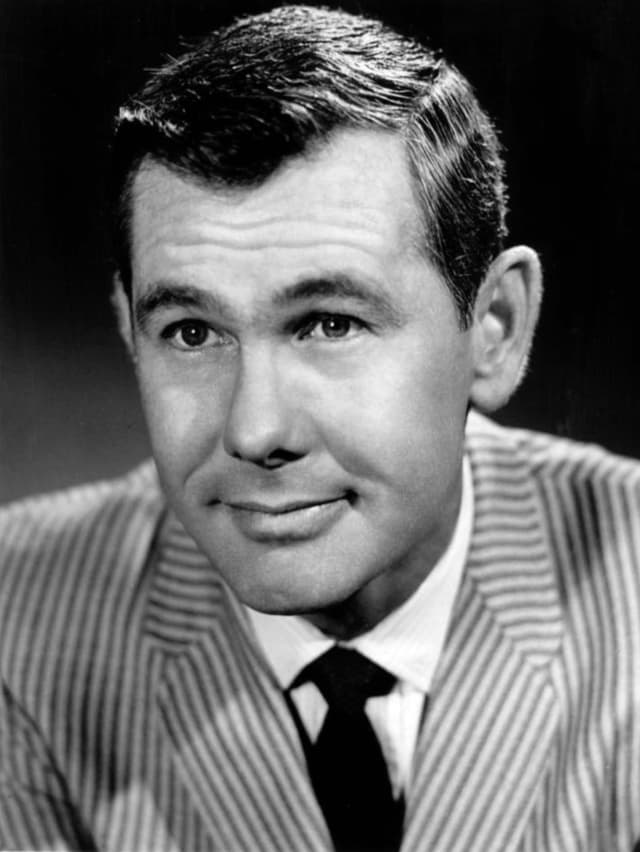
Johnny Carson
The Tonight Show Starring Johnny Carson
A pioneering force in late-night television, Johnny Carson transformed the landscape of entertainment with his iconic role as the host of The Tonight Show Starring Johnny Carson from 1962 to 1992. After spending 17 years as a highly paid employee, he gained ownership of the show, which catapulted him to become one of the wealthiest entertainers in history, with an estimated net worth of over $300 million at the time of his retirement. Carson's commitment to craftsmanship and work ethic exemplified the value of mastering one's craft, as he delivered legendary performances that captivated audiences for three decades. His experience hosting a televised event for Ronald Reagan's inauguration, arranged by his idol Frank Sinatra, highlighted his ability to leverage relationships while staying true to his core excellence in comedy. Carson's legacy serves as a powerful reminder for today's entrepreneurs about the importance of ownership, focus, and continuous improvement in achieving lasting success.
Core Principles
culture
You should never have to pay your best friend or maintain friendships through transactions. True friendships based on genuine connection are rare and should be protected.
Carson paid nearly everyone in his life: employees, lawyers, companions. He had very few, if any, unpaid relationships. When asked who his best friend was, he named Henry Bushkin, his paid lawyer. Henry was shocked, noting he was always working when around Johnny, not genuinely relaxing as friends do.
“Henry Bushkin, my lawyer, who's probably my best friend.”
Parenting requires presence and attention, not just financial provision. Children need your time and emotional availability, not excuses about work demands.
Carson had three sons from his first marriage whom he seldom saw. He used his career demands as justification for absence, but this was a choice. His children did not receive the relationship they needed, regardless of financial support.
“Selfishness with your children is a character flaw.”
finance
Ownership of your work creates exponential wealth relative to being a highly paid employee. Carson earned modest income for 17 years before owning the show, then became one of the wealthiest entertainers in history once he gained equity.
Carson was paid $100,000 per week but received only $3,000 due to deferred compensation and aggressive management. Once he negotiated ownership of The Tonight Show in 1980, he earned $25 million annually plus production income and eventually controlled all show archives, creating generational wealth.
“The real money and power went to those who own the companies that produce the programs.”
You must have a good defense to protect your wealth. Surrounding yourself with competent lawyers and advisors who prioritize your interests is essential, as bad actors will exploit you otherwise.
Carson's manager Sonny negotiated a clothing deal where Carson received a salary while the manager and manufacturer each owned 50 percent equity. His agent billed him for 10 percent of deferred compensation he would never see. Henry Bushkin's intervention to fire exploitative managers and renegotiate contracts protected Carson from losing millions.
“Staying rich is having a good defense, and it's very easy for you to lose your money.”
Read and understand your own contracts. Complexity is used as a weapon against talent. If contracts are too complicated to understand, reduce their scope until you can grasp every term.
Carson was harmed repeatedly by contracts he did not fully understand or have explained to him. When Henry took over, he immediately identified equity issues in the apparel deal, commission disputes with agents, and other unfavorable terms that Carson had accepted without scrutiny.
“You have to have equity. That's where wealth is built. You're never going to build wealth without it.”
After a certain point, marginal dollars provide diminishing utility. Once you have enough money, additional income should not divert attention from what creates meaning or joy in your work.
Carson declined modeling opportunities for apparel company profits, rejected hotel ownership with performance strings attached, and refused Coca-Cola equity because each offered money at the cost of time away from his show. He recognized his show's earnings would far exceed these side ventures.
“He understood that after a certain point there was a decreased marginal utility to an extra dollar.”
Being the highest-paid employee is fundamentally different from being a business owner. No salary, no matter how large, replaces equity ownership in creating generational wealth.
Carson's $100,000 weekly salary ($5 million annually in 1979) versus $3,000 take-home shows how little of his value he captured. After gaining ownership in 1980, his wealth grew exponentially. Merv Griffin and Aaron Spelling built vastly larger fortunes through ownership, not performance.
“Equity makes all the difference. Being a star in Hollywood is a fabulous thing but the real money and power went to those who own the companies.”
focus
Stay within your circle of competence and resist distractions that pull you away from your core excellence, even when offered significant money. The best use of time is deepening mastery in what you do best.
Carson repeatedly declined lucrative opportunities including equity in an apparel line, Coca-Cola board seat for $100 million, hotel ownership requiring appearances, and production company expansion. He believed his highest return came from perfecting his show, not diversifying into unfamiliar businesses.
“I want to do my show. Why would I go and sit on the board of directors?”
Keep the main thing the main thing. When success expands your opportunities, it becomes easier to drift into adjacent ventures. Restrain yourself to what produces your highest returns.
After owning the show and becoming wealthy, Henry urged Carson to diversify into production companies, real estate, and investments. Carson resisted, wanting only to do his show. History shows Carson's instinct was correct: his show compound in value while his production ventures underperformed.
“Always keep the main thing, the main thing.”
hiring
Introduce yourself to trusted advisors through mutual connections and fit rather than credentials alone. Sometimes the best relationships begin with unexpected compatibility.
When Henry interviewed with Carson, Johnny ignored credentials and instead asked if Henry played tennis. This became the basis for their relationship. Carson hired based on fit and whether someone could integrate into his world, not traditional qualifications.
“You play tennis, right? I play tennis. It's my sport. If you work for me, I'll expect you to join me.”
leadership
Ego-driven decisions based on status create unnecessary friction and waste leadership energy. Mature leaders focus on the work, not on protocols or personal slights.
Carson became enraged when not personally escorted around the White House and threw fits requiring President Reagan to apologize. This behavior wasted energy on ego maintenance rather than on what mattered to his work and life.
“It was truly a testament to the power and prestige that Johnny had gained that the president called him over a minor, minor issue of protocol. It was also a reminder that Carson's ego had grown so large that only a call like that could pacify him.”
mindset
Craftsmanship and work ethic compound over decades. Being the best at what you do requires sustained focus, continuous improvement, and an appreciation for the gap between good intention and excellent execution.
Carson worked the show for 30 years, constantly critiquing every episode immediately after taping. He read every guest's book, rehearsed his monologues, and maintained live performance standards with no retakes. He doubled the audience from 7 million to 17 million viewers over his tenure.
“He does his work and he comes prepared. Every night in front of millions of people, he has to do an aerial somersault performed on a tightrope. What's more, he does it without a net.”
You cannot build a healthy life through success alone. Wealth, fame, and achievement do not fill emotional voids created in childhood or resolve unprocessed trauma. Personal work is required.
Carson was immensely successful yet unhappy, blaming his failures in relationships and emotional unavailability on his cold mother. At 45, despite being famous and well-paid, he expressed deep self-loathing and questioned his own capacity for love, suggesting unresolved personal issues that success could not remedy.
“If a doctor opened my chest up right now, he couldn't find a heart or any goddamn thing. Just a lot of misery.”
Personal responsibility for one's emotional patterns is non-negotiable. Blaming childhood circumstances for adult failures prevents growth. You must choose to address unresolved trauma.
Carson repeatedly blamed his mother for his failed marriages and emotional distance even decades into adulthood. Many people experience difficult childhoods without repeating the same relationship failures. Carson's choice not to address this meant the pattern persisted through multiple marriages.
“My mother made sure of that. She deprived us, deprived us of any real goddamn warmth.”
Control and emotional avoidance create relationship toxicity. When you need to control all aspects of your life and avoid emotional turbulence, you poison relationships with spouses, children, and colleagues.
Carson was obsessed with controlling his world. When his wife's infidelity forced him to feel pain he could not manage, his obsession with control intensified. He used the affair as justification for rage, though he had been far more unfaithful. His need for control over emotional experience damaged marriages and prevented deep connections.
“He was constantly obsessed with controlling all aspects of his life.”
Consistency over intensity enables longevity. Choosing to be genuinely yourself rather than playing a role allows you to sustain excellence across decades without burnout.
Unlike actors who inhabit invented characters, Carson performed as himself, relying on native gifts and real preparation. This authenticity allowed him to host the show for 30 years while remaining the undisputed standard that all successors still follow. Intensity-based performances typically peak early then decline.
“Johnny took the stage just as himself, reliant mostly on his own native gifts.”
product
Byproducts and residual assets created through your main work have enormous value if captured. Archive, preserve, and monetize the output of your primary business.
NBC routinely destroyed old Tonight Show episodes, taping over them. When Carson negotiated ownership, he captured rights to all preserved episodes. Columbia Television paid $26 million for Carson's Comedy Classics, edited clips from archives. Carson's cost was zero, creating pure profit from already-created content.
“Carson had zero cost for the material. Carson now occupied a position the likes of which had never before existed.”
strategy
Negotiate from a position of strength by knowing your alternatives and the other side's alternatives. Intelligence about what others will pay is more valuable than any single offer.
When ABC secretly expressed interest in Carson, Henry learned they would double his salary and give him show ownership. This became a template for negotiating with NBC. The intelligence about ABC's position gave Carson leverage to restructure his NBC deal into ownership, which proved far more valuable than salary increases.
“What we had in our hands now was not a contract, but a lever.”
Simple, memorable advice often outperforms complex analysis. Ask trusted advisors for the clearest insight, then act on it decisively.
When Carson, Henry, and advisors agonized over whether to go to ABC or stay with NBC, Lou Wasserman offered one criterion: Americans won't change the channel once they are used to tuning to a given station. This single insight sealed the decision to stay with NBC and negotiate ownership there.
“It's not prudent to ask people to change their nightly viewing habits. Once they are used to tuning into a given channel, they find it hard to make the move.”
Leverage is created by having alternatives. Being willing to walk away from an unfavorable situation gives you negotiating power to reshape terms in your favor.
When Carson decided to quit in 1979, citing a 17-year tenure, he had no leverage. However, by taking NBC to court (proving California law limited personal service contracts to seven years) and simultaneously exploring ABC's interest, he created a bidding situation that resulted in becoming show owner with production control.
“Nobody can force me to work. They'll figure it out.”
Frameworks
The Ownership Arbitrage
Identify the gap between what you are paid as a high-performing employee versus what you could capture by owning the asset you produce. Build leverage to transition from employment to ownership by becoming indispensable, then using your value to negotiate equity. This creates exponential wealth through compounding returns on an asset rather than linear income from a salary.
Use case: When you have proven exceptional skill and market value in a specific role, use that proof of value to transition to ownership of the business or show you create. Carson went from $3,000 weekly net to $25 million annual salary plus ownership by leveraging his proven audience and the network's dependence on him.
The Leverage Paradox
Your leverage is greatest when you are most willing to walk away. The more you signal you need a deal, the weaker your negotiating position. Conversely, demonstrating alternatives and willingness to exit strengthens your hand. Courts, competitors, and opposing parties respond to alternatives and credible threats more than to arguments.
Use case: When negotiating major deals or contracts, develop genuine alternatives (other offers, litigation strategy, competitive options) and make those alternatives known indirectly. Carson's decision to quit and legal action to prove the NBC contract violated California law created real alternatives that forced NBC to restructure the entire relationship.
The Discretionary Income Threshold
Beyond a certain income level, additional marginal dollars should not divert attention from your highest-leverage activity. Calculate your hourly value in your core business, then compare any side opportunity against that rate. If the opportunity's implied hourly value is lower than your core business return, decline it regardless of nominal dollar amount.
Use case: For high-earning founders and performers, use this framework to systematically reject distracting opportunities. If your core business generates $50 million yearly and the distraction pays $2 million but costs 10 percent of your time, the opportunity is worth less than $5 million in opportunity cost, making it value-destructive.
The Craft Compounding Curve
Excellence in a specific craft compounds over decades as mastery deepens, reputation strengthens, and audiences grow. The value of staying in one domain for 20-30 years far exceeds the value of moving to adjacent domains every 5-7 years. Graph the cumulative return of deep focus versus diversification across multiple ventures.
Use case: When evaluating whether to expand into new businesses, model the compounding return of going deeper in your current domain versus the startup risk and attention cost of new ventures. Carson's 30-year focus on the Tonight Show created more wealth than any diversification could have generated.
Stories
Carson is invited to host a television event for Ronald Reagan's inauguration, arranged by his idol Frank Sinatra. Though reluctant, Carson agrees because of his admiration for Sinatra. The event includes a tour of the White House with Reagan personally escorting him and others. Carson is enraged by the protocol and embarrassed by being with other people. He throws a fit, yelling at Henry and the organizers. The next day, President Reagan personally calls Carson to apologize for the protocol offense.
Lesson: Ego-driven reactions to perceived slights waste leadership energy and create uncomfortable situations. Carson's rage over protocol was self-inflicted and forced the President of the United States to manage his emotional reaction. This illustrates how unprocessed control needs and emotional fragility can cascade into absurd outcomes.
Joan Rivers becomes a permanent guest host for the Tonight Show when Carson reduces his on-air days to three or four nights weekly. When Fox network recruits Joan to host her own talk show, Carson never speaks to her again. In her memoir, Joan explains that being 'one of Johnny Carson's nearest and dearest show business friends' conferred very little benefit. It did not mean he greeted you in your dressing room, socialized with you, or spoke to you off-set. Anyone outside his small inner circle received only professional politeness.
Lesson: Transactional relationships with famous or powerful people are not friendships. Carson maintained buffer relationships with most people and had an extremely small circle of genuine connection. Proximity to power is not friendship. His insistence that Joan be number one or nothing reflected his binary thinking about relationships.
Henry Bushkin, a 27-year-old lawyer, interviews with 45-year-old Johnny Carson for the position of counsel. The interview is dismissive and short. Carson asks only one substantive question: Do you play tennis? Upon learning Henry played in college, Carson says, 'I play tennis. It's my sport. If you work for me, I'll expect you to join me.' That is the entire basis for hiring.
Lesson: Hiring is about fit and whether someone will integrate into your world and be available for your priorities, not just credentials. Carson recognized that intelligence and bar membership were table stakes. What mattered was whether someone would share his sport and integrate into his circle.
Carson discovers his second wife Joanne is cheating with Frank Gifford by breaking into her apartment with his lawyer Henry, a private investigator, and other men. After discovering furniture from their home and photographs of Gifford, Carson leans against the wall and weeps. During this vulnerable moment, Henry realizes Carson is carrying a loaded .38 revolver. The situation is dangerous, tense, and ultimately resolves without incident.
Lesson: Emotional turbulence can create dangerous situations. Carson was obsessed with controlling his world, and the loss of control over his wife's infidelity drove him to desperate measures. The gun suggests he was in a dark mental state, illustrating how unprocessed emotional pain can escalate.
Carson is threatened with extortion: kidnapppers demand a quarter million dollars or they will kidnap his wife and stepson. Despite police objections, Carson insists on personally dropping the money to protect his wife and stepson from danger. He places himself in harm's way rather than send someone else and risk the extortionists becoming enraged and harming his family.
Lesson: Courage and willingness to personally take risk for those you care about is a form of love. Though Carson was emotionally unavailable in many ways, his immediate willingness to endanger himself for his wife's safety demonstrated genuine care in crisis.
At 2 a.m. after the apartment raid, Carson calls Henry to meet him at a bar in Manhattan. Once there, after knowing Henry for only two days, Carson pours out his deepest insecurities and self-loathing, saying 'If a doctor opened my chest up right now, he couldn't find a heart or any goddamn thing. Just a lot of misery.' He confesses his failures as a father and husband. Henry is astonished that a man he barely knows would burden him with such darkness.
Lesson: Success and fame do not cure emotional voids. Despite being one of the most celebrated entertainers in America, Carson was deeply unhappy and tormented by self-doubt. This reveals that achievement alone cannot heal emotional wounds created in childhood.
When Henry's father dies, Johnny sends a beautiful flower arrangement and platters of food, knowing it is Jewish tradition to have food available for mourners. He also calls Henry's mother personally to pay condolences, and his mother breaks into tears thanking him. Despite Carson's many character flaws, he demonstrated genuine thoughtfulness in recognizing others' grief.
Lesson: Kindness and generosity in supporting others through loss is a value that transcends business. Carson was emotionally stunted in relationships but capable of profound consideration when someone was suffering. This generosity coexisted with his selfishness.
In 1979, Carson announces to NBC that he is quitting after 17 years hosting the Tonight Show. He is tired and doesn't want to perform into his 60s. NBC executives are stunned, insisting they have a contract. Henry challenges the contract's validity using California law limiting personal service contracts to seven years. The dispute goes to mediation. Meanwhile, ABC secretly expresses interest in acquiring Carson, willing to double his salary and give him show ownership.
Lesson: Leverage is created by having viable alternatives and demonstrating your willingness to use them. Carson's threat to quit, combined with legal action proving the contract might be invalid, combined with ABC's competing interest, forced NBC to completely restructure the deal. Without these elements, he had no leverage.
Lou Wasserman, a legendary Hollywood executive, advises Carson on whether to go to ABC or renegotiate with NBC. After extensive deliberation, Wasserman offers one simple insight: 'Americans won't change the dial once they are used to tuning to a given channel. They find it hard to make the move, no matter how good the alternative.' This single criterion settles the entire decision to stay with NBC and negotiate ownership there.
Lesson: Simple, memorable wisdom from experienced advisors often cuts through complex analysis. The best advice is often the most obvious once stated. Wasserman's insight about habit and distribution loyalty outweighed all other considerations.
After becoming wealthy and achieving ownership of the Tonight Show, Henry urges Carson to expand into production companies, real estate, and investments. Henry had negotiated deals that would position Carson as an entertainment mogul comparable to Merv Griffin or Aaron Spelling. Carson repeatedly declines, saying 'I want to do my show. Why would I go sit on a board of directors?' Carson eventually closes his production company. Henry is frustrated, viewing these decisions as leaving money on the table.
Lesson: Focus compounds more than diversification when you are already excellent at one thing. Carson understood his highest return came from deepening his show, not from building conglomerate businesses outside his expertise. Henry's frustration reveals a common mistake: confusing money opportunity with time opportunity. More income at the cost of attention to your best work is usually a poor trade.
Notable Quotes
“The graveyards are full of indispensable men.”
When Henry warned that NBC would sue him for massive damages if he quit, Carson rejected the argument that he was irreplaceable. This quote reflects Carson's understanding that no individual is truly indispensable to an institution.
“Nobody can force me to work. They'll figure it out.”
Responding to Henry's warnings about contractual liability if he quit the Tonight Show, Carson asserted his fundamental right to refuse to work, regardless of contractual claims.
“I want to do my show. Why would I go and sit on the board of directors?”
Declining Henry's offer to negotiate a Coca-Cola seat and $100 million investment, Carson articulated his single priority: performing his show. This response encapsulates his resistance to diversification.
“If a doctor opened my chest up right now, he couldn't find a heart or any goddamn thing. Just a lot of misery.”
At 2 a.m. after discovering his wife's infidelity, Carson expressed deep self-loathing to Henry, revealing the emotional void beneath his famous persona.
“He enchants the invalids and the insomniacs, as well as the people who have to get up at dawn. He has to be their nurse and their surgeon.”
Wilder articulated Carson's role as an entertainer who had to serve audiences across diverse circumstances and needs, requiring constant excellence.
Frequently Asked Questions
What are Johnny Carson's key business principles?▼
Johnny Carson's core principles include: You should never have to pay your best friend or maintain friendships through transactions. True friendships based on genuine connection are rare and should be protected.. Parenting requires presence and attention, not just financial provision. Children need your time and emotional availability, not excuses about work demands.. Ownership of your work creates exponential wealth relative to being a highly paid employee. Carson earned modest income for 17 years before owning the show, then became one of the wealthiest entertainers in history once he gained equity.. Founder Almanac has cataloged 23 total principles from Johnny's career.
What can entrepreneurs learn from Johnny Carson?▼
Key lessons from Johnny Carson include: Ego-driven reactions to perceived slights waste leadership energy and create uncomfortable situations. Carson's rage over protocol was self-inflicted and forced the President of the United States to manage his emotional reaction. This illustrates how unprocessed control needs and emotional fragility can cascade into absurd outcomes.. Explore 10 stories and 4 frameworks from Johnny's experience.
What is Johnny Carson known for in business?▼
A pioneering force in late-night television, Johnny Carson transformed the landscape of entertainment with his iconic role as the host of The Tonight Show Starring Johnny Carson from 1962 to 1992. After spending 17 years as a highly paid employee, he gained ownership of the show, which catapulted him to become one of the wealthiest entertainers in history, with an estimated net worth of over $300 million at the time of his retirement. Carson's commitment to craftsmanship and work ethic exemplified the value of mastering one's craft, as he delivered legendary performances that captivated audiences for three decades. His experience hosting a televised event for Ronald Reagan's inauguration, arranged by his idol Frank Sinatra, highlighted his ability to leverage relationships while staying true to his core excellence in comedy. Carson's legacy serves as a powerful reminder for today's entrepreneurs about the importance of ownership, focus, and continuous improvement in achieving lasting success.
More Media & Entertainment Founders

Want Johnny's advice on your business?
Our AI has studied Johnny Carson's biography, principles, and decision-making frameworks. Ask any business question.
Start a conversation