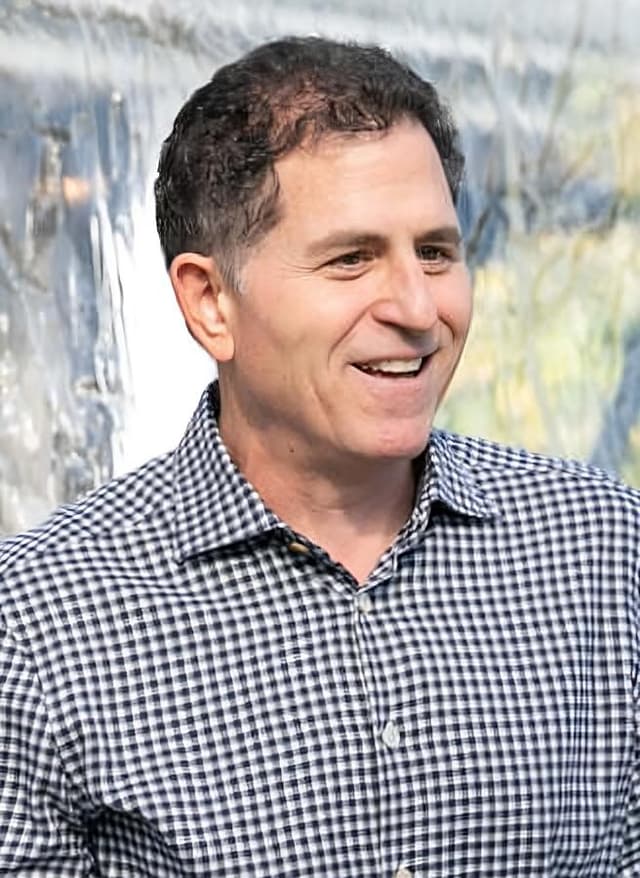
Michael Dell
Dell
A pioneer in the technology industry, Michael Dell founded Dell Technologies in 1984 with a revolutionary vision to sell computers directly to consumers, eliminating retailer markups. This innovative approach not only led to a billion-dollar enterprise but also transformed how technology companies connect with their customers. By prioritizing economics over traditional product-focused strategies, Dell demonstrated that understanding customer needs could drive remarkable growth, as evidenced by Dell's rise to the top of the PC market with a revenue of $57 billion in 2022. His commitment to staying close to customers has set a standard for entrepreneurs, emphasizing the importance of direct engagement in an increasingly competitive landscape.
Core Principles
competitive advantage
When you possess a significant cost advantage, use it aggressively to undercut competitors and expand market share rather than taking higher margins.
Dell's direct model allowed him to offer IBM-compatible machines at $795 versus IBM's $1,500-2,500 for the same configuration. He used this price advantage to gain market share. This aggressive pricing strategy, combined with reinvestment of profits, created an expanding spiral of growth and advantage.
customer obsession
The fidelity of signal you receive from direct customer interaction is superior to guessing what customers want through retail intermediaries.
In retail distribution, companies must guess what customers want before they enter the store. In Dell's direct model, customers call and specify exactly what they want. This real-time demand signal goes immediately back to suppliers, enabling a far more efficient supply chain and better inventory management.
“If somebody walks into a store, you would have had to have guessed what they were going to buy before they walked in. But if somebody calls us on the phone, we know exactly what they want because they're telling us.”
Build businesses around solving real customer problems in a direct way, not around financializing existing assets or extracting value from intermediaries.
Michael Dell's approach differed fundamentally from Carl Icahn's. Icahn was interested in buying undervalued companies, forcing buybacks, and moving on. Michael built Dell to solve customer problems: making computers accessible, affordable, and customizable. This founder mentality versus financial operator mentality created vastly different outcomes.
Stay close to your customer. Competitors who are detached from customers and instead sell to intermediaries (like retailers or dealers) are ultimately vulnerable.
Dell sold directly to customers while competitors sold to dealers. This gave Dell superior information about what customers actually wanted and needed. Being detached from the end customer, through intermediaries, prevents you from understanding true demand and pain points.
“Being detached from the customer is the ultimate death.”
Find patterns in customer behavior through careful observation, then exploit those patterns systematically.
When selling newspaper subscriptions at age 14-15, Michael observed that people who recently moved, who were getting married, or who sounded like the salesman were more likely to subscribe. He went to the courthouse to get marriage license records (public information), then hired friends to visit 16 county courthouses to gather prospect data. This systematic approach turned cold calls into a sales machine.
“If you sounded like the people you were trying to sell subscriptions to, they were much more likely to buy from you. People who were moving into a new residence were more likely to subscribe to the paper. People who were getting married were much more likely to buy a subscription.”
Don't confuse your customer. Your true customer is the end user, not the intermediary retailer or distributor.
Rod Canion and other executives thought their customer was the retail dealer. This blindness to the true customer caused them to optimize for the wrong metric. Michael understood the true customer was the person using the computer, and he would serve them directly.
“Being detached from the customer is the ultimate death. A lot of these guys, they think their customer is the dealer, which is still amazing to me.”
finance
Examine your cost structure in obsessive detail to discover hidden opportunities to improve profits, weaken competitors, and expand influence.
Michael Dell achieved a structural cost advantage over Compact: Dell's operating costs were 18% of revenue versus Compact's 36%. This 18-point difference became insurmountable. Forty years later, Dell thrives while Compact no longer exists. History's greatest founders know their business from A to Z and their costs down to the penny.
“If you have not examined your cost in detail, it is very likely that there exists lurking somewhere in your cost structure a major opportunity to improve your profits, weaken your competitors, and expand your influence.”
focus
Obsessively study a specific domain by consuming all available information: magazines, articles, manuals, everything available.
Michael Dell subscribed to Byte magazine about microcomputers and read every issue cover to cover, then read them again. He read about Steve Wozniak's vision for personal computers. Later he read PC Magazine obsessively. This deep, repetitive consumption created expertise that gave him edge over competitors who dabbled.
“I got a subscription and read every issue cover to cover. Then I read it again.”
innovation
Take apart products and systems to understand how they work at a fundamental level.
Michael Dell purchased an Apple II at age 14 and immediately disassembled it to see how it worked. Later he did the same with the IBM PC, discovering it was made from off-the-shelf parts, not proprietary IBM technology. This hands-on understanding shaped his later innovations in manufacturing and assembly.
“As soon as I took apart my 5150, I discovered a couple of striking things. First of all, like the Apple II, the 5150's architecture was open. The other thing I found when I disassembled the IBM PC was that there was nothing inside from IBM. It was all parts from other companies.”
leadership
Work relentlessly and put in the hours required in early stages, treating sleep as an interruption rather than a priority.
When asked how many hours he worked in early days, Michael Dell answered simply: 'All of them. Like what else is there to do?' He had a bed in the back of his office for brief sleep during 16-hour work days. This relentless work ethic was not unique to him but essential to his success during the critical growth phase.
“All of them. Like what else is there to do?”
mindset
Develop self-confidence and self-belief before you have evidence. Belief precedes ability, not the other way around.
At 19, Michael Dell looked at a successful local computer retailer named Bill Hayden and thought he could do everything Hayden was doing and much more. He acknowledges this required being 'a little full of himself,' but argues you must have this confidence to do anything important. This confidence enabled him to take on IBM despite massive resource disadvantages.
“Was I a little full of myself at 19? Sure I was. I think you have to be to do anything important.”
Study history's greatest founders and entrepreneurs to understand what is possible and to build your own belief that you can achieve great things.
Michael Dell's parents exposed him to business from childhood through magazines like Forbes, Fortune, and Barron's. He read about entrepreneurs who challenged the status quo, which made him believe he could do it too. He later idolized Steve Jobs and other business pioneers. This pattern of studying predecessors appears across nearly all history's greatest entrepreneurs.
“There's a history of other entrepreneurs that you can look to, that I look to, and say, well, they did it, so maybe I can do it.”
Introduce yourself to business and money-making from a young age so that your true interests reveal themselves early.
Dell's parents discussed economy, oil prices, interest rates, and the stock market at the dinner table. This early exposure shaped his heroes as entrepreneurs, not athletes. By age 14, he was collecting stamps not for passion but to resell them. He tutored kids on computers for money. His true interest in building businesses revealed itself naturally, guiding him toward his eventual path.
“When my mom and dad talked, it was constantly discussing the economy. What were the oil prices and interest rates? We had Forbes and Fortune and Barron's in the house.”
When you find you are bored in a classroom but excited about a business problem, recognize that as a clear signal about where you should invest your life energy.
Michael Dell attended pre-med classes at the University of Texas but spent lectures staring out the window thinking about his computer business. He realized medicine had no appeal while computers were absolutely thrilling. He returned to full-time business without guilt, recognizing the signal his own mind was sending.
“I realized that the prospect of practicing medicine had held absolutely no appeal for me and the prospect of building my working life on computers was absolutely thrilling.”
Be underestimated by larger competitors as a motivating force, and take advantage of their disdain.
Rod Canion, founder of Compaq, told PC Magazine he didn't compete with 'garage shop operations.' IBM and Compaq failed to notice Dell for years. Rather than being discouraged, Michael saw this underestimation as 'a wonderful and powerful motivating force.' Competitors that look down on you reveal they fundamentally misunderstand your business model.
“Being underestimated by IBM and Compaq was a wonderful and powerful motivating force.”
operations
Move fast through experimentation. The faster you test what works and discard what doesn't, the faster you find your winning business model.
In a startup, you must experiment widely to find what works. Speed of iteration matters more than perfect planning. The companies that cycle through experiments fastest learn fastest and adapt faster than competitors.
“The challenge in a startup is that you almost have to spread your wings pretty far to see what will work. The faster you do the experimentation and get rid of things that don't work and keep doing things that do work, the faster you get to the winning business model.”
Invest in technology early to gain efficiency advantages over slower-moving competitors, even when it seems premature.
While his peers were hand-writing prospect lists, young Michael carried his Apple II to courthouse to type them. This small technological edge multiplied across all 16 counties. The principle is old (Andrew Carnegie invested early in new machinery) and timeless: technology investments compound advantages over time.
“I realized I could bring in my Apple II, which was much lighter than the IBM PC, plug it in and type in all the info.”
resilience
Expect that at various points in your business, you will be 'smacked in the face with something you never anticipated.' This is the cost of building something important.
Michael Dell faced unexpected crises including Carl Icahn's attempted hostile takeover when the company was struggling. He acknowledges that even with smart people around you and careful planning, surprises will come. The ability to navigate these surprises with conviction and long-term thinking separates founders from operators.
“One thing you can count on is that from time to time, you're going to get smacked in the face with a flounder with something that you never anticipated.”
sales
Start by serving one customer, then systematize to serve many customers at scale.
Michael first customized computers for individual doctors and lawyers. Then one doctor asked him to buy the computer and handle customization. He repeated this for more customers. Next, he realized he could sell to large residential complexes offering free subscriptions to all new residents at once, scaling from one at a time to 200-300 at a time.
“One doctor called and said he wanted to buy an IBM PC for me to customize. What model should he get? I told him, do not bother. I'll buy the computer, put in everything you need, and sell it to him at a reasonable markup.”
strategy
Constraints are your friend because they force you to innovate and be resourceful in ways well-capitalized competitors never learn.
Dell couldn't afford to mass-produce inventory upfront, so he pioneered build-to-order. This wasn't a strategic vision but a necessity. It turned out to be structurally superior: lower inventory costs, better capital efficiency, faster signal of actual demand. Sam Walton learned the same lesson: many of Walmart's best practices came from being undercapitalized in small towns.
“We didn't start building to the customer's order because we saw some massive paradigm in the future. We started that way because we didn't have the capital to mass produce. It turned out to be a pretty lucky handicap.”
Do not assume new business models cannot scale beyond arbitrary limits. Competitors often underestimate disruptive models and put artificial ceilings on their growth potential.
Michael Dell's competitors thought direct-to-consumer sales would only work up to $150 million in revenue. Dell proved them wrong by growing to $546 million in seven years. Established companies often create mental barriers that prevent them from recognizing new model scalability.
“They didn't think that we could grow beyond $150 million in sales. And now that's about two days worth of orders.”
Eliminate unnecessary middlemen and steps in the supply chain to create structural cost advantages.
Michael observed that retail supply chains had multiple layers of markups. He went directly to manufacturers in Taiwan, Japan, Korea, and Hong Kong at age 20 to establish direct relationships. This direct-to-customer, direct-to-supplier model became Dell's competitive moat. It was obvious once understood but invisible to competitors obsessed with traditional retail distribution.
“It's an early age. I've been fascinated with the idea of eliminating unnecessary steps. So I guess it's not surprising that I started a company based on eliminating the middleman.”
Focus on economics first, then customer experience, then product. This inverted priority from traditional thinking gives you a competitive advantage.
While competitors built computers and thought about sales last, Dell analyzed the economics first and realized he could offer better prices with better service through direct sales. The economics made the business model work, not the other way around.
“My underlying thinking was to focus on economics first and then the customer and then the product, as opposed to product customer economics which is the traditional way in our industry.”
Frameworks
Economics-First Product Strategy
When designing a business model, analyze the economics first, then consider customer experience, then product features. This inversion of typical priority ensures your business model is fundamentally sound before optimizing product or experience.
Use case: When launching a new business model or competing against established companies. Forces critical thinking about unit economics and supply chain before product design, which prevents building great products that don't make financial sense.
Rapid Experimentation Cycle
In a startup, deliberately experiment across many areas to discover what works. The key is speed of iteration: quickly identify what works and double down, quickly identify what doesn't work and kill it. The company that iterates fastest learns fastest.
Use case: During early startup phases when the business model is not yet proven. Less applicable once a winning business model is found and the focus shifts to scaling.
Direct-to-Customer Model
Eliminate retail intermediaries and sell directly to end customers who specify their exact needs over the phone or mail. Use their real-time demand signal to coordinate with suppliers, reducing inventory costs and improving capital efficiency. This model creates structural cost advantages over companies with indirect distribution channels.
Use case: When you can identify a customer segment willing to customize their purchases and you have efficient logistics to deliver. Particularly powerful in technology and physical goods where customization and cost are primary drivers of preference.
Cost Structure Obsession
Audit your cost structure in obsessive detail, break it down to the penny, and identify structural advantages you can create over time. Look for the spread between your costs and competitors' costs across every dimension: manufacturing, distribution, inventory, support. Use that advantage to undercut prices and gain share.
Use case: At any stage of business, but especially powerful in growth and scaling phases. Most valuable when competing against larger companies with legacy cost structures.
Flying Buys Arbitrage
Identify supply chain inefficiencies where one city has surplus inventory and another has shortage. Physically purchase surplus stock at discount, transport it to shortage locations, and resell at markup. This requires speed, flexibility, and constant market awareness.
Use case: In early-stage businesses with limited capital where you can exploit temporary supply imbalances. Most relevant in markets with uneven distribution and rapid inventory turnover.
Public Information Exploitation
Identify public records and public information (courthouse records, government bids, industry reports, magazines) that reveal customer patterns and opportunities others overlook. Use this to systematically build prospect lists and target markets that others miss.
Use case: In any business where customer data and behavior patterns can be derived from public sources. Useful for sales prospecting, market research, and identifying underserved segments.
Build-to-Order Manufacturing
Instead of mass-producing inventory and hoping to sell it, take customer orders first and then manufacture or assemble to specification. This eliminates inventory risk, improves capital efficiency, and provides real-time demand signals. Becomes more viable as you establish reliable supply chains.
Use case: Most valuable when you can customize products and when your suppliers can respond quickly. Particularly powerful in industries where customer preferences vary and technology is changing rapidly.
Stories
Michael Dell realized in his dorm room that he could achieve obscene profits by eliminating retailer markups and directly serving customers. When asked if leaving college was risky, he explained that he was already making more money than seemed safe to give up. The real risk, he concluded, was staying in school and missing the opportunity.
Lesson: When the opportunity in front of you is generating real value and the potential upside is massive, staying in a conventional path like school can actually be the riskier choice.
At age 14-15, Michael Dell was selling newspaper subscriptions via cold calls. He observed that people who recently moved, who were getting married, or who 'sounded like him' were much more likely to buy. He went to the courthouse to pull marriage license records (public information), then hired his high school friends to visit 16 county courthouses to gather prospect data systematically. He made $18,000 that summer, more than his high school teacher.
Lesson: Pattern recognition in customer behavior combined with relentless resourcefulness (using public data, bringing computers to courthouses, hiring friends) creates exponential advantage over brute-force approaches. Small data advantages compound massively when systematized.
Michael Dell regularly got speeding tickets (going 92 in 55) in his red Porsche 911 at age 20. He had generated $6 million in revenue in Dell's first nine months of operation and eventually over $33 million in his first full year. He was young, in a hurry, and proving that the business model worked at scale. The speeding tickets were a symptom of his intensity and urgency.
Lesson: Extreme focus and drive are visible in all behaviors, not just work. Young founders with real traction often have a visible intensity in all areas of life. The impatience that gets you speeding tickets is often the same force that compels building a great company.
Michael Dell's parents expected him to become a doctor, like his father. When they discovered he was running a thriving computer business from his dorm room instead of focusing on pre-med, they confronted him. His mother cried. His father said he had to get his priorities straight. Michael replied: 'I want to compete with IBM.' His father was not amused and demanded he focus only on school. Michael agreed for 10 days, then realized that medicine held no appeal and returned to the business, permanently damaging his relationship with his parents for several years.
Lesson: Founders cannot follow a path laid out by someone else, even people they love and respect. The self-knowledge required to pursue a big vision requires breaking with expectations. True entrepreneurs reveal themselves through persistence despite opposition. Words matter but actions reveal truth.
Michael Dell's grandfather visited Dell's office headquarters in its early days. The space was controlled chaos: computers and boxes everywhere, employees wearing multiple hats, loud and busy. His grandfather laughed with delight and said: 'Michael, you're a businessman.' This was the highest praise he could have given. The comment from someone Michael respected anchored his confidence during the difficult early years.
Lesson: Encouragement from people you respect creates disproportionate impact. A brief moment of recognition can sustain a founder through years of difficulty. Conversely, founders should offer such recognition to others because you do not know when your words will matter most.
When Michael took apart his IBM PC, he discovered something shocking: there was nothing inside from IBM. It was all components from Intel, Microsoft, and other manufacturers. IBM had created the PC quickly with off-the-shelf components because they secretly feared Apple's market inroads. This realization was a turning point. Michael realized that the most powerful company in the world had let others dictate crucial technology decisions.
Lesson: The biggest companies often make their mistakes out of fear and expediency. Market leaders sometimes handicap themselves by delegating core capabilities. A young entrepreneur can exploit these weaknesses by understanding what the market actually needs and building it more directly.
Notable Quotes
“All of them. Like what else is there to do?”
When asked how many hours per day he worked during the early days of Dell.
“Being detached from the customer is the ultimate death.”
Dell is explaining why his direct-to-customer model was so powerful. Traditional computer retailers were detached from actual customer needs and preferences.
“My underlying thinking was to focus on economics first and then the customer and then the product, as opposed to product customer economics which is the traditional way in our industry.”
Dell is describing the counterintuitive priority that gave him advantage. Most companies thought product first, but Dell analyzed the financial model first.
“The faster you do the experimentation and get rid of things that don't work and keep doing things that do work, the faster you get to the winning business model.”
Dell is emphasizing the importance of speed in early-stage company development. Iteration speed matters more than having the perfect initial plan.
“If you don't have a crisis make one. You get people excited motivated and you drive the necessary change that you need in your business.”
On using crisis or creating urgency to drive transformation
“If you have not examined your cost in detail, it is very likely that there exists lurking somewhere in your cost structure a major opportunity to improve your profits, weaken your competitors, and expand your influence.”
Discussing the importance of understanding your cost structure better than competitors. This principle explains Dell's ability to maintain 18% operating costs versus Compact's 36%.
“There's a history of other entrepreneurs that you can look to, that I look to, and say, well, they did it, so maybe I can do it.”
Discussing how studying history's greatest entrepreneurs (whom he read about obsessively in Forbes and Fortune) gave him belief that he could also succeed.
“When my mom and dad talked, it was constantly discussing the economy. What were the oil prices and interest rates? We had Forbes and Fortune and Barron's in the house.”
Describing how his parents introduced him to business thinking from childhood through dinner table conversations and business magazines.
“Was I a little full of myself at 19? Sure I was. I think you have to be to do anything important.”
Discussing the self-confidence required to think you could compete with IBM while still a teenager with minimal resources.
“I realized that the prospect of practicing medicine had held absolutely no appeal for me and the prospect of building my working life on computers was absolutely thrilling.”
After trying to go cold turkey on computers for 10 days to appease his parents, realizing his true calling.
Frequently Asked Questions
What are Michael Dell's key business principles?▼
Michael Dell's core principles include: When you possess a significant cost advantage, use it aggressively to undercut competitors and expand market share rather than taking higher margins.. The fidelity of signal you receive from direct customer interaction is superior to guessing what customers want through retail intermediaries.. Build businesses around solving real customer problems in a direct way, not around financializing existing assets or extracting value from intermediaries.. Founder Almanac has cataloged 27 total principles from Michael's career.
What can entrepreneurs learn from Michael Dell?▼
Key lessons from Michael Dell include: When the opportunity in front of you is generating real value and the potential upside is massive, staying in a conventional path like school can actually be the riskier choice.. Explore 6 stories and 7 frameworks from Michael's experience.
What is Michael Dell known for in business?▼
A pioneer in the technology industry, Michael Dell founded Dell Technologies in 1984 with a revolutionary vision to sell computers directly to consumers, eliminating retailer markups. This innovative approach not only led to a billion-dollar enterprise but also transformed how technology companies connect with their customers. By prioritizing economics over traditional product-focused strategies, Dell demonstrated that understanding customer needs could drive remarkable growth, as evidenced by Dell's rise to the top of the PC market with a revenue of $57 billion in 2022. His commitment to staying close to customers has set a standard for entrepreneurs, emphasizing the importance of direct engagement in an increasingly competitive landscape.
More Technology Founders

Want Michael's advice on your business?
Our AI has studied Michael Dell's biography, principles, and decision-making frameworks. Ask any business question.
Start a conversation