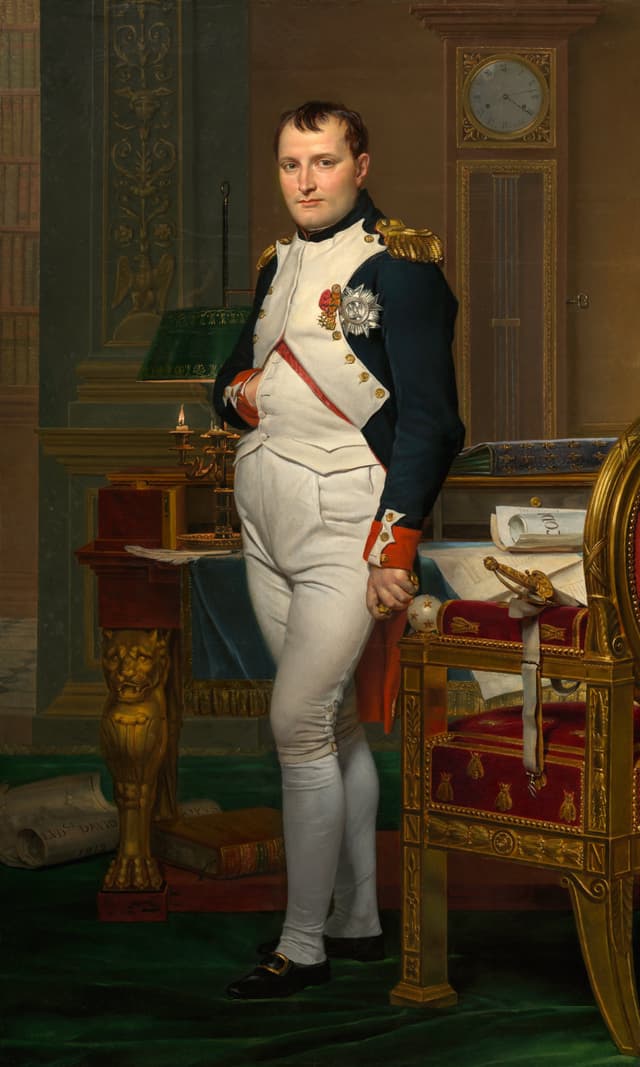
Napoleon Bonaparte
A master strategist and visionary leader, Napoleon Bonaparte transformed the landscape of military and government during his reign from 1769 to 1821. His ability to inspire confidence in those around him was evident when, upon escaping exile, he faced an opposing army and boldly approached them, showcasing his remarkable talent for leadership. Napoleon's establishment of the Napoleonic Code in 1804 not only reformed the legal system in France but also influenced legal frameworks in numerous countries worldwide, demonstrating his far-reaching impact. His belief that imagination rules the world resonates with entrepreneurs today, emphasizing the power of vision and narrative control in achieving success.
Core Principles
action
Thoughts are only valuable when they lead directly to action. Inaction is unbearable. Each thought must be a step toward execution in the real world.
Napoleon believed thinking and planning were merely prerequisites to action. He constantly repeated that figuring out what you want and then making it happen in reality was the essential cycle. He valued execution above contemplation alone.
“Work, I am born and built for work. To his mind, inaction was unbearable.”
competitive advantage
Only compete where you have a structural advantage. Do not enter a competitive arena where your opponent has an insurmountable edge built over generations.
France could not match Britain's naval power. Developing a powerful navy required expertise that only came from decades of maritime tradition and training. Even low-ranking British sailors had skills that French soldiers could not quickly acquire. Napoleon choosing to fight Britain at sea was like a cow pursuing a rabbit. Businesses should similarly avoid competing on dimensions where rivals have generational advantages.
“You might as well send a cow in pursuit of a rabbit.”
Success is what makes the great man. Outcomes are the only legitimate measure of greatness. Results determine how history will judge you.
When Napoleon analyzed George Washington, he noted that Britain initially refused to acknowledge Washington or American independence, but their success forced Britain to change its position. This taught Napoleon that actual results in the world are what create legitimacy and recognition.
“It is success which makes the great man.”
Do not compete on your enemy's terms. Avoid battles where your competitor has already studied the terrain, has fortified their position, or holds structural advantage. Create or find different games to play.
Napoleon taught to avoid fields of battle the enemy had studied or fortified. This principle parallels Ed Thorp's maxim to only play games where you have an edge. Smaller companies must outthink larger ones rather than engage in direct competition.
“A well-established maximum of war is to not do anything which your enemy wishes.”
Smaller organizations without numerical superiority must employ greater cleverness and tactical sophistication. Intelligence and resourcefulness can overcome size disadvantages.
When facing larger forces, Napoleon emphasized that small teams cannot win without the aid of art (strategy and cleverness). Smaller companies must be more creative and strategic than larger competitors to succeed.
“The natural positions which are commonly met with cannot secure an army against the superiority of a more numerous one without the aid of art.”
culture
Avoid allowing your organization to become soft through excessive luxury and ease. Comfort erodes discipline, preparedness, and the hunger necessary to compete against hungrier rivals.
Napoleon understood that troops concentrated in comfortable home areas lost discipline and competitive edge. Success and wealth naturally make organizations complacent. Maintaining a culture of continuous challenge and improvement is necessary to prevent younger competitors from overtaking you.
“Napoleon seems to have in mind the dangers of having troops concentrated in your home area, where they might be exposed to a loss of discipline.”
finance
Keep a fortress of cash. Maintain significant liquid reserves to enable rapid opportunistic acquisitions and strategic moves when unexpected opportunities arise.
Napoleon emphasized the importance of having ammunition, food, supplies, and repair facilities readily available to restore troops and weapons quickly. For modern business, this translates to maintaining a cash fortress like Rockefeller and Buffett did, enabling you to act decisively when opportunities appear.
“It is a distinct advantage to have near at hand ammunition, food, supplies, and repair facilities to restore rapidly troops and weapons of war.”
focus
As organizations grow, maintain the agility and focus that made them successful initially. Large organizations become harder to maneuver, distracted by internal complexity, and vulnerable to focused competitors.
The very size of Napoleon's army made it harder to control and maneuver than the forces he commanded earlier. The problems of ruling his vast, troubled empire pressed in on him, distracting from the campaign. Success had created bureaucratic overhead that slowed decision-making. Meanwhile, focused Russian commanders adapted faster.
“The very size of his army made it harder for him to control and maneuver than the forces he had commanded earlier in his career.”
The distracted do not beat the focused. Divided attention across too many initiatives, markets, or goals reduces the quality of execution across all of them.
Napoleon was trying to rule an empire, expand further, and fight on multiple fronts simultaneously. His attention was divided between political consolidation and military conquest. The Russians were focused solely on defending their homeland using asymmetric tactics. This focus advantage, combined with harsh conditions, proved decisive.
Winning solves everything. Keep the main thing the main thing. Victory is the ultimate measure of all decisions and actions. Judge men only by the results of their actions.
Napoleon believed that success in whatever arena ultimately legitimized all decisions and actions. Winning changed circumstances, perceptions, and what was possible. Everything was subordinated to achieving victory.
“Winning is the main thing. Keep the main thing, the main thing.”
Skill in business consists of focusing concentrated effort on a single critical point. Bring unexpected concentration of resources to bear on one selected objective, and you will capture it.
Napoleon believed that effectiveness came from convergence of forces at a single point rather than dispersed effort. This principle of focus applies directly to startup strategy: concentrate resources on winning one critical market or customer segment rather than dispersing efforts.
“Skill consists in converging a mass of fire upon a single point. He that has the skill to bring a sudden unexpected concentration of artillery to bear upon a selected point is sure to capture it.”
innovation
Imagination rules the world. The power to envision what does not yet exist is more valuable than any physical force or resource.
Napoleon recognized that human vision and imagination are the ultimate sources of power and change. The ability to imagine a different reality and then make it actual is the foundation of all greatness and transformation.
“Imagination rules the world.”
The most valuable mind is one that gives existence to the non-existent. Creation is the greatest improvisation of the human mind: bringing something new into being that did not exist before.
Napoleon articulated the founder mindset by emphasizing that true creativity and greatness come from building entirely new things. This requires the belief that you can change the world by creating something fundamentally new rather than merely copying what exists.
“The greatest improvisation of the human mind is that which gives existence to the nonexistent.”
leadership
Understanding people and inspiring confidence is the prime necessity for large-scale success. The ability to identify talent, build loyalty, and bring out the best in others is what separates great leaders from competent ones.
John D. Rockefeller, reflecting on Napoleon's genius, noted that Napoleon's greatest strength was his ability to select exceptional marshals and inspire their devotion through leadership. The marshals' enthusiasm and confidence in Napoleon were critical to his military victories. This same principle applies to building any large organization.
“A thorough understanding of men and ability to inspire in them confidence in him and confidence in themselves... It is by such traits as these that men get the work of the world done.”
Appeal directly to people's sense of pride and destiny rather than using command-and-control management. Give people a story they can be proud to tell, a legacy they are building.
Napoleon made frequent addresses to his troops praising their bravery, distributed medals and engraved sabers for heroism, and connected their sacrifices to a larger mission. He would say things like, 'All of you wish to be able to say with pride upon returning to your villages, I was part of the conquering army of Italy.' This approach made soldiers fight harder than fear or discipline alone could achieve.
“The fatherland has the right to expect great things of you. All of you wish to be able to say with pride upon returning to your villages, I was part of the conquering army of Italy.”
Men are moved by only two levers: fear and self-interest. Understanding human psychology means recognizing these as the primary drivers of behavior and motivation.
Napoleon studied human nature intensively and concluded that beyond fear and self-interest, humans have no other primary motivations. This psychological insight informed his approach to leadership, war, and governance. He used this understanding to predict and influence behavior.
“Men are moved by two levers only, fear and self-interest.”
Master human psychology and morale above all else. Your troops believe what you convince them to believe. Perception and confidence determine outcomes as much as material conditions.
Napoleon spent enormous effort communicating with and influencing his troops' beliefs about their situation and capabilities. He understood that an army's effectiveness depends fundamentally on their morale, confidence, and belief in their leader.
“The morale of your troops, who are either strong and victorious, are weak and beaten depending on which they think they will be.”
Boldness is the distinguishing characteristic of great leaders. Timidity in execution destroys everything. The boldness to take risks and pursue audacious strategies separates great men from mediocre ones.
Napoleon repeatedly praised boldness in the great generals and leaders he studied. Alexander, Caesar, and Frederick the Great all distinguished themselves through willingness to take extreme risks and pursue bold strategies that more cautious commanders would never attempt.
“Everything he did was calculated deeply, carried out audaciously and managed wisely.”
learning
Study great historical figures intensively. Learn from both their successes and failures. History reveals how humans actually behave, not how we wish they would behave.
Napoleon made systematic study of Alexander, Caesar, Hannibal, and other great commanders the core of his military education. He treated their campaigns as case studies to extract principles and tactics he could apply to his own situations.
“The history of their 83 campaigns would constitute a complete treatise on the art of war.”
marketing
Control the narrative across all available media channels. Strategic storytelling and deliberate image-crafting directly influence how people perceive your power and capabilities.
Napoleon understood viscerally how to manage celebrity in the service of power. He founded two French-language newspapers to report on his conquests, used painters and sculptors to spread his image, and carefully orchestrated dramatic moments that would be retold for centuries. He recognized that political success in the revolutionary age depended on forging emotional bonds with ordinary people through narrative.
“Napoleon founded two French language newspapers to report on his conquest.”
Control the narrative and information flow. Guide public opinion through deliberate communication. The masses must understand things in the way you want them understood.
Napoleon believed information and propaganda were tools as important as armies. He personally dictated army bulletins to control messaging, used them to counter rumors and mislead enemies, and understood that controlling what people believed shaped outcomes.
“The masses must be guided without their noticing it. It is necessary to enlighten public opinion. With ink and paper, you can draw any picture you like.”
In your external communications, project strength and confidence. Internally, ensure your team understands competitive advantages. Public psychology and perception matter enormously in business.
Napoleon understood propaganda and public opinion deeply. He would publish statements to enemies about his superior strength while telling his own troops the enemy was inferior. Modern businesses must tell their own story and shape public perception.
“Public opinion is invisible and mysterious. Before it, nothing stands. With it, everything becomes easy.”
Vocal minority voices carry disproportionate weight in shaping opinion. Ten people who vocally communicate make more noise than ten thousand who remain silent. Tell your story.
Napoleon understood that volume of voice and active communication shape perception more than population size or truth alone. Modern founders must actively communicate their narrative rather than assume quality speaks for itself.
“Ten people who yell make more noise than 10,000 who keep silent.”
Frameworks
Stage Management for Organizational Control
Deliberately craft your image and narrative across all available media channels to create emotional bonds with followers. Use all media forms (newspapers, paintings, public speeches, monuments) to control what story gets told about your organization and achievements. This creates loyalty and identity that transcends rational calculation.
Use case: When building large organizations that depend on loyalty rather than just salary. Particularly powerful during periods of rapid change or uncertainty when people need a story to believe in.
The Ladder of Chaos
When structural change disrupts traditional hierarchies, ambitious individuals with the right skills can climb much faster than in stable environments. The key is recognizing that the chaos itself creates the opportunity and having the competence to exploit it.
Use case: Identifying when industry disruptions are opening new paths to power or market dominance. Most relevant for founders entering markets undergoing technological or regulatory transformation.
Concentrated Force Maneuvering
Divide your forces into dispersed groups, then execute rapid coordinated movements to concentrate them at a single strategic point where you have overwhelming advantage. The goal is not skirmishing but complete destruction of enemy capability.
Use case: Market entry strategy where you concentrate resources to dominate a specific segment completely before expanding. Also applies to product strategy: dispersed R&D, concentrated launch.
Appeal to Pride and Destiny
Rather than managing people through command and control, give them a mission worth sacrificing for and recognition for their contributions. Make them proud to be part of the organization and able to tell that story to others.
Use case: Building loyalty in scaling organizations where you cannot rely on direct supervision. Particularly effective in startups and in competitive talent markets.
Thought to Action Cycle
Each thought must be immediately evaluated for how it leads to action in the real world. Ideas are only valuable insofar as they translate into results. This creates a tight feedback loop where thinking is disciplined by its purpose to drive execution.
Use case: Evaluating business strategies and avoiding analysis paralysis. Teams can use this to move quickly from planning to execution without endless deliberation.
Asymmetric Defense Against Superior Force
When facing a stronger opponent at their game, refuse to play that game. Instead, use their size and speed against them by stretching supply lines, denying decisive battles, and leveraging environmental factors. Turn their advantages into liabilities.
Use case: Competing against larger, better-resourced competitors. Particularly relevant for startups entering markets dominated by incumbents with more resources.
Timid Planning, Bold Execution
During the planning phase, imagine all possible worst-case scenarios and dangers. Exaggerate potential problems to prepare contingencies. Once committed to action, eliminate all doubt and fear, and execute with complete boldness and relentlessness.
Use case: Risk management and decision-making. Useful for founders designing go-to-market strategies, product launches, or major business pivots. Plan conservatively, execute aggressively.
Two Levers of Human Motivation
All human behavior is ultimately driven by two levers: fear and self-interest. Understanding this allows you to predict how people will act and to influence them by appealing to one or both of these motivations rather than appeals to virtue or logic.
Use case: Marketing strategy, sales messaging, team motivation, and leadership. Instead of explaining why your product is superior, explain what it does for the customer's self-interest or what problems it prevents.
Squareness: Equilibrium of Mind and Character
The most effective leaders balance two things equally: intellectual capability and strength of character (physical courage, perseverance, daring). Neither alone is sufficient. True effectiveness requires both sharp thinking and courageous action.
Use case: Team building and leadership development. Identifies that you need both analytical thinkers and bold risk-takers. The best people are those who can do both.
Do Everything Framework
Assume that great events depend on tiny factors that others overlook. The successful person takes advantage of everything, neglects nothing that might give added opportunity, and understands that missing one small thing can mean missing everything.
Use case: Operations and execution. Reminds founders to obsess over details, follow up on small things, and never assume something is too trivial to matter. Applies to customer service, quality control, and relationship management.
Stories
As opposing armies faced each other during Napoleon's escape from exile, he ordered his men to lower weapons and walked directly toward the opposing force, opening his coat to expose his chest. He said, 'If there is any soldier among you who wants to kill his emperor, here I am.' Instead of shooting, soldiers began shouting 'Long live the emperor' and threw down their weapons. His small army immediately doubled in size.
Lesson: The narrative you control and the emotional bonds you have built matter more than military hardware. Stage management and careful image cultivation create loyalty that survives rational self-interest. This was not a real military move but a performance that worked because Napoleon had previously earned the devotion of his soldiers.
Napoleon invaded Russia carrying Voltaire's History of Charles VII, which detailed how a Swedish king had invaded Russia a century earlier and been destroyed by exhaustion and winter. Early in the campaign, Napoleon said to an aide, 'We shall not repeat the folly of Charles VII.' But he did exactly that, delaying his retreat for a month because he believed he had time before winter. He was proven catastrophically wrong when one of the coldest winters on record began early. Of 650,000 men, barely 85,000 returned.
Lesson: Reading history provides answers if you have the humility to actually absorb the lessons. Napoleon had poor reading comprehension because his ego prevented him from seeing the parallel between Charles and himself. The same intellectual capability that allowed him to win battles prevented him from learning from the past. Success and ego can block wisdom.
As a lonely nine-year-old sent to military boarding school, Napoleon was harassed by classmates for his Corsican accent and name. He spent five years without returning home. Rather than breaking him, he found solace in obsessive reading, developing habits of note-taking and filing obscure words. By adolescence, books were his only friends. This childhood isolation built the mental frameworks and resilience that would later allow him to visualize complex military systems.
Lesson: Hardship in formative years, when transformed through deliberate study and reflection, can become a source of competitive advantage. Napoleon's isolation forced him to develop internal resources and intellectual depth that served him later. The childhood pain was real but became fuel for extraordinary capability.
When Napoleon was shaved by his barber, Tim, he would read French newspapers and repeatedly say 'Skip it, skip it' because he knew the papers only printed what he told them to print. This demonstrates both his complete control over information and his understanding of how to shape public perception.
Lesson: Control of information flow is a critical lever of power. Those who shape the narrative shape how reality is perceived, which shapes outcomes. Information control is as important as any physical resource.
General Mack, commander of Austrian forces, objected that Napoleon violated Swiss and Prussian neutrality in battle. Napoleon simply smiled and asked, 'Why didn't you do it?' Mack had failed to understand that agreed-upon rules don't apply to those willing to break them in pursuit of their goals.
Lesson: In competition, rules are only binding on those who choose to be bound by them. Those seeking supremacy will disregard conventions others respect. This illustrates the danger of not understanding human psychology and the lengths ambitious people will go.
When dictating his wife Josephine's itinerary for a water cure, Napoleon dictated 21 large sheets of paper detailing her every move, despite being emperor of France with countless pressing matters. His inability to delegate even trivial details revealed both his need for control and a contradiction with his own advice about effective ruling.
Lesson: Micromanagement and need for control can contradict principles of effective leadership. Even those who know better often struggle with letting go of details. However, this same drive to control details was partly responsible for Napoleon's military success.
Napoleon studied 83 campaigns of history's great commanders (Alexander, Hannibal, Caesar, Frederick) and identified that they all followed the same core principles: keep forces united, be vulnerable nowhere, strike at critical points speedily, and exploit every opportunity. This became the foundation of his military strategy.
Lesson: Principles of success recur across contexts and across history. Great performers study patterns in how others succeeded and extract underlying principles that apply to their situation. History is a curriculum of how to succeed.
Napoleon strategically praised the Austrian general Provera as exceptionally competent and wise, despite knowing him to be incompetent. The Austrian government, believing Napoleon's reports, kept Provera in his position. The incompetent general remained in power where he could do no harm to Napoleon's objectives.
Lesson: Understanding human psychology and how people interpret information enables strategic manipulation of situations. This illustrates that psychology and narrative shaping are legitimate strategic tools. Be aware that enemies may use flattery or other psychological tactics to influence your decisions.
Notable Quotes
“A thorough understanding of men and ability to inspire in them confidence in him and confidence in themselves... It is by such traits as these that men get the work of the world done.”
Rockefeller's reflection on what made Napoleon a genius. This is what Rockefeller saw as the prime necessity for large-scale success in any enterprise.
“I live like a bear, always alone in my small room with my books. They were my only friends.”
Describing his adolescent years at boarding school. This reading habit became foundational to his intellectual development.
“I am your emperor. Acknowledge me... If there is any soldier among you who wants to kill his emperor, here I am.”
During his escape from exile, speaking to opposing forces. A moment of pure stage management that reversed the military situation through narrative and loyalty.
“Did I believe myself to be a superior man. And did the ambition come to me of executing the great things which so far had been occupying my thoughts only as a fantastic dream.”
Reflecting years later on the moment after a major military victory when he transitioned from believing in himself theoretically to believing he was destined for greatness.
“In Egypt, I found myself freed from the obstacles of an irksome civilization. I was full of dreams. I saw myself founding a religion, marching into Asia, riding an elephant.”
Demonstrating the moment when he began to get high on his own supply, transitioning from soldier to would-be god. A warning about the dangers of believing your own mythology.
“I wanted to rule the world. Who wouldn't have in my place?”
Late in his reign, showing the unlimited ambition that would lead to his downfall. No proportional limits or acknowledgment of constraints.
“We shall not repeat the folly of Charles VII.”
Early in the Russian invasion, about the Swedish king who had tried and failed to invade Russia. Ironically, he then repeated that exact folly.
“All my life, I have sacrificed everything, comfort, self-interest, happiness, to my destiny. Destiny must be fulfilled. That is my chief doctrine.”
Describing his life philosophy and the organizing principle that guided all his decisions and actions.
“To have lived without glory, without leaving a trace of one's existence, is not to have lived at all.”
On the importance of creating lasting impact and legacy. Repeated multiple times throughout the book as a central theme.
“The greatest improvisation of the human mind is that which gives existence to the nonexistent.”
Defining creation and the founder mindset: the ability to bring something new into the world that did not exist before.
Frequently Asked Questions
What are Napoleon Bonaparte's key business principles?▼
Napoleon Bonaparte's core principles include: Thoughts are only valuable when they lead directly to action. Inaction is unbearable. Each thought must be a step toward execution in the real world.. Only compete where you have a structural advantage. Do not enter a competitive arena where your opponent has an insurmountable edge built over generations.. Success is what makes the great man. Outcomes are the only legitimate measure of greatness. Results determine how history will judge you.. Founder Almanac has cataloged 30 total principles from Napoleon's career.
What can entrepreneurs learn from Napoleon Bonaparte?▼
Key lessons from Napoleon Bonaparte include: The narrative you control and the emotional bonds you have built matter more than military hardware. Stage management and careful image cultivation create loyalty that survives rational self-interest. This was not a real military move but a performance that worked because Napoleon had previously earned the devotion of his soldiers.. Explore 8 stories and 10 frameworks from Napoleon's experience.
What is Napoleon Bonaparte known for in business?▼
A master strategist and visionary leader, Napoleon Bonaparte transformed the landscape of military and government during his reign from 1769 to 1821. His ability to inspire confidence in those around him was evident when, upon escaping exile, he faced an opposing army and boldly approached them, showcasing his remarkable talent for leadership. Napoleon's establishment of the Napoleonic Code in 1804 not only reformed the legal system in France but also influenced legal frameworks in numerous countries worldwide, demonstrating his far-reaching impact. His belief that imagination rules the world resonates with entrepreneurs today, emphasizing the power of vision and narrative control in achieving success.
More Military & Government Founders
Want Napoleon's advice on your business?
Our AI has studied Napoleon Bonaparte's biography, principles, and decision-making frameworks. Ask any business question.
Start a conversation