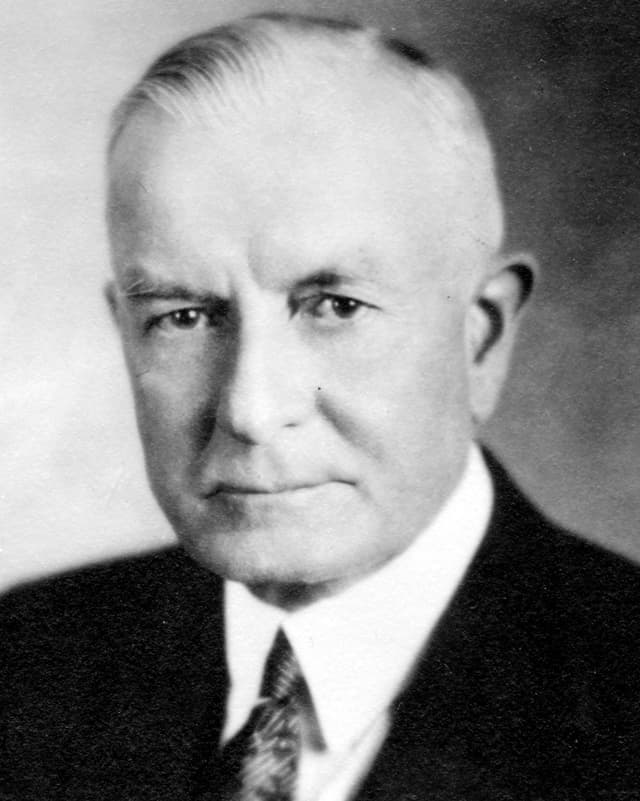
Thomas Watson Sr.
IBM (International Business Machines)
A pioneer in the technology industry, Thomas Watson Sr. transformed IBM into a global powerhouse, leading the company through its formative years from 1924 until his retirement in 1956. Under his leadership, IBM's revenue skyrocketed from $1 million to over $1 billion, a testament to his relentless focus on studying the business and fostering expertise among his employees. Watson's philosophy emphasized the importance of aligning incentives with contributions, advocating for compensation structures that allowed individuals to capture value proportional to their successes. His commitment to continuous learning and mastery remains a guiding principle for entrepreneurs today, as he famously declared, "I preach and preach and preach to study the business, study the business, study the business."
Core Principles
competitive advantage
Build your competitive advantage through patents. Acquire patents through both internal invention and strategic acquisition of competitors or their innovations.
Watson learned the value of patents at NCR and applied this systematically at IBM. He established patent strategy as a cornerstone of competitive defense, acquiring companies like J. Roden Pierce specifically for their patents and talented engineers. This made it difficult for competitors who had to either invent new technology or license from IBM.
“Controlling the key patents on tabulating systems help make life difficult for the competition because competitors would have to invent entirely new technology or license IBM patents.”
culture
Reward loyalty with genuine support during personal crises and celebrations. Acts of personal compassion ripple through organizations and create deep commitment.
Watson was known for taking extraordinary action when employees faced difficulties. During the Dayton flood, he organized massive relief efforts. When an employee's child died, he was there for them. He supported struggling former employees financially decades later. These acts of kindness created loyalty that extended far beyond transactional business relationships.
“He came through for people when they needed him, and he did more than they expected.”
finance
Never cap your upside when structuring compensation or employment agreements. Align incentives so you capture value proportional to your contribution and success.
When Watson joined CTR, he negotiated for 5 percent of profits rather than a fixed salary. This uncapped upside structure made him extraordinarily wealthy and famous, and he became one of the highest-paid executives in America for several years. This demonstrated the power of equity-based compensation.
“Watson would get 5% of CTR's profits. It gave Watson great financial upside.”
hiring
Promote from within and develop people through training rather than always hiring external talent. Building your own leadership pipeline creates cultural consistency and loyalty.
Watson preferred to promote from within and develop people through training rather than hire from outside. This approach built a cohesive culture where people shared Watson's values and vision. However, the author notes this can become problematic if taken to extremes, as Watson did, creating insularity and preventing fresh thinking.
“I like to develop men from the ranks and promote them. I don't look outside of the company for talent.”
innovation
When your existing technology becomes outdated or patents expire, double down on innovation rather than defend the old business. Invest heavily in R&D to invent your way out of the problem.
Watson realized that CTR's existing patents would expire and competitors would emerge. He studied Charles Kettering's approach at GM and made the strategic decision to fund a large laboratory full of brilliant engineers. This led to recruiting James Bryce, who generated over 400 patents and became one of the ten greatest living inventors.
“Better technology translated into sales. Thinking of the lessons from his friend Charles Kettering, Watson decided to fund a laboratory full of engineers.”
leadership
Give credit generously and publicly to those who contribute great ideas. Publicly recognize engineers and employees, especially to external audiences. This builds loyalty and attracts talent.
Watson would publicly name employees who came up with great ideas and lauded his engineers in speeches to external audiences. He rarely failed to thank thousands of employees. This generous crediting of others created emotional investment and encouraged continued excellence.
“As much as he promoted himself and thought the world revolved around him, Watson also generously gave credit to others.”
Create a compelling culture and vision that inspires belief in the company's future, even when circumstances suggest skepticism. Use optimism strategically to attract talent and build momentum.
When Watson took over CTR, it was a bloated, failing company. Many employees saw no reason to believe in its future. Watson's first major move was not to announce specific products but to proclaim that CTR would become 'a glorious institution.' This vision, backed by his charisma and conviction, gradually won converts who believed in the company's potential.
“The only vision Watson communicated to CTR in those first few months was that the company was going to become a glorious institution.”
mindset
Study your business relentlessly and develop expertise in your craft. Continuous learning and mastery should be non-negotiable disciplines.
Watson preached constantly about studying the business. He believed that whether you were managing people or running a company, deep knowledge of your domain was essential. This philosophy permeated IBM culture through signs saying 'THINK' in offices everywhere.
“I preach and preach and preach to study the business, study the business, study the business.”
Use dedicated thinking time as a legitimate work activity. Before entering the office, clarify four or five concrete items you want to accomplish by spending uninterrupted time in deep thought.
Watson would not go to the office unless he had thought through what he wanted to accomplish that day. If that meant sitting with coffee for an hour or two to think through problems, he would do so. He encouraged his employees to do the same, recognizing that rigorous thinking is essential work, not avoidance of work.
“Unless he needed time to think through an idea, he wouldn't go into the office unless he had thought through four or five items he wanted to get done.”
Learn from founders and leaders who came before you. Study their decision-making, their experiments over entire lifetimes, and extract principles you can apply to your own business.
Watson studied Patterson at NCR, learned from Charles Kettering about innovation and research labs, observed George F. Johnson's management approach, and learned from conversations with friends in business. He was a constant student of founder behavior and business principles. The author emphasizes that centuries of founder experiments are available for study at minimal cost.
“For very little money and a few hours of time, you can learn from someone's accumulated experience. There is so much more to learn from the past than we often realize.”
resilience
Accept early setbacks and failures as redirection rather than permanent obstacles. Pivot quickly and persevere through multiple failures until you find what works.
Watson failed at selling sewing machines, lost his horse and wagon full of inventory due to visiting a saloon, sold a failing butcher shop, and struggled early in his sales career. Rather than give up, he persisted through each failure, learned from each experience, and eventually found success. None of these early failures stopped him from becoming one of history's great business leaders.
Perseverance and continued effort can overcome early failures and lack of natural talent. Success is not predetermined by youthful achievement, and late bloomers can achieve extraordinary things.
Watson grew up poor with no outstanding talents, failed at school and multiple early jobs, and didn't find real success until his 40s. He showed persistence by repeatedly applying for work with John Range until Range hired him, then built exceptional skills through study and effort. His story demonstrates that late starts and early struggles do not preclude building world-changing businesses.
“Watson asked Range for a job and continued calling on Range until Range said yes.”
A traumatic failure or public humiliation can be transformed into fuel for long-term excellence if you channel the experience into proving your critics wrong and rebuilding your reputation.
Watson was indicted as part of an antitrust case at NCR, convicted, and faced potential jail time while his wife was pregnant and he had no job prospects. The shock of being labeled a criminal had a profound impact. Rather than being destroyed, he channeled this into an obsessive commitment to building a squeaky clean image and a morally superior company. This became his core motivation.
“The shock of the reality of a jury proclaiming him guilty, of being labeled a criminal had a profound and lasting impact. If there was a single moment when Tom Watson changed, when he decided that a squeaky clean image and reputation were paramount, this was that moment.”
strategy
Great business discovery and product positioning rarely come from a single epiphany. Instead, make incremental observations and refinements over many years to gradually identify what your company should become.
Watson did not arrive at IBM with a grand vision for punch card dominance. Rather, over 10-12 years he made one observation after another, visited Kodak to learn better management systems, discovered Hollerith machines, studied market dynamics, and gradually positioned IBM in tabulating. His determination and will allowed him to toil through this discovery process.
“Watson had no epiphanies. No voice spoke to him about the future of data processing. He got there little by little. One observation after another over a period of 10 to 12 years.”
During economic downturns, while competitors cut costs and R&D, consider the opposite strategy if you have the conviction and capital. Maintain production and increase investment in research and development to dominate when the economy recovers.
During the Great Depression when unemployment exceeded 20 percent and companies slashed budgets, Watson made two dangerous decisions: he kept all factories running and laid off no one, and he increased R&D spending dramatically. He even built a massive research facility during the crisis. When the Social Security Act created sudden demand for accounting machines, IBM was the only company prepared with both capacity and superior products.
“He made two dangerous decisions. One, he would keep factories running and lay off no one. And two, he would increase spending on research and development, even as companies around the world slashed their R&D budgets.”
Identify markets with massive untapped potential and position yourself to dominate them rather than competing in mature industries where leadership is already established.
Watson analyzed IBM's options and chose to focus on tabulating machines and data processing rather than time clocks or scales. He recognized that tabulating machines automated mental work, not just physical work, and that the field lay wide open with enormous potential. This strategic focus led to a 90 percent market share and decades of dominance.
“There isn't any limit for the tabulating business for many years to come. We have just scratched the surface in this division.”
Move beyond what makes you average and anchor yourself around what makes you unique, especially as you advance in your career and take on greater responsibility.
Watson's father told him that what he had been doing as a sales manager, hundreds of men could do, but his new opportunity was something different and new. This advice became foundational to Watson's thinking about differentiation and competitive advantage throughout his career at NCR and IBM.
“What you've been doing, hundreds of men can do, but now you're doing something different, something new.”
Frameworks
The Four or Five Item Daily Clarity Framework
Before starting work each day, spend dedicated uninterrupted time (even hours if needed) thinking through exactly four or five specific items you want to accomplish. This framework forces prioritization, deep thinking about execution, and ensures that work time is spent on pre-planned high-impact activities rather than reactive firefighting.
Use case: When you find yourself scattered across too many priorities or reactive problem-solving. Ideal for executives and entrepreneurs who need to make strategic decisions and set direction.
The Observation and Iteration Discovery Model
Rather than trying to predict the future with a single grand vision, make incremental observations over 10-12 years, learn from visiting other companies and leaders, gather data points about what works, and gradually refine your understanding of what your company should become. This reduces the risk of betting everything on a wrong guess early.
Use case: When entering a new market or taking over an existing company where the strategic direction is unclear. Particularly useful in emerging industries where the ultimate winners are not yet obvious.
The Patent Moat Strategy
Identify your industry's key technological barriers. Build a patent portfolio through both internal R&D and strategic acquisition of competitors and their innovations. Use patent control to make it expensive or difficult for competitors to enter, forcing them to either license your technology or invent completely new approaches.
Use case: In technology-driven industries where patents provide meaningful protection. Most effective when combined with continuous innovation so that your patent portfolio stays ahead of industry needs.
The Counter-Cyclical Investment Strategy
When competitors are cutting R&D and reducing capacity during economic downturns, consider doing the opposite: maintain production capacity, keep your workforce intact, and increase investment in research and development. This positions you to dominate when the economy recovers and demand returns.
Use case: During recessions or industry downturns when you have sufficient capital reserves and conviction that the market will recover. Requires willingness to accept short-term pain for long-term dominance.
The Glorious Institution Vision Framework
When taking over a struggling company, do not immediately announce specific products or tactical fixes. Instead, paint a compelling vision of what the institution will become at its best (the glorious institution vision). Use charisma and optimism to convince people to believe in a better future, which attracts talent and builds momentum for actual change.
Use case: In turnaround situations where employees are demoralized and skeptical about the company's future. Useful when you need to attract talent and rebuild organizational morale before executing tactical improvements.
Stories
Watson worked as a sales manager selling sewing machines in Buffalo. One evening he stayed too late at a saloon and when he emerged, his horse, wagon, and all the sewing machines had been stolen. His boss fired him for this loss. This early career setback proved formative.
Lesson: Early failures and consequences create learning that lasts a lifetime. Watson concluded that alcohol could never be mixed with business, and this experience shaped his later strict prohibition on drinking for IBM employees. Sometimes painful consequences are the best teachers.
Watson was indicted as a criminal for his role in NCR's antirust violations and faced potential jail time while his wife was about to give birth. Unlike every other defendant, Watson refused a plea deal that would have avoided prison. He fought the conviction despite being guilty because admitting wrongdoing was psychologically unacceptable to him.
Lesson: Trauma and public humiliation can be transformed into fuel for excellence if channeled properly. Watson's conviction and the shame of being labeled a criminal became his core motivation to prove he was honest and moral, which drove his obsessive focus on building a great company and squeaky clean image.
When Watson discovered that Kodak's sales manager had a system to monitor individual salesman performance using charts and numbers, Watson's mind 'began to swim around' with excitement. He immediately asked how to do the same thing and was shown Hollerith machines, which automated data processing using punched cards. This chance observation led him to discover IBM's future core business.
Lesson: Stay curious and visit other successful companies to see how they solve problems you haven't yet solved. Exposure to better systems can open your eyes to what's possible. Incremental observations like this accumulate over time into strategic insights.
During the Great Depression when most companies slashed R&D budgets and cut production, Watson made the dangerous decision to maintain full production, keep all workers employed, and increase R&D spending dramatically. He even built a massive new research facility during the crisis. This nearly bankrupted IBM but positioned it perfectly for the Social Security Act, which suddenly created enormous demand for accounting machines.
Lesson: Conviction about the future combined with willingness to take calculated risks can position you for extraordinary success. When Watson's bet paid off, IBM had capacity and superior products while competitors had neither. However, this strategy requires sufficient capital reserves and can fail if the market recovery is delayed too long.
Watson took over CTR when it was a bloated failure with no clear purpose. Instead of rushing to fix tactical problems, his first move was to declare that CTR would become 'a glorious institution.' This optimistic vision statement, backed by his charisma and conviction, gradually won over skeptical employees who had seen the company fail. Those who didn't believe eventually left.
Lesson: Culture and vision can be powerful tools for transformation. By creating belief in a better future, Watson attracted talent and created momentum that enabled actual improvement. However, the culture became cult-like, which had both positive and negative consequences.
Notable Quotes
“I preach and preach and preach to study the business, study the business, study the business.”
Watson's fundamental belief about how to excel in any business. He believed that mastery of your domain required relentless study and attention to detail.
“There isn't any limit for the tabulating business for many years to come. We have just scratched the surface in this division. I expect the bulk of increased business to come from tabulating.”
Watson's vision for where IBM's future lay. He recognized that data processing had massive untapped potential compared to other office equipment like time clocks and scales.
“Better technology translated into sales. Thinking of the lessons from his friend Charles Kettering, Watson decided to fund a laboratory full of engineers.”
Watson's strategic decision to double down on R&D when the company's key patents were about to expire, ensuring IBM could stay ahead of competitors.
“Controlling the key patents on tabulating systems help make life difficult for the competition because competitors would have to invent entirely new technology or license IBM patents.”
How Watson used patents as a competitive weapon to build and maintain IBM's market dominance.
Frequently Asked Questions
What are Thomas Watson Sr.'s key business principles?▼
Thomas Watson Sr.'s core principles include: Build your competitive advantage through patents. Acquire patents through both internal invention and strategic acquisition of competitors or their innovations.. Reward loyalty with genuine support during personal crises and celebrations. Acts of personal compassion ripple through organizations and create deep commitment.. Never cap your upside when structuring compensation or employment agreements. Align incentives so you capture value proportional to your contribution and success.. Founder Almanac has cataloged 17 total principles from Thomas's career.
What can entrepreneurs learn from Thomas Watson Sr.?▼
Key lessons from Thomas Watson Sr. include: Early failures and consequences create learning that lasts a lifetime. Watson concluded that alcohol could never be mixed with business, and this experience shaped his later strict prohibition on drinking for IBM employees. Sometimes painful consequences are the best teachers.. Explore 5 stories and 5 frameworks from Thomas's experience.
What is Thomas Watson Sr. known for in business?▼
A pioneer in the technology industry, Thomas Watson Sr. transformed IBM into a global powerhouse, leading the company through its formative years from 1924 until his retirement in 1956. Under his leadership, IBM's revenue skyrocketed from $1 million to over $1 billion, a testament to his relentless focus on studying the business and fostering expertise among his employees. Watson's philosophy emphasized the importance of aligning incentives with contributions, advocating for compensation structures that allowed individuals to capture value proportional to their successes. His commitment to continuous learning and mastery remains a guiding principle for entrepreneurs today, as he famously declared, "I preach and preach and preach to study the business, study the business, study the business."
More Technology Founders


Want Thomas's advice on your business?
Our AI has studied Thomas Watson Sr.'s biography, principles, and decision-making frameworks. Ask any business question.
Start a conversation