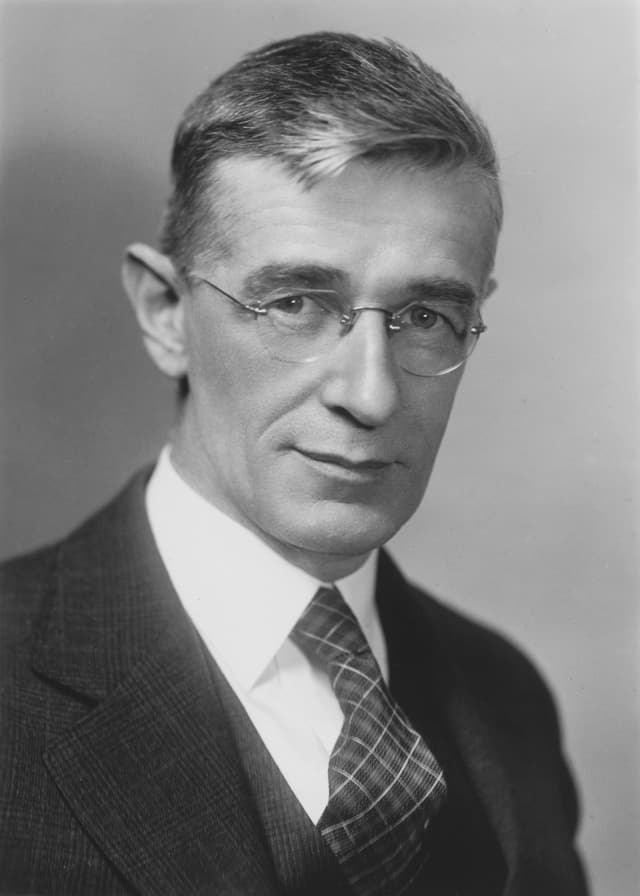
Vannevar Bush
Raytheon
A pioneer in technological innovation, Vannevar Bush served as the dean of engineering at MIT and founded Raytheon, which became a leader in radar technology during World War II, significantly enhancing military capabilities. He emphasized the importance of a triangular relationship among government, industry, and academia to drive sustained innovation, a principle that remains relevant for entrepreneurs today. Bush's decisive leadership and advocacy for government funding of basic research laid the groundwork for modern science and technology funding models. Notably, his belief in the necessity of building an intellectual foundation rather than relying on existing knowledge resonates with business builders who seek competitive advantages in a rapidly evolving landscape. As he remarked, "In these days when there's a tendency to specialize so closely, it is well for us to be reminded that the possibilities of being at once broad and deep did not pass with da Vinci or Benjamin Franklin."
Core Principles
culture
Tolerate and protect genius even when disagreeable. Mediocre people resent genius and try to destroy it. Do not destroy them; they lay golden eggs. The best organizations preserve space for difficult brilliant people.
Bush admired FDR's willingness to build a team of high-spirited thoroughbreds rather than reliable workhorses, even if it meant hand-holding prima donnas. Bush himself was a difficult genius and appreciated being given room to operate. He understood that genius is rare and must be protected from bureaucratic destruction.
“Roosevelt wanted an inventive government rather than an orderly government. Not a team of reliable workhorses, but a team of high-spirited and sensitive thoroughbreds. Even if that meant he must spend time hand-holding his prima donnas.”
customer obsession
An engineer must understand not just the principles of science but the needs, aspirations, possibilities, and frailties of the humans he would serve. Technical mastery without human empathy produces tools that fail to solve real problems.
Bush argued that the best engineers and innovators are those who blend technical capability with understanding of human nature. He saw the gap between men of science and men of affairs, between technologists without humanities and humanists without science, as a major brake on progress. True innovation requires both.
“The engineer must not only grasp the principles of science, but also know the needs and aspirations, the possibilities and the frailties of those whom he would serve.”
focus
Create urgency and scarcity for yourself by refusing to be indefinite about timelines. Bush negotiated his MIT doctorate to be completed within a year because he had no money and wanted to marry. This constraint forced focus and speed.
As a young man, Bush had barely enough money for one year of graduate study. Rather than extending his time at MIT, he negotiated with professors to compress his doctoral work into one year, driven by his need to marry and avoid financial hardship for his wife. This deadline-driven approach became a lifelong pattern of moving quickly.
“He had barely enough money for one year of study, and he wished to avoid dragging his new wife into a life of penurary. He wound up working two jobs to get by.”
Be impatient with yourself and your organization. The best founders are in a hurry because time is finite and opportunity windows close. This productive impatience drives focus and prevents complacency.
Throughout Bush's life, the note 'stubborn, independent, and in a hurry' describes his approach. As a young man, he negotiated his PhD in one year. As a leader during WWII, he moved quickly to mobilize resources. As a thinker, he published essays foreseeing the internet decades before it arrived. This impatience was not anxious but purposeful.
hiring
The engineer is a pragmatic polymath, not a specialist in a single domain. The most valuable people acquire skills from physics, business, and invention, then apply them at scale to solve real problems for real people.
Bush defined the engineer not as physicist, businessman, or inventor alone, but as someone who blends all three. This perspective made him invaluable during WWII when he had to bridge government, academia, and industry to mobilize research. He looked for people who could think across domains.
“The engineer was not a physicist, a businessman, or an inventor, but someone who would acquire some of the skills and knowledge of each of these and be capable of successfully developing and applying new devices on the grand scale.”
innovation
Give visionary targets to inventors and let them figure out how to hit them. You do not need to know the means; a clear vision of the desired future is enough to guide a generation of problem-solvers.
Bush's 1945 essay 'As We May Think' described the Memex, a machine that could amplify individual consciousness and manage vast information. He had 'barely a clue how to actually achieve this.' Yet by putting the vision into plain English, he 'gave a generation of inventors a target to shoot at.' The vision was more valuable than the technical roadmap.
“He put into plain English a set of problems that technologists must satisfy if they were to claim victory in the drive to mechanize cognition. That he had barely a clue how to actually achieve this in no way detracts from the value of his vision. He gave a generation of inventors a target to shoot at.”
Identify emerging information overload problems before they arrive and invent tools to manage them. The person who solves the knowledge management problem for their era shapes that era's thinking.
In the 1930s, Bush foresaw that specialists and scholars would be drowned in rapidly accumulating documents and data. He mused about machines that could help discipline random ideas and manage information. This thinking led to his 1945 essay 'As We May Think,' which described the Memex, essentially predicting the internet and personal computing.
“People trying to think straight in the midst of complexity needed more than a device that just crunched numbers. They needed help in disciplining their random ideas. More important, they needed a way to manage the rapidly growing amount of documents and data that threatened to overwhelm the specialist and render whole fields incomprehensible to even the intelligent layman.”
leadership
When in doubt, act. If you are unsure whether something is your responsibility, do it. If someone pushes back, you lay off. But take as much ground as your opponents cede. This bias toward action prevents analysis paralysis and reveals the true boundaries of your authority.
Bush told generals during WWII that his philosophy was simple: if he had doubt about whether he was supposed to do something, he did it. If someone objected, he would stop. But he would not wait for perfect clarity to move. This approach allowed him to take initiative and coordinate across bureaucratic boundaries without constantly seeking permission.
“My whole philosophy is very simple. If I have any doubt as to whether I am supposed to do a job or not, I do it. And if someone socks me, I lay off.”
Make decisions crisply and clearly, without doubt or endless deliberation. Decisiveness creates direction for others to follow.
Vannevar Bush came from a line of sea captains and embodied their principle: run things decisively without doubt. As the dean of MIT's engineering school, founder of Raytheon, and America's top military science administrator in WWII, he made clear decisions that moved initiatives forward rapidly. This clarity allowed others to execute effectively.
“All of my recent ancestors were sea captains. That left me with some inclination to run a show once I was in it.”
Believe in the paramount importance of the individual and restrict their freedom as little as possible. Faith in one person's capacity for greatness should be the foundation of how you organize systems, companies, and institutions.
Bush held an unwavering conviction that the individual was the driver of progress and innovation. He actively resisted bureaucratic mediocrity throughout his career, from his education reform ideas to how he managed research teams during WWII. This philosophy shaped his choices in hiring, delegation, and organizational design.
“The individual to me is everything. I would restrict him as little as possible. He never lost his faith in the power of one.”
Stand up to authority and bullies. If you take mistreatment lying down, you signal weakness and will continue to be mistreated. Push back respectfully but firmly, and maintain the relationship after the confrontation.
When Jackson, Bush's department head at MIT, criticized how Bush ran his lab, Bush told him exactly what he thought. Expecting to be fired, he discussed moving to Caltech with his wife. The next day, Jackson and Bush walked down the corridor together like nothing happened. The key was not backing down, combined with a willingness to move forward without rancor.
“If you don't like it, you can stick it up your rear end. If you took it lying down, you'd get it in the neck.”
Organize talented researchers financially and organizationally, protect them from arbitrary demands of others, and insulate them from politics. Your job as leader is not to do the creative work but to make it possible for others to do their best work.
During WWII, Bush did not immerse himself in making specific weapons. Instead, he organized far-flung researchers, sustained them financially and organizationally, and protected them from arbitrary government demands. He became the father to all weapons that would spring from his lab, creating the conditions for breakthroughs rather than creating breakthroughs himself.
“His role would not be to build more powerful bombs, but to organize the experts who would. He would not immerse himself in the making of any special weapon, but become the father, in a sense, to all weapons that would spring from his lab. He would sustain his far-flung researchers financially and organizationally, protect them from arbitrary demands of others in government.”
mindset
Universities and educational institutions are mass-producing mediocrity by teaching narrow specialization instead of teaching students to solve comprehensive real-world problems. Education should teach how to integrate knowledge from many fields, not how to memorize the minutiae of a single domain.
Bush criticized how students were crowded into schedules taught by narrow specialists with no time for reflection or reading. He contrasted this with Leonardo da Vinci and Benjamin Franklin, who ranged broadly across disciplines. He argued that brilliant minds confined to monastic cells in one field lose the breadth needed for true innovation and the ability to serve humanity.
“They are taught by a narrow specialist with an interest in the minutia of a very limited field. His hours are crowded and closely scheduled. He has little time for reading or reflection, and he does little such. All but the exceptional students become automatons. Using freedom wisely was the whole point of life, and so must be the entire thrust of education.”
Be a contrarian skeptical of easy solutions, but willing to tackle tough problems without waiting for a perfect map. Pragmatism grounded in physical reality, not wishful thinking, should guide your decisions.
Bush rejected the ostrich approach to technology and disruption. When others like Charles Lindbergh argued German superiority was insurmountable, Bush responded by committing to innovation rather than retreat. He built his entire approach around confronting stubborn reality directly.
“Do not emulate the ostrich. For better or worse we are destined to live in a world devoted to modern science and engineering. If the road we are on is slippery, we cannot avoid a catastrophe by putting on the brakes, closing our eyes, or taking our hand off the wheel.”
Use hobbies and private pursuits as serious tools for managing anxiety and maintaining creative energy. A founder who cannot relax will burn out; those who embrace varied interests sustain their vitality.
Despite his intense work, Bush was equally intent on relaxing through diverse hobbies. He was a believer in the tonic effect of hobbies and pursued them seriously, never doing anything by halves. When anxiety from his heavy responsibilities threatened to overwhelm him, he would turn to these pursuits for relief and renewal.
“As hard as Bush worked, he seemed equally intent on relaxing. He was a great believer in the tonic effect of hobbies and took his private pursuits seriously.”
You cannot depend on others for fundamental scientific knowledge and expect to maintain competitive advantage. Build your own intellectual foundation.
Vannevar Bush warned that nations dependent on others for basic scientific knowledge will be slow in industrial progress and weak in world trade. This principle applies to individuals and companies: you must develop your own curriculum of learning rather than depending entirely on others' discoveries. Personal knowledge compounds competitively over time.
“A nation which depends upon others for its new basic scientific knowledge will be slow in its industrial progress and weak in its competitive position in world trade.”
Invent for the joy of it, not just for profit or status. Make inventing a calling and a way of life. The best inventors cannot stay away from their work because it relaxes and amuses them. This intrinsic motivation sustains effort through long difficult projects.
Bush was an irrepressible inventor who pursued his grandest intuitions alone for pleasure. No matter how tight his schedule, he never stayed away long from his own experiments. He would find sheer pleasure in tinkering. This love of the work itself, not external rewards, was the engine of his prolific output.
“For him, inventing was a calling, a way of life. Inventing was a game. He was good at it, and it relaxed and amused him. No matter how tight a schedule, Bush never stayed away for long from his own experiments. He would find sheer pleasure in tinkering.”
operations
Run meetings with precision to avoid dilly-dallying. Outline the situation, declare alternatives and pros/cons, kick those around, identify the best option with its trade-offs, then decide and move. The meeting ends with action, not endless discussion.
Bush conducted meetings in a disciplined, three-step process: situation assessment, alternative analysis with trade-offs, and decision. He used precise language to signal certainty and prevent circular discussion. Once decided, he moved immediately to implementation without second-guessing.
“He would outline the situation up to that date using his precisely accurate recollections. Then he would say, what's new? What are our alternatives? What are the pros and cons of each? Then we'd kick those around. Then he'd say, well, it looks like we should do so-and-so. But if we do that, what are the pros and cons? From this winnowing process, a decision would arise. He'd then say, we'll do that. We'll move.”
The most resourceful competitors win. In business and war alike, ability to convert inputs into useful outputs with intelligence and planning outweighs having a head start. Competence in execution beats initial advantage.
During WWII, Germany and Japan began with large leads in weaponry but were hampered by inadequate production planning and conversion processes. The Allies, by contrast, proved astonishingly competent at churning out useful equipment. By 1943, the Allies outproduced the Axis in aircraft by nearly four to one. Execution capability, not resources alone, determines winners.
“The more resourceful entrepreneurs are the ones that will win. Allied administrators proved astonishingly competent at churning out useful equipment. While the Axis began the war with a huge lead in weaponry, by 1943, the material balance had reversed.”
product
Domesticate complex technology to expand markets radically. Make what is difficult simple, scary approachable, and specialized accessible. This transforms tiny markets into mass markets.
When Raytheon's radio tubes let people plug radios into wall sockets instead of relying on unwieldy batteries, they removed the sense that radio required specialized knowledge. This 'domestication' transformed radios from hobbyist devices into household appliances and exploded the market. Steve Jobs applied the identical principle 50 years later with personal computers.
“They brought down the price of home radios and made them easier to use. They took away the sense that mastering a radio required a zeal for gadgetry. The ability to plug a radio into a wall socket rather than rely on unwielding batteries domesticated the radio. It was now no more threatening than an electric lamp.”
resilience
Manage anxiety through ceaseless activity and purpose-driven work. The best antidote to doubt and fear is action aligned with your mission. Sitting with discomfort will destroy you; channeling it into work will sustain you.
Bush was prone to bouts of nervous tension and anxiety throughout his career. Rather than seeking escape or paralysis, he managed it through sheer activity and focus on his work. During WWII, the tremendous responsibility created intense anxiety, but action in service of the mission kept him moving forward.
“The best antidote for Bush's anxiety was action.”
See threats not as reason for retreat but as stimulus to innovation. When an enemy has technological superiority, respond by getting smarter, not by accepting defeat. Every innovation can be countered by counter-innovation.
When Lindbergh warned that German air superiority made war unwinnable, Bush was galvanized rather than intimidated. He asserted that 'every innovation in war could be stymied by a counter-innovation.' This mindset led him to aggressively pursue the Manhattan Project and other technological solutions rather than surrender to German advances.
“Every innovation in war could be stymied by a counter-innovation. He glimpsed around the curve of knowledge, exuding a poise and confidence that tomorrow's inventions would erase the advantage of today's dominant weapons.”
simplicity
Brevity is the soul of wit. Compress your argument to its essence on a single page or a few sentences. Clarity and concision signal respect for the reader's time and sharpen your own thinking.
Bush pulled out a single sheet of paper with a crisp six-point description of his plan to mobilize military technology. FDR, busy managing a war, made a decision in minutes because the proposal was clear and brief. Contrast this to lengthy position papers that delay decisions and blur thinking.
“He pulled out a single sheet of paper that contained a crisp description of his plan for mobilizing military technology.”
strategy
Build a triangular relationship among government, industry, and academia. This three-part structure creates the foundation for sustained technological innovation.
Vannevar Bush advocated for government funding of basic research in partnership with universities and industry after World War II. His report, 'Science, the Endless Frontier,' shaped national policy and created the institutional framework that produced the internet, semiconductors, computers, and the post-war technological boom.
“Basic science, discovering the fundamentals of nuclear physics, laser, computer science, radar, is absolutely essential to national security and America's economic security.”
Anticipate future crises and position yourself before you are asked. Bush moved to Washington, D.C. before America entered WWII because he sensed government would need scientific coordination. Being in the right place proactively opens doors.
In 1938-1939, Bush recognized that war was likely coming and imagined how science could be mobilized. Rather than wait to be summoned, he moved to Washington despite disliking the city because he thought 'Washington is a central point and I might be useful there in time of war.' When the need came, he was already positioned.
“Washington is a central point, he thought, and I might be useful there in time of war.”
Frameworks
The Three-Pillar Innovation Ecosystem
A framework for building sustained technological progress through three interdependent institutions: government funding of basic research, academic institutions conducting pure science, and industry applying discoveries to commercial problems. No single pillar can sustain the ecosystem alone. Government provides patient capital for unsexy foundational work that won't produce immediate returns. Academia maintains intellectual rigor and trains talent. Industry provides practical problems that guide research and commercializes discoveries.
Use case: Creating policy frameworks for technology development, building regional innovation centers, and structuring research funding
The Decision Winnowing Process
Bush's meeting framework moves through four steps: outline the current situation with accurate recollection, declare alternatives and their pros/cons, discuss the options to let them settle, then identify the best path and its trade-offs. Once decided, the group moves immediately to action without revisiting the decision. This prevents endless circular discussion and creates psychological closure.
Use case: Use when leading high-stakes meetings where speed and clarity matter. Works especially well for cross-functional teams that need to move from analysis to execution quickly.
The Memex Vision
A conceptual framework for a personal thinking machine that extends human consciousness through associative retrieval of information. Information is stored on microfilm and linked associatively like human memory. The machine removes drudgery from thinking and lets users navigate massive information stores by association rather than linear search. Predates the internet and personal computing by decades.
Use case: Use as a conceptual model when designing tools for knowledge workers, researchers, or anyone drowning in information. The framework asks: how can this tool extend human cognitive capacity rather than replacing human judgment?
Science, the Endless Frontier
Bush's argument that government should finance independent researchers at unprecedented levels, decoupling scientific advancement from market demand in the near term. By funding basic research infrastructure and allowing researchers independence to pursue promising directions, nations build the technological foundations for future economic and military advantage. The state becomes a venture capitalist in fundamental science.
Use case: Use when advocating for long-term investment in foundational research or infrastructure that lacks immediate commercial application. Helps reframe R&D spending as strategic national/competitive investment rather than cost.
The Liaison Model
A coordination structure that unites government, academic, and industry researchers during times of crisis or high stakes. The liaison leader protects researchers from political interference, secures resources, and translates between the different languages and incentives of each sector. This proved essential for mobilizing American science in WWII and the Manhattan Project.
Use case: Use when you need to coordinate across sectors with different incentives and cultures (e.g., between startups, enterprises, and government). The framework emphasizes protecting innovation from bureaucratic interference while maintaining alignment on shared goals.
Stories
Vannevar Bush led multiple fields simultaneously: MIT dean of engineering, founder of Raytheon, and America's top military science administrator. After WWII, he advocated for government funding of basic research through academic institutions. This triangular structure became the foundation for the internet, semiconductors, and post-war innovation.
Lesson: Building sustainable institutions creates more value than building individual companies. Bush's greatest contribution wasn't any single technology but the policy framework that enabled decades of technological progress.
When Bush was five years old, he attended a funeral and broke down crying on the way home. His father Perry stopped the car and said nothing, letting silence address the tears. This simple act taught young Bush that emotional hardship can be met with stoicism and perspective. Perry's approach modeled a kind of fearlessness that shaped Bush's personality for life.
Lesson: The most powerful teaching moments are often the simplest. A parent's calm presence in the face of a child's distress teaches resilience more effectively than any lecture. Bush carried this lesson into his leadership style.
At MIT, Bush's department head Jackson told him he didn't like the way Bush ran his lab. Bush replied bluntly that Jackson could 'stick it up your rear end.' That night, Bush told his wife he assumed they'd be fired and asked where she wanted to move. The next morning, Jackson and Bush walked down the corridor together like old buddies. They never spoke of the confrontation again.
Lesson: Stand up to authority when disrespected, but don't hold a grudge afterward. The relationship can survive honest conflict if both parties move forward without rancor. Backing down signals weakness and invites further mistreatment; honest pushback combined with willingness to move on establishes mutual respect.
When Charles Lindbergh warned that German air superiority made American victory impossible, many were terrified and pessimistic. Bush heard the same warning and was galvanized rather than intimidated. He responded by committing to out-innovate the Germans through superior research organization and technological development. This stance animated the entire WWII research mobilization.
Lesson: Threats are invitations to innovation, not reasons for surrender. While others see an opponent's lead as insurmountable, the resourceful entrepreneur sees a target to overcome. The right response to technological superiority is not to accept it but to commit to leapfrogging it.
Bush negotiated his MIT doctoral admission with a contentious professor who refused to grant him credit for his Tufts thermodynamics course. When the professor said the Tufts instructor didn't know thermodynamics, Bush shot back: 'That's correct, he didn't. But he isn't trying to enter MIT. I am.' His argument worked. Then Bush demanded a promise he'd receive his doctorate within a year if he completed the thesis. He got it, driven by urgent need to marry and avoid poverty.
Lesson: Use constraints and scarcity to sharpen negotiating power. Bush's poverty wasn't a weakness but a clarifying force that let him make a bold ask that a wealthy student might not have dared. Urgency and honesty about your actual constraints often outweigh credentials and pedigree.
At the moment the first atomic bomb detonated at Trinity, Oppenheimer was leaving the test site. Bush walked to the gate and stood at attention. When Oppenheimer's car approached and recognition flickered in Oppenheimer's eyes, Bush removed his hat in salute. The car sped off. Bush felt tremendous relief and returned to Washington that afternoon.
Lesson: Sometimes the most powerful leadership is done through gesture and presence rather than words. Bush's silent salute honored both Oppenheimer's achievement and the significance of the moment. It also represented Bush's willingness to subordinate his own ego to the mission and its chief scientist.
Bush pulled out a single page with six crisp points outlining his plan to mobilize military technology. He steeled himself for tough questions from President Roosevelt. Instead, Roosevelt read it, made up his mind, and scribbled 'OK, dash FDR' across the bottom. The whole approval took less than 15 minutes. This became Roosevelt's pattern: brief Bush, get a concise proposal, approve with minimal discussion.
Lesson: Brevity is a superpower. Brevity forces clarity and respects the reader's time. A single page of clear thinking outperforms a hundred pages of elaboration. In high-stakes environments, the ability to compress your argument to its essence determines whether you get access and action.
Notable Quotes
“In these days when there's a tendency to specialize so closely, it is well for us to be reminded that the possibilities of being at once broad and deep did not pass with da Vinci or Benjamin Franklin.”
On the value of maintaining breadth alongside depth. Bush was arguing against over-specialization, a principle that shaped Shannon's approach and that of other generalists like Buffett and Munger.
“He was a person who loved to be with the leaders of any one particular enterprise. As such, he was called a dilettante by people who thought that he was that that was a good name for him. So you had to work for him and talk to him a bit. And then you found out there wasn't anything phony about him. He was a first class scientific person. And he had a lot of money.”
Bush's description of why Loomis was misunderstood by some, and what made him effective
“A nation which depends upon others for its new basic scientific knowledge will be slow in its industrial progress and weak in its competitive position in world trade.”
From his report 'Science, the Endless Frontier,' advocating for government funding of basic research
“All of my recent ancestors were sea captains. That left me with some inclination to run a show once I was in it.”
Explaining his decisive leadership style
“The individual to me is everything. I would restrict him as little as possible. He never lost his faith in the power of one.”
Expressing his core philosophy that individual human capacity for greatness should be the foundation of all institutional design
“Do not emulate the ostrich. For better or worse we are destined to live in a world devoted to modern science and engineering.”
Responding to critics who wanted to retreat from technology; arguing that avoidance is impossible and wishful thinking dangerous
“The engineer was not a physicist, a businessman, or an inventor, but someone who would acquire some of the skills and knowledge of each of these and be capable of successfully developing and applying new devices on the grand scale.”
Defining the role of the engineer as a pragmatic polymath capable of integrating diverse knowledge to solve real problems at scale
“My whole philosophy is very simple. If I have any doubt as to whether I am supposed to do a job or not, I do it. And if someone socks me, I lay off.”
Explaining to generals during WWII his bias toward action in the face of ambiguous authority; taking ground unless explicitly stopped
“If you don't like it, you can stick it up your rear end. If you took it lying down, you'd get it in the neck.”
Responding to his department head Jackson's criticism at MIT; demonstrating Bush's refusal to accept disrespect without pushback
“They brought down the price of home radios and made them easier to use. They took away the sense that mastering a radio required a zeal for gadgetry. The ability to plug a radio into a wall socket rather than rely on unwieldy batteries domesticated the radio.”
Describing how Raytheon's innovation made radios accessible to ordinary people by removing complexity and fear
Frequently Asked Questions
What are Vannevar Bush's key business principles?▼
Vannevar Bush's core principles include: Tolerate and protect genius even when disagreeable. Mediocre people resent genius and try to destroy it. Do not destroy them; they lay golden eggs. The best organizations preserve space for difficult brilliant people.. An engineer must understand not just the principles of science but the needs, aspirations, possibilities, and frailties of the humans he would serve. Technical mastery without human empathy produces tools that fail to solve real problems.. Create urgency and scarcity for yourself by refusing to be indefinite about timelines. Bush negotiated his MIT doctorate to be completed within a year because he had no money and wanted to marry. This constraint forced focus and speed.. Founder Almanac has cataloged 30 total principles from Vannevar's career.
What can entrepreneurs learn from Vannevar Bush?▼
Key lessons from Vannevar Bush include: Building sustainable institutions creates more value than building individual companies. Bush's greatest contribution wasn't any single technology but the policy framework that enabled decades of technological progress.. Explore 7 stories and 5 frameworks from Vannevar's experience.
What is Vannevar Bush known for in business?▼
A pioneer in technological innovation, Vannevar Bush served as the dean of engineering at MIT and founded Raytheon, which became a leader in radar technology during World War II, significantly enhancing military capabilities. He emphasized the importance of a triangular relationship among government, industry, and academia to drive sustained innovation, a principle that remains relevant for entrepreneurs today. Bush's decisive leadership and advocacy for government funding of basic research laid the groundwork for modern science and technology funding models. Notably, his belief in the necessity of building an intellectual foundation rather than relying on existing knowledge resonates with business builders who seek competitive advantages in a rapidly evolving landscape. As he remarked, "In these days when there's a tendency to specialize so closely, it is well for us to be reminded that the possibilities of being at once broad and deep did not pass with da Vinci or Benjamin Franklin."
More Technology Founders
Want Vannevar's advice on your business?
Our AI has studied Vannevar Bush's biography, principles, and decision-making frameworks. Ask any business question.
Start a conversation