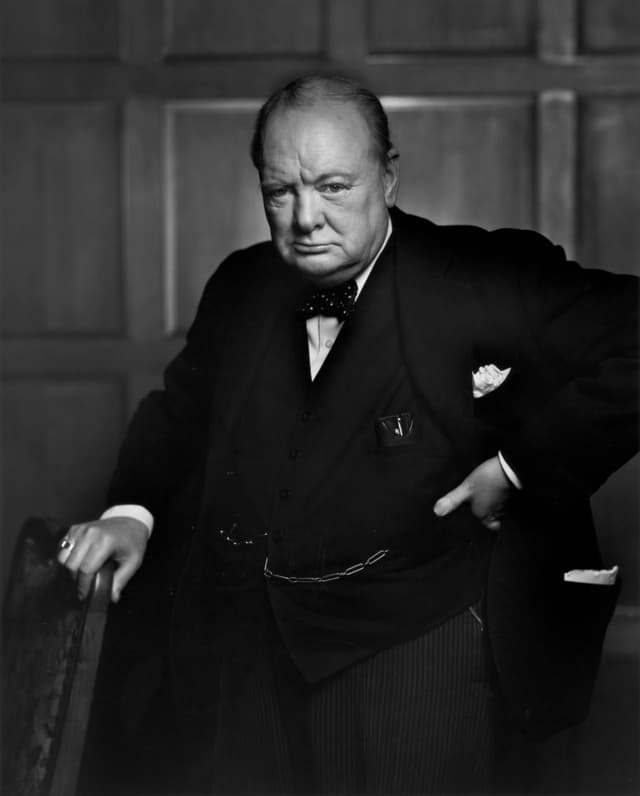
Winston Churchill
A formidable leader and strategist, Winston Churchill played a pivotal role in shaping military and government policies during a tumultuous era from 1874 to 1965. His strategic approach to energy conservation—favoring deliberate inactivity to sustain productivity—serves as a valuable lesson for modern entrepreneurs seeking longevity in their ventures. Churchill's extensive study of history informed his decisions, allowing him to draw insights from past patterns, which remains relevant for today's business builders navigating complex landscapes. Notably, he led Britain through World War II, demonstrating resilience and inspiring a nation to stand firm against adversity, ultimately securing victory in 1945. His unique perspective on leadership and unconventional thinking continues to inspire those who challenge the status quo in pursuit of success.
Core Principles
communication
Communication Is a Strategic Weapon
Churchill used speeches not just to inform but to transform morale. He understood that how you communicate in crisis determines whether people fight or surrender.
culture
Encapsulate your philosophy in memorable maxims that guide your behavior and become known to your organization and followers.
Churchill's maxim captured his approach to life: In war, resolution. In defeat, defiance. In victory, magnanimity. In peace, goodwill. These principles guided his decisions and became known throughout his organization.
“In war, resolution. In defeat, defiance. In victory, magnanimity. In peace, goodwill.”
leadership
Do not hold grudges after conflict ends because bearing rancor prevents you from forming new alliances and moving forward productively.
Churchill bore rancor at the time of conflict but seldom afterward. Once victory came, he ceased to hate Germany. This ability to separate present conflict from future possibility made him more effective as a leader.
“The moment victory came, I ceased to hate Germany.”
Understand that you cannot succeed alone. Build relationships with capable people willing to take risks on your behalf, and trust them completely.
Churchill's escape succeeded only because John Howard and Charles Burnham risked their lives to help him. They provided shelter, food, bribes, and transportation across enemy lines knowing they could be executed if caught. Churchill had to completely surrender control, trusting men he barely knew. Without them, his audacity and self-belief would have meant nothing.
Demand and insist on possessing sufficient power to accomplish your mission, as working without adequate power ensures mediocre results.
Churchill insisted that he be invested with sufficient power to direct the war effort. He believed his failure at Gallipoli resulted from lacking power, so he ensured he would never work under such constraints again.
marketing
Master the tools of communication and narrative available in your era to control how your achievements are remembered and understood.
Churchill was the most thorough and successful at getting posterity on his side through his books, speeches, broadcasting, and writing. His multi-volume work on World War II shaped how history understood that period.
mindset
Practice and preparation are non-negotiable foundations for natural-seeming excellence. Combine relentless practice with unwavering self-confidence.
Churchill's famous impromptu speeches were actually the result of exhaustive rehearsal. He would spend hours writing and rehearsing every line, even brief remarks. His friend joked that Churchill spent the best years of his life composing his impromptu speeches. This combination of hidden work and visible confidence created the appearance of effortless brilliance.
“He overcame this problem with practice and perseverance.”
An undisciplined and largely self-educated mind sometimes works to your advantage because it avoids the constraints of conventional thinking.
Churchill had a fine mind but was largely self-educated and undisciplined. This unconventional education allowed him to arrive at novel ideas and strategies that formally trained minds in his era could not imagine.
“The truth is, Churchill had a fine mind, and the fact that it was an undisciplined and uneducated mind sometimes worked to his advantage.”
Always default to more audacity, not less. When uncertain, err on the side of boldness.
Churchill's guiding maxim during his escape was always more audacity. When hiding in plain sight in town, he made no attempt to hide in shadows, instead walking openly as if he belonged. After crossing the border to safety, he celebrated by firing his revolver repeatedly and singing at the top of his lungs, despite not yet being fully secure. This relentless boldness often worked, though not always prudently.
“I said to myself, always more audacity.”
Reading voraciously during difficult periods provides both solace and the intellectual foundation for future accomplishment.
Churchill was an unhappy student but found refuge in reading four to five hours daily. He studied history, philosophy, economics, and evolution. This habit sustained him through lonely childhood and later prison hiding. His wide reading equipped him with the knowledge and perspective that would distinguish his leadership and writing throughout his life.
“The greatest pleasure I had in those days was reading.”
Study history extensively because it is the great teacher and studying the patterns of history gives you advantage in understanding present and future.
History to Churchill was the great teacher, and he remained under her influence all his life. His deep study of history informed his decision-making and gave him insights others lacked about how events would unfold.
resilience
Never Surrender Mentality
We shall never surrender. Churchill embodied the principle that total commitment to a goal, even when the odds are impossible, can change the outcome.
Take risks that others refuse to take. Willingness to put yourself in harm's way separates you from the competition.
As a war correspondent, Churchill positioned himself at the front lines when other correspondents remained safely in the rear. He understood that the only way to gain the glory and distinction he needed was to go where few others dared. This risk-taking was calculated but real, and it created opportunities unavailable to the cautious.
“A man should get to the front at all costs. For every 50 men who will express a desire to go on service, there is only about one who really means business, and he will take the trouble and run the risk of going to the front.”
In times of extreme uncertainty and fear, allow yourself to trust in something larger than yourself, whether faith, fate, or providence.
Churchill was not a religious man, yet during his most desperate moment on the run, alone with no supplies and no path forward, he spent the night praying earnestly. This moment of vulnerability and surrender paradoxically preceded the stroke of luck that saved his life. Sometimes letting go of control allows for breakthroughs.
“He prayed long and earnestly.”
simplicity
Make your thinking concise by compressing your thoughts because slothfulness manifests as failure to crystallize ideas clearly.
Churchill noted that it is slothful not to compress your thoughts. This principle applies to communication, writing, and strategy. Clear compression requires deeper thinking than verbose explanation.
“It's slothful not to compress your thoughts.”
strategy
Never wait for permission or invitation. Pull every string and leverage every relationship to access the opportunities you need.
Churchill didn't wait for official channels to join military campaigns or seek war correspondent roles. He actively cultivated relationships with influential people and used them strategically to position himself in theaters of war where he could gain glory. He viewed his network as a tool to be deployed relentlessly.
“I am certainly not one of those who needs to be prodded. In fact, if anything, I am a prod.”
Predictability is your greatest vulnerability. Study your competitors to avoid becoming trapped by patterns they can anticipate.
The Boers defeated the British repeatedly because the British were utterly predictable in their tactics and movements. The Boers knew exactly how the British would respond and set traps accordingly. Churchill observed this and noted the importance of never letting enemies guess your next move. Unpredictability creates strategic advantage.
Adaptability and speed beat preparedness for every contingency. Sacrifice total readiness for mobility and agility.
The Boers defeated the far larger British army because they traveled light, knew the terrain, and could move rapidly. The British carried excessive supplies and equipment, moving at a glacial pace. This principle mirrors lessons from Shackleton's expeditions, where those unburdened by equipment for every contingency outperformed the heavily prepared.
Frameworks
Churchill's Energy Conservation Model
Conserve physical energy strategically to sustain extraordinary output across decades. The model includes: never stand when you can sit, never sit when you can lie down, spend mornings in bed conducting business, separate high-energy activities from low-energy routines, and use this conservation to enable sustained productivity rather than burning out.
Use case: Audit your daily energy expenditure. Identify non-essential physical activities consuming energy. Redesign your schedule to protect deep work time. Build rest into your routine so you can maintain intensity over years rather than months.
The Audacity Flywheel
Start by acting as if you already possess the status or capability you seek. Back your audacity with relentless practice and preparation hidden from view. When you face setbacks, lean further into boldness rather than retreat. Each success reinforces the narrative of your inevitable rise, creating a self-fulfilling prophecy. Churchill used this repeatedly: presenting himself as destined for leadership before he held office, practicing speeches exhaustively while seeming spontaneous, and celebrating survival as confirmation of his fate.
Use case: When establishing yourself in a new field or pursuing a long-term ambitious goal where you lack credentials. Particularly useful for founders who must convince others of their vision before they have proven results.
The Risk Hierarchy
Identify opportunities where you can take calculated risks that others refuse to take. Position yourself where few competitors will go, but where the stakes are real enough that victory matters. This creates a natural moat around your accomplishments. The greater the risk others avoid, the greater the distinction you gain by accepting it. Churchill applied this by positioning himself at the front lines as a correspondent, by personally engaging in battle, and by undertaking an escape that others deemed suicidal.
Use case: Building competitive advantage through willingness to accept physical, financial, or reputational risk that more cautious competitors will not. Works best when the risk is visible to your target audience and success is undeniable.
The Distinction Pipeline
Map out a multi-stage strategy for converting personal accomplishment into broader influence. First, seek glory or success in a domain where risk is high and visibility is high. Second, document and publicize these accomplishments through writing, speaking, or self-promotion. Third, translate this reputation into access to decision-making circles and positions of authority. Churchill executed this as: military service and personal courage in wars, book writing and war correspondence to amplify his story, then leveraging this fame to enter parliament.
Use case: For ambitious individuals seeking rapid ascent into positions of leadership or influence. Most effective when you can control the narrative around your accomplishments and have platforms to amplify them.
Stories
Churchill asked about his success in life replied instantly: 'Conservation of energy. Never stand up when you can sit down and never sit down when you can lie down.' He spent mornings in bed reading letters, dictating answers, reading newspapers, and receiving visitors, conducting an extraordinary amount of business while resting.
Lesson: Strategic rest and energy conservation enable sustained high output over decades. Do not confuse activity with productivity. Design your schedule to protect your energy for the work that matters most.
Churchill wrote a letter to the Secretary of State for War and deliberately left it on his bed before escaping from POW camp, knowing it would be found and that thousands of pictures of his face would be circulated throughout enemy territory. This deeply foolish act of theatrical defiance meant he had to escape with no supplies, no compass, no weapon, and no plan across 110,000 square miles of hostile territory.
Lesson: Pride and the desire to have the last word can override sound judgment. Even people with exceptional self-belief must sometimes resist the urge to provoke. However, this recklessness also demonstrated Churchill's commitment to his identity and his willingness to embrace consequences of his boldness.
During his desperate escape, Churchill stumbled upon a coal mine in the middle of the night out of 110,000 square miles of surrounding territory. The mine was managed by John Howard, one of the few remaining Englishmen in the region, whose presence was protected by a German mine owner. Howard immediately risked his life to shelter Churchill, then spent days planning an escape route using wool shipments and bribes.
Lesson: Extraordinary luck often requires putting yourself in the path of possibility through audacious action. Churchill's willingness to knock on a stranger's door at 3 AM, despite being the most hunted man in the region, created the opening for rescue. But luck alone was insufficient, luck required a network of people willing to take life-threatening risks.
Churchill lost his first election at age 24 despite his absolute certainty that he would win. He had written extensively about his qualifications and delivered carefully rehearsed speeches. Politicians mocked him, saying he was a young man of promises, not promise. Rather than questioning his conviction, he treated this as a temporary setback and pivoted to the Boer War to gain the military glory needed to establish himself.
Lesson: Unwavering self-belief can persist through contradiction and failure. Churchill did not interpret loss as evidence that his destiny was wrong. Instead, he saw it as evidence that his chosen path was incomplete, and he adapted his strategy while maintaining his conviction about the ultimate outcome.
As a young military officer in India, Churchill rode a gray pony deliberately along the front of the battle lines while all other soldiers took cover. He explained this by saying that given an audience, there is no act too daring or too noble. Later, after the battle, he observed that he had survived untouched while men around him lay dead, which he took as confirmation that he was meant for greatness.
Lesson: Some people use high-visibility risk-taking as a tool to build legend and reinforce their own conviction of destiny. Churchill's choice to stand out made him impossible to miss, which could have gotten him killed but instead reinforced his belief that fate protected him. This behavior is not rational but it is consistent with a particular type of ambition.
Notable Quotes
“Hearst was the most interesting to meet. I got to like him. A grave, simple child with no doubt a nasty temper, playing with the most costly toys, a vast income always overspent, ceaseless building and collecting, two magnificent establishments, two charming wives, complete indifference to public opinion, a 15 million daily circulation, extreme personal courtesy, and the appearance of a Quaker elder.”
Describing his impression of William Randolph Hearst after visiting him
“I have nothing to offer but blood, toil, tears, and sweat.”
In a speech after France fell, when there was renewed talk of appeasement or surrender. Churchill reframed the challenge not as something to avoid but as the noble price of victory.
“God alone knows how great this task is. All I hope is that it's not too late. I'm very much afraid that it is, but we can only do our best and give the rest of what we have, whatever there may be left of us.”
Upon learning he would become Prime Minister, speaking to his bodyguard Thompson. Shows his combination of realism about the magnitude of the challenge with determination to proceed anyway.
“I felt as if I were walking with destiny and that my past life had been but a preparation for this hour and this trial.”
Reflecting on his appointment as Prime Minister in the darkest hour. Demonstrates his sense of purpose and his view that all his experiences had prepared him for this moment.
“We shall go to the end. We shall fight in France. We shall fight on the seas and oceans. We shall fight with growing confidence and growing strength in the air. We shall defend our island, whatever the cost may be. We shall fight on the beaches. We shall fight on the landing grounds. We shall fight in the fields and in the streets. We shall fight in the hills. We shall never surrender.”
The famous speech after France fell, escalating in intensity and defiance. Used repetition and crescendo to transfer his determination to the British people.
“Some people take drugs. I take Max.”
On his relationship with Max Beaverbrook, his provocative and entertaining advisor. Shows how Churchill used people strategically to maintain his own energy and perspective.
“Of course, I mean, we can beat them. I shall drag the United States in.”
To his son Randolph while shaving, when asked if they could beat the Germans. Shows his clear strategic objective and his understanding that victory required American involvement.
“I'm convinced that every man of you would rise up and tear me down from my place if I were for one moment to contemplate surrender.”
Speaking to his team and the British people. Demonstrates his understanding that credibility depends on absolute commitment to stated objectives.
“There are times when it is equally good to live or to die.”
Said aloud to himself after watching RAF pilots launch into combat. Reflects his understanding that some things are worth dying for, particularly freedom and the defense of one's people.
“It is slothful not to compress your thoughts.”
On the requirement for brevity in memos and communications. Shows his belief that clear thinking requires distilled expression.
Frequently Asked Questions
What are Winston Churchill's key business principles?▼
Winston Churchill's core principles include: Communication Is a Strategic Weapon. Encapsulate your philosophy in memorable maxims that guide your behavior and become known to your organization and followers.. Do not hold grudges after conflict ends because bearing rancor prevents you from forming new alliances and moving forward productively.. Founder Almanac has cataloged 22 total principles from Winston's career.
What can entrepreneurs learn from Winston Churchill?▼
Key lessons from Winston Churchill include: Strategic rest and energy conservation enable sustained high output over decades. Do not confuse activity with productivity. Design your schedule to protect your energy for the work that matters most.. Explore 5 stories and 4 frameworks from Winston's experience.
What is Winston Churchill known for in business?▼
A formidable leader and strategist, Winston Churchill played a pivotal role in shaping military and government policies during a tumultuous era from 1874 to 1965. His strategic approach to energy conservation—favoring deliberate inactivity to sustain productivity—serves as a valuable lesson for modern entrepreneurs seeking longevity in their ventures. Churchill's extensive study of history informed his decisions, allowing him to draw insights from past patterns, which remains relevant for today's business builders navigating complex landscapes. Notably, he led Britain through World War II, demonstrating resilience and inspiring a nation to stand firm against adversity, ultimately securing victory in 1945. His unique perspective on leadership and unconventional thinking continues to inspire those who challenge the status quo in pursuit of success.
More Military & Government Founders
Want Winston's advice on your business?
Our AI has studied Winston Churchill's biography, principles, and decision-making frameworks. Ask any business question.
Start a conversation