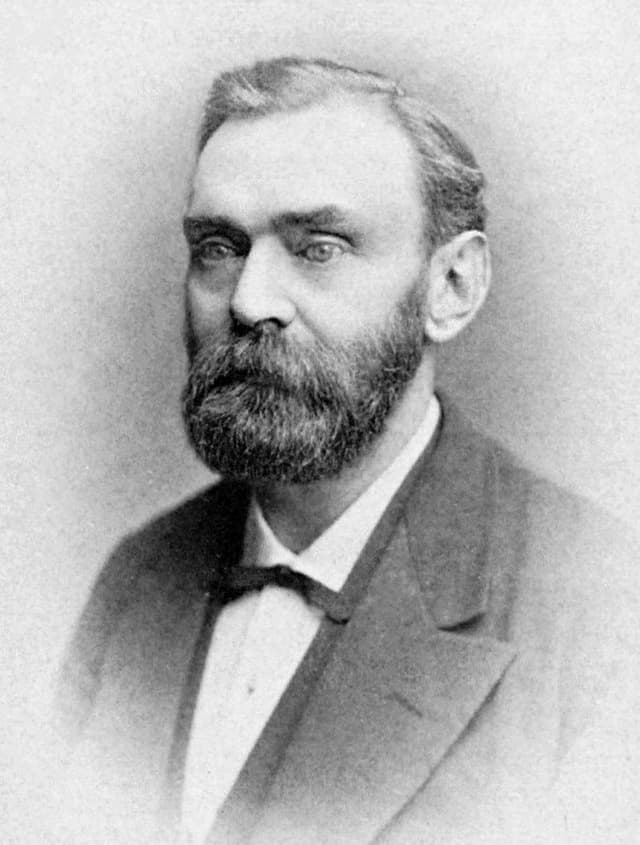
Alfred Nobel
Nobel & Sons / Dynamite Company
A pioneering figure in the Oil and Energy industry, Alfred Nobel founded Nobel & Sons, which specialized in the production of dynamite, revolutionizing construction and demolition practices. Emphasizing the importance of mastering financial fundamentals before scaling operations, he learned from the financial failures of his father, Emmanuel, who faced bankruptcy due to over-reliance on military contracts. Nobel's commitment to maintaining independence in his business decisions allowed him to reject lucrative offers that would compromise his control. His creation of the Nobel Prizes, established through his will, reflects his belief in the power of innovation and the responsibility that comes with wealth, embodying the ideals of a super idealist who sought to benefit humanity despite his complex personality.
Core Principles
finance
Distinguish between financial pressure as a motivator and financial pressure as a destructor. Use it wisely to accelerate development in early stages, but don't let it become permanent.
Alfred's early financial desperation accelerated his development as an inventor and forced resourcefulness. He created solutions under constraint that he might not have discovered with abundant capital. However, he never released this constraint psychologically, remaining obsessed with money and afraid of loss even when impossibly wealthy.
“Financial pressure was accelerating his development as an inventor.”
Master the financial aspects of your business before pursuing growth or scale. Finance is primary, not secondary to product development or innovation.
Alfred constantly criticized his father and brother for treating financing as secondary to their technical accomplishments. He observed that his father could invent things but failed to maintain success because he did not pay attention to the financial management of the business. Alfred made finance primary in all his decisions, which allowed him to build sustainable, profitable enterprises while others collapsed.
“Solving the matter of financing was primary.”
Track every expenditure, no matter how small, to maintain awareness and control of your financial situation. This discipline persists even at great wealth.
Even after becoming extraordinarily wealthy with a net worth equivalent to hundreds of millions of dollars, Alfred carried a small book recording every expense from hat purchases to million-dollar investments in his brother's companies. This meticulous accounting reflected his deep fear of poverty and commitment to financial mastery.
innovation
When regulations or external constraints block your path, engineer creative workarounds rather than abandoning your venture. Resourcefulness under pressure reveals entrepreneurial ability.
After laws prohibited manufacturing nitroglycerin in residential areas, Alfred found and bought a covered barge, anchored it in the bay outside Stockholm, and manufactured his explosive oil on the water using primitive equipment. This innovative solution allowed him to continue production and serve customers while respecting legal constraints.
“Backed into a corner, Alfred proved his abilities as an entrepreneur. He found and bought a covered barge, which he anchored in the bay.”
Embrace experimentation and failure as part of the innovation process. Successful invention requires trying hundreds of approaches, most of which will fail.
Alfred conducted more than 50 experiments to develop the patented igniter for dynamite. He worked alone in his laboratory, trying approach after approach without including colleagues, maintaining secrecy around his methods. This iterative, experimental approach became the foundation of his innovative success.
Solve the technical innovation problem first, then solve the manufacturing and business scaling problem. Many inventors fail because they neglect the latter.
Alfred's father could invent new products but failed to commercialize them effectively or manage production at scale. Alfred succeeded because he treated the invention phase and the business execution phase with equal rigor. He not only invented the detonating cap for dynamite, but also built a global manufacturing and distribution network.
Invention alone is insufficient for wealth creation. Successful business requires matching invention with financial discipline, operational excellence, and market execution. The first person to invent something rarely becomes wealthy; the first to build a great business around it does.
Alfred Nobel was not the first to experiment with nitroglycerin, but he was the first to combine successful experimentation with genius for business organization and financial management. His conservative approach to growth and obsession with cost control built a sustainable empire that outlasted more aggressive competitors.
“Alfred was not the first to experiment with nitroglycerin, but he was the first to combine successful experimentation with a genius for business organization and financial management.”
leadership
As your business grows and becomes too large for one person to manage, delegate to people whose strengths complement your weaknesses. Know where you are weak and find strong collaborators.
Alfred recognized his limitations in managing large teams and human relations, despite his genius in chemistry and finance. He found partners and managers who excelled at the interpersonal and operational aspects he disliked. This allowed him to scale his business beyond what any one person could accomplish alone.
“Never do yourself what others could do better or equally well. Anyone who tries to do everything himself would become worn out of body and soul.”
mindset
Fear of repeating past failures can be a powerful motivator for success, but must be balanced with other values. Unbalanced fear leads to hollow achievement and unhappiness.
Alfred's terror of experiencing poverty again, having witnessed his father's bankruptcy twice, drove him to build unparalleled financial discipline and success. However, this fear-based motivation, unchecked by attention to relationships and meaning, left him clinically depressed despite extraordinary wealth and achievement.
“Alfred never forgot poverty.”
Understand that progress in building a business is nonlinear. Initial work with minimal resources can compound into enormous results over decades, but requires sustained effort and belief.
Alfred started with less than $25,000, doing all work himself, selling from a barge outside Stockholm. Within years, he had factories across Europe and was earning $110,000 per day. This transformation from near-poverty to extraordinary wealth happened within a single lifetime through consistent effort and smart decisions.
Actions and results are the true measure of your values and character, not words or intentions. Build a legacy that aligns with how you wish to be remembered.
When Alfred read an obituary mistakenly published about him after his brother's death, he was devastated by being characterized as a merchant of death who built wealth through finding ways to kill. This prompted him to completely rewrite his will, bequeathing most of his fortune to establish the Nobel Prize, ensuring his legacy would reflect humanistic values rather than destruction.
“Actions are the yardstick by which values can be measured.”
Combine brains, discipline, and enterprise to achieve exceptional results. These three qualities in balance are more powerful than any single strength.
Alfred's father observed that of his three sons, Ludwig had the most brains, Robert had the greatest sense of enterprise, but Alfred possessed the greatest discipline combined with all three qualities. It was Alfred's unique combination of all three that took him the furthest in business and invention.
“Brains, discipline, and enterprise. It was Alfred's combination of all three qualities that took him the furthest.”
Recognize that education and access to knowledge are foundational assets that cannot be taken away, unlike money or possessions. Invest in learning first.
After his father experienced financial losses, he prioritized education for his sons, hiring the best private tutors in chemistry, languages, and engineering. Emmanuel believed that knowledge was the most valuable asset because one might lose money but never what one knows. This investment shaped Alfred's ability to become an inventor and entrepreneur.
“One might lose one's money, which he had already previously done, but never what one knows.”
operations
Do not rely on others for what you can accomplish yourself in the early stages. This maintains control and teaches you every aspect of your business.
With less than $25,000 in working capital, Alfred performed the work of managing director, head of production, financial manager, and director of publicity. He personally wrote 20 to 30 letters daily, demonstrated his product at stone quarries and mines, and created detailed instruction manuals. This hands-on approach gave him complete knowledge of his business operations.
“Alfred had less than $25,000 in working capital and thus forced him to do most things himself.”
resilience
Learn from the failures of others, especially family members, to avoid repeating their mistakes. Observe what they did wrong and do the opposite.
Alfred's father went bankrupt twice due to poor financial management and frivolous spending despite having thousands of people working for him. Alfred used these observations to develop his own disciplined approach to business finances. He watched his father's humiliation from poverty and made it a foundational principle to never allow himself or his family to experience the same fate.
“Alfred tried to learn from the mistakes of his father.”
Work with intensity and single-minded focus until you exhaust the problem, then rest completely. Alternating between intense effort and restoration prevents burnout from becoming permanent.
Alfred worked 15 to 20 hours without rest, driven by the desire to exhaust himself to ward off melancholy. When his chest pains and headaches became overwhelming, work itself became his escape, and the symptoms disappeared once he engaged fully in his problems. However, this relentless pace contributed to his declining mental health over time.
“It was as if he wanted to exhaust himself in order to ward off melancholy.”
sales
Demonstrate the concrete value of your product to customers through direct comparison and tangible proof. Show how your solution saves them money or improves efficiency.
Alfred traveled to stone quarries and mines to demonstrate the superior explosive power of his dynamite compared to traditional gunpowder. He proved that blasting work could proceed faster and require fewer workers, directly translating to substantial cost savings. This direct selling approach built his initial customer base.
“Because of its greater explosive power, he could promise and deliver substantial savings. Blasting work could proceed faster and require fewer workers.”
strategy
Building a durable business preserves future opportunity. Over-optimization for short-term growth at the expense of durability forecloses much larger opportunities in the distant future.
Alfred was conservative with growth. He refused to expand faster than he could properly manage. This conservatism felt like leaving money on the table, but it preserved the core business for compounding. Faster growth would have sacrificed durability and potentially destroyed the empire.
“Victory in our industry is spelled survival. All the money is in the future. Do not interrupt the compounding.”
Maintain absolute independence in your business by avoiding reliance on other people's money or control. Turn down lucrative deals that compromise your decision-making authority.
When Scottish financiers wanted to place an embargo on Alfred's future patents in exchange for investment, he refused. When the Rothschilds wanted controlling interest in his brother's oil company, he advised against ceding control. Alfred structured his business to remain profitable without external capital, allowing him to pursue long-term vision rather than short-term investor demands.
“Why not place an embargo on the patents of my children also? Of course, I would not dream of doing business on such terms.”
Be willing to walk away from partnerships or business arrangements that compromise your principles or independence, even if they offer significant financial gains.
Alfred consistently rejected arrangements where investors or partners tried to control his future inventions or business decisions. Despite having less than $25,000 at one point, he refused to surrender authority over his work or accept unfavorable terms, preferring to build slowly with independence rather than grow quickly under someone else's control.
Seek strategic alliances with powerful competitors rather than fighting them when you lack sufficient resources. Peace with rivals is preferable to prolonged conflict you cannot win.
When Alfred's brother Ludwig's oil company faced competition from Rockefeller's Standard Oil and the Rothschild financial interests, Alfred advised him to make peace with both competitors rather than continue fighting. The resulting alliance divided global oil markets among the three companies, creating stability and profitability for all parties.
Frameworks
Brains, Discipline, Enterprise Triangle
A framework for evaluating talent and capability across three dimensions. Brains represents intellectual capacity and technical skill. Discipline represents the ability to execute consistently and master details. Enterprise represents initiative, drive, and the ability to turn ideas into action. The combination of all three is rare and more powerful than any single dimension alone.
Use case: Evaluating your own strengths and weaknesses, understanding what type of team members you need to hire, and identifying where you might be limited and need partnership.
Finance-First Business Model
A business design philosophy where financial sustainability is the primary constraint driving all decisions, not secondary to technical innovation or growth. This means understanding unit economics, cost structure, and cash flow before scaling. It requires treating the finance function with as much rigor as the product function.
Use case: Building profitable, sustainable businesses that don't require constant external capital. Most useful in capital-intensive industries or when you want to maintain independence from investors.
Knowledge as Permanent Asset
The principle that education and knowledge are the most valuable assets because they cannot be lost or taken away, unlike money, possessions, or status. This justifies investing heavily in learning early, even at personal sacrifice, because the returns compound over a lifetime.
Use case: Making decisions about education investment, prioritizing learning in resource-constrained environments, and recovering from financial setbacks by leveraging accumulated knowledge.
Intensity and Rhythm
A work philosophy that alternates between periods of intense, exhausting effort and complete rest. The theory is that you work with such focus and single-mindedness that you burn through problems and achieve breakthroughs, then rest to recover fully before the next cycle.
Use case: Sustaining high-performance work over decades. Useful for entrepreneurs in critical phases of business development. However, requires careful balance to avoid permanent burnout and health damage.
Independence Through Profitability
A business strategy where the goal is to reach profitability quickly enough that the company never requires external capital or investor control. This maintains decision-making authority and allows the founder to pursue long-term vision without quarterly pressure.
Use case: Founders who want to maintain control of their vision and are willing to grow more slowly. Requires disciplined capital allocation and willingness to turn down larger investment opportunities.
Stories
Alfred's father Emmanuel went bankrupt twice and relied heavily on military contracts from the Tsar for his underwater mine company. When the Crimean War ended, the Russian government refused to pay their bills and the contracts disappeared. This financial catastrophe was transformative for young Alfred, who witnessed his father's humiliation and made a vow never to allow his family to experience poverty again.
Lesson: Observing a parent or mentor fail in business can be more educational than observing success. Alfred learned from his father's mistakes and built his financial discipline specifically to avoid repeating them. The fear of poverty became a lifelong motivator.
When regulations prohibited manufacturing nitroglycerin in residential areas, Alfred could have abandoned the business. Instead, he purchased a covered barge, anchored it in the bay outside Stockholm, and manufactured his explosive oil on the water with primitive equipment, selling it for 50 cents a pound. This workaround became the foundation for a global industry.
Lesson: Creative problem-solving under constraint is often the sign of a true entrepreneur. Rather than complaining about regulations or market obstacles, resourceful founders engineer workarounds that no one else has thought of.
A household staff member who was getting married asked Alfred what he wanted as a wedding gift. She boldly replied that she wanted as much as he earned in one day. Alfred was so impressed by her boldness that he agreed without further thought. He wrote her a bank draft for $110,000, equivalent to approximately one day's earnings at that point in his life.
Lesson: Wealth at extreme scale becomes almost incomprehensible. What seems like a massive sum to most people is a casual afterthought to someone earning that amount daily. This illustrates both the extraordinary success Alfred achieved and hints at why no amount of money solved his deeper unhappiness.
After his brother Ludwig's death, newspapers mistakenly published an obituary for Alfred Nobel instead. The obituary called him a 'merchant of death' who had built his fortune 'discovering new ways to mutilate and kill.' Alfred was devastated by this characterization and read it several times, unable to forget it. This experience so pained him that he rewrote his entire will, bequeathing most of his fortune to establish the Nobel Prize.
Lesson: Your legacy and how you are remembered matter deeply, even (or especially) to those who claim not to care about public opinion. This story explains the paradox of why a man who hated publicity and considered himself a misanthrope would establish the world's most famous prize. He could not bear to have his life summarized as having caused destruction.
Alfred's youngest brother Emil died in a catastrophic explosion at one of Alfred's nitroglycerin facilities. The explosion was so powerful that it killed multiple people and destroyed everything in its path. Emil's body was so mutilated that it barely resembled a human form. Alfred never wrote about Emil's death in any of his surviving letters, despite the immense tragedy.
Lesson: The cost of being a pioneer in dangerous fields can be tragic and permanent. This story illustrates the human cost of innovation in explosives and serves as a reminder that genius and achievement do not occur in a vacuum. People die in the pursuit of progress.
Despite accumulating wealth equivalent to hundreds of millions of dollars, Alfred continued to meticulously record every single expenditure in a small notebook, from the cost of a hat ($6) to investments of $2.3 million in his brother's oil company. He did this every day, in the same ledger, and never once allowed the scale of his wealth to reduce his attention to financial detail.
Lesson: Financial discipline is a habit, not a circumstance. Wealthy people don't relax their financial rigor. The discipline that created the wealth persists even when wealth becomes so abundant that loss is impossible. However, this also suggests that some people's relationship with money is pathological, rooted in fear rather than necessity.
Alfred's mistress, Sophie, was a woman 20 years younger than him. He never married her, had an unclear relationship with her (possibly never consummated), and wrote her over 200 letters. After his death, when she felt Alfred's will did not provide her with enough money, she hired a lawyer and threatened to publish all 200 of his private letters if the executor didn't increase her payment.
Lesson: Even brilliant people can have poor judgment in relationships and can be vulnerable to manipulation by those closest to them. This also illustrates the importance of financial defense mechanisms and why trusting someone personally doesn't mean trusting them completely. Alfred's private thoughts became leverage.
Notable Quotes
“I am a misanthrope, and yet utterly benevolent, have more than one screw loose, yet am a super idealist who digests philosophy more efficiently than food.”
Alfred's self-description when he was asked to write about his own life for publication. It captures the paradox of his character: he hated people but was capable of great generosity, he had quirks but deep idealism.
“How pitiful to strive to be someone or something in the motley crew of 1.4 billion two-legged tailless apes running around on our revolving earth projectile.”
Alfred's sarcastic reflection on the insignificance of human achievement. Despite his extraordinary accomplishments, he viewed human striving as ultimately futile, a reflection of his underlying melancholy.
“Actions are the yardstick by which values can be measured.”
This principle underlay Alfred's belief that his legacy should be judged by concrete action, not words or intentions. It motivated him to create the Nobel Prize as the ultimate expression of his values.
“Rather than regarding this idea as your own, far from it, you made a bit of fun of it at my expense. I decided then to take off the leash and find another way of reaching my goal without conflict or unpleasantness.”
Letter to his father about the invention of dynamite. Alfred was asserting his right to claim credit for his own work and refusing to defer to his father's attempts to take credit for the discovery.
“I would scarcely serve to deny the credit I deserve in the matter. I can hardly make myself believe that such would be your serious intent, but can only ascribe it to bad humor or ill health.”
Continuation of his letter to his father, showing his willingness to give his father the benefit of the doubt while still firmly asserting his own intellectual property rights and contributions.
“At the age of 30, I will not allow myself to be treated as a schoolboy.”
Alfred's statement to his father about demanding to be treated as a peer and business partner, not as a subordinate. This reflects his early determination to be the master of every situation.
“Never do yourself what others could do better or equally well. Anyone who tries to do everything himself would become worn out of body and soul.”
Advice Alfred gave to his brother Ludwig when Ludwig was trying to micromanage his rapidly expanding oil business. This reflects Alfred's understanding of leadership and delegation, even though he struggled to apply it to his own emotional life.
“I would like to invent a substance or a machine so frightfully effective and devastating that it would forever make wars altogether impossible.”
Alfred's hope that dynamite would be so destructive that nations would avoid war altogether. This reflects a common misunderstanding among weapons inventors about how deterrence actually works.
“I am totally sick and tired of the explosive substance field in which one is forever stumbling around in accidents, preventative clauses, red tape, acts of villainy, and other unpleasantness. I long for peace and quiet.”
Written near the end of Alfred's life, showing his exhaustion with the business he built and his desire to escape from it. Despite his desire to retire, he could not let the company drift aimlessly.
“I can clearly read between the lines that things are going well for you, and that my absence seems to give you more happiness than sorrow.”
From a letter to Sophie, his mistress. Alfred's tendency to interpret situations negatively, finding rejection even in ambiguous situations, illustrates his pessimism and tendency toward melancholy.
Frequently Asked Questions
What are Alfred Nobel's key business principles?▼
Alfred Nobel's core principles include: Distinguish between financial pressure as a motivator and financial pressure as a destructor. Use it wisely to accelerate development in early stages, but don't let it become permanent.. Master the financial aspects of your business before pursuing growth or scale. Finance is primary, not secondary to product development or innovation.. Track every expenditure, no matter how small, to maintain awareness and control of your financial situation. This discipline persists even at great wealth.. Founder Almanac has cataloged 22 total principles from Alfred's career.
What can entrepreneurs learn from Alfred Nobel?▼
Key lessons from Alfred Nobel include: Observing a parent or mentor fail in business can be more educational than observing success. Alfred learned from his father's mistakes and built his financial discipline specifically to avoid repeating them. The fear of poverty became a lifelong motivator.. Explore 7 stories and 5 frameworks from Alfred's experience.
What is Alfred Nobel known for in business?▼
A pioneering figure in the Oil and Energy industry, Alfred Nobel founded Nobel & Sons, which specialized in the production of dynamite, revolutionizing construction and demolition practices. Emphasizing the importance of mastering financial fundamentals before scaling operations, he learned from the financial failures of his father, Emmanuel, who faced bankruptcy due to over-reliance on military contracts. Nobel's commitment to maintaining independence in his business decisions allowed him to reject lucrative offers that would compromise his control. His creation of the Nobel Prizes, established through his will, reflects his belief in the power of innovation and the responsibility that comes with wealth, embodying the ideals of a super idealist who sought to benefit humanity despite his complex personality.
More Oil & Energy Founders
Want Alfred's advice on your business?
Our AI has studied Alfred Nobel's biography, principles, and decision-making frameworks. Ask any business question.
Start a conversation