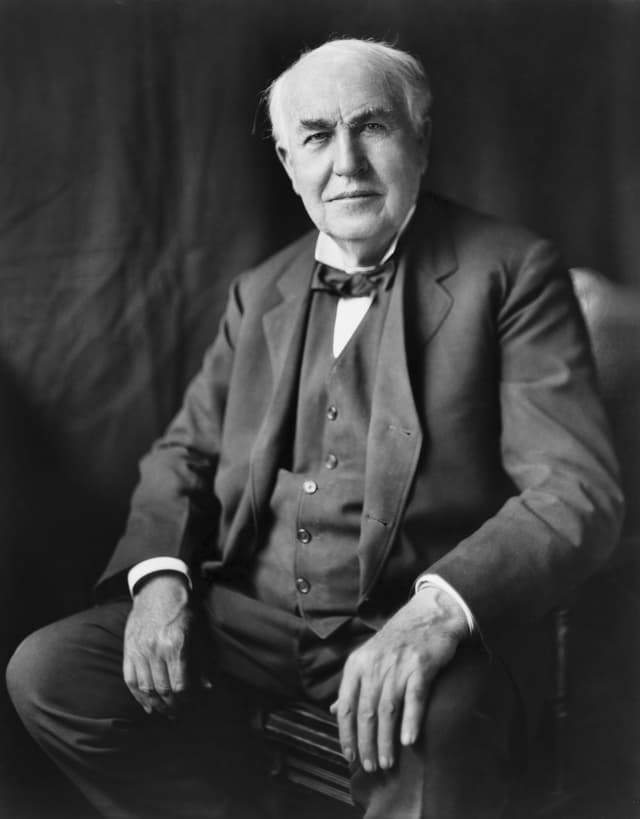
Thomas Edison
Edison Electric Light Company
A pioneer in the Oil and Energy industry, Thomas Edison founded the Edison Electric Light Company in the late 19th century, revolutionizing electric power distribution. Recognizing the importance of early adopters, he strategically targeted influential customers to validate and promote his innovations, leading to the successful deployment of electric lighting in homes and businesses. By focusing on practical applications of electricity rather than raw power, Edison developed the incandescent light bulb, which became a household necessity, demonstrating that understanding consumer needs drove technological adoption. His innovative approach, including the establishment of the first investor-owned electric utility, set a foundation for modern entrepreneurship, illustrating the value of solving problems from unique perspectives. As Edison once said, "I never did a day's work in my life. It was all fun," embodying the spirit of creativity and perseverance that continues to inspire business builders today.
Core Principles
finance
When capital providers are timid and unwilling to invest in necessary infrastructure, you must be willing to fund it yourself. Commitment to your vision sometimes requires you to bear the financial risk alone.
The directors of Edison's company would not fund manufacturing facilities. Edison established his own factory at Menlo Park, raising capital through stock sales and borrowing heavily. He declared the choice was factories or death, demonstrating that founders sometimes must take on the financial burden themselves when investors are chickens rather than pigs.
“Since capital is timid, I will raise and supply it. The issue is factories or death.”
focus
Jumping between ideas and new ventures, no matter how promising, prevents you from building long-term competitive advantage and capturing the full value of your innovations.
Edison invented the phonograph but abandoned it for other projects while competitors built dominant market positions. He refused to produce longer films when audiences wanted them, and rejected jazz music recordings because he preferred symphonies. In each case, his lack of focus allowed competitors to capture markets he had created.
“Time and again, he invented things with long-term market appeal only to lose interest or miscalculate what form of his inventions consumers wanted to buy.”
innovation
Attack problems from a different angle than competitors. When everyone is working in the same groove, breakthrough innovation comes from trying an entirely different approach.
All scientists and inventors were trying to create incandescent light using the same experimental methods. Edison studied the problem for one week and immediately saw what others had missed: he took a fundamentally different approach to solving the subdivision of light, not just attempting variations of existing methods.
“I have obtained it, the light through an entirely different process than that from which scientists have sought to secure it. They had all been working in the same groove.”
marketing
Use early adopters and influential customers as proof of concept and marketing channels. When a respected figure endorses your product, others will follow.
J.P. Morgan's private electrification of his home impressed 400 guests at a reception. Two notable guests, Darius Ogden Mills and White Law Reid, immediately contacted Edison's company to have their homes electrified. This early form of influencer marketing demonstrates how satisfaction from trusted sources drives adoption.
Avoid competing on fear, uncertainty, and doubt (FUD). While effective short-term, FUD damages credibility and alienates stakeholders when the underlying fears prove unfounded.
Edison campaigned heavily against AC current, claiming it would kill users. He issued an 84-page diatribe warning of the deadly dangers of alternating current. This FUD campaign was the opening salvo in the War of the Currents, but it ultimately backfired as AC proved safe and superior.
“The passage of the current from these machines through the human body even by the slightest contacts, produces instantaneous death.”
mindset
Your actions express your true priorities. Do not confuse stated ambitions with actual commitment. Real commitment is visible in what you do, not what you say.
Edison avoided all reporters and distractions once his light bulb was working, because he needed to solve the filament problem. His actions demonstrated where his real priorities lay. Many people say they want to build a business or achieve a goal, but their daily actions reveal they do not actually prioritize these ambitions.
“Action expresses priority.”
Demonstrate hardwork, entrepreneurship, and commitment to self-improvement early in your career. These traits create opportunities and attract mentors and investors.
Edison joined the railroad as a newsboy at 13 and spent two days of his wages to join the Detroit Public Library because of his hunger for knowledge. He impressed his bosses as hardworking, entrepreneurial, and intent on self-improvement. These early behaviors established a reputation that led to advancement and opportunity throughout his career.
Your true ambition reveals your actual values. If you are motivated primarily by freedom to work on problems, profits become merely the fuel to enable that work, not the end goal.
Edison stated his ambition was not wealth or possessions like horses or yachts, but rather the perfect workshop where he could exercise his gifts as an inventor without regard to expense. This mindset, shared by Tesla and Westinghouse, meant profits were viewed as stored energy to reinvest in innovation and expansion, not personal consumption.
“My one ambition is to be able to work without regard to the expense. I want none of the rich man's usual toys. I want no horses or yachts. I have no time for them. What I want is the perfect workshop.”
Ego and pride of authorship can blind you to better solutions created by others. The refusal to adopt superior innovations because you did not invent them is ultimately self-defeating.
Edison refused to adopt or develop alternating current systems despite their obvious advantages and despite his own company owning patent options on European AC technology. He was emotionally and intellectually committed to DC because every aspect was his own creation. This pride of authorship caused him to cede market leadership to Westinghouse.
Criticism from those without expertise or detailed knowledge should be dismissed. Only criticism from informed, objective sources deserves serious consideration.
An unnamed scientist publicly declared that incandescent light would never work without providing details or evidence. He simply stated it was impossible based on theoretical objections. Edison was right to ignore this baseless criticism. However, criticism with substance from peers working in the field deserves different treatment.
“I cannot tell you what his method may be, but I can tell you that any system depending on incandescence light will fail.”
product
Identify the killer app that will drive adoption of your technology. Subdividing and domesticating the core technology for practical household use is more valuable than raw power.
Edison recognized that arc lights for streetlights had limited market potential. The true fortune lay in subdividing light to make it practical for homes and offices. He understood the killer app was not the technology itself but making it useful and accessible at a residential scale.
“The man who could subdivide the light to take it indoors and tame it into a gentle glow, and power it with a dynamo, would be the true Promethean.”
resilience
Patience and persistence overcome obstacles that appear insurmountable. Breakthrough innovation requires years of sustained effort, not weeks of inspiration.
Edison promised to light lower Manhattan after one week of successful light bulb creation. However, it took him four years of relentless experimentation to find a filament material that would not burn out. During this time, his hair turned gray and his family was neglected, but he persisted until the problem was solved.
strategy
You must both create value and capture that value. Creating exceptional products means little if you do not build systems to profit from them and retain control.
Edison invented the incandescent bulb and efficient power generation systems but sold his interests to competitors who eventually formed General Electric. GE captured the substantial profits rather than Edison. Similarly, Edison invented the phonograph first but lost market dominance by failing to stay focused while competitors marketed their versions.
“Edison is easily the world's greatest scientist. I am not sure that he is also not the world's worst businessman.”
In emerging industries, you must create everything from scratch: the product, the distribution, customer education, and the manufacturing processes. Customers do not yet exist and must be created.
Edison's managers noted that people did not appreciate the need or value of electricity. The company had to create suitable manufacturing methods, distribution networks, and customer education. Before electricity, these systems did not exist. Every aspect of the industry had to be invented simultaneously.
“Customers did not exist. They had to be created.”
Do not underestimate competitors who combine formal status with real competence and unlimited access to capital. Such rivals deserve respect and serious strategic response.
Edison initially dismissed smaller competitors but immediately recognized Westinghouse as different. Westinghouse was an established industrialist with major capital access and a proven track record of success. Edison's response was not dismissal but serious engagement, as he understood Westinghouse was a formidable rival.
Frameworks
The Killer App Identification Framework
In emerging industries, identify the single most valuable application of your core technology. The killer app is not the raw technology itself but the practical problem it solves that people desperately need. For electricity, the killer app was not power generation but residential lighting. For the internet, email was the killer app before commerce. Focus resources on perfecting and scaling the killer app.
Use case: Technology companies launching into new markets. Determine what practical user problem your technology solves better than alternatives, then focus relentlessly on perfecting that one application before expanding.
The Divergent Problem-Solving Approach Framework
When competitors solve problems using the same methodology, breakthrough innovation often comes from attacking the problem from a completely different direction. Rather than trying to improve competitors' approaches, identify what makes their approach inefficient and select a fundamentally different path. This often requires observing the problem with fresh eyes.
Use case: Product development and technical problem-solving. When you find that all competitors are pursuing the same approach with incremental improvements, look for entirely different solution pathways that others have overlooked.
Value Creation and Value Capture Framework
Successful business requires both creating genuine value that customers want and building systems to capture that value through ownership, intellectual property, distribution control, or strategic partnerships. Creating value without capturing it leaves you poor while competitors profit.
Use case: Assessing whether your business model allows you to benefit from the value you create. Critical in technology and innovation businesses where the inventor may not also be the commercial beneficiary.
Stories
Edison toured William Wallace's electrical equipment shop, saw dynamos and lighting experiments, and immediately proclaimed to a reporter that he would succeed where others had failed. One week later, he had a working incandescent bulb. However, the true difficulty was finding a filament that would not burn out, a problem that took four years of relentless experimentation to solve.
Lesson: Initial success and public pronouncements can obscure the depth of work required. Innovation requires both the moment of insight and years of persistent problem-solving. Confidence is necessary, but humility about the remaining work is equally important.
Edison promised to light all of lower Manhattan after one week of success with the light bulb. It took him four years of constant experimentation to find a filament that would not burn out. During those four years, his hair turned gray from stress, and his family felt neglected as he focused solely on solving the filament problem.
Lesson: The gap between confident public promises and actual delivery can be vast. Persistence through this gap requires sacrifice and unwavering focus. Success demands paying a personal price, though the cost to family relationships is a legitimate concern.
When Edison invented the phonograph, he initially envisioned families having 'audio cellars' of recorded sermons and lectures, similar to wine cellars. The public wanted recorded music instead. Edison became uninterested and pivoted to other projects while competitors dominated the phonograph market he had created.
Lesson: Your initial vision of how customers will use your invention often misses the mark. Listen to what customers actually want, not what you expected them to want. Persistence in execution matters more than being right about initial assumptions.
Notable Quotes
“I never did a day's work in my life. It was all fun.”
Edison's reflection on his entire 62-year career as a self-employed inventor, emphasizing that his dedication stemmed from genuine love of tinkering rather than external obligation.
“Having one's own shop, working on projects of one's own choosing, making enough money today so one could do the same tomorrow. These were the modest goals of Thomas Edison when he struck out on his own as full-time inventor and manufacturer.”
Describing Edison's core motivation for independence and autonomy in his early career, highlighting that wealth and fame were secondary to the freedom to pursue his own interests.
“I never did a day's work in my life. It was all fun.”
Edison's reflection on his entire 62-year career as a self-employed inventor, emphasizing that his dedication stemmed from genuine love of tinkering rather than external obligation.
“Your car is self-contained, carries its own power plant. No fire, no boiler, no smoke, and no steam. You have the thing. Keep at it.”
Edison's encouragement to Henry Ford at a dinner in 1896 after Ford demonstrated his gasoline-powered quadricycle, recognizing the fundamental superiority of the internal combustion engine over electric cars.
“Well, you know, I like a hustler.”
Edison's response when Henry Stanley suggested he would prefer to hear the voice of Jesus Christ rather than Napoleon from a recording, revealing Edison's core values and admiration for action and results over religious figures.
“How do you do? asked the machine, introducing itself crisply. How do you like the phonograph? It itself was feeling quite well, assured its listeners, and then cordially bid everyone a good night.”
The first public demonstration of the phonograph at Scientific American offices in December 1877, the moment that launched Edison to international celebrity overnight.
“Although I'm over 67 years old, I'll start all over again tomorrow.”
Edison's immediate response on the night of December 7, 1914, when fire destroyed 10 of 18 buildings at his manufacturing complex, causing an estimated 3 to 5 million dollars in damage. Rather than despair, he cracked jokes and committed to rebuilding.
“I could go to Wall Street and get more, but my experience over there is as sad as Chopin's funeral march. I keep away.”
Edison's explanation to Henry Ford for why he would not seek capital from Wall Street financiers, preferring instead to accept Ford's forgivable loans in exchange for preserving his complete autonomy over laboratory spending.
“Invention should not be pursued as an exercise in technical cleverness, but should be shaped by commercial needs.”
The lesson Edison drew at age 21 when his Legislative Chamber Vote Recorder was rejected because customers did not actually want the problem solved, teaching him that technical brilliance without market demand is worthless.
“There's only one Fort Myers and now 90 million people are going to find out.”
Edison's complaint after 2,000 people came to Fort Myers to welcome Henry Ford and his family, realizing that the combination of two celebrities' presence had exponentially increased public interest and invaded his private winter hideaway.
Frequently Asked Questions
What are Thomas Edison's key business principles?▼
Thomas Edison's core principles include: When capital providers are timid and unwilling to invest in necessary infrastructure, you must be willing to fund it yourself. Commitment to your vision sometimes requires you to bear the financial risk alone.. Jumping between ideas and new ventures, no matter how promising, prevents you from building long-term competitive advantage and capturing the full value of your innovations.. Attack problems from a different angle than competitors. When everyone is working in the same groove, breakthrough innovation comes from trying an entirely different approach.. Founder Almanac has cataloged 17 total principles from Thomas's career.
What can entrepreneurs learn from Thomas Edison?▼
Key lessons from Thomas Edison include: Initial success and public pronouncements can obscure the depth of work required. Innovation requires both the moment of insight and years of persistent problem-solving. Confidence is necessary, but humility about the remaining work is equally important.. Explore 3 stories and 3 frameworks from Thomas's experience.
What is Thomas Edison known for in business?▼
A pioneer in the Oil and Energy industry, Thomas Edison founded the Edison Electric Light Company in the late 19th century, revolutionizing electric power distribution. Recognizing the importance of early adopters, he strategically targeted influential customers to validate and promote his innovations, leading to the successful deployment of electric lighting in homes and businesses. By focusing on practical applications of electricity rather than raw power, Edison developed the incandescent light bulb, which became a household necessity, demonstrating that understanding consumer needs drove technological adoption. His innovative approach, including the establishment of the first investor-owned electric utility, set a foundation for modern entrepreneurship, illustrating the value of solving problems from unique perspectives. As Edison once said, "I never did a day's work in my life. It was all fun," embodying the spirit of creativity and perseverance that continues to inspire business builders today.
More Oil & Energy Founders
Want Thomas's advice on your business?
Our AI has studied Thomas Edison's biography, principles, and decision-making frameworks. Ask any business question.
Start a conversation