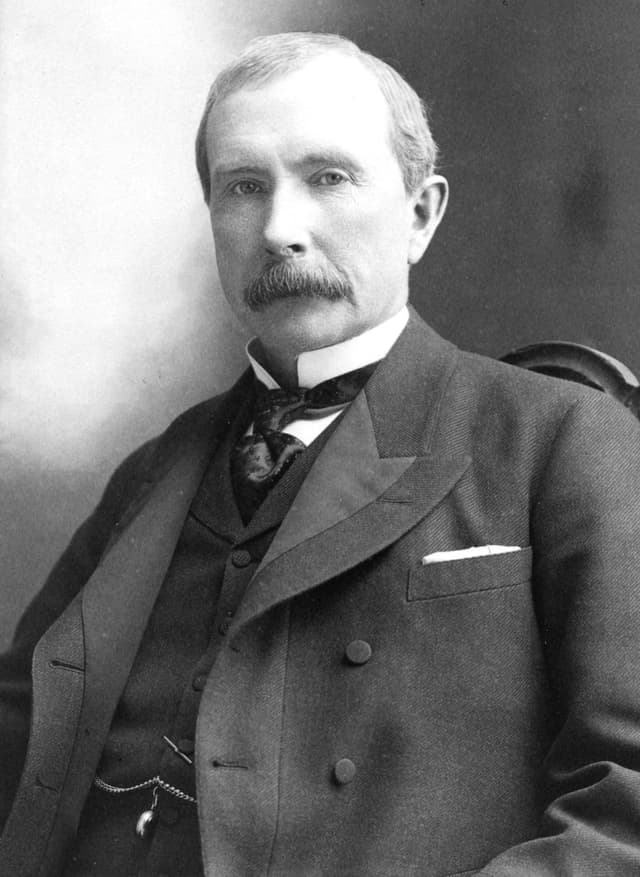
John D. Rockefeller
Standard Oil
A pioneering force in the oil and energy industry, John D. Rockefeller co-founded Standard Oil, which controlled over 90% of U.S. refineries at its peak. He exemplified the principle of subordinating individual identities to organizational interests, emphasizing shared ownership and collective goals among partners. His strategic approach to logistics and transportation allowed him to optimize production and distribution, ultimately leading to significant cost reductions and increased efficiency. Rockefeller's commitment to solving industry-wide challenges is evident in his response to a competitor who refused to sell, where he transparently showcased his accounting books to demonstrate his superior production capabilities. His belief that "whatever is done for this general good is done for the good of us all" continues to resonate with entrepreneurs and business leaders today as they navigate collective success in competitive markets.
Core Principles
competitive advantage
Use information asymmetry as a competitive weapon. Know your competitors' volumes through preferential access while they remain blind to yours.
Under the South Improvement Company scheme, Standard Oil would receive detailed information about all oil shipped by competitors through railroad manifests, enabling precise underpricing. Information asymmetry translated directly to competitive advantage.
“Standard Oil and other SIC refiners would receive comprehensive information about all oil shipped by their competitors, invaluable in underpricing them.”
Easy profits attract low-quality competitors who will destroy margins. Build difficult, complex businesses where few can succeed and competition remains rational.
When crude oil refining was simple and profits were large, everyone entered the market: the butcher, baker, candlestick maker. They produced at a loss and eventually failed. Rockefeller learned that by mastering a difficult business, he gained knowledge competitors couldn't replicate. The difficulty was the moat.
“The cleansing of crude petroleum was a simple and easy process. At first, the profits were very large. Naturally, all sorts of people went into it. And it was only a short time before more and more of the finished product was put on the market than could possibly be consumed.”
In a commodity business with low margins, superior cost structure is the only sustainable competitive advantage. Obsess over costs.
Oil is a cheap, standardized commodity. Rockefeller understood that transportation costs and production efficiency were the only differentiators. He reduced costs in every dimension: barrel manufacturing, timber sourcing, solder usage, and transportation routing. This allowed him to operate profitably at prices that bankrupted competitors.
See what others overlook: posted rates can be negotiated. All is not as it seems on the outside. Look for the gap between appearance and reality.
While handling freight settlements, Rockefeller discovered that railroad rates supposedly fixed could actually be negotiated. Favored shippers received rebates at month-end that amounted to substantial sums. This hidden knowledge became the foundation of his monopoly strategy.
“All was not as it seemed on the outside. He saw that posted rates supposedly fixed could also be negotiated.”
Cut prices below cost to force competitors to match your prices, hastening their demise. You can afford the losses better than they can.
When competitors refused consolidation, Rockefeller would drop refined oil prices below cost. The price cuts forced competitors to match or lose customers, destroying their profits.
“A good sweating will be good for them.”
culture
Cultivate natural optimism and ambitious mindset in yourself and your team. Success of others should inspire you, not make you jealous.
Rockefeller described himself as naturally optimistic. He and his partners were not jealous of others' success but inspired by it. The success of one man in any walk of life spurred the others on rather than souring them. This ambition and positive energy was a key characteristic of his team.
“I am naturally an optimist. We were not jealous of the success of others. We were the most extraordinarily ambitious, and the success of one man spurs the others on. It does not sour them.”
Use organizational autonomy as a recruitment tool for founders and strong leaders. Let division heads run their operations semi-independently while setting overall strategy.
Rockefeller offered acquired founders (Pratt in New York, Lockhart in Pittsburgh, Archibald in oil regions) autonomy over their divisions plus seats at company strategy meetings. This retained their talent and prevented the knowledge loss that typically comes with acquisitions.
“Policy would be set at the home office, but considerable authority would be given to the division leaders.”
Acquire leadership through collaboration, not just capital transfer. Buy the company but keep its brand and let its founder run it autonomously within your system.
Rather than absorb acquired companies into Standard directly, Rockefeller let them operate under their original names with original leaders in charge. This preserved customer loyalty, founder motivation, and operational knowledge while giving Standard ownership and strategic control.
“Chescarly continued to operate under its own name. No one in the industry was aware of the partnership it had with Standard.”
Use religious language and covenant thinking in business. Treat contracts as sacred agreements and demand fidelity as a sign of real character.
Rockefeller spoke in religious terms, calling contracts 'covenants' rather than simple agreements. He believed fidelity to a covenant was the mark of a real man, and he despised those who broke their word.
customer obsession
Choose your profession based on where you can be most effective in advancing the general interest, not on extracting maximum value for yourself.
Rockefeller advised young people entering business to first ask where they can fit in to be most effective in the world's work and lend their hand most effectively to advance general interest. Enter life in this spirit and you take the first step on the highest road to large success. The great fortunes have come to men who performed great and far-reaching economic services.
“If you aim for a large success, do not begin your business career with the idea of getting from the world by hook or crook all you can. Where can I fit in so that I may be most effective in the work of the world?”
Never accept what conventional wisdom says about market distribution. Study market data and act on shifts faster than competitors.
Rockefeller noticed export of refined oil jumped from under 50% to 70% of total output in 1866. While competitors spotted the shift, only he acted immediately by opening his own wholesale office in New York.
finance
Operate with extreme frugality regardless of wealth. Cost discipline compounds into competitive advantages that allow you to survive industry downturns.
Rockefeller obsessively controlled expenses from his earliest days, arriving at 6:30 AM and staying until 10 PM rooting out inefficiencies. Even as a wealthy man, he refused new clothes for his children and kept office decor sparse. This discipline meant his refineries remained profitable when competitors lost money on every barrel.
“Rockefeller never allowed his office decor to flaunt the prosperity of his business, lest it arouse unwanted curiosity.”
Align executive incentives to equity appreciation and dividends rather than salary. This creates powerful motivation and ensures leadership stays focused on long-term value creation.
When Standard Oil incorporated, Rockefeller decided the leading founders would receive no salary, profiting only from shares and rising dividends. This aligned incentives perfectly and motivated relentless focus on building equity value, which made Rockefeller the richest person in history.
“Rockefeller's decision that the leading men would receive no salary, but would profit solely from the appreciation of their shares and rising dividends, which Rockefeller thought a more potent stimulus to work.”
Maintain a personal financial buffer and prepare for emergencies before you need them. Financial resilience is a form of insurance.
When Rockefeller's oil warehouses and refinery burned to the ground, he approached his partner S.V. Harkness for a potential loan. Harkness immediately offered all the capital Rockefeller might need. Though the insurance claim came through in time and the money wasn't needed, Rockefeller found comfort in knowing he had access to capital if required.
“We were accustomed to prepare for financial emergencies long before we needed the funds.”
Stick to your financial and business principles even when it costs you important customers. Customers who respect your principles are worth more long-term.
Rockefeller's best customer asked to draw advances on shipments before the produce arrived. Rockefeller refused despite pressure from his partner and the risk of losing the customer. He visited the customer to persuade him. To his surprise, the customer continued doing business normally. Later, Rockefeller believed the customer had been testing them, and his firm's reputation for sound principles actually strengthened the relationship.
“I insisted that we stick to our principles and refuse to give the shipper the accommodation he had asked for. What was our surprise and gratification to find that he continued his relations with us as though nothing had happened.”
Know exactly where you are losing and gaining money. Intelligent bookkeeping and truth-facing about your business metrics is a basic requirement of success.
Many of Rockefeller's competitors kept poor books and didn't know when they were making or losing money on specific operations. They avoided studying the facts because the truth was unpleasant. Standard Oil kept books intelligently and correctly, knowing their exact position. This allowed them to make better decisions and avoid competitors' mistakes.
“We kept our books intelligently as well as correctly. We knew how much we made and where we gained or lost. We tried not to deceive ourselves.”
Frameworks
The Cleveland Massacre Strategy
Use an announced or proposed competitive threat to panic competitors into rapid consolidation before regulators can intervene. The South Improvement Company was never fully implemented, but the threat of rebate and drawback schemes terrified enough refiners that they surrendered within weeks. The framework involves: announcing a cartel structure, letting competitors learn of it, having regulators shut it down before implementation, then using the consolidation momentum achieved in those intervening weeks as a foundation for further acquisitions through different vehicles.
Use case: When you have limited time and resources to consolidate fragmented competitors before regulation intervenes. Most effective when competitors are already financially stressed.
The South Improvement Company Model
Create a secret cartel among suppliers and transportation providers that improves margins for members while creating competitive disadvantages for non-members. The structure involves: negotiating rebates for member shipments, securing drawbacks (payments on competitor shipments), sharing competitive intelligence about non-member volumes, and guaranteeing traffic allocations to transportation providers to prevent their destructive price wars. This solves multiple problems simultaneously: stabilizes transport prices, prevents excess capacity from destroying margins, and centralizes information.
Use case: When both your industry and your supplier industries are suffering from overcapacity and destructive price competition. Most effective when transportation or logistics is a critical cost component.
The Vertical Integration Cartel
Build end-to-end control from raw materials through to consumer distribution, rather than just participating in one stage. This involves acquiring or building: production facilities, storage infrastructure, transportation assets (tank cars, pipelines), distribution networks, and ancillary product lines. The competitive advantage compounds because you control information flow, can optimize handoffs between stages, and can sustain losses in one stage to gain advantage in another. Rockefeller controlled refineries, pipelines, tank cars, barges, railroads, warehouses, and home delivery, creating a moat that independent refiners could never match.
Use case: When you're scaling a commodity or near-commodity product and margins are being compressed by competition. Vertical integration allows you to absorb losses in high-competition areas while generating returns elsewhere in the value chain.
The Shell Company Acquisition Strategy
When operating in multiple jurisdictions prevents you from directly owning property or operating across state lines, create a network of independent-appearing subsidiary companies with different names and management. Maintain total ownership and strategic control through the parent company while allowing each subsidiary to operate under its original brand and leadership, giving the appearance of independence. This allows you to build a hidden empire where competitors and the public don't understand the consolidated ownership structure until it's too late to challenge.
Use case: When regulatory restrictions prevent direct ownership of assets across jurisdictions, or when secrecy is a competitive advantage. Most effective in pre-internet eras when ownership structures couldn't be quickly mapped.
The Preferential Rate Negotiation
Choose locations and build operations that give you multiple transportation options, then use this leverage to negotiate preferential rates with transportation providers. Having redundant options (water and rail shipping, or multiple railroads) means you're not captive to any single provider. This forces providers to compete for your volume by offering discounts. Once you've secured preferential rates, buy out competitors who don't have equivalent optionality, improving your cost structure relative to theirs.
Use case: In industries where transportation or logistics costs are major profit drivers. Identify which geographic locations or infrastructure combinations create negotiating leverage.
The Daily Self-Warning Practice
Each night, speak to yourself in cautionary terms about your success. Remind yourself that small wins can disappear quickly, that you must remain humble and vigilant, and that complacency leads to failure. Use this internal dialogue to counterbalance ego inflation from business victories. This practice grounds you and keeps you focused on the fundamentals that created success.
Use case: When experiencing early business success or whenever ego begins to inflate. Particularly valuable for entrepreneurs and leaders who are still early in their journey and at risk of losing focus.
The Close-Proximity Partnership Model
Work in close physical proximity with your key business partner. Sit at desks in the same room, walk to and from the office together, take lunch breaks together. This creates multiple daily touchpoints for thinking, talking, and planning together away from office interruptions. The walks and informal times allow for deeper thinking and relationship building that strengthens business decisions.
Use case: When building a business in the early stages with a trusted co-founder or partner. Most effective for partnerships that need strong alignment and frequent course correction.
The Cool-Off and Reframe Approach
When facing strong resistance to an idea from a key partner, do not push harder or repeat your argument. Instead, let emotions cool and the heat of discussion pass. Then, approach the same person with a completely new frame or angle that recontextualizes the problem. This removes defensiveness and allows the other person to reconsider with fresh perspective.
Use case: When a partner or stakeholder is dug in on a position and defensive argumentation is failing. Useful in leadership, negotiation, and partnership disputes where you need buy-in rather than victory.
The Detail Obsession System
Treat every financial transaction and business detail as if you are personally responsible to your employer. Review bills and invoices with meticulous care, checking even small amounts. Understand that approving an expense represents an executive act that releases capital and carries responsibility. This system trains you to be a careful steward of resources and differentiates you from careless competitors.
Use case: For any finance or operations role. Most powerful in early stage businesses where attention to detail becomes a competitive advantage against larger, less careful competitors.
The Character-Based Hiring Model
Prioritize character traits over prior experience when hiring. Look for honesty, good sense, enterprise, keenness, thriftiness, and ability to quickly master new subjects. Believe that a person with these fundamentals can learn any job faster than an experienced person lacking these traits. Give them time to study and prepare for the new role.
Use case: When hiring for new roles that require learning, innovation, or leadership. Particularly effective for rapidly scaling companies where past experience may be less valuable than adaptability.
Stories
A competing refiner refused to sell his operation to Rockefeller. Rockefeller responded by showing the competitor his detailed accounting books, which proved that Rockefeller could produce oil at profit margins where his competitor was losing money on every barrel. The competitor immediately capitulated and sold.
Lesson: Cost discipline creates a competitive moat that's invisible until you expose it. Your superior execution eventually becomes impossible to compete against, making acquisition the only rational choice for failing competitors.
Rockefeller's son grew up wearing only dresses because his father refused to buy new clothes despite having become extraordinarily wealthy. Even as Standard Oil made him the richest person in the world, Rockefeller continued this fanatical frugality, wearing the same modest outfits and living austerely.
Lesson: Extreme frugality compounds over a lifetime and becomes a value system independent of wealth. The discipline that created success persists long after necessity for it has disappeared, becoming part of identity rather than circumstance.
When the South Improvement Company's preferential rebate scheme became public knowledge, regulators and competitors mobilized to shut it down before any shipments were made. Within weeks it was formally dissolved. However, in the brief window of time before dissolution, Rockefeller had already acquired 22 of 26 competing Cleveland refineries using the threat of the scheme as leverage.
Lesson: Regulatory and competitive windows are brief. The actual implementation of a competitive advantage matters less than the fear it creates. Use the fear to consolidate before your mechanism is shut down.
When acquiring Camden Oil Company, the transfer was so secretive that even the superintendent of Camden's barrel factory was kept in the dark. Rockefeller sent his representative McGregor to do the inventory, but Camden worried the superintendent might recognize him and expose the ownership change, so he arranged to have the inspection done without the superintendent discovering the truth.
Lesson: Information asymmetry requires operational discipline. Competitors and their employees shouldn't understand ownership changes until you've fully integrated them. Secrecy preserves strategic optionality.
When John Garrett of the Baltimore and Ohio Railroad wanted to help independent refiners compete against Standard Oil by offering markdown freight rates, he unknowingly gave those discounted rates to Camden Oil after Camden had secretly sold itself to Rockefeller. Garrett was thus inadvertently subsidizing Standard Oil's competitive advantage over his own intended allies.
Lesson: Information asymmetry can invert incentives. Your competitor can manipulate others into working against their own interests by controlling information about ownership and allegiance. What appears to be a competitor's strategic move may actually be serving your interests.
As a young man, Rockefeller was stuck with bullying, corrupt business partners who controlled the votes and squeezed his business to death. Rather than confront them directly, he quietly lined up financing from another oil man and waited. When confrontation finally came, he outbid them at auction for the firm's assets, revealing his hidden backing. On that day, his former partners realized their empire had been dismantled by the young man they had dismissed.
Lesson: Silence and preparation are more powerful than confrontation. Work quietly on your strategy while others talk loudly, then execute when ready. Let your results speak rather than your words.
A partner and friend, John Archibald, was asked by opposing counsel in court if he was a director of the company. When asked what his occupation was, he promptly replied that he was there 'to clamor for dividends,' which so confused the lawyer that they had to start over with a different line of questioning.
Lesson: Find people in your life with a well-developed sense of humor and perspective who can lighten tense situations. These relationships become cherished memories and make the journey more enjoyable.
When Rockefeller's oil warehouses and refinery burned to the ground, he approached his partner S.V. Harkness and said he might need to call upon him for money. Without needing explanation, Harkness simply said, 'All right, JD, I'll give you all that I have.' Though the insurance payout arrived in time and the money wasn't needed, Rockefeller never forgot the solid way in which Harkness offered it.
Lesson: True partners show up for you in moments of crisis without hesitation or need for elaborate justification. These moments of unconditional support are among the most valuable experiences in business.
As a young man starting his own business, Rockefeller desperately wanted to oblige an important customer who asked for a credit advance before goods shipped. His financial instincts told him this violated sound business principle. He visited the customer to convince him otherwise. The customer was disturbed but Rockefeller insisted on their principle. Later, Rockefeller learned the customer had been testing them to see if they would compromise. The firm's reputation for sound principles ultimately strengthened the relationship.
Lesson: Customers ultimately respect and trust companies that maintain their principles, even when those principles cost them business in the short term. What appears to be a lost customer today often becomes a loyal one tomorrow.
A young Rockefeller spent days and weeks tramping the streets asking merchants and storekeepers for a job. Few showed any interest in hiring a boy. Finally, one man on the Cleveland docks told him he might come back after the noonday meal. Rockefeller was elated and in a fever of anxiety lest he lose this opportunity. When he arrived, the man said 'We'll give you a chance,' without discussing pay. Rockefeller accepted and discovered his calling in bookkeeping.
Lesson: Early desperation for opportunity builds character and gratitude. When you are grateful to have any chance, you show up with maximum effort and attention, which becomes the seed of later success.
Notable Quotes
“We ought to do it. Never forget that we are partners. Whatever is done for this general good is done for the good of us all.”
Rockefeller's philosophy on organizational alignment, emphasizing collective benefit over individual credit.
“So many wells were flowing that the price of oil kept falling, yet they went right on drilling.”
Describing the irrational behavior of competitors during the oil industry collapse of 1869-1870, where producers continued destructive overproduction despite falling prices.
“Oftentimes the most difficult competition comes not from the strong, the intelligent, the conservative competitor, but from the man who is holding on by the eyelids and is ignorant of his cost.”
Explaining why desperate competitors without cost discipline are harder to defeat than rational rivals, as they cannot be reasoned with or undercut.
“The Standard Oil Company will someday refine all the oil and make all the barrels.”
Stated to Cleveland businessman John Prindle early in Standard Oil's history, expressing his ambition for total vertical integration and monopoly. He came very close to achieving this.
“Do not many of us who fail to achieve big things fail because we lack concentration, the art of concentrating the mind on the thing to be done at the proper time and to the exclusion of everything else.”
Rockefeller's philosophy on focus, explaining why he abandoned other business interests to concentrate entirely on oil refining.
“Success comes from keeping the ears open and the mouth closed.”
His philosophy on information gathering and discretion, emphasizing listening over broadcasting.
“The impression was gaining ground with me that it was a good thing to let the money be my slave and not make myself a slave to money.”
Late-life reflection on his relationship to wealth, describing how he maintained frugality despite enormous riches.
“I wish I had the brains to think of it. It was Henry Flagler.”
Crediting Henry Flagler with the idea of incorporating Standard Oil to raise capital from investors without relinquishing control.
“All the fortune that I have made has not served to compensate me for the anxiety of that period.”
Reflecting late in life on the stress and health consequences of the competitive battles during the 1869-1870s period.
“Either this experiment will result in a great success or a dismal failure. It was a course which older and more conservative businessmen shrank back from and regarded as reckless, almost to the point of insanity.”
Describing how his contemporaries viewed the consolidation strategy that would create Standard Oil monopoly.
Frequently Asked Questions
What are John D. Rockefeller's key business principles?▼
John D. Rockefeller's core principles include: Use information asymmetry as a competitive weapon. Know your competitors' volumes through preferential access while they remain blind to yours.. Easy profits attract low-quality competitors who will destroy margins. Build difficult, complex businesses where few can succeed and competition remains rational.. In a commodity business with low margins, superior cost structure is the only sustainable competitive advantage. Obsess over costs.. Founder Almanac has cataloged 30 total principles from John's career.
What can entrepreneurs learn from John D. Rockefeller?▼
Key lessons from John D. Rockefeller include: Cost discipline creates a competitive moat that's invisible until you expose it. Your superior execution eventually becomes impossible to compete against, making acquisition the only rational choice for failing competitors.. Explore 10 stories and 10 frameworks from John's experience.
What is John D. Rockefeller known for in business?▼
A pioneering force in the oil and energy industry, John D. Rockefeller co-founded Standard Oil, which controlled over 90% of U.S. refineries at its peak. He exemplified the principle of subordinating individual identities to organizational interests, emphasizing shared ownership and collective goals among partners. His strategic approach to logistics and transportation allowed him to optimize production and distribution, ultimately leading to significant cost reductions and increased efficiency. Rockefeller's commitment to solving industry-wide challenges is evident in his response to a competitor who refused to sell, where he transparently showcased his accounting books to demonstrate his superior production capabilities. His belief that "whatever is done for this general good is done for the good of us all" continues to resonate with entrepreneurs and business leaders today as they navigate collective success in competitive markets.
More Oil & Energy Founders
Want John's advice on your business?
Our AI has studied John D. Rockefeller's biography, principles, and decision-making frameworks. Ask any business question.
Start a conversation