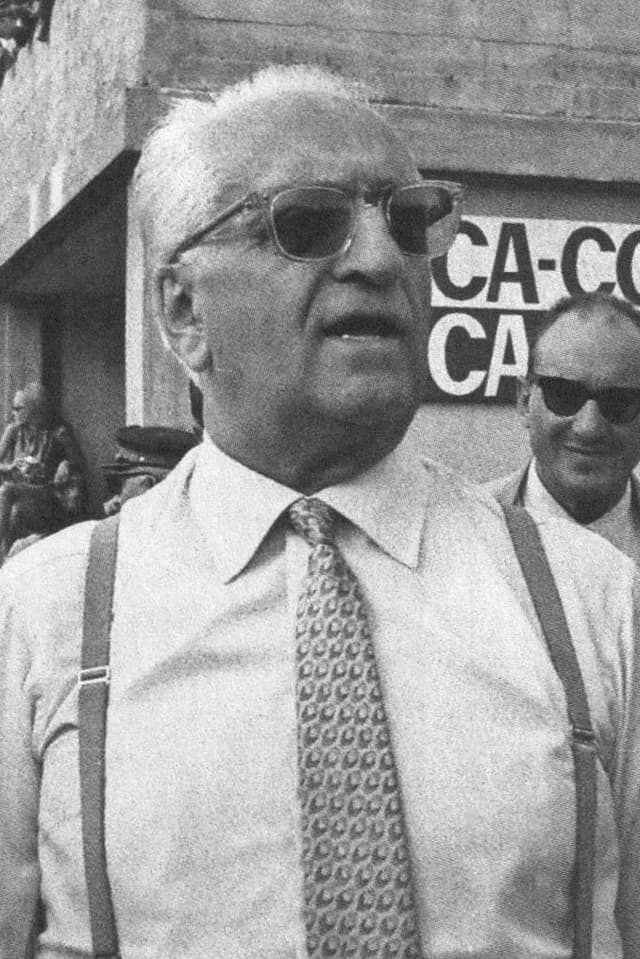
Enzo Ferrari
Ferrari
A visionary in the automotive industry, Enzo Ferrari founded Ferrari in 1939 and transformed it into a symbol of passion and performance. His commitment to high standards and attention to detail earned the brand a reputation for excellence, culminating in more than 16 Formula 1 World Championships. Ferrari believed that true quality stems from a team of specialists united by a shared passion, rather than hierarchical authority, a principle that continues to inspire entrepreneurs today. His famous quote, "Everything that I've done, I did because I couldn't do anything less," encapsulates his relentless pursuit of perfection and integrity in every aspect of his work.
Core Principles
culture
Connect your work to a larger purpose or place greater than profit. Ferrari's deep attachment to Modena and Italian pride in the company gave him motivation beyond money when resources were scarce.
Ferrari viewed his company as representing Italian excellence and national pride. When vilified as a monster, the threat of selling to Americans reframed him as a national treasure. This connection to place and culture sustained him through difficult periods and motivated his team.
“There are innate gifts that are particular to a certain region, and that transferred into industry, these propensities may at times acquire an exceptional importance.”
Build a culture where people must argue and compete to determine who is correct. Harmony is not the goal; finding truth and excellence through conflict is.
Enzo deliberately created an environment at Ferrari with no harmony, where people argued fiercely and competed with each other. He believed the best results came from individuals having to fight it out to prove their ideas, forcing only the strongest concepts to survive.
Work with extreme intensity and set impossibly high standards for yourself and your team, using chaos and urgency as creative fuel.
Ferrari worked 12-16 hours daily, seven days a week, including holidays. He imposed this same demanding schedule on his team. Rather than avoiding chaos, he seemed to gain energy from it, using the pressure and disorder as a catalyst for innovation and improvement. This intensity permeated the culture he built.
“He worked seven days a week, 12 to 16 hours a day, holidays included.”
customer obsession
Understand that humans are attracted to and purchase from winners, making competitive victory a core business strategy.
Ferrari recognized that wealthy customers did not buy Ferrari automobiles merely as transportation. They bought them to own a piece of victory and associate with winning. By making winning on the track his obsession, Ferrari made customers desperate to own his cars, creating a virtuous cycle of prestige and sales.
“When Ferrari wins a Le Mans, people want some of that victory.”
finance
Live simply and reinvest profits back into the business rather than spending on personal luxury, especially in early stages.
Even after becoming wealthy, Ferrari lived in a modest two-bedroom apartment above his factory. He maintained simple tastes and frugal spending habits. Every lira earned was plowed back into the racing operation and car development, accelerating the company's growth.
“Every ounce of his energies and every lira in his pocket was being plowed back into the business. He lived a modest frugal life.”
focus
Maintain singular focus on one domain for multiple decades to compound knowledge and achieve mastery that no competitor can match.
From 1930 until his death in 1988, Ferrari focused exclusively on racing and high-performance automobiles. This sustained commitment created a unique knowledge base about motorsports, engineering, and competition that rivals could not replicate. Knowledge compounds when you avoid interrupting it with diversification.
“From 1930 onward, for nearly 60 years, hardly a day passed when this thought was not foremost in his mind: his fierce devotion to the single cause of winning automobile races with cars bearing his name.”
Focus intensely on one core product category rather than expanding into adjacent markets, even if they seem lucrative.
While Maserati diversified into grand touring cars, machine tools, and electric trucks, Ferrari remained focused exclusively on high-performance racing cars and elite sports cars. This singular focus allowed Ferrari to dominate the premium segment while Maserati blurred its identity and lost competitive position.
“While Ferrari was zeroing in on the tiny world of exotic cars, Maserati was doing just the opposite, expanding in a variety of directions and thereby blurring the focus of the old, much-honored firm.”
hiring
Build a team of specialists united by shared passion for the goal, not just employment. The quality of execution comes from people who believe deeply in the mission, not from hierarchical authority.
Ferrari described his racing car development as the result of a team fired by common enthusiasm. He was described as an agitator of men, not an engineer or designer. He recruited talented drivers and engineers who shared his obsession with winning, creating a team bonded by purpose rather than just contracts.
Recruit talented people based on demonstrated ability to compete and win, not credentials or educational background.
Ferrari's greatest strength was recognizing talent and recruiting the best engineers and drivers available. He would poach top performers from competitors like Bugatti and Maserati, building a team of proud, competitive, egocentric men. He did not rely on traditional hiring practices but on direct observation of competitive performance.
“It is often said that his greatest skill was his ability to recognize talent.”
innovation
Improve existing products through relentless iteration rather than pursuing revolutionary innovation for its own sake.
Ferrari never tried to introduce completely new technologies or ideas. Instead, he took existing components like the V12 engine and made every aspect of it better. His method mirrored Henry Royce and Rolls-Royce: take a proven design and execute it with superior quality and performance.
“All we wanted to do was build a conventional engine, but one that was outstanding.”
leadership
Founder-led companies have decisive speed advantages over committee-based structures. When one person has clear authority, decisions can be made in minutes rather than weeks, allowing rapid iteration and adaptation.
Ferrari made all decisions unilaterally. Ford's racing team had to route decisions through multiple levels of management in Michigan, requiring meetings with 25 people. When Ford finally gave Carroll Shelby autonomy, he could use hacksaws to modify cars on the spot, matching Ferrari's agility.
Competition within your organization, when managed carefully, can drive excellence. Pitting people against each other on the same team can produce better results than collaborative environments, though this approach carries relationship risks.
Ferrari would assign multiple people to the same role and have them compete against each other. He believed competition brought out the best in people. He also engaged in psychological warfare with his team. While this was controversial, it achieved his goal of maximizing performance, though it created a difficult work environment.
Describe yourself by your role in creating rather than in traditional corporate titles. A founder is an agitator and maker, not a CEO or manager. This identity shapes how you approach your work.
Ferrari described himself as neither a designer nor an engineer, but rather an agitator of men. He called himself a maker and craftsman. This self-description reflected his hands-on role in directing and inspiring the team rather than managing through process.
“I never felt myself to be an industrialist but a constructor.”
Social withdrawal and emotional reserve can be strategic in business. Controlling information flow, observing others, and maintaining mystery allows you to gather intelligence and maintain advantage in negotiations.
Ferrari was described as closed like a walnut. He wore glasses to hide his expression, gave little away emotionally, and collected information rather than sharing it. He created a Shakespearean world of intrigue. This approach gave him intelligence advantages and kept others guessing about his intentions.
“The facial expression, a smile or frown, is merely a form of defense and should be taken only as such.”
Respect only those who possess the same passion and dedication you do. Passionate people recognize passion in others regardless of personal conflict.
Enzo respected Carroll Shelby and Ken Miles not because he liked them personally, but because he saw the same obsessive dedication to their craft that consumed him. He had no use for people lacking this fire, no matter their position or contributions.
marketing
The way you describe and market your product shapes how customers perceive it. Speaking about your creation with passion and artistry elevates its perceived value far beyond the functional.
Ferrari described his cars using artistic and sensual language, comparing them to paintings and sculptures. He spoke of making them as living creatures. This poetic framing made customers feel they were buying art, not just vehicles, justifying premium prices and long waiting periods.
“A racing car does not necessarily come into being as the creation of a superior mind, but is always the compendium of the common unflagging and enthralling work of a team fired by a common enthusiasm.”
Creating scarcity and controlling access to your product increases its desirability and perceived value. Hiding inventory and requiring customers to wait years builds desire more effectively than aggressive sales tactics.
Ferrari would hide inventory from potential buyers even when the company faced financial difficulties. People would travel worldwide to meet him and purchase a car. He understood that forced waiting and difficulty in acquiring the product made people value it more and pay higher prices.
Use public perception and media strategically to shape narratives about your company and competitors. Publishing your own defeat before it happens controls the narrative and positions you favorably regardless of outcome.
Knowing Ford would likely beat him, Ferrari published an article in Italian magazines casting himself as David against Ford's Goliath, declaring defeat in advance. If he lost, he had predicted it. If he won, it would be his greatest moment. This framing controlled how the story would be told.
“We know that nothing is being done to resist the steamroller of the Americans...The battle was lost in advance.”
Racing and competition serve as the ultimate marketing tool and validation mechanism for automotive products. A single win translates into millions in sales and establishes technical superiority in customers' minds.
In the 1950s-60s, Le Mans victories directly drove customer purchases for sports car makers. Ferrari won Le Mans multiple years, triggering instant demand across the continent. Ford understood this value and invested $40 million annually in racing to beat Ferrari, recognizing that racing wins were worth more than traditional advertising.
Build your brand through competitive victory and performance rather than through advertising or marketing spend.
Ferrari understood that winning races directly translated to car sales. Wealthy customers wanted to own cars that proved victorious on the track. By focusing all resources on winning races, Ferrari created unprecedented brand value without traditional marketing. Success on the track created customer demand at premium prices.
“Build successful racing cars that improve the image of the company and rich men will flock to the door to obtain similar cars with which to play out their fantasies.”
mindset
Belief in your superiority and destiny to win is necessary before success arrives. The confidence to declare you are the best must come first, before the evidence of victory justifies it.
Ferrari believed he was building the best cars in the world and acted accordingly. This belief drove his decisions and standards long before Ford's challenge emerged. Like great athletes, the belief precedes and enables the achievement, not the other way around.
Entrepreneurs can succeed with minimal formal education if they develop deep expertise in one domain and maintain unwavering focus on it. You do not need credentials to build something valuable.
Ferrari failed out of trade school with only elementary schooling. He became one of the greatest automotive innovators by focusing intensely on one thing: building the best cars. His lack of credentials did not prevent him from creating extraordinary value.
Never sit on your laurels. Celebrate briefly, then immediately focus on the next challenge. Every accomplishment is merely the starting point for what comes next.
After winning eight races with seven victories in a month, Enzo celebrated for perhaps an hour, then completely forgot about it and moved to the next race. His mindset was always that it was day one, treating each victory as only the beginning.
“Each victory or accomplishment was only the starting point for the next.”
Frameworks
Three Principles of Winning
Ferrari identified three elements that enable victory: competition drives innovation and faster performance, selecting people with the need to achieve greatness and matching them with talent creates exceptional humans, and willingness to take extreme risk (dying at the wheel) can overcome superior resources. These principles guided how he built his team and cars.
Use case: Leadership, team building, and competitive strategy in high-stakes environments
The Product Creation Process
Ferrari described car development as a five-stage process: conception and dreaming of the design in detail, planning the work, assembly with a passionate team sharing the vision, assembly and construction in record time, and finally testing which is the most delicate and engrossing phase. Each stage requires specific mindset and leadership.
Use case: Product development and manufacturing, especially for complex engineering projects
Scarcity as Marketing
Rather than displaying inventory or aggressively selling, hide availability and require customers to wait extended periods. Long wait times and difficulty obtaining the product increase its perceived value and customer willingness to pay premium prices, while creating a sense of privilege in owning it.
Use case: Luxury products, brand building, and premium pricing strategies
The Step-Up Strategy
Master your current role and perform exceptionally, which opens doors to the next opportunity. Then repeat this process over decades. Each step positions you better for the next. Do not try to make one giant leap; instead, make a series of calculated, small steps upward by proving yourself at each level.
Use case: Building a business empire when you start from nothing. Useful for founders with no capital, connections, or credentials who must bootstrap their way to success.
The Indispensable Role Design
Position yourself at the critical intersection of multiple constituencies, dependencies, and decision points. Make your role so central and complex that removing you would collapse the operation. Control information flow, relationships, and critical decisions so that no one else can easily replace you.
Use case: Building power and influence within an existing organization before starting your own company. Ensures you cannot be easily pushed out and gives you leverage in negotiations.
The Aligned Upside Partnership
Structure partnerships so that all parties share unlimited upside if you succeed, but one party (you) absorbs the downside risk if you fail. This gives partners confidence in your venture without requiring them to risk significant capital. They benefit from your success; you absorb the burden of failure.
Use case: Raising support from large, established companies or wealthy individuals who are risk-averse. Useful when you need resources or credibility from others but have a different risk tolerance.
The Passion Pivot
When you realize you cannot be the best in your current field, redirect your talents toward something you can dominate. This requires honest self-assessment and willingness to change direction. Your passion may not lie where you first thought; the key is to redirect it toward something you are uniquely suited for.
Use case: Mid-career transitions when you realize your original goal is not achievable or not the best use of your talents. Especially useful for people in competitive fields like sports or racing.
The Resourceful Trade-Up
When you lack capital to buy what you need, use charm and strategic reasoning to negotiate trades. Position your partner's current assets as soon to be obsolete, and offer them something more valuable in exchange. This leverages persuasion and future value rather than present cash.
Use case: Acquiring better equipment, technology, or resources when you are cash poor. Works well in markets where assets depreciate rapidly and sellers are motivated to upgrade.
The Agitator of Men Framework
Rather than doing the technical work yourself, identify what you are naturally talented at (often people management and motivation) and build an organization where others handle specialized work. Ferrari excelled at recruiting talented people, managing their egos and ambitions, and creating conditions for their best work. He left engineering to engineers and driving to drivers, focusing his energy on orchestration and motivation.
Use case: When building a growing organization and you realize your greatest value is in team leadership and culture rather than technical execution. Most effective when combined with clear vision and high performance standards.
The Focused Domination Strategy
Select one narrow niche and dominate it completely rather than spreading efforts across multiple markets. Ferrari chose high-performance racing and elite sports cars, refusing diversification despite opportunities. This focus allowed him to become unchallenged in his category while competitors like Maserati fragmented their efforts across machines tools, grand touring, and other categories.
Use case: When entering competitive markets where you lack the scale or resources of larger competitors. By choosing a narrow wedge and going deep rather than wide, you can achieve dominance in a specific segment while larger competitors remain generalists.
Stories
At age 11 in 1909, Ferrari hiked two miles alone across railroad tracks to attend a local automobile race where drivers attempted to break the mile speed record. He was seduced by automobiles that day and immediately knew he wanted to be a race car driver. This early exposure shaped his entire life's work.
Lesson: Exposure to excellence and possibility in youth can determine life direction. A single formative experience can create the passion that sustains decades of difficult work.
During the Ford-Ferrari negotiations, Ferrari initially engaged seriously but grew angry when reading Ford's contract terms. The document required him to request American authorization to spend money on racing. Ferrari rejected the entire deal, declaring his integrity and autonomy could not work within Ford's bureaucratic structure, despite needing the money.
Lesson: Control over your core mission matters more than financial security. A founder should walk away from deals that require surrendering decision-making authority over what matters most, even when desperate for resources.
When facing vilification as the monster of Maranello due to driver deaths, Ferrari initiated negotiations to sell his company to Ford. The Italian press, viewing this as a national betrayal, rallied around Ferrari as a national treasure. Ferrari was reframed from monster to monument, and suddenly no Italian would underestimate his value again.
Lesson: Strategic threats and narrative control can reposition your standing in the eyes of stakeholders. Sometimes the threat of losing something is more powerful than maintaining the status quo.
Ferrari refused to attend races despite building racing cars, feared elevators, and refused to fly in airplanes. He worked 12-16 hours daily but never left Modena except for the few miles to his factory. His entire life revolved around his company with no social life to speak of.
Lesson: Extreme focus requires extreme lifestyle choices. The most dedicated creators eliminate everything that does not serve their primary mission, even when those choices seem illogical to others.
At age 10, Enzo attended his first automobile race with his father. This single event ignited an internal fire that would consume the rest of his life. From that moment forward, he knew his dream was to become Ferrari.
Lesson: A formative experience can imprint a lifelong passion. This passion, if genuine and sustained, can drive decades of relentless work and ultimately create something extraordinary.
At 18, just after the deaths of his father and brother, Enzo came to Turin seeking a job at Fiat, the most prestigious car manufacturer in Italy. He was rejected. Desperate, broke, and alone, he sat on a snowy park bench and wept in despair. He then accepted a job at a tiny repair shop for minimal pay and began his climb.
Lesson: The lowest points in life can become the foundation for future success if you refuse to give up. Rejection and hardship are tests of your determination. How you respond to them defines what you become.
Nearly 30 years after being rejected by Fiat and sitting on that bench in despair, Enzo won his first major race in Turin with a car bearing his own name. He left his team and walked back to that same bench, sat down, and wept again, this time with tears of triumph. He had paid his debt to himself.
Lesson: Victory is sweetest when it comes after long struggle and deep disappointment. The fulfillment of a dream forged in despair carries a meaning that quick success never could. This moment marked his transformation from trying to prove himself to others into becoming the master of his own empire.
Enzo's first business, Amelia, a car dealership and coach builder, went bankrupt. He was humiliated and embarrassed. Rather than hiding from this failure, he deliberately sought work at Alfa Romeo to learn from experienced men how to run a business correctly and avoid such a disaster in the future.
Lesson: Failure is a better teacher than success if you are willing to learn from it. The key is to extract the lessons and apply them ruthlessly in your next venture. Enzo's willingness to study failure turned it from a source of shame into the foundation of his future success.
When Enzo realized he would never be a championship-level race car driver, he faced a painful identity crisis. He was tormented by conflicting ideas about what to do with his life and talents. Eventually, he made the difficult choice to redirect his passion from driving to building cars and leading racing teams.
Lesson: Sometimes your greatest strength lies not in the arena you initially chose, but in a related field where you can leverage your passion in a different way. Recognizing this and having the courage to pivot is what separates people who achieve outlier success from those who languish in mediocrity.
Enzo spent eight years building Scuderia Ferrari into the most dominant racing team in Italy, with 144 victories and 171 podium finishes across 225 races. Then, due to political and economic changes, Alfa Romeo shut it down without warning or gratitude. But this forced closure made Enzo rich and left him free to pursue his true dream: building Ferrari cars.
Lesson: Sometimes external forces destroy what you have built, but they can also free you to build something greater. The loss of Scuderia Ferrari was painful, but it provided the capital and psychological freedom to create the Ferrari that would outlast him by decades.
Notable Quotes
“Everything that I've done, I did because I couldn't do anything less.”
When asked about the root of his obsession with victory and his relentless drive to build better cars
“Ferrari's aim is to perfect an ideal, to transform inert raw material into a living machine.”
Describing his philosophy of car making to a reporter, referring to himself in the third person
“A racing car does not necessarily come into being as the creation of a superior mind, but is always the compendium of the common unflagging and enthralling work of a team fired by a common enthusiasm.”
Explaining the collaborative nature of creating racing cars, emphasizing shared passion over individual genius
“The engine of a car was both heart and soul. Its rumble, the heartbeat of the creature.”
Describing how he thought about automobiles as living beings with emotional and spiritual qualities
“I never felt myself to be an industrialist but a constructor.”
Clarifying his identity when negotiations with Ford required him to relinquish control of his cars
“The car which I have not yet created...the victories which I have not yet achieved.”
When asked which car was his favorite and which victory meant most, revealing his forward-looking mindset
“This kind of love, which I can describe in almost a sensual or sexual way within my subconscious, is probably the main reason why for so many years I no longer went to see my cars race. To think about them, to see them born, and to see them die, because in a race they are always dying, even if they win, it is unbearable.”
Explaining the emotional intensity of his attachment to his creations and why he stopped attending races
“The facial expression, a smile or frown or whatever it might be, is merely a form of defense and should be taken only as such.”
From his memoirs, explaining his reserved and closed demeanor
“We know that nothing is being done to resist the steamroller of the Americans, who will find the road open to success in sports car racing...The battle was lost in advance.”
Published article in Italian magazine predicting his defeat before the race, controlling narrative
“My rights, my integrity, my very being as a manufacturer, as an entrepreneur, cannot work under this enormous machine, the suffocating bureaucracy of the Ford Motor Company.”
Rejecting Ford's contract terms and walking away from the acquisition deal
Frequently Asked Questions
What are Enzo Ferrari's key business principles?▼
Enzo Ferrari's core principles include: Connect your work to a larger purpose or place greater than profit. Ferrari's deep attachment to Modena and Italian pride in the company gave him motivation beyond money when resources were scarce.. Build a culture where people must argue and compete to determine who is correct. Harmony is not the goal; finding truth and excellence through conflict is.. Work with extreme intensity and set impossibly high standards for yourself and your team, using chaos and urgency as creative fuel.. Founder Almanac has cataloged 30 total principles from Enzo's career.
What can entrepreneurs learn from Enzo Ferrari?▼
Key lessons from Enzo Ferrari include: Exposure to excellence and possibility in youth can determine life direction. A single formative experience can create the passion that sustains decades of difficult work.. Explore 10 stories and 10 frameworks from Enzo's experience.
What is Enzo Ferrari known for in business?▼
A visionary in the automotive industry, Enzo Ferrari founded Ferrari in 1939 and transformed it into a symbol of passion and performance. His commitment to high standards and attention to detail earned the brand a reputation for excellence, culminating in more than 16 Formula 1 World Championships. Ferrari believed that true quality stems from a team of specialists united by a shared passion, rather than hierarchical authority, a principle that continues to inspire entrepreneurs today. His famous quote, "Everything that I've done, I did because I couldn't do anything less," encapsulates his relentless pursuit of perfection and integrity in every aspect of his work.
More Automotive Founders
Want Enzo's advice on your business?
Our AI has studied Enzo Ferrari's biography, principles, and decision-making frameworks. Ask any business question.
Start a conversation