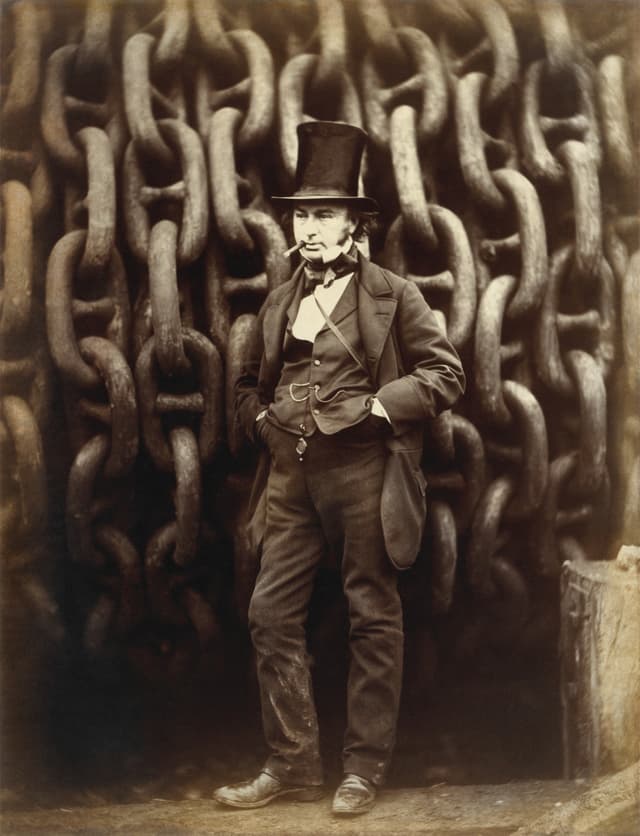
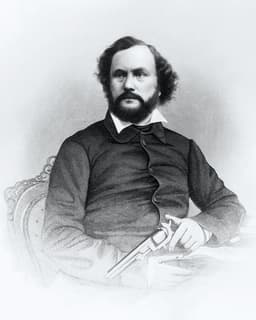
Isambard Kingdom Brunel
Great Western Railway, Thames Tunnel Project
A visionary engineer of the 19th century, Isambard Kingdom Brunel fundamentally transformed the manufacturing and transportation landscapes through his ambitious projects. He founded and led the Great Western Railway, which connected London to the West Country and Wales, significantly reducing travel time and fostering economic growth, while also overseeing the construction of the Thames Tunnel, the first underwater tunnel in the world. Brunel's unwavering belief in tackling seemingly impossible challenges inspired not only his contemporaries but also modern entrepreneurs, encouraging a mindset that views obstacles as opportunities. Despite facing setbacks, such as the temporary shutdown of his tunnel project while a friend thrived with the London docks, Brunel's determination remained resolute, as he documented his struggles and aspirations in his journal. His legacy serves as a reminder to business builders today that tenacity and a grand vision can lead to groundbreaking achievements.
Core Principles
focus
Your work should be your primary commitment. Be willing to sacrifice personal relationships and health for professional excellence.
Brunel worked 20 hours a day for sustained periods, often going without sleep for days. His marriage was secondary to his work. He famously stated that his profession was after all his only fit wife. This singular focus and sacrifice enabled him to achieve unprecedented engineering feats but contributed to his early death at age 52.
“My profession is after all my only fit wife.”
Practice persistence by attacking one point with overwhelming force rather than switching strategies when facing resistance.
When conventional approaches failed, Brunel's method was to commit even more resources and energy to the same attack rather than retreat to an easier path. This doctrine of unrelenting focus, while consuming, allowed him to overcome obstacles that would have stopped someone using opportunistic pivoting.
“To stick to the one point of attack, however defended, and if the force first brought up is not sufficient, bring ten times as much, but never to try back upon another in hope of finding it easier.”
hiring
Set exacting standards for craftsmanship and surround yourself only with people who can meet them. Remove mediocrity ruthlessly.
Brunel's apprenticeship under a master watchmaker instilled exacting standards that he applied throughout his career. He had no tolerance for mediocre work or inattentive employees, issuing harsh rebukes to those who failed to meet his standards. He understood that great work cannot be achieved with mediocre people on the team.
“The exacting standards of workmanship under which Brunel insisted throughout his lifetime were undoubtedly formed at this time.”
innovation
Question precedent and established rules rather than accepting them as inevitable. First principles thinking enables innovation.
When Brunel questioned the standard gauge used in railways, others accepted it without examination simply because previous engineers had chosen it. Brunel rejected this acceptance of precedent and examined the question on its merits, designing what he believed would prove to be the perfect railway.
“Brunel rejected precedent and proceeded from first principles to design what he confidently believed would prove to be the perfect railway.”
Visualize the completed work in your mind before execution begins. See it with your mind's eye in full detail.
Before constructing the Great Western Railway, Brunel covered every yard of the survey route and conceived the completed work in his imagination, seeing the iron road laid wide and true. This mental visualization was not abstract fantasy but detailed spatial understanding that guided the physical execution.
“In the course of the survey, he had covered every yard of the way and had seen with his mind's eye his iron road laying wide and true.”
Unable to think small, view the impossibility of precedent as proof of opportunity rather than barrier.
Brunel approached every project as unprecedented. The fact that something had never been done before presented no suggestion that it was impossible. He rejected precedent and proceeded from first principles, designing solutions that were often six times larger or more ambitious than anything existing.
“Isambard Kingdom Brunel was unable to think small and nothing was a barrier to him. The mere fact that something had never been done before presented to Brunel no suggestion that the doing of it was impossible.”
leadership
Be willing to stake your entire reputation and character on the success of your work. Full commitment signals seriousness.
In a letter to the directors of the Great Eastern project, Brunel made clear that he had devoted himself entirely to the work and staked his character on its success. This total commitment was not mere rhetoric but reflected his actual willingness to stake everything. This kind of full commitment is what attracts investors and team members who will go to extreme lengths.
“I have so entirely devoted myself and to which I've devoted so much time thought and labor on the success of which I have staked so much reputation.”
Develop acute self-awareness of your weaknesses while maintaining a bold public persona of self-confidence.
Brunel's private journals reveal deep self-awareness of his own faults, including his obsession with glory and tendency toward foolish displays. Yet publicly, he presented an impeccably confident engineer, which was essential for convincing investors and teams to undertake unprecedented projects. This duality allowed him to master his weaknesses while projecting the assurance needed to lead.
“The private man was a character very different from that of the cold, proud, abundantly self-confident engineer whom he impersonated to such perfection on the public stage.”
Require complete authority and personal responsibility for projects you lead, or resign rather than share decision-making power.
Brunel consistently threatened to resign whenever leadership attempted to impose oversight or share authority. He understood that large-scale innovation requires unequivocal decision-making from a single mind. He refused to be part of systems with multiple advisors or sources of information, knowing this fragmented authority.
“I cannot act under any supervision or form part of any system which recognizes any other advisor than myself or any other source of information than mine.”
Maintain an external facade of gaiety and confidence while internally managing intense pressure, doubt, and exhaustion.
Those working with Brunel observed that despite working extreme hours and dealing with immense pressure, he maintained constant good spirits and readiness. His external persona was one of lightness and confidence. Yet his private journals reveal the internal struggle and occasional despond. This ability to compartmentalize allowed him to inspire others without burdening them with his doubts.
“His ready wit and gaiety concealed a fire and a power which would drive him, undeterred by repeated disappointments, to achieve within a decade a degree of fame and fortune.”
learning
Every commission, however humble, contributes to your store of experience and versatility. Never refuse work based on perceived prestige.
During his lean years, Brunel accepted various small projects that others might have rejected as beneath their status. Through observation and engagement, each project taught him valuable lessons that became tools he later applied to massive undertakings. His refusal to dismiss work as too humble was central to developing his extraordinary versatility.
“Thanks to his acute powers of observation, everything he undertook contributed something of value to that store of experience, which was the secret of his versatility.”
mindset
Treat life and work as a grand adventure, living fully and intensely rather than merely surviving.
Brunel viewed his entire career as an adventure requiring complete commitment. He treated his work not as obligation but as the means to live more fully and intensely than his peers. This mindset drove him to sacrifice health, family time, and personal comfort in pursuit of greatness.
“A great man achieves eminence by his capacity to live more fully and intensely than his fellows.”
resilience
Control your response to adversity rather than the adversity itself. What you can control is your next move.
When Brunel nearly died in the Thames tunnel accident, he responded not with despair but with observation and recovery. Similarly, when major projects were postponed or cancelled, he did not dwell on failure but immediately threw himself into the next opportunity. His philosophy was that setbacks are inevitable, but your reaction determines your trajectory.
Maintain unshakeable self-belief and inner strength as a foundation, even when external circumstances suggest failure.
Brunel drew from an inner fire that drove him forward undeterred by repeated disappointments. During years of frustration when projects failed and peers succeeded, he refused to become downhearted. His motto was 'never despair' which sustained him through nearly a decade of struggle before the Great Western Railway opportunity emerged.
“He was fired by an inner strength and self-belief almost impossible to imagine in this feckless age.”
Understand that failure is information, not terminal. Rapidly recover from disappointment and concentrate on the next challenge with full energy.
Brunel's pattern throughout his career was to suffer setbacks, experience temporary despair recorded in his private journal, then quickly shift focus to new opportunities. Once a project failed, he would not dwell on it but would rapidly recover and apply himself to the next venture with undiminished energy.
“Once one project on which he had pinned his hopes had failed, he would rapidly recover from that blow, dismiss it from his mind and concentrate upon the next with undiminished energy.”
Frameworks
Never Despair Doctrine
A personal motto and operating philosophy that acknowledges setback and failure as inevitable, but reframes them as temporary obstacles rather than terminal conditions. When one avenue closes, pause briefly, acknowledge the disappointment, then immediately redirect energy to the next opportunity with full commitment. This framework prevents despair from accumulating into paralysis.
Use case: Navigating the startup phase when multiple early projects fail or encounter setbacks. Useful whenever momentum is threatened by repeated disappointment.
Store of Experience Principle
Accept all work and all projects, regardless of perceived prestige or scale, as contributions to a growing toolbox of experience. Each project, successful or failed, teaches lessons and develops capabilities that become available for future application. This creates optionality and versatility over time.
Use case: Early career phase when you are building foundational skills and knowledge. Prevents premature specialization and narrow focus before you understand the full landscape of your field.
Mind's Eye Visualization
Before beginning execution, spend time thoroughly surveying and studying the physical space or problem domain, then construct a detailed mental image of the completed solution. This visualization should be specific and spatial, not abstract. Use this mental model to guide actual construction or implementation.
Use case: Planning large-scale projects with long timelines and many moving parts. Particularly useful for physical infrastructure, product design, or any endeavor requiring coordination of many elements.
Unequivocal Decision Authority
Establish a single locus of decision-making power for major projects. The leader must have complete authority without supervision, oversight, or competing advisors. This person is fully responsible for outcomes and must be willing to resign rather than operate under divided authority.
Use case: Scaling a complex operation that requires rapid, coordinated decisions. Prevents decision paralysis and mission creep from multiple stakeholders with conflicting priorities.
Overwhelming Force on Single Point
When facing resistance on a particular challenge, do not pivot to an easier alternative. Instead, commit even greater resources and energy to the original point of attack. This doctrine trades flexibility for breakthrough force.
Use case: Situations where you have correctly identified the core problem but initial solutions are insufficient. Most effective when the problem is solvable with more effort rather than a fundamentally different approach.
Stories
During the years of frustration, Brunel's friend Palmer was succeeding with the London docks while Brunel's tunnel project was shut down. Brunel recorded despond in his journal but refused to give in to it, instead writing: 'I cannot, with all my efforts, work myself up to be downhearted.'
Lesson: Emotional control in the face of relative failure requires active effort. Brunel had to consciously resist the temptation to despair even as his peers succeeded, demonstrating that resilience is a practiced skill.
Brunel received word that a boiler had exploded on his Great Eastern ship just as he was recovering from a stroke. He had willed himself to stay alive to hear news of success. Upon learning of the disaster, his spirit broke and he died ten days later.
Lesson: Identity and work are intertwined. When the work fails at the moment you have staked everything on it, the psychological blow can be terminal. The price of total commitment is total vulnerability.
A worker under Brunel made a repeated mistake in drawing conventions that wasted Brunel's time. Brunel sent a harsh missive: 'Plain gentlemanly language seems to have no effect upon you. I must try stronger language.' He was willing to be ruthlessly direct about substandard performance.
Lesson: Excellence requires intolerance of mediocrity. Brunel understood that allowing poor performance to continue unchecked sets a standard for the entire organization.
During his recovery from the tunnel accident, Brunel was sent to Clifton to recuperate. While sketching the gorges and cliffs, he learned of a competition for engineers to design a bridge. This chance location and timing launched him toward his first major independent success.
Lesson: Preparation meets opportunity in unpredictable moments. By developing his observation skills and staying engaged with his surroundings during recovery, Brunel was ready when an opportunity emerged.
At age 20, Brunel was thrust into charge of the Thames Tunnel project when the resident engineer resigned and his father fell ill. Working in appalling conditions under a sewage-filled river, he led diving operations from a mattress after being paralyzed by a near-fatal accident, refusing to leave his post until learning the extent of damage.
Lesson: Early responsibility and high stakes create rapid capability development. Brunel's willingness to accept dangerous conditions and his refusal to abandon the project established his reputation and taught him critical engineering lessons.
After nearly dying in the tunnel collapse, Brunel recorded in his private journal that the experience felt 'grand' and 'well worth the risk.' While trapped, he focused not on his own survival but on encouraging two coworkers to escape. He survived with permanent effects but immediately returned to surveying once recovered.
Lesson: Extreme mindset reframes danger as part of the adventure. Brunel's ability to find meaning and even aesthetic appreciation in near-death experience sustained his willingness to undertake dangerous projects.
Notable Quotes
“My self conceit and love of glory vie with each other, which part of me shall govern, which part of them shall govern me. The latter is so strong that I often do the most silly, useless things to appear to advantage before those whom I care nothing about.”
From his private journal, revealing his self-awareness of his own obsession with legacy and reputation
“Never despair. The tunnel will never be finished now in my father's lifetime, I fear. However, never despair has always been my motto. We may succeed yet. Persevere.”
From his private journal during the years of frustration before the Great Western Railway opportunity
“I can compare it to nothing but the sudden adoption of a language that's familiar enough to the speaker, but unfortunately understood by nobody but him. Every word has to be translated. And so it is with my work. One alteration has involved another, and no one part can be copied from what others have done.”
Explaining the unique challenge of designing the Great Western Railway, where no precedent exists to guide the work
“To stick to the one point of attack, however defended, and if the force first brought up is not sufficient, bring ten times as much, but never to try back upon another in hope of finding it easier.”
His doctrine for overcoming obstacles, preferring overwhelming commitment to a single approach over pivoting to easier paths
“I cannot act under any supervision or form part of any system which recognizes any other advisor than myself or any other source of information than mine, nor could I continue to act if it could be assumed for a moment that the work required to be looked after by anybody but myself.”
In a letter to project directors asserting his absolute authority and willingness to resign if shared with oversight
“My profession is after all my only fit wife.”
Describing his absolute commitment to his work over personal relationships
“What a blank in my journal. During the most eventful part of my life. What a change. The railway now is in progress. I am the engineer to the finest work in England. It is like looking back upon a fearful past, but we have succeeded.”
His journal entry reflecting on the sudden transformation from years of struggle to success
“I have never regretted one instant the course I have taken.”
Even during the most difficult phases of the Great Western Railway construction
“A 140th of the remainder of my life. What a life, the life of a dreamer. I am always building castles in the air. What time I waste.”
Reflecting on wasting six months on an experiment that failed, calculating it as a fraction of his remaining years
Frequently Asked Questions
What are Isambard Kingdom Brunel's key business principles?▼
Isambard Kingdom Brunel's core principles include: Your work should be your primary commitment. Be willing to sacrifice personal relationships and health for professional excellence.. Practice persistence by attacking one point with overwhelming force rather than switching strategies when facing resistance.. Set exacting standards for craftsmanship and surround yourself only with people who can meet them. Remove mediocrity ruthlessly.. Founder Almanac has cataloged 15 total principles from Isambard's career.
What can entrepreneurs learn from Isambard Kingdom Brunel?▼
Key lessons from Isambard Kingdom Brunel include: Emotional control in the face of relative failure requires active effort. Brunel had to consciously resist the temptation to despair even as his peers succeeded, demonstrating that resilience is a practiced skill.. Explore 6 stories and 5 frameworks from Isambard's experience.
What is Isambard Kingdom Brunel known for in business?▼
A visionary engineer of the 19th century, Isambard Kingdom Brunel fundamentally transformed the manufacturing and transportation landscapes through his ambitious projects. He founded and led the Great Western Railway, which connected London to the West Country and Wales, significantly reducing travel time and fostering economic growth, while also overseeing the construction of the Thames Tunnel, the first underwater tunnel in the world. Brunel's unwavering belief in tackling seemingly impossible challenges inspired not only his contemporaries but also modern entrepreneurs, encouraging a mindset that views obstacles as opportunities. Despite facing setbacks, such as the temporary shutdown of his tunnel project while a friend thrived with the London docks, Brunel's determination remained resolute, as he documented his struggles and aspirations in his journal. His legacy serves as a reminder to business builders today that tenacity and a grand vision can lead to groundbreaking achievements.
More Manufacturing Founders
Want Isambard's advice on your business?
Our AI has studied Isambard Kingdom Brunel's biography, principles, and decision-making frameworks. Ask any business question.
Start a conversation