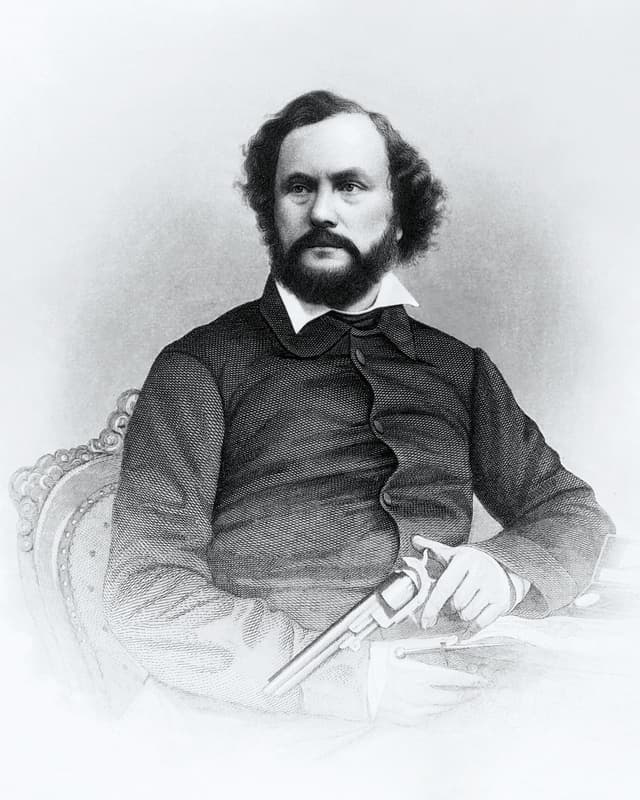
Samuel Colt
Colt's Patent Arms Manufacturing Company
A pioneer in the manufacturing industry, Samuel Colt revolutionized firearm technology by creating the first successful mass-produced revolver, the Colt Paterson, in 1836. His relentless focus on innovation allowed him to solve a longstanding engineering challenge—developing a reliable repeating firearm—by integrating principles from unrelated fields, thereby transforming the gun industry. Colt’s early hardships as a ship deckhand instilled in him an unyielding belief in self-determination, shaping his approach to business and leadership. By the time of his death in 1862, Colt's Patent Arms Manufacturing Company had produced over 400,000 firearms, showcasing his obsessive commitment to perfecting his craft and establishing a lasting legacy that continues to inspire entrepreneurs today. "It is better to be the head of a louse than the tail of a lion," he believed, embodying his drive to forge a unique path in a competitive world.
Core Principles
customer obsession
Find your champion in the market, not in institutions. When the U.S. military rejected Colt's revolver, Texas Rangers and frontiersmen who actually needed the product became his true customers and advocates.
After years of military rejection, Captain Jack Hayes and Sam Walker of the Texas Rangers recognized the revolver's superiority for mounted warfare against Comanches. Their advocacy single-handedly convinced the government to order thousands, reigniting Colt's business.
“Walker had achieved in a few weeks what Colt had failed to achieve in years.”
finance
Spend money only after you validate the market and prove your manufacturing capability. Colt's first business failed by building expensive infrastructure before solving core problems, while his second succeeded by outsourcing initially and scaling gradually.
Colt's first gun company invested hundreds of thousands in a factory before mastering production, leaving him with debt and no cash flow. His second business worked with Whitney Armory initially, proving demand and manufacturing feasibility before building his own scaled factory.
“Within days of meeting Walker, Colt had approached Eli Whitney Jr. to discuss having pistols made at the Whitney Armory.”
Working on a shoestring budget requires strategic sequencing, not compromised quality. Colt paid for work gradually, underpaid contractors, and stretched resources, but never accepted substandard craftsmanship on the core innovation.
Unable to pay gunsmiths adequately, Colt delayed payments and underestimated costs, straining relationships. However, he maintained relentless focus on perfecting the revolver's mechanical design, demonstrating that limited resources require prioritization rather than across-the-board compromise.
“$50, which is what he sent him, was nowhere near sufficient to cover the gunsmith's wages and pay for materials and other expenses.”
focus
Focus so narrow it borders on obsessive produces breakthrough results. Colt possessed an almost pathological ability to concentrate on a single objective while blocking out distractions, allowing him to perfect his revolver over many years despite repeated failures.
Even while traveling the country selling nitrous oxide gas for income, Colt dedicated his days to improving his gun prototype. At 19, he worked nights on his revolver after days spent negotiating with gunsmiths, maintaining singular focus on his invention despite multiple business failures.
“At times, Colt had a focus so narrow as to almost literally obscure his peripheral vision.”
hiring
Recruit talented people by offering them a larger challenge than they currently face. Rather than compete on salary alone, appeal to their ambition to solve problems at a scale they cannot find elsewhere.
Colt convinced Elijah Root, who had turned down lucrative offers from the Springfield Armory and the U.S. Mint, by offering him the opportunity to reinvent machine production at a far grander scale than any other factory in the world.
“Colt offered him an opportunity to re-envision machine production at a far grander and more complex scale than he'd ever find in any other factory.”
innovation
Solve old problems in new ways. Colt took a technology problem that had existed for 400 years and solved it by applying principles from an unrelated domain, creating genuine innovation rather than incremental improvement.
Colt observed how the ship's windlass used a ratchet mechanism to hoist anchors. He miniaturized this same principle and applied it to rotate the revolver's cylinder, creating a reliable multi-shot firearm. This cross-domain application became his breakthrough invention.
“In retrospect, using a pawl to push a ratchet, to turn a cylinder, to fire a gun, sounds like fairly basic applied mechanics. But in 1831, it was nothing less than revolutionary.”
leadership
Retain control of your own destiny by avoiding corporate structures that limit your authority. Colt's refusal to take on a formal board or charter in his second business ensured he remained master of his company decisions.
After his first company failed partly due to board interference, Colt structured his second venture as a private company with no charter or stock sale, maintaining sole control and management. He explicitly rejected having to answer to a board of directors.
“I am working on my own hook and have sole control and management of my business. No longer subject to the whims of a pack of damn fools styling themselves as a board of directors.”
learning
Persistent reinvention through continuous learning from mentors. Colt studied the operations of established armories, learned from contemporary manufacturers, and read biographies of great leaders to constantly improve his approach.
Colt visited Springfield Armory and other manufacturing facilities to observe how they worked. He picked up Andrew Jackson's three-volume biography to understand leadership. He regularly consulted with experienced gunsmiths and manufacturers to refine his methods.
marketing
Build brand presence through earned media rather than paid advertising. Colt's revolver appeared almost daily in newspapers covering murders, robberies, and heroic incidents, creating omnipresent brand awareness without advertising budget.
Colt's product was featured constantly in newspaper stories of crime and frontier adventure. Rather than paying for advertisements, Colt benefited from editorial coverage that made his revolver the iconic weapon of American drama.
“Colt revolvers were a staple of American newspaper coverage. They were featured almost daily in gripping stories of murders, suicides, accidents, adulterous affairs, robberies, and duels.”
mindset
Extreme personality traits that drive success also create significant liabilities. Colt's boldness, confidence, and relentlessness enabled his breakthroughs but also made him dishonest, unreliable with money, dismissive of others, and prone to unwinnable conflicts.
Colt's willingness to not pay contractors, his arrogance toward colleagues decades his senior, his bribery attempts, and his disregard for board oversight created substantial friction. These same traits enabled him to push through overwhelming obstacles that would have stopped a more cautious person.
“Friends admired him for his generosity, his warmth, and his boldness. Adversaries reviled him for his dishonesty and his rapaciousness.”
Stunning confidence in your own rightness is both your greatest asset and your costliest flaw. Colt's unwavering belief that he was right and others were wrong pushed him through impossible odds but also caused him to waste resources on unwinnable battles.
Young Colt maintained absolute confidence in his revolver design despite the U.S. Ordnance Board rejecting it and despite years of failure. This same confidence later led him to waste substantial resources trying to bribe officials to extend his patent beyond what was realistic.
“He had stunning confidence. He was right. Others were wrong. For the rest of his life, he would encounter the world on these terms.”
Relentless personal productivity, where every moment must serve progress, can accelerate growth but often at great personal cost. Colt metabolically converted all his time and energy into business advancement, which created extraordinary output but compromised his health.
Colt would stop at his fish pond to improve his trout population, drill artisan wells, and plan orchards while traveling between locations. He woke at five or six in the morning and worked until seven or eight at night. This obsessive productivity contributed to the illnesses that ultimately killed him at 47.
“It was the nature of Colt to convert his time, his waking hours, and space into profit.”
Entrepreneurs often misunderstand how their products will be used in the future. Colt believed his revolver would prevent war, yet it became an agent of frontier expansion and warfare, demonstrating that innovation has unpredictable consequences.
Colt stated his gun would be a peacemaker and prevent war through superior force. Instead, it became essential to westward expansion, frontier violence, and civil war. This pattern repeats with other inventors who misunderstood their inventions' ultimate use cases.
“I would not have made it known meaning my revolver did I think it would put a stop to war. The good people of this world are very far from being satisfied with each other and my arms are the best peacemakers.”
Self-reliance forged through hardship becomes a lasting competitive advantage. Extreme circumstances early in life created an unshakeable belief in self-determination that drove Colt to master his own destiny rather than accept others' authority.
Colt's experience as a teenage deckhand on a ship to Calcutta, including being flogged, instilled in him a fierce need for control and independence. This philosophy shaped how he built his business and refused to be subordinate to boards or investors.
“It is better to be the head of a louse than the tail of a lion. Its sentiment, meaning self-determination, took deep root in my heart and has been the mark which has and shall...”
operations
The machine that makes the machine is as important as the product itself. Colt understood that his manufacturing system was as revolutionary as his revolver, and he invested heavily in perfecting production methods.
Colt emphasized in speeches that his machines and production methods were equally significant to his gun design. He achieved four-fifths machine automation by breaking the revolver into components and dedicating machines to each part, creating the foundation for modern assembly manufacturing.
“He wanted his audience to understand that his machines and his production methods were every bit as significant, as revolutionary as his revolver.”
sales
Master salesmanship allows you to bend circumstances to your will. Colt could convince gunsmiths to work without payment, investors to fund failed ventures, and manufacturers to partner with him despite his unreliability.
Colt convinced established gunsmiths like Pearson to continue working for him despite unpaid bills and broken commitments. He later persuaded Eli Whitney Jr. and Elijah Root to join ventures when they had far better alternatives available.
“Colt had a gift for convincing others to do as he pleased. Even after he had become obvious it was not in their interest to do so.”
simplicity
Simplicity in design and manufacturing is a competitive weapon. Breaking the revolver into the fewest possible parts and dedicating machines to each part created uniformity, speed, and cost advantages that competitors could not match.
Colt's manufacturing philosophy emphasized reducing the gun to essential components and creating specialized machines for each. This approach achieved four-fifths automation when competitors still relied on hand production, enabling mass scale and consistency.
“In America, where manual labor is scarce and expensive, it was imperative to devise means for producing these arms with the greatest rapidity and economy.”
strategy
Market pull is more powerful than product push. A great market with an adequate product will always beat a great product in a poor market. Colt's success came when circumstances created desperate demand, not from superior marketing.
Colt's revolver generated limited interest until westward expansion and the Mexican-American War created urgent demand from settlers and military forces. The market pulled the product from him through genuine necessity rather than marketing efforts.
“The market will pull the product out of you. If you have an okay team and an okay product, but a great market, you're going to beat a great team and a great product in a shitty market.”
External circumstances create windows of opportunity that no planning can fully anticipate. Colt benefited from westward expansion, the Mexican-American War, the California Gold Rush, and finally the Civil War, none of which he could have predicted or created.
Colt's business remained in crisis for a decade until Texas Rangers, frontier settlers, gold rushers, and war created desperate demand for his product. No amount of persuasion could have created this demand earlier, but he was positioned to capture it when it arrived.
“Between these two Sams lay a country that was about to change in ways neither could have anticipated.”
Failing at your first attempt teaches you how to succeed on your second. Colt's catastrophic failure with his first gun company, where he built an expensive factory before perfecting manufacturing, taught him to subcontract production and retain control before scaling.
Colt's first company failed because he invested heavily in factory infrastructure before solving the manufacturing problem. His second business worked with Eli Whitney Jr.'s armory initially, then built his own factory only after proving the market and the manufacturing process.
“The greatest mistake of his past, Colt believed, had been ceding control of his business to others and he did not intend to repeat it.”
Frameworks
Cross-Domain Innovation Transfer
Identify problems that have existed unsolved for long periods in one domain, study how they are solved in unrelated domains, and apply those solutions to the original problem. This requires understanding principles rather than specific implementations. Colt's application of the ship's windlass ratchet to revolver mechanics exemplifies this approach, creating breakthroughs by thinking across domains rather than iterating incrementally within one field.
Use case: When facing technical problems that have resisted solution through conventional approaches, explore how different industries or domains solve analogous problems and adapt those principles.
Sequential Capital Deployment for Startups
Stage capital investment to match your progress: secure seed funding to perfect the core product, use subcontractors or partnerships to validate the market before building infrastructure, and only invest in owned factories after demand is proven and manufacturing methods are validated. This prevents building expensive capacity before you understand what to build or how to build it.
Use case: Early-stage founders must choose between building infrastructure early (Colt's failed first approach) or outsourcing initially to validate before investing (Colt's successful second approach).
The Champion Champion Strategy
When institutions (government, large buyers, established players) reject your innovation, identify and find champions within the user community who actually need your solution. Their advocacy and proof of value is far more persuasive to institutions than your own arguments. The champion is more credible because they have no financial interest in your success, only in solving their own problem.
Use case: B2B founders facing institutional resistance should focus on identifying and supporting power users who will advocate internally to decision-makers, rather than continuing to pitch directly to gatekeepers.
Machine Production Simplification
Reduce your product to the fewest possible necessary components, then design a dedicated machine for each component. This approach enables automation while maintaining quality and consistency. By thinking of production as a series of simplified, repeatable machine-driven processes rather than artisanal hand work, you unlock dramatic cost reduction and scalability.
Use case: Manufacturing companies looking to scale should map the production process, identify the fewest components possible, and then design purpose-built machines for each step rather than trying to automate existing complex processes.
Control Retention Through Structure
When building a business where you plan to remain involved long-term, structure the company to ensure you retain decision-making authority. This may mean avoiding traditional corporate charters, stock sales to outside investors, or boards of directors that can overrule you. The trade-off is limited capital but preserved autonomy.
Use case: Founders who view the business as an extension of their vision should consider private company structures that prevent board-level interference, rather than pursuing maximum capital through equity sales that dilute control.
Stories
At 17, Colt volunteered for a grueling 17,000-mile voyage to Calcutta as a ship deckhand. Working in harsh conditions with hardened sailors, he was flogged for perceived infractions and had to be completely self-reliant. During the voyage, while observing the ship's windlass mechanism, he conceived the basic principle for his revolver and carved a wooden model in his scarce downtime.
Lesson: Extreme hardship and exposure to new environments creates both psychological drive (the flogging reinforced his need for self-determination) and practical knowledge (the windlass mechanism). Many founding ideas emerge not from comfortable study but from difficult circumstances where you must observe and solve real problems.
Colt invested hundreds of thousands of dollars in a factory for his first gun business before he had solved how to actually mass-produce the revolver. He had only one gunsmith making handmade prototypes, yet he was spending lavishly on machinery, buildings, and salaries. The factory construction fell four months behind schedule, demand existed but he had no guns to sell, and he went bankrupt within four years despite strong market interest.
Lesson: Do not build infrastructure before you have proven your core process works. Validate manufacturing methods at small scale (through subcontractors or partnerships) before investing in owned factories. Colt learned this lesson and never repeated the mistake in his successful second business.
Sam Walker, a Texas Ranger who had used Colt's revolver in combat, recognized its superiority for mounted warfare against Comanches. Walker wrote enthusiastically about the gun's potential and convinced the U.S. Ordnance Department to reverse its prior rejection and order 1,000 units. This single endorsement reignited Colt's business after a decade of failure and turned him toward wealth.
Lesson: The champion inside the market (the actual user) is infinitely more persuasive than the inventor. After years of failing to convince the military directly, Colt's product succeeded because someone with battlefield credibility insisted it was essential. Find your champions in the real world.
During years of financial struggle while perfecting his revolver, Colt worked a traveling road show selling nitrous oxide gas to raise income. He would deliver lectures on chemistry, then offer paying audience members the chance to inhale laughing gas. Nights were dedicated to this work, days to improving his gun. This scrappy approach kept him alive while he waited for his product to be market ready.
Lesson: Before your core business is viable, you may need parallel income streams to sustain your work on the core innovation. Rather than viewing this as a compromise, use it strategically to extend your runway while you perfect your actual product.
Colt's first gun company was structured as a traditional corporation with investors, a board of directors, and limited autonomy for Colt despite being the founder. When his second gun business succeeded, Colt explicitly rejected this structure, insisting on operating as a private entity with no charter, no stock sale, and sole control and management. This allowed him to make decisions rapidly without board approval.
Lesson: Your legal structure determines your operational freedom. If maintaining control and rapid decision-making is important to your vision, choose structures that preserve autonomy even if they limit capital availability. The trade-off is worth it if the alternative is board-imposed constraints.
The U.S. Ordnance Board tested Colt's early revolver and formally rejected it as unsuited for military use, calling it complicated and prone to accidents. Colt was furious, but years later acknowledged the board's verdict was justified given the gun's actual deficiencies and given 19th-century army doctrine favoring coordinated musket fire over individual weapon capability. The negative feedback forced him to improve his design significantly.
Lesson: Harsh feedback from people positioned to judge your product often contains truth, even when it feels rejecting and painful. The military's insistence on reliability and simplicity pushed Colt to improve where he might otherwise have accepted mediocrity. Rejection can be more valuable than early success if it forces genuine improvement.
Colt worked with a gunsmith named Pearson for years without paying adequate compensation. Despite Colt being a decade younger and having no money, he held Pearson to exacting standards, refused to accept substandard work, and demanded continuous refinements. Pearson continued working despite the financial strain because Colt had an almost hypnotic ability to convince people to do as he wished, combined with demonstrating genuine care for perfect execution.
Lesson: Charisma and absolute confidence in your vision can induce talented people to work on your terms even when those terms are not in their financial interest. This is powerful but morally fraught, and relies on the person's belief that the vision is worth the sacrifice.
As Colt's business scaled and he grew wealthy, his spending increased to match his income. He indulged excessively in alcohol, cigars, and luxuries. When called to testify before Congress about allegedly bribing officials to extend his patent, Colt appeared obviously drunk. Yet the business generated such massive demand and profit that his personal overspending barely made a dent in the company's finances.
Lesson: Extraordinary revenue can mask profound personal and professional dysfunction. Colt's drinking, bribing, and recklessness would have destroyed a normal business, but the underlying demand for his product was so great that he could not outspend the profits. This is an exception, not a rule, and most founders do not have this margin for error.
Notable Quotes
“It is better to be the head of a louse than the tail of a lion.”
Written 14 years after his experience being flogged on the ship, expressing his core belief that self-determination and autonomy were worth more than security or status under another's authority.
“I am working on my own hook and have sole control and management of my business. No longer subject to the whims of a pack of damn fools styling themselves as a board of directors.”
Describing his second gun business structure, which was deliberately designed to prevent outside investors or boards from constraining his decisions.
“In America, where manual labor is scarce and expensive, it was imperative to devise means for producing these arms with the greatest rapidity and economy.”
Explaining his philosophy of automation and machine production, which became the foundation for the American system of manufacturing.
“I have spent the last 10 years of my life without profit in perfecting military inventions.”
Reflecting on his decade of struggle and investment in developing the revolver before any commercial success, demonstrating his willingness to sacrifice income for product perfection.
“I would not have made it known meaning my revolver did I think it would put a stop to war. The good people of this world are very far from being satisfied with each other and my arms are the best peacemakers.”
Expressing his belief that his revolver would prevent war, a common delusion shared by many weapon inventors throughout history.
Frequently Asked Questions
What are Samuel Colt's key business principles?▼
Samuel Colt's core principles include: Find your champion in the market, not in institutions. When the U.S. military rejected Colt's revolver, Texas Rangers and frontiersmen who actually needed the product became his true customers and advocates.. Spend money only after you validate the market and prove your manufacturing capability. Colt's first business failed by building expensive infrastructure before solving core problems, while his second succeeded by outsourcing initially and scaling gradually.. Working on a shoestring budget requires strategic sequencing, not compromised quality. Colt paid for work gradually, underpaid contractors, and stretched resources, but never accepted substandard craftsmanship on the core innovation.. Founder Almanac has cataloged 20 total principles from Samuel's career.
What can entrepreneurs learn from Samuel Colt?▼
Key lessons from Samuel Colt include: Extreme hardship and exposure to new environments creates both psychological drive (the flogging reinforced his need for self-determination) and practical knowledge (the windlass mechanism). Many founding ideas emerge not from comfortable study but from difficult circumstances where you must observe and solve real problems.. Explore 8 stories and 5 frameworks from Samuel's experience.
What is Samuel Colt known for in business?▼
A pioneer in the manufacturing industry, Samuel Colt revolutionized firearm technology by creating the first successful mass-produced revolver, the Colt Paterson, in 1836. His relentless focus on innovation allowed him to solve a longstanding engineering challenge—developing a reliable repeating firearm—by integrating principles from unrelated fields, thereby transforming the gun industry. Colt’s early hardships as a ship deckhand instilled in him an unyielding belief in self-determination, shaping his approach to business and leadership. By the time of his death in 1862, Colt's Patent Arms Manufacturing Company had produced over 400,000 firearms, showcasing his obsessive commitment to perfecting his craft and establishing a lasting legacy that continues to inspire entrepreneurs today. "It is better to be the head of a louse than the tail of a lion," he believed, embodying his drive to forge a unique path in a competitive world.
More Manufacturing Founders
Want Samuel's advice on your business?
Our AI has studied Samuel Colt's biography, principles, and decision-making frameworks. Ask any business question.
Start a conversation