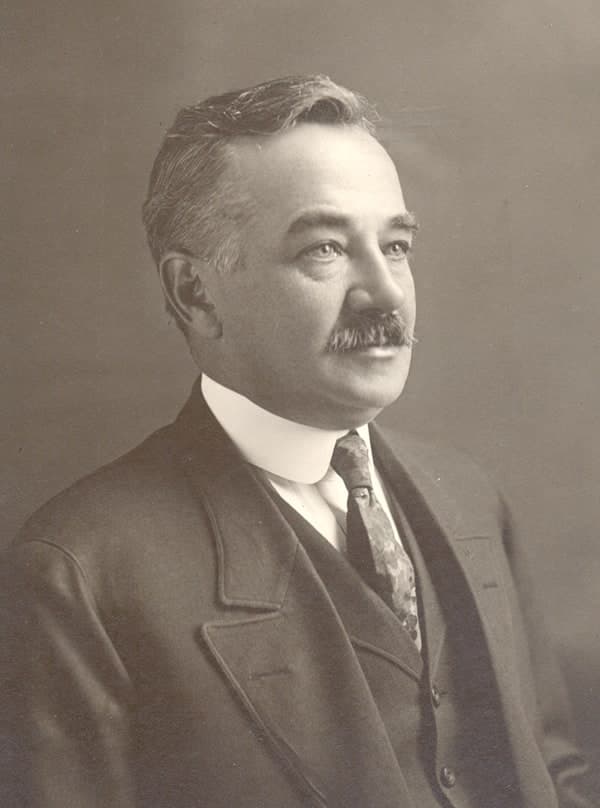
Milton Snavely Hershey
Hershey Chocolate Company
A prominent figure in the food and restaurant industry, Milton Snavely Hershey founded the Hershey Chocolate Company and revolutionized the candy market with his innovative products. After enduring 14 years of failures in various business ventures, he demonstrated that perseverance is a key trait for entrepreneurs, ultimately leading to the establishment of a company that produced over 100 million pounds of chocolate annually by the 1940s. Hershey's commitment to creating unique, high-quality confections set his brand apart from competitors, showcasing the importance of innovation in a crowded market. His relentless study of successful business models allowed him to seize market opportunities, making him an enduring inspiration for today's entrepreneurs.
Core Principles
competitive advantage
When entering a competitive market, avoid creating 'me too' products. Instead, develop unique innovations that competitors cannot easily replicate.
Hershey's early candy businesses failed because he competed in crowded markets with standard products. He succeeded only when he identified the Denver-style caramel innovation and later when he committed to mass-producing milk chocolate, a product no one else could yet produce at scale in America.
customer obsession
Use business success to address social problems and help the disadvantaged. Wealth should serve something higher than personal accumulation.
Milton was deeply affected by witnessing 50,000 poor children living in squalor in New York. He created the Milton Hershey School as an orphanage and boarding school for disadvantaged children, mirroring his own difficult childhood. He established a trust that made the school the majority owner of the Hershey Company, ensuring permanent funding for the school and direct benefit from company profits.
“It's a sin for a man to die rich.”
finance
Create permanent institutional structures for philanthropy rather than personal charity. Structure assets so that charitable impact compounds and continues indefinitely.
Rather than leaving his fortune to individuals or making one-time grants, Milton created the Milton Hershey School Trust, which holds majority ownership of the Hershey Company. This structure ensures that as the company grows and generates profits, the school automatically receives benefits. By 2005, the trust had grown to $5 billion in assets, making the school richer than Cornell, Columbia, and the University of Pennsylvania.
innovation
Master your craft through hands-on experimentation and learning, not just inherited knowledge. Bring in experts to fill gaps in your own education.
Milton did not know how to make or mass-produce milk chocolate when he decided to enter the industry. He spent two years experimenting with roasting, grinding, pressing, and mixing. He hired chocolate makers from Switzerland, Chicago, and Massachusetts to teach him and his team. He essentially created a skunk works operation where 18 men worked in secrecy, sometimes for full days without leaving, to solve the technical challenges of mass production.
Invest in superior technology and manufacturing processes, even when expensive. The competitive advantage gained justifies the capital investment.
Milton recognized that Layman chocolate machines represented superior European technology and placed an order for every machine available, despite the $60,000 price tag per unit. He also invested in building efficient factory systems and machinery that allowed him to produce high quality chocolate at the lowest cost in the industry.
leadership
Share company profits with employees through bonuses and incentives. High wages and profit participation create dignity, stability, and expand the consumer economy.
In 1912, Milton paid every worker a 20% bonus matching the dividends paid to investors. He continued this practice for many years. Following Henry Ford's principle, he believed high wages were not just an expense but an investment in the economy. Workers with living wages could consume and buy other products and services, expanding the broader economy.
Build more than a business, build a community. Create a complete ecosystem that reflects your values about commerce, education, and human flourishing.
Milton created Hershey, Pennsylvania as a utopian company town based on the Cadbury model. He built not just a factory but housing, schools, parks, churches, and social infrastructure. He deliberately kept rents and prices at break-even to serve workers rather than exploit them. He started a newspaper to publish his philosophy of populism combined with capitalism, which he called the Hershey Idea.
Be radically honest with creditors and stakeholders about your situation. Transparency builds trust and creates opportunities for support.
When seeking additional credit from the bank in Lancaster, Milton came down and laid everything on the table. He told banker Frank Brenneman he could not pay back the original loan, showed him the modest facilities, and explained his dependence on a single export contract. Brenneman was so impressed by Milton's honesty and lack of excuses that he personally guaranteed the loan, saving the business.
“He didn't conceal the bad part. He made no excuses for it. He was honest.”
learning
Study successful entrepreneurs and competitors relentlessly to steal ideas and understand market opportunities. Observation and learning from others is as valuable as direct experience.
Milton traveled regularly to Great Britain to observe the Cadbury chocolate works, studied the Smith Brothers cough drop manufacturing system, and examined Layman chocolate machines at exhibitions. He copied their playbook directly: building a company town, manufacturing efficiency, and branded products. He also learned the Denver caramel recipe while working in Colorado and brought it east.
mindset
Avoid the trap of unrealized ambition and endless dreaming. Act, persevere, and focus relentlessly on execution rather than talking about great schemes.
Milton's father Henry embodied the opposite principle. He had a thousand schemes but never stuck to any of them, had no concept of perseverance, and abandoned projects within weeks. Milton learned to reject this pattern. He focused on execution, stayed with the confectionery industry for his entire life starting at age 14, and built his success through consistent, focused action rather than scattered ambitions.
operations
Small, continuous improvements over many years produce remarkable results. Focus on incremental progress rather than revolutionary change.
Milton Hershey improved his caramel business through consistent quality enhancements and fair pricing. He competed on quality where competitors battled on price. This steady growth approach built the Lancaster Caramel Company from a one-person operation to over 700 workers within five years.
“Small continuous improvements over many years produces miracles.”
Build business success on systematic efficiency: simple choreographed routines, latest technology, and purpose-built facilities. Every detail should serve efficiency.
Milton designed his chocolate factory and operations so that workers performed carefully choreographed tasks using new machinery in buildings designed for efficiency. This allowed him to produce high quality chocolate at very low cost, creating an unbeatable competitive advantage. Ray Kroc identified the same principle at McDonald's.
“With workers performing simple but carefully choreographed routines and using new machinery in a building designed for efficiency, Hershey was able to make high quality chocolate at very low cost.”
resilience
Rise from adversity and rejection by recognizing that being cut off from easy support can be liberating. Loss of external backing forces self-reliance and innovation.
When his uncles and aunt finally rejected his request for another loan, declaring him too much like his unreliable father, Milton was devastated but also liberated. He began making candy alone in a rented warehouse room, selling from a handbasket, then a pushcart. This rejection forced him to bootstrap and eventually led to his most successful ventures.
“This rejection was a great motivator.”
Perseverance through repeated failure is the primary differentiator between successful and unsuccessful entrepreneurs. Milton Hershey failed multiple times over 14 years before building a successful business, yet refused to quit.
Hershey attempted three separate candy businesses before finding success with the Lancaster Caramel Company. He was broke, embarrassed, and had exhausted family loans and support, but continued to pursue the confectionery business. His mother's high expectations and refusal to accept failure as permanent kept him moving forward.
“I'm convinced about half of what separates the successful entrepreneurs from the non-successful ones is pure perseverance.”
simplicity
Simplify your product line and focus on high-volume, low-price production of a few excellent items rather than making hundreds of varieties.
Instead of following the confectionery industry standard of producing hundreds of items at varying prices, Milton decided to make huge quantities of a few varieties, priced at no more than a nickel. This strategy, combined with efficient manufacturing, allowed him to dominate the market. The Hershey Kiss and Almond Bar became iconic products.
strategy
Democratize luxury goods by mass producing them affordably. Transform products from luxury items available to the wealthy into everyday products for all people.
Milk chocolate was originally sold as a luxury good by Swiss chocolatiers. Milton recognized the opportunity to mass-produce it and make it affordable at a nickel price point. This democratization of chocolate mirrors Henry Ford's approach with automobiles, making previously exclusive products accessible to the average consumer.
“The caramel business is a fad. It is not a staple business, but chocolate is something we will always have.”
When something is critical to your business, you must control its supply. Don't rely on external suppliers for essential inputs.
Hershey was squeezed by suppliers and learned this lesson painfully. Later in life, he established his own sugar plantations in Cuba to control a core ingredient for chocolate production. He applied this principle to nearly every ingredient he could, ensuring supply security and quality control.
Know when to exit a business and move to the next opportunity. Recognize when a market is declining and shift your focus to emerging industries.
When the caramel business was at its peak, Milton sold the Lancaster Caramel Company for over one million dollars. While competitors believed the market would continue growing, Milton believed he had ridden the caramel market to its crest and could see its decline ahead. He used the capital to pursue his true opportunity in chocolate manufacturing.
Frameworks
The Edisonian Principle of Design
A rigorous experimentation methodology where one variable is changed at a time in controlled conditions to isolate cause and effect. Multiple failures and iterations lead to unique insights that cannot be easily replicated by competitors. This approach requires long, laborious testing but produces defensible competitive advantages.
Use case: Developing proprietary manufacturing processes or products where technical mastery is the competitive advantage. Particularly effective when building products that require systematic optimization like chocolate, automobiles, or complex machinery.
The Skunk Works Model
A separated, secret experimental facility where a small team works intensively with minimal external constraints to solve critical technical problems. The team operates with extended hours, complete focus, and confidentiality to maximize learning velocity and prevent competitors from copying work-in-progress.
Use case: When entering a new industry where you lack technical expertise but need to develop proprietary methods quickly. Useful when you need to reverse-engineer or master complex manufacturing processes before scaling to full production.
The Systemic Efficiency Model
Every element of operations, from worker movements to factory layout to machinery, is designed to support a single objective: produce high quality at the lowest cost. Workers perform carefully choreographed, simple tasks in purpose-built facilities using optimal technology. The result is an efficiency advantage that competitors cannot match through incremental improvements.
Use case: Building a sustainable competitive advantage in manufacturing or operations-intensive businesses. When competitors are more focused on product features than process, systematic efficiency creates an insurmountable cost advantage.
The Permanent Institution Structure
Design philanthropic or charitable giving as a self-sustaining institution that holds ownership stakes in operating businesses rather than relying on grants or personal wealth distribution. As the business grows, the charitable institution automatically benefits from profits and asset appreciation, creating compound growth.
Use case: Creating lasting social impact at scale. Particularly effective when you want to fund a specific mission (education, care for disadvantaged populations) in perpetuity without depending on future personal wealth or management decisions.
The Geographic Market Arbitrage Strategy
Identify successful business models, products, or innovations in one geographic region and replicate them in an underserved region. The innovation already has proven market demand elsewhere, reducing risk, but faces no competition in the new market because of geographic separation.
Use case: Entering new markets with lower risk than pure innovation. Milton took the Denver caramel formula east, and later took the Swiss milk chocolate model to America. Works best when moving from smaller to larger markets or from saturated to underdeveloped regions.
Stories
At 12 years old, Milton was apprenticed to a printer by his father, but deliberately let his hat fall into the printing press so he would be fired. His mother then secured him an apprenticeship at Royer's Ice Cream Parlor and Confectionery, where he would find his life's calling. He worked in the confectionery business continuously for the next 73 years until his death.
Lesson: The right opportunity often comes when someone who knows you well (your mother, a mentor, or trusted advisor) redirects you toward work that matches both your circumstances and innate strengths. Sometimes a strategic failure (the printing job) is necessary to escape the wrong path.
After his first Philadelphia candy business failed in 1879-1880, Milton was so broke he couldn't pay railroad fees to retrieve shipped equipment. He wandered the country unemployed, briefly seeking work but nearly being trafficked into slave labor. He eventually found work at a Colorado candy shop where he learned the superior Denver caramel recipe and realized he could use this knowledge to build a successful business back east.
Lesson: Complete failure and displacement, while painful, can position you to learn from different markets and bring proven ideas to new regions. Sometimes the most valuable business education comes from failure and forced exploration rather than direct success.
Milton needed a $700 loan to buy equipment for his Lancaster caramel operation but had only 90 days to repay it, serving a market of just 30,000 people. A visiting candy retailer ordered caramels and requested shipment to London, giving Milton the leverage to ask the bank for more time and an additional $1,000. Banker Frank Brenneman was so impressed by Milton's radical honesty about his situation that he personally guaranteed the loan in his own name to avoid scrutiny from other bank officers.
Lesson: Complete honesty about your situation, without excuses or exaggeration, can inspire others to take risks on you. Showing your actual condition (the dusty warehouse, the two helpers wrapping candies) and demonstrating determination builds trust that overshadows conventional financial metrics.
Milton sold his successful caramel business for over one million dollars when it was at peak profitability, while competitors believed the market would continue growing. He had observed the emerging chocolate industry in Britain and recognized that chocolate would be the next major wave. He then spent two years learning how to mass-produce milk chocolate before bringing the first Hershey chocolate to market.
Lesson: The ability to recognize when you have ridden a wave to its crest and exit at the peak, rather than staying until the decline, separates great entrepreneurs from good ones. Observation of emerging trends in other markets gives you the confidence to abandon success for better opportunities.
When Milton's family finally rejected his loan request, declaring him too much like his unreliable father, he was devastated but also liberated. He began making candy alone in a rented warehouse room, selling from a handbasket, then graduating to a pushcart. This bootstrap operation eventually led to the Lancaster Caramel Company, which became enormously successful.
Lesson: Rejection from those you had relied upon can be a turning point toward true independence. When external support is cut off, necessity forces you to become resourceful and self-reliant. The small scale of your initial bootstrap operations often become the foundation for larger successes.
Milton hired chocolate makers from Switzerland, Chicago, and Massachusetts to teach him how to make milk chocolate, yet still spent years experimenting in a secret skunk works facility on his farm. A team of 18 men would sometimes work continuously for full days without leaving, changing one variable at a time to understand the science of mass production. The complexity came from the fact that different breeds of cows and feed qualities made imperceptible differences in milk taste that were magnified during chocolate production.
Lesson: Even with expert guidance, mastering a complex technical process requires hands-on, long-duration experimentation. The Edisonian principle of isolating variables and rigorous testing is the only path to proprietary knowledge that competitors cannot replicate. Expert advice fills gaps but cannot replace the learning that comes from failure.
Rather than retiring after selling his caramel business for over one million dollars, Milton invested heavily in building a chocolate factory, a town around it, worker housing, schools, churches, and parks. He did this while still uncertain whether he could actually solve the technical problems of mass-producing milk chocolate. His belief in the vision was so strong that he committed enormous capital to infrastructure before proving the process worked.
Lesson: True visionary commitment sometimes requires betting large amounts of capital on an unproven premise. Milton's willingness to build the factory and town before solving every technical detail demonstrated confidence that he would find a solution, and this confidence drove the intensive experimentation that made success possible.
Milton created the Milton Hershey School Trust, which made the industrial school the majority owner of the Hershey Chocolate Company. As the company grew over decades and generated profits, the school automatically benefited through dividends and asset appreciation. By 2005, the trust had accumulated $5 billion in assets, making it wealthier than Cornell, Columbia, and the University of Pennsylvania. The structure guaranteed permanent funding for the school's mission to help orphaned and disadvantaged children.
Lesson: Philanthropic impact can be exponentially greater through permanent institutional structures than through personal wealth distribution. By making a charitable institution the owner of a successful business, the mission receives growing benefits as the company succeeds. This aligns profit generation with social good in a self-sustaining way.
Notable Quotes
“You never thought that you'd have to look at me in a cage like a monkey in the zoo, did you?”
Milton's lighthearted comment to his nurse while in an oxygen tent, demonstrating his sense of humor and perspective even facing death.
“The caramel business is a fad. It is not a staple business, but chocolate is something we will always have.”
Milton's reasoning for exiting the caramel business at peak profitability and entering chocolate manufacturing, demonstrating his ability to identify emerging markets and declining industries.
“It's a sin for a man to die rich.”
Milton's philosophy on wealth, echoing Andrew Carnegie, explaining his decision to leave his entire fortune to the Milton Hershey School Trust rather than passing it to heirs.
“After all, what good is one's money unless one uses it for the good of the community and humanity in general?”
Milton's explanation of his philanthropic approach, demonstrating his belief that business success should serve a social purpose beyond personal accumulation.
“I never could see what happiness a rich man gets from contemplating a life of acquisition only.”
Milton's reflection on the emptiness of wealth-hoarding, explaining his philosophy of using his fortune to build a town, school, and community for disadvantaged children.
“Cities never seemed natural to me. I never learned to like them.”
Milton's reaction to the urban poverty and squalor he witnessed in New York and Philadelphia, which informed his later decision to build Hershey, Pennsylvania as a planned utopian community.
“I can't pay you. I want you to come up and see. I have material and merchandise. Let me show you what I have.”
Milton's approach to Frank Brenneman when seeking additional credit, exemplifying his transparency and willingness to show the actual state of his business rather than exaggerate or hide problems.
“All right, you're the boss.”
Milton's final words before being placed in an oxygen tent at the hospital, showing his characteristic calm acceptance as his health declined. He died of pneumonia shortly after.
“With workers performing simple but carefully choreographed routines and using new machinery in a building designed for efficiency, Hershey was able to make high quality chocolate at very low cost.”
David Senra's description of Milton's systematic approach to manufacturing, which created an unbeatable competitive advantage by combining simplicity, choreography, technology, and efficiency.
Frequently Asked Questions
What are Milton Snavely Hershey's key business principles?▼
Milton Snavely Hershey's core principles include: When entering a competitive market, avoid creating 'me too' products. Instead, develop unique innovations that competitors cannot easily replicate.. Use business success to address social problems and help the disadvantaged. Wealth should serve something higher than personal accumulation.. Create permanent institutional structures for philanthropy rather than personal charity. Structure assets so that charitable impact compounds and continues indefinitely.. Founder Almanac has cataloged 18 total principles from Milton's career.
What can entrepreneurs learn from Milton Snavely Hershey?▼
Key lessons from Milton Snavely Hershey include: The right opportunity often comes when someone who knows you well (your mother, a mentor, or trusted advisor) redirects you toward work that matches both your circumstances and innate strengths. Sometimes a strategic failure (the printing job) is necessary to escape the wrong path.. Explore 8 stories and 5 frameworks from Milton's experience.
What is Milton Snavely Hershey known for in business?▼
A prominent figure in the food and restaurant industry, Milton Snavely Hershey founded the Hershey Chocolate Company and revolutionized the candy market with his innovative products. After enduring 14 years of failures in various business ventures, he demonstrated that perseverance is a key trait for entrepreneurs, ultimately leading to the establishment of a company that produced over 100 million pounds of chocolate annually by the 1940s. Hershey's commitment to creating unique, high-quality confections set his brand apart from competitors, showcasing the importance of innovation in a crowded market. His relentless study of successful business models allowed him to seize market opportunities, making him an enduring inspiration for today's entrepreneurs.
More Food & Restaurants Founders

Want Milton's advice on your business?
Our AI has studied Milton Snavely Hershey's biography, principles, and decision-making frameworks. Ask any business question.
Start a conversation