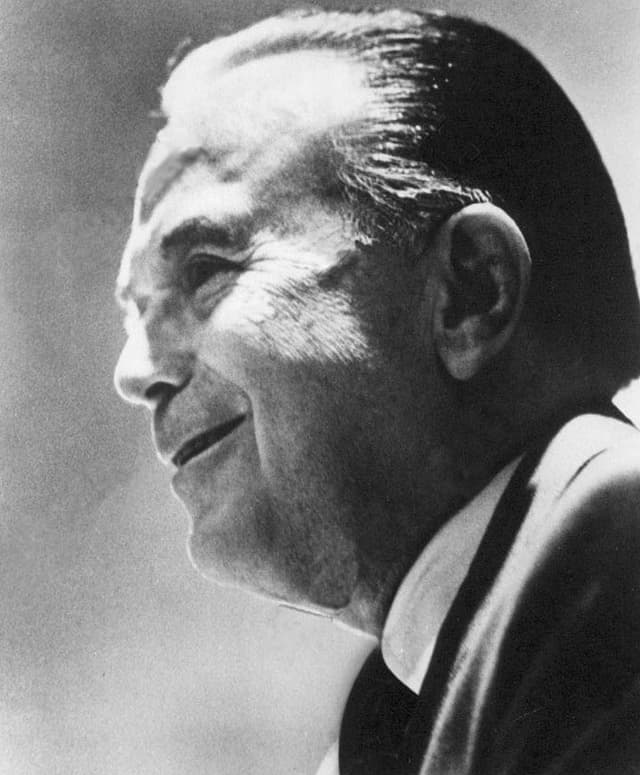
Ray Kroc
McDonald's
A relentless entrepreneur, Ray Kroc transformed the fast-food landscape by founding McDonald's, turning it into a global icon with over 40,000 locations worldwide. His belief in the power of hard work and persistence shaped his approach to business, famously asserting that talent is a myth and success stems from obsession and dedication. Kroc's commitment to detail was evident in his management style; he famously fired employees for minor infractions, believing that such discipline was essential for maintaining high standards. His journey underscores the idea that age and prior experience are not barriers to entrepreneurial success, as he achieved his breakthrough in his fifties, demonstrating that determination can lead to remarkable accomplishments at any stage of life.
Core Principles
culture
Small details are indicators of broader quality and attention. An employee's failure to maintain uniform standards (hat, shoes) signals sloppiness in thinking and execution across their work.
Ray Kroc fired an employee not merely for wearing the wrong hat or having unshined shoes, but because these were symptoms of sloppy thinking and lack of attention to standards. He believed how someone does one thing reveals how they do everything.
“I didn't like those things about the man, but those weren't the reasons I fired him. The hat and shoes were merely symptoms of his sloppy way of thinking.”
finance
Real estate control is more valuable than restaurant operation. Own or control the property underneath franchises to generate recurring revenue and ensure long-term profitability.
Harry Sonneborn and Ray Kroc shifted McDonald's from simply franchising the brand to developing and owning the real estate. This subordinated lease model allowed them to generate substantial recurring revenue from property leases and mortgages, making McDonald's a real estate company that served hamburgers.
“The agreement gave me 1.9% of the gross sales from franchisees. But the biggest revenue came from controlling the real estate.”
innovation
Embrace failure as a learning opportunity, especially in innovation. If you are willing to take big risks, you will strike out sometimes. Learn from failures rather than just cutting losses.
Ray tried several ventures that failed: a beer garden, Raymond's elegant hamburger restaurants, the Jane Dobbins Pie Tree chain, and roast beef sandwiches. He viewed these failures as valuable education about what works in McDonald's system rather than pure losses.
“That's important, because if you are willing to take big risks, and I always have been, you are bound to blow one once in a while. When you strike out, you should try to learn as much as you can from it.”
leadership
When hiring qualified people, get out of their way. If you doubt their ability, don't hire them. Micromanagement stifles strong talent and causes them to leave.
Ray Kroc hired Harry Sonneborn to handle real estate and financing, then allowed Harry to spend $300 per day on a consultant without interference. Ray believed that if you hire someone to do a job, you should let them do it rather than second-guess their methods.
“I believe that if you hire a man to do a job, you ought to get out of the way and let him do it. If you doubt his ability, you shouldn't have hired him in the first place.”
Decentralize authority to the lowest level possible. Give decision-making power to people closest to the work. Some wrong decisions will be made, but the benefits of empowered, engaged leaders outweigh occasional errors.
Ray believed strongly in decentralization, wanting store managers and regional leaders to make decisions without seeking approval from Chicago headquarters. This contrasted with Harry Sonneborn's preference for centralized control, contributing to their eventual conflict.
“Authority should go with a job. Some wrong decisions may be made as a result, but that's the only way you can encourage strong people to grow in an organization. Sit on them and they will be stifled.”
marketing
Advertising and marketing are not luxuries but necessities for growth. Quality advertising can repay its cost many times over while neglecting it can cost far more in lost opportunity.
Ray initially resisted spending $180,000 on television advertising in California in 1963, suggesting raising hamburger prices to pay for it. He was convinced to find the money through Harry Sonneborn, and the campaign was hugely successful, turning Californians to McDonald's in large numbers.
mindset
Persistence and determination are the only guarantees of success. Talent, genius, and education are common among the unsuccessful. Only persistence is omnipotent.
Ray quoted his favorite homily about persistence being more valuable than talent, genius, or education. This was the core of his philosophy and the reason he titled his autobiography 'Grinding It Out.'
“Persistence and determination alone are omnipotent. Talent will not. Genius will not. Education will not.”
Talent is a myth. Success comes from obsession and putting in the time, not from innate ability. Anyone can reach the top if they are willing to work for it.
Ray Kroc rejected the idea that he was naturally talented, instead attributing his success to obsessive dedication. He worked multiple jobs as a young man and continued this relentless pace throughout his career, arriving early to stores and staying late to ensure quality.
“There's no talent here this is hard work this is an obsession talent does not exist we are all equals as human beings you could be anyone if you put in the time you will reach the top”
Success can come late in life if you persist. Age is not a barrier to entrepreneurial achievement. Previous experience in adjacent fields builds the skills needed for breakthrough success.
Ray Kroc was 52 years old, overweight, diabetic, and missing several organs when he took over the McDonald's franchise. He had spent 30 years selling paper cups and multi-mixers before his overnight success, giving him the sales skills and business acumen to recognize and execute the McDonald's opportunity.
“When I flew back to Chicago that fateful day in 1954, I had a freshly signed contract with the McDonald's brothers in my briefcase. I was 52 years old. I had diabetes and incipient arthritis. But I was convinced that the best was ahead of me.”
Work is not a burden but a pleasure. View work as the main substance of life, not something separate from enjoyment. Passion for work is the foundation of success.
Ray Kroc saw work as play and got as much pleasure from it as from playing baseball. He would wake early to clean toilets in good suits and stayed engaged with the business even after becoming one of the richest people in America, working until his death.
“For me, work was play. I got as much pleasure out of it as I did from playing baseball.”
Recognize that an overnight success is often preceded by decades of preparation. Your prior experience and failures build the skills needed for later success.
Ray worked in sales for 30 years before McDonald's made him wealthy. His experience selling paper cups and multi-mixers taught him how to recognize opportunities, build relationships with restaurant owners, understand operations, and sell at scale.
“I was an overnight success all right, but 30 years is a long, long night.”
operations
Build from details to the whole, not the other way around. Perfect each small element before scaling. Grand designs often fail because essential details are overlooked.
Ray Kroc worked incrementally, perfecting operations at individual stores before expanding. He was obsessed with cleanliness, signage, and employee uniforms because he believed small details reflected larger systemic quality. This contrasted with visionaries like Steve Jobs who conceived complete systems.
“I work from the part to the whole, and I don't move on to the large scale ideas until I've perfected the small details.”
resilience
Don't let financial worries overwhelm you. Refuse to worry about more than one problem at a time. Sleep well so you can be sharp with customers the next day.
During the period when Ray was heavily indebted from buying out his partner Clark, he developed the ability to compartmentalize worry and get proper sleep. He believed this was essential to remaining effective as a salesman and operator.
“I refused to worry about more than one thing at a time, and I would not let useless fretting about a problem keep me from sleeping. If I didn't, I wouldn't be bright and fresh to deal with customers in the morning.”
Calculated risk-taking is essential to entrepreneurship. You must be willing to risk everything if you truly believe in your venture, but avoid recklessness. The challenge and fun of business lies in taking reasonable risks.
Ray Kroc mortgaged his home to buy out his partner Clark, then later put every asset he had as collateral for the Franchise Realty Corporation. He was willing to go into debt when he believed in the opportunity, but this was calculated rather than reckless.
“If you believe in something, you've got to be in it to the ends of your toes. Taking reasonable risks is part of the challenge. It's the fun.”
simplicity
Focus on simplicity in product and operations. Strip down to essentials, then perfect each element. This allows consistent quality across locations and makes the system replicable.
McDonald's was deliberately stripped to the minimum in service and menu, with an assembly-line approach to hamburgers, fries, and beverages. This simplicity allowed franchisees to maintain quality and allowed Ray to scale the system nationally.
“It was a restaurant stripped down to the minimum in service and menu. The simplicity of the procedure allowed McDonald's to concentrate on quality in every step, and that was the trick.”
strategy
Franchisees are partners, not customers. Avoid being a supplier to your franchisees as this creates misaligned incentives. Your success depends on their success, so help them win even if it means lower short-term sales.
Ray Kroc decided McDonald's would not be a supplier of materials to franchisees, even though this was standard practice. Franchisees bought from neutral suppliers, preventing McDonald's from optimizing for short-term supply sales at the expense of franchise profitability.
“The corporation was not going to get involved in being a supplier for its operators. I had to help the individual operator succeed in every way I could. His success would ensure my success, but I couldn't do that and at the same time treat him as a customer.”
Develop a system with uniform quality and methods. This builds brand reputation that generates repeat business regardless of individual operator quality. Requires ongoing R&D and operator education.
Ray Kroc emphasized that McDonald's would be more than a name, it would be a system with consistent quality across all locations. This required investment in research and development, staff training, and performance monitoring, which required a different business model than simple licensing.
“We wanted to build a restaurant system that would be known for food of consistently high quality and uniform methods of preparation.”
Read contracts carefully and understand all terms before signing. Poor contractual terms early on can constrain your business for years. Get proper legal representation.
Ray signed the initial McDonald's franchise agreement without his own attorney, relying on trust in the brothers. The contract's requirement for registered mail approval on any changes created massive problems and constrained his ability to adapt the business model. He later acknowledged this as foolish.
“There's an old saying that a man who represents himself has a fool for a lawyer, and it certainly applied in this instance.”
Recognize when you are being exploited in a business relationship and act decisively. Don't let misplaced trust or fear of confrontation cost you millions.
Ray realized after two years that Clark had obtained the multi-mixer license for free and was taking 60% of Ray's business unfairly. Ray negotiated to buy out Clark's share, even at an inflated price of $68,000, because he recognized the relationship was fundamentally unbalanced.
“I was boiling mad, but there was not a damn thing I could do about it.”
Control your own destiny. Build your own business rather than being dependent on others' products or companies. Changing circumstances can destroy businesses built on others' platforms.
Ray spent years selling multi-mixers, then saw the product becoming obsolete as soda fountains disappeared. This motivated him to pursue the McDonald's opportunity, giving him control over his own business model rather than being a dependent salesman.
“It was clear that Multimixer's days were numbered. I knew I had to find a new product. Preferably something that would be as innovative and as attractive as the multi-mixer had been 15 years earlier.”
Frameworks
Grinding It Out Philosophy
A systematic approach to business building that emphasizes relentless effort, incremental improvement, and persistence over talent or luck. Start with one detail at a time, perfect it, then scale. Accept that early years will involve debt, setbacks, and long hours. Success comes from consistent effort over decades, not overnight breaks.
Use case: Long-term business building when quick wins are not available. Appropriate for operators entering mature or competitive markets.
Quality Through System Standardization
Build a replicable system with detailed specifications for every operation, from equipment placement to menu items to employee uniforms. Create training programs and oversight to ensure consistency. Quality emerges not from talented individuals but from a system that any competent person can execute.
Use case: Rapid franchise expansion where centralized quality control is impossible. Consumer trust in brand consistency.
Stories
Ray fired an employee for not wearing the right hat and having unshined shoes, even though these were not stated reasons. These details revealed sloppy thinking that manifested in mistakes across his work.
Lesson: Small details in how people present themselves and attend to standards are indicators of their thinking and execution in all areas. Standards and consistency matter as cultural signals.
As a young Red Cross ambulance driver during World War I, Ray Kroc and a fellow recruit named Walt Disney both lied about their ages to enlist. Disney stayed in camp drawing pictures while others chased girls. Years later, Ray negotiated a deal to serve food at Disneyland in California.
Lesson: Unexpected connections made early in life can materialize into valuable business relationships decades later. Two young dreamers who met by chance eventually became partners in one of America's most iconic entertainment and food destinations.
Ray mortgaged his home to buy out his partner Clark's 60% stake in the multi-mixer business for $68,000, despite Clark obtaining the license for free initially. His wife Ethel was dismayed to discover they were nearly $100,000 in debt. Ray learned to compartmentalize worry and focus on sales rather than financial stress.
Lesson: Major career decisions often require financial sacrifices that strain relationships. Learning to manage psychological stress while in debt is as important as the financial strategy itself.
Ray proposed franchising McDonald's to the brothers when they declined his expansion idea, saying they preferred to sit on their porch and watch the sunset. When they hesitated, Ray quickly pivoted and offered himself as the franchisee developer, convincing them in one conversation.
Lesson: Quick thinking and willingness to change your ask can turn a rejection into an opportunity. When someone says no to your proposal, find a way to meet their actual needs rather than arguing for your original idea.
Ray signed the initial McDonald's franchise agreement without his own attorney, trusting the brothers' affability. The contract required registered mail approval for any changes, which created massive problems when he needed to modify restaurants for local conditions. Two of his own attorneys quit, saying he was insane to continue.
Lesson: Trust and verbal agreements are insufficient in complex business relationships. Detailed contracts, proper legal counsel, and clear terms protect both parties and prevent years of constraint.
During World War II, copper supplies for multi-mixer motors were restricted by the war effort. Ray had to pivot to selling malted milk powder and paper cups to survive, making it harder to pay off his debt. When the war ended, he returned to selling multi-mixers, but the industry was declining.
Lesson: External forces beyond your control can destroy even successful businesses. Success requires building on your own platform rather than being dependent on products or industries subject to disruption.
Notable Quotes
“There's no talent here this is hard work this is an obsession talent does not exist we are all equals as human beings you could be anyone if you put in the time you will reach the top”
Speaking to graduate students at Dartmouth College in 1976 about entrepreneurship, emphasizing that success comes from obsession and effort, not innate ability.
“When I flew back to Chicago that fateful day in 1954, I had a freshly signed contract with the McDonald's brothers in my briefcase. I was 52 years old. I had diabetes and incipient arthritis. But I was convinced that the best was ahead of me.”
Describing his state when starting McDonald's, emphasizing that late-life success is possible despite health challenges and age.
“For me, work was play. I got as much pleasure out of it as I did from playing baseball.”
Explaining his philosophy that work should not be separated from enjoyment, that passion for work is the foundation of success.
“If you believe in something, you've got to be in it to the ends of your toes. Taking reasonable risks is part of the challenge. It's the fun.”
Addressing graduate students on the nature of entrepreneurial risk-taking, distinguishing between calculated risks and recklessness.
“I work from the part to the whole, and I don't move on to the large scale ideas until I've perfected the small details.”
Explaining his approach to business building, contrasting his incremental style with visionaries who conceive complete systems.
“The corporation was not going to get involved in being a supplier for its operators. I had to help the individual operator succeed in every way I could.”
Describing the decision not to supply materials to franchisees, to avoid misaligned incentives.
“We wanted to build a restaurant system that would be known for food of consistently high quality and uniform methods of preparation.”
Explaining McDonald's strategy to shift from simple licensing to a quality-controlled system.
“I believe that if you hire a man to do a job, you ought to get out of the way and let him do it. If you doubt his ability, you shouldn't have hired him in the first place.”
Explaining his leadership approach when delegating to Harry Sonneborn on real estate and financing.
“Authority should go with a job. Some wrong decisions may be made as a result, but that's the only way you can encourage strong people to grow in an organization. Sit on them and they will be stifled.”
Arguing for decentralization of authority, allowing managers at the lowest levels to make decisions without approval from headquarters.
“I refused to worry about more than one thing at a time, and I would not let useless fretting about a problem keep me from sleeping.”
Describing his mental approach to managing stress and debt during the period after buying out his partner.
Frequently Asked Questions
What are Ray Kroc's key business principles?▼
Ray Kroc's core principles include: Small details are indicators of broader quality and attention. An employee's failure to maintain uniform standards (hat, shoes) signals sloppiness in thinking and execution across their work.. Real estate control is more valuable than restaurant operation. Own or control the property underneath franchises to generate recurring revenue and ensure long-term profitability.. Embrace failure as a learning opportunity, especially in innovation. If you are willing to take big risks, you will strike out sometimes. Learn from failures rather than just cutting losses.. Founder Almanac has cataloged 20 total principles from Ray's career.
What can entrepreneurs learn from Ray Kroc?▼
Key lessons from Ray Kroc include: Small details in how people present themselves and attend to standards are indicators of their thinking and execution in all areas. Standards and consistency matter as cultural signals.. Explore 6 stories and 2 frameworks from Ray's experience.
What is Ray Kroc known for in business?▼
A relentless entrepreneur, Ray Kroc transformed the fast-food landscape by founding McDonald's, turning it into a global icon with over 40,000 locations worldwide. His belief in the power of hard work and persistence shaped his approach to business, famously asserting that talent is a myth and success stems from obsession and dedication. Kroc's commitment to detail was evident in his management style; he famously fired employees for minor infractions, believing that such discipline was essential for maintaining high standards. His journey underscores the idea that age and prior experience are not barriers to entrepreneurial success, as he achieved his breakthrough in his fifties, demonstrating that determination can lead to remarkable accomplishments at any stage of life.
More Food & Restaurants Founders

Want Ray's advice on your business?
Our AI has studied Ray Kroc's biography, principles, and decision-making frameworks. Ask any business question.
Start a conversation