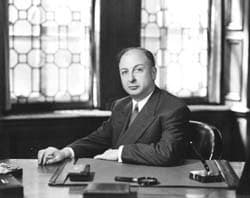
Samuel Bronfman
Seagram's (Distillers Corporation Seagrams Limited)
A visionary entrepreneur, Samuel Bronfman transformed the Seagram's brand into one of the largest distillers in the world, with revenues exceeding $1 billion by the 1970s. His keen ability to identify hidden opportunities led him to pivot from horse trading to the lucrative beverage industry, a decision inspired by the profitability of hotel bars he observed as a child. Bronfman's commitment to long-term partnerships over short-term gains fostered relationships that would solidify Seagram's dominance in the market. Notably, he embraced the challenge of mastering whiskey production despite lacking initial expertise, famously stating, "Shin, I don't know the first goddamn thing about how to make whiskey, but I'll be goddamn if I'm not going to learn." His legacy continues to inspire entrepreneurs to adapt, innovate, and prioritize trust in their business endeavors.
Core Principles
finance
Build a barbell strategy for spending: be ruthlessly frugal on things that don't matter, but invest lavishly in elements that directly impact product quality and competitive advantage.
Sam notoriously turned off lights in his office and complained about minor expenses, refusing to carry cash. Yet he would spend fortunes upgrading equipment, hiring the best advertising agencies, sourcing premium materials, and improving distilling techniques. Quality was non-negotiable; everything else was expendable.
“Son, if you got to spend money, go first class. First class in Sam's admonition was hardly restricted to advertising and indeed extended to every nook and cranny of his business.”
Build massive inventory and financial buffers to survive unpredictable external shocks that competitors cannot anticipate. Redundancy appears inefficient until catastrophe arrives.
Sam developed what he called inventory mania, constantly purchasing and aging whiskey stocks. This strategy seemed wasteful during normal times but proved invaluable when World War II arrived. The Canadian government commandeered distilleries for military production. Competitors without reserves collapsed, while Sam's stockpiled aged whiskey allowed him to maintain product quality and market share, wiping out competitors who couldn't recover.
“Inventory wins them all was one of his favorite remarks. A strategy that served him well years later when despite a worldwide shortage of scotch, he was able to draw upon long-aged quality whiskeys.”
Be willing to make bold moves and major acquisitions when unique opportunities align with your long-term strategy. Use leverage strategically when you have superior knowledge and information.
After establishing his position in spirits, Sam borrowed $75 million in 1963 to acquire Texas Pacific, putting down $50 million on a $266 million purchase price. He structured the deal so future revenues would pay the balance. By 1975 the company had paid off debt. When his heirs sold it in 1980, it was worth $2.3 billion, a 9-fold return in 17 years.
“Bought with only $50 million in borrowed cash, it was sold by his heirs in 1980 for $2.3 billion.”
leadership
Communicate company values through clear principles to employees, emphasizing unrelenting standards and constant improvement. Attack opportunities with full force rather than cautious retreat.
Sam's sales philosophy statement read: When you attack, attack vigorously and never give up until you win. Go all out. Do not keep your foot on first base, ready to retreat in case you fail. To production teams he repeated: The best whiskey has not yet been made. This constant message to improve standards and never accept current achievement pushed the entire organization forward.
“When you attack, attack vigorously and never give up until you win. Go all out. Do not keep your foot on first base, ready to retreat in case you fail. The best whiskey has not yet been made.”
Lead as a generational inflection point. Make decisions not for your own wealth but to establish a family dynasty and legacy that compounds for generations.
Sam was not motivated by personal luxury or spending. His obsession was building something that would outlast him and enrich his family for generations. He deliberately designed the company for his sons to inherit and operate. His note to his son Charles reflects this: the story of building the company is partly the story of my life, lived brick by brick, with branches representing children, grandchildren, and all the people in his organization.
“This story of the building of our company is also partly the story of my life, but with one of the lessons of my dear parents, to be steadfast and true, and to build my life brick on brick.”
When dealing with highly driven, intense leaders, push back respectfully when you disagree. They respect competence and backbone more than deference.
An employee showed Sam advertising aimed at blue-collar workers. Sam dismissed it harshly. The employee replied that the ads weren't designed to be liked by multi-millionaires. Sam flushed with anger, but the employee held his ground: if I wasn't smart, I wouldn't be working for you. Sam smiled, approved the campaign, and the employee reported having no problems with him for the next 13 years.
“You think you're pretty goddamn smart, don't you? Mr. Sam, if I wasn't smart, I wouldn't be working for you. Sam looked at his employee, smiled, and said, okay, run them.”
marketing
Reposition commodities as luxury products by controlling the narrative through advertising and association. Build prestige and brand perception rather than competing on price.
After prohibition repeal, whiskey was associated with poor people in grimy bars. Sam repositioned Seagram's as a luxury product sipped in London gentlemen's clubs by cultured people. His advertising emphasized Canadian government supervision, aged quality, and responsible consumption. He launched the Drink Moderately campaign positioning whiskey as part of fine living rather than excess.
“The selling power of prestige has always been and continues to be the basic idea behind all of your company's advertising. Every Seagram advertisement is designed primarily to accomplish one thing, to sell Seagrams, and not just whiskey, to sell the fundamental principles of the House of Seagram, the craftsmanship, the traditions, the experiences, the quality, and the prestige.”
mindset
Cultivate relentless ambition and focus to the exclusion of other interests. Channel anxiety and shame from early hardship into tireless work and perfectionism.
Sam had no interests outside family and business. He was described as literally sprouting ideas, writing them on scraps of paper, his wife calling him a walking loose-leaf notebook. His childhood shame of poverty in torn clothes drove him to build an empire where his children would never experience want. This singular focus became his greatest competitive advantage.
“Business was Sam's sole preoccupation. Besides his business, Sam had few interests. He never liked to do anything that he didn't do well. He had a restless ambition. He lavished attention on the smallest details.”
Maintain relentless curiosity and ask questions without ego, even questions that appear basic. Continuous learning and information gathering compound into competitive advantage.
Sam would visit operations across 20 countries and ask frontline workers extensive questions, unconcerned about appearing ignorant. Employees admired his willingness to ask what seemed like dumb questions because he genuinely wanted to understand why things were done certain ways. This pattern of learning and questioning defined his entire career.
“This guy's asking some of these questions he was asking would seem like a dumb question. He doesn't care about looking stupid. He wants to collect a ton of information. And then he also wants to think, he wants to know why you're doing what you're doing to make sure you understand it.”
Develop a personal curriculum of self-education that continues throughout your life. Prioritize reading, biographies, history, and learning from practitioners in your field.
Sam never completed high school but invested enormously in self-education. He read business papers every night, studied biographies, history, and poetry. He could quote reams of poetry by heart. He respected learned people and industrialists who had succeeded, ranking them as the most worthy of respect. His education continued accelerating as his business grew.
“Never having completed high school, Sam put great energy into self-education, much of it centering on literature. Sam was constantly reading. Besides the business papers he brought home every night, he enjoyed good books, biographies, history, and poetry.”
Bet on yourself when you lack domain expertise. Commit fully to learning from the best practitioners, treating ignorance as an advantage rather than a liability.
Sam knew nothing about whiskey distilling when he decided to enter the spirits business. Rather than hiring consultants, he lived at a Kentucky distillery for two years, studying every detail from milling and yeast to barrels and bottling. He treated his ignorance as freedom to learn without preconceptions.
“Shin, I don't know the first goddamn thing about how to make whiskey, but I'll be goddamn if I'm not going to learn. It was probably the best thing for me that I didn't know anything about distilling. I lived at the distillery for two years.”
product
Obsess over product quality as your primary competitive advantage and distribution strategy. Make quality non-negotiable across every phase of production, and refuse shortcuts that threaten long-term reputation.
In a business environment where corners were cut, Sam was known as a fanatic for quality. He personally paid attention to every detail from grain selection to packaging, and would spurn shortcuts despite short-term profit pressure. His son noted he would lavish fortunes to upgrade equipment or improve techniques rather than compromise quality.
“I paid personal attention to every aspect of the production process, to grains, to water and yeast, to milling, to cooking procedures and temperatures, to fermenters, to stills and distilling techniques, to barrels used to manufacturing whiskey, to packaging and bottling.”
strategy
When entering a newly opened market after competitors, wait for the market to stabilize before entering with your superior product. Let competitors establish cheap expectations, then elevate the category with quality.
After prohibition repeal, competitors rushed to market with unaged, low-quality whiskey. Sam waited a year, allowing Americans to become accustomed to poor quality at low prices. He then released his decade-aged whiskeys at premium prices backed by aggressive advertising. The quality gap was so dramatic that demand exceeded expectations, and surveys showed more people claimed to drink Seagram's than actually purchased it, indicating brand prestige.
“We realized from the very beginning that the industry must build itself on a class basis.”
Prioritize long-term relationships and trust over short-term profit maximization. Forgo immediate gains when building strategic partnerships that will compound in value over years and decades.
When Hudson Bay Company desperately needed inventory and offered above-market prices, Sam refused the windfall. Instead, he said he only wanted them to repay the same quantity later, prioritizing a relationship with the massive company over immediate profit. This built trust that benefited him for years.
“I don't want your money, he said. Just let me have the same amount back as soon as you can. His point was that it was foolish to capitalize on his momentary advantage. With his eye on the long run, Sam wanted a relationship of trust with the mighty Hudson Bay Company.”
Learn from the best by finding geographies and practitioners that possess unique, concentrated expertise in your field. Establish partnerships with masters rather than trying to replicate their knowledge independently.
Sam recognized that Scotland possessed centuries of whiskey-making expertise that couldn't be replicated elsewhere. Rather than attempting to build that knowledge in-house, he traveled to Scotland, studied their techniques, and eventually partnered with DCL, which controlled over half the global Scotch whiskey trade. He also studied with master Kentucky distillers.
“Scotland was where Sam saw his opportunity. His dream was to make blends of whiskey, similar in character to what was manufactured in Scotland, to sell throughout Canada and then to export, just as the Scots were doing around the world.”
Respond to adversity by identifying hidden opportunities within constraints. When obstacles block your primary strategy, systematically explore legal loopholes and adjacent markets that competitors overlook.
When temperance movements threatened the hotel and bar business, Sam didn't fight the trend. Instead, he identified that federal law permitted interprovincial liquor trade while provinces restricted local sales. He pivoted to mail-order liquor distribution across provinces, then eventually to export houses. Each legal constraint led him to discover a new business model.
“And as Sam saw it, their greatest challenge to date. And that's another theme that we see over and over again. Every single book that, that I've talked to you about, it's not, the person doesn't wake up, starts a business and nothing happens. It's, it's great depressions. It's war. It's, it's all kinds of extremely difficult things outside of your control that you're gonna have to engage with and overcome.”
Build brick by brick, scaling deliberately through a staircase of progressively larger opportunities. Each step solved enables you to see the next opportunity you couldn't see before.
Sam's progression illustrates this perfectly: he started with fuel and fish businesses, moved to hotels and bars, then mail-order liquor, then provincial trade, then export houses, then blending, then manufacturing, then dominating American markets. Each step opened capital and knowledge that enabled the next, larger opportunity.
“I build brick by brick. Ten years after the first foundations were laid in Montreal, Sam could look with pride at the edifice that he had constructed.”
Frameworks
The Staircase of Opportunity
Each business stage creates the capital, knowledge, and networks required to see and pursue the next larger opportunity. Rather than trying to jump directly to your ultimate vision, focus on the immediate step that is achievable with your current resources. Once that step generates surplus capital and domain knowledge, it reveals the next step previously invisible. This creates a progression of exponentially larger opportunities.
Use case: When you're starting a business with limited capital and are unclear about how to reach your long-term vision. Build the immediate, achievable step, then let success reveal the next logical progression.
The Barbell Strategy for Spending
Allocate spending across two extremes: ruthless frugality on everything that doesn't directly impact competitive advantage or product quality, and lavish investment in the few areas that define your differentiation. Reject middle-ground spending. The goal is to accumulate capital by being cheap on non-essentials while dominating in the areas that matter.
Use case: When you're building a business and need to allocate limited capital strategically. Identify the 2-3 areas that directly impact your competitive advantage, and spend without limit there. Cut everything else ruthlessly.
Reposition Commodity to Luxury Through Narrative Control
When entering a mature commodity market, don't compete on price. Instead, control the narrative about your product through advertising and association. Reposition the category itself as a luxury good associated with refined taste, quality, and prestige rather than necessity or excess. Use advertising to establish standards that elevate the entire category while locking in premium pricing.
Use case: When you have a superior product but are entering a market dominated by cheap commodity versions. Use advertising and brand positioning to change how consumers perceive the entire category, allowing premium pricing.
Inventory Mania for Crisis Resilience
Build massive reserves of inventory, capital, and supplies that appear inefficient during normal times but provide survival advantage when unpredictable external shocks arrive. Create redundancy throughout your business: excess inventory, excess cash, excess capacity. These buffers cost money in the short term but compound into competitive advantage when industry disruption occurs.
Use case: When you're in a stable market but recognize that unpredictable shocks (war, regulation, economic crisis) are inevitable. Invest in reserves and redundancy that competitors will mock as inefficient until crisis arrives.
Think Big and Appeal to Interest
When approaching a much larger, more powerful partner or competitor, don't think small. Present a vision that is genuinely valuable to them, appealing to their interests and long-term advantage rather than asking for favors. Frame your proposition as a mutual opportunity they don't want to miss.
Use case: When you need to negotiate with partners or customers much larger than your company. Present a vision and opportunity that is compelling to them on business terms, not on your need.
Stories
At age ten, while working at the family horse trading business, Sam observed that the hotel bar generated more profit than horse sales. He proposed to his father: forget horses, let's sell drinks instead. His father agreed, and the family pivoted to the hotel business. This insight came from direct observation of business fundamentals, not from schooling.
Lesson: Pay attention to where the real profit margins are in your ecosystem. Direct observation of customer behavior and financial flows often reveals better business opportunities than your current focus.
During a negotiation for a hotel near a lumber camp, the local mayor also wanted to purchase it. Rather than wait for the owner to return from the camp, Sam traveled six days by dog sled in cold, hunger, and discomfort to meet the owner directly. He made the deal because he wanted it more than the mayor. This willingness to endure suffering for the prize revealed Sam's ruthlessness.
Lesson: When you want something badly enough, you'll endure suffering that others won't. That willingness to suffer is what separates you from competitors. Out-desire your competition.
Sam refused an above-market price offer from Hudson Bay Company when they desperately needed inventory. He said he only wanted them to repay the same quantity later with no payment. Hudson Bay was shocked but agreed. This act of restraint built such deep trust that it became a long-term partnership benefiting Sam for years.
Lesson: Foregoing short-term profits to build trust with powerful partners pays exponential dividends over time. The temporary advantage you don't exploit becomes the permanent relationship you gain.
Sam traveled through the American South during prohibition, ostensibly on vacation with his wife, but actually scouting distilleries, studying whiskey production, and interviewing unemployed whiskey makers. He was gathering knowledge about an industry he planned to enter, understanding that when prohibition ended, the demand would be massive and he'd need that expertise.
Lesson: Use every interaction and journey as a learning opportunity. Scout your target market even before you enter it. Build knowledge networks before you need them.
When asked what he knew about whiskey distilling, Sam replied: I don't know the first goddamn thing about how to make whiskey, but I'll be goddamn if I'm not going to learn. He then moved to a Kentucky distillery for two years, studying every detail of production. His ignorance freed him from preconceptions and his commitment ensured mastery.
Lesson: Ignorance is an asset when paired with commitment to learning. Not knowing how something is supposed to be done frees you to learn from first principles and potentially do it better.
After building Seagram's into a dominant force through prohibition and repeal, Sam approached the massive DCL company, which controlled over half the world's Scotch whiskey trade. He pitched a partnership to make Scotch-type whiskey in Canada and dominate North America. He appealed to their interests: a massive untapped market opportunity. They agreed, transforming Sam's company.
Lesson: When you need to partner with a giant, frame the opportunity in terms of what is valuable to them, not what you need. Appeal to their self-interest and the market opportunity, not your ambition.
After prohibition was repealed in 1933, competitors rushed to market immediately with unaged, low-quality whiskey. Sam waited an entire year before entering with Seagram's. In that year, Americans became accustomed to poor quality at low prices. When Sam finally entered with decade-aged whiskeys at premium prices, the quality gap was so dramatic that demand exceeded expectations. Surveys showed more Americans claimed to drink Seagram's than actually purchased it, indicating the prestige he'd built.
Lesson: Patience in market entry can be more valuable than speed. Let competitors establish cheap baseline expectations, then enter with superior quality to completely reset market perceptions and pricing.
During World War II, the Canadian government conscripted distilleries to produce alcohol for military goods. Competitors without massive reserves collapsed because they couldn't produce whiskey or age new inventory. Sam had spent years building stockpiles that others called wasteful. While competitors failed, Sam maintained product quality from reserves and captured their market share permanently.
Lesson: Redundancy and reserves appear wasteful until crisis arrives. Build buffers that competitors mock as inefficient, and you will dominate when unpredictable shocks occur.
An employee showed Sam advertising aimed at blue-collar workers. Sam dismissed it harshly. The employee replied: they weren't designed to be liked by multi-millionaires. Sam flushed with anger but the employee held his ground, saying if I wasn't smart, I wouldn't be working for you. Sam smiled and approved the campaign. That employee worked for him 13 more years without conflict.
Lesson: When working for or with intense, driven people, they respect competence and backbone more than deference. Push back respectfully when you disagree, demonstrate your intelligence, and they'll respect you more than if you simply complied.
Sam refused to spend money on personal luxury despite becoming wealthy beyond imagination. He wouldn't carry cash, complained about minor office expenses, turned off lights. Yet he would spend fortunes on distillery equipment, hire the best advertising agencies, and source premium materials. His son noted: most people would waste money on luxuries. Sam wasted nothing except on the things that actually mattered.
Lesson: Apply a barbell strategy to spending: be ruthless about everything except the 2-3 areas that define your competitive advantage. Spend lavishly there, cut everything else ruthlessly.
Notable Quotes
“Shin, I don't know the first goddamn thing about how to make whiskey, but I'll be goddamn if I'm not going to learn.”
When questioned about his audacity in entering the whiskey business despite having no distilling experience. He responded with characteristic intensity, demonstrating his willingness to learn and his absolute commitment to mastery.
“I don't want your money. Just let me have the same amount back as soon as you can.”
Responding to Hudson Bay Company's offer to pay above-market prices for scarce inventory. Sam prioritized building a long-term relationship of trust over short-term profit exploitation.
“I build brick by brick.”
Sam's philosophy of deliberate, sequential business building. This became his operating principle throughout his career, describing how he scaled from small operations to a global empire.
“The best whiskey has not yet been made.”
Recurring message to his production teams, emphasizing that current achievement was never sufficient and that continuous improvement was mandatory. This drove constant innovation and quality improvement.
“When you attack, attack vigorously and never give up until you win. Go all out. Do not keep your foot on first base, ready to retreat in case you fail.”
Sam's sales philosophy communicated to his sales teams. It emphasized unrelenting aggression and commitment once you decided to pursue an opportunity.
“Son, if you got to spend money, go first class.”
Advice to one of his advertising men. Sam embodied a barbell spending strategy: be ruthlessly frugal on everything except the few areas where spending directly impacts competitive advantage.
“I paid personal attention to every aspect of the production process, to grains, to water and yeast, to milling, to cooking procedures and temperatures, to fermenters, to stills and distilling techniques, to barrels used to manufacturing whiskey, to packaging and bottling.”
Sam describing his hands-on approach to quality control and product development. This demonstrated his obsessive attention to detail across every phase of operations.
“Inventory wins them all.”
One of Sam's favorite remarks, expressing his belief in maintaining massive reserves of inventory. This strategy proved invaluable when World War II forced production shutdowns and created whiskey shortages.
“The selling power of prestige has always been and continues to be the basic idea behind all of your company's advertising.”
Sam's core marketing philosophy communicated to shareholders. He understood that true competitive advantage came from brand prestige and perception, not just product quality.
“We realized from the very beginning that the industry must build itself on a class basis.”
Sam's positioning strategy after prohibition repeal. Rather than compete on price like competitors, he decided to reposition whiskey as a luxury product for refined consumers.
Frequently Asked Questions
What are Samuel Bronfman's key business principles?▼
Samuel Bronfman's core principles include: Build a barbell strategy for spending: be ruthlessly frugal on things that don't matter, but invest lavishly in elements that directly impact product quality and competitive advantage.. Build massive inventory and financial buffers to survive unpredictable external shocks that competitors cannot anticipate. Redundancy appears inefficient until catastrophe arrives.. Be willing to make bold moves and major acquisitions when unique opportunities align with your long-term strategy. Use leverage strategically when you have superior knowledge and information.. Founder Almanac has cataloged 17 total principles from Samuel's career.
What can entrepreneurs learn from Samuel Bronfman?▼
Key lessons from Samuel Bronfman include: Pay attention to where the real profit margins are in your ecosystem. Direct observation of customer behavior and financial flows often reveals better business opportunities than your current focus.. Explore 10 stories and 5 frameworks from Samuel's experience.
What is Samuel Bronfman known for in business?▼
A visionary entrepreneur, Samuel Bronfman transformed the Seagram's brand into one of the largest distillers in the world, with revenues exceeding $1 billion by the 1970s. His keen ability to identify hidden opportunities led him to pivot from horse trading to the lucrative beverage industry, a decision inspired by the profitability of hotel bars he observed as a child. Bronfman's commitment to long-term partnerships over short-term gains fostered relationships that would solidify Seagram's dominance in the market. Notably, he embraced the challenge of mastering whiskey production despite lacking initial expertise, famously stating, "Shin, I don't know the first goddamn thing about how to make whiskey, but I'll be goddamn if I'm not going to learn." His legacy continues to inspire entrepreneurs to adapt, innovate, and prioritize trust in their business endeavors.
More Food & Restaurants Founders
Want Samuel's advice on your business?
Our AI has studied Samuel Bronfman's biography, principles, and decision-making frameworks. Ask any business question.
Start a conversation