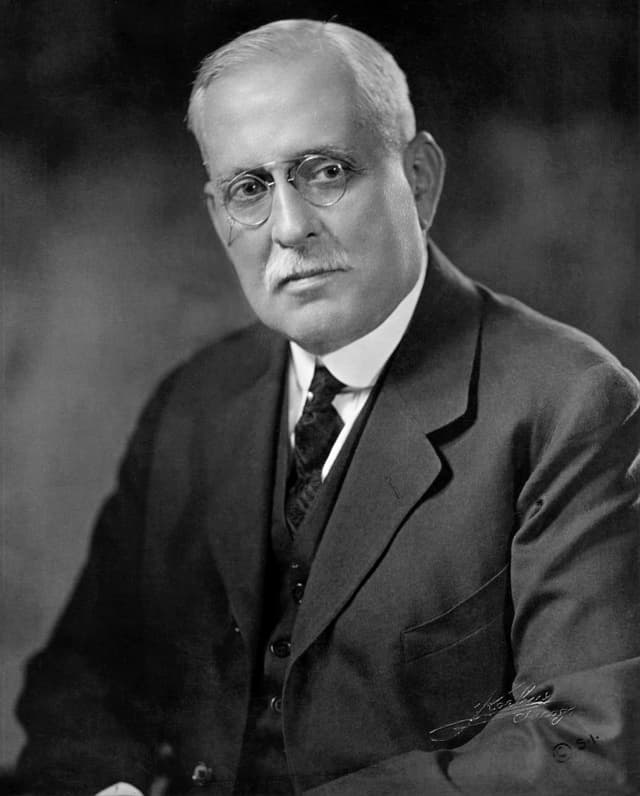
Samuel Insull
Chicago Edison Company
A pioneer in the oil and energy sector, Samuel Insull transformed the landscape of electric utility services in the early 20th century. After a setback at age 19, he redirected his career towards innovation and efficiency, ultimately founding the Chicago Edison Company, which fueled the city's rapid electrification. Insull's vision led to a dramatic reduction in electricity costs, famously stating, "We will make electric lights so cheap that only the rich will be able to burn candles," a testament to his commitment to making energy accessible. By mastering every aspect of his business and focusing on exceptional service, he built influential networks that propelled his company's growth and expanded opportunities in the burgeoning electric utility industry. Today, entrepreneurs can draw inspiration from Insull's principles of hard work, skill mastery, and the strategic handling of opportunities to cultivate lasting success.
Core Principles
culture
Treat workers generously and humanely for sound economic reasons, not sentimentality. Discontent breeds stoppages, and stoppages are inefficient, irrational, and costly.
Insull pioneered welfare programs years before most businesses took significant steps in this direction. He treated workers well not from emotional benevolence but because he understood that labor unrest disrupted operations and increased costs. This approach reduced friction and kept his plants operating efficiently during periods when competitors faced constant labor problems.
finance
Use financial instruments creatively to overcome resistance to capital requests. Reframe proposals to make large asks seem smaller and less threatening.
When the board refused Insull's request for $100 million in bonds, an advisor suggested he ask for an open-ended mortgage with no specified limit instead. This reframing made the request seem more conservative, and the board approved it. Over time, Insull issued half a billion dollars in bonds under this structure, five times the original request they had rejected.
Understand that leverage is addictive. Once you profit from leverage, few people retreat to more conservative practices. Excessive leverage can destroy brilliant careers when credit conditions change.
Insull began his career using leverage modestly to finance expansion. His early borrowing proved profitable and he expanded more aggressively. By the late 1920s, he had become addicted to leverage, borrowing $200 million in 1930 alone during the Great Depression. When banks could no longer refinance his debt, his entire empire collapsed, turning a $150 million personal fortune into bankruptcy and indebtedness.
Never pay cash when you can give a note. Use leverage to accelerate growth and expansion when you have confidence in future cash flows and expansion.
Insull made borrowing a deep-rooted habit early in his career. When Edison asked him what salary he wanted, Insull said, 'Pay me whatever.' He was more focused on proving his worth than extracting maximum immediate compensation. This borrowing habit allowed him to expand aggressively, but it also became the fatal flaw that destroyed his empire when credit conditions tightened.
“Never pay cash when you can give a note.”
focus
Focus on your core industry and resist diversification if you have superior understanding of your market. Deeper knowledge of one industry compounds advantages far more than spreading attention across many.
While competitors diversified into unrelated businesses, Insull remained focused on electricity for 53 years. He understood the electricity market's potential far better than competitors. His most optimistic competitors estimated a maximum of 25,000 customers in Chicago, while Insull correctly anticipated a market of millions. He vertically integrated within electricity (buying equipment manufacturers and traction companies) but never pursued unrelated businesses.
hiring
Build a position by acquiring valuable assets (equipment, customers, talent) that strengthen your competitive moat. New properties can be more valuable than cash for acquiring executives and infrastructure.
When Insull acquired competitors, he wasn't just buying equipment and customers. He was acquiring talented people who could help him operate and expand. New properties became the most prolific producers of executives within his organization. This approach, similar to Rockefeller's strategy, turned acquisitions into leadership pipelines.
leadership
Service first builds relationships with powerful people. Rather than asking for favors, work excessively hard to provide value and gradually earn access to influential networks.
Insull gained proximity to Thomas G. Bowles, editor of Vanity Fair, by volunteering to work as his nighttime stenographer without pay. He would work his full-time day job, then transcribe Bowles' notes at night, sleep four hours, and deliver materials to printers before his next job. This service-first approach eventually connected him to Edison's chief engineer and led to his role as Edison's private secretary.
marketing
Educate your customers about the value and complexity of your product. Most customers cannot judge service and rates when they know nothing about the details involved in delivery.
Insull established a public relations department and published Electric City magazine, distributed free to tens of thousands. He made public appearances constantly to educate customers about the electricity business. He understood that customers who understood the complexity of generating and distributing electricity would value the service more highly and support favorable regulation.
“Unless you conduct your business as to get the goodwill of the community in which you are working, you might as well just shut up shop and move away.”
Create visibility through rate cuts and operational improvements. Customers and the press will provide free advertising when you deliver tangible value like lower prices.
The most effective public relations tool Insull employed was not advertising but voluntary rate cuts. When he reduced prices, newspapers covered the story extensively, creating publicity he couldn't have purchased. This mirrored Henry Ford's strategy: instead of paying for ads, constantly improve operations and reduce prices, letting the market provide free publicity.
The moment of applause is the moment for action. When you have public goodwill and support, use it immediately to advance your strategic agenda before sentiment shifts.
Insull understood public relations deeply. When he was popular with the public due to falling electricity rates, he initiated the movement for utility regulation in the United States. He recognized that public goodwill was a temporary asset to be used strategically. He pushed regulatory frameworks during his moment of highest popularity, securing favorable structures before attitudes could change.
“The moment of applause was the moment for action.”
mindset
Absorb information systematically and commit it to memory. Develop the ability to read through large volumes of material quickly, identify key assumptions and generalizations, and assimilate important details.
Insull had a gifted deductive mind that allowed him to race through large quantities of reading material, perceive important assumptions, and thoroughly assimilate salient details. He would systematically go through every scrap of paper in the office about Edison's business and commit it to memory. When Edison's chief engineer arrived from America, Insull knew more about Edison's European business affairs than the manager did.
Opportunity handled well leads to more opportunity. Excel at your current task, no matter how small, because demonstrated competence creates the foundation for advancement.
Insull became an expert stenographer, which caught the attention of his employer's connections and led to work with Thomas Bowles. This small success led to work with Edison's chief engineer, which eventually landed him a position as Edison's private secretary at age 21.
“Opportunity handled well leads to more opportunity.”
Completely lack the sense of caution that doubt brings. Doubting yourself is dangerous and can prevent you from attempting things that might otherwise succeed.
Insull had a trait that was absolutely unable to imagine the possibility of his own failure. He entirely lacked the sense of caution of those who doubt themselves. His family and friends warned him not to leave England for America without knowing his job or salary, but his conviction was absolute. This confidence enabled his early successes but also contributed to his failure to take precautions against the Great Depression.
“He was absolutely unable to imagine the possibility of his own failure.”
Do everything and you will win. Master every skill available to you, even small ones, because mastery of current tasks opens doors to bigger opportunities.
As a teenage office boy, Insull didn't just file papers. He became an expert stenographer by practicing nights and weekends. He then taught himself bookkeeping by purchasing courses and keeping imaginary double-entry books to practice. Each skill he mastered made him more valuable and attracted better opportunities.
“Do everything and you will win.”
Develop the ability to concentrate on a single subject and completely shut out everything else, no matter how pressing. Focus is increasingly rare and powerful.
Insull learned to concentrate completely on whatever task was in front of him, filtering out distractions. Combined with his demonic energy and work ethic, this focus made him extraordinarily productive. He would systematically go through documents and internalize them completely, or work through a problem until it was solved, regardless of competing demands.
operations
Systematize and render efficient whatever you deal with. Build systems that improve operations and reduce waste in every aspect of your business.
Insull was brought into Edison's company to systematize the business around the inventor. He learned to systematize and render efficient whatever he dealt with. Later, people would bring him into other companies knowing he could build systems to make every operation more efficient without needing to manage Edison's creative process directly.
Spread fixed costs as thinly as possible through diversification and vertical integration of related operations. Keep plants busy by expanding into complementary businesses that use the same infrastructure.
Insull bought equipment manufacturing companies that his generating stations needed to purchase from. He acquired electric traction companies (trolleys) that used electricity. This vertical integration wasn't about diversification for diversification's sake. It was about filling unused capacity in his plants and distribution network, effectively spreading his massive fixed costs across more revenue-generating activities.
resilience
Beware the trap of past success. If you have survived multiple financial crises with profitability intact, you may incorrectly assume future crises will be similar. Each downturn can be fundamentally different.
Insull had weathered multiple financial panics (1893-1894, 1907, etc.) and had prospered during some of them. When the Great Depression began, he called to the White House with other businessmen and was told to conduct business as usual. Believing this crisis was like previous ones, he continued heavy borrowing and expansion when he should have contracted. This wrong lesson from history proved fatal.
strategy
Acquire competitors strategically, prioritizing the largest and most threatening. This creates market leadership and eliminates the strongest competition quickly rather than gradually.
In his first year as Chicago Edison's president, Insull bought the second-largest competitor. Three months later, he bought the first-largest competitor. This followed the strategy of John D. Rockefeller in oil: knock out the top competitors quickly rather than gradually acquiring smaller rivals. This created a dominant position that made subsequent acquisitions easier.
Turn a luxury product into a necessity by making it universally cheap and abundant. This requires scale, low prices, and a business model that spreads fixed costs across the largest possible customer base.
Insull's fundamental insight was that electricity should not be a luxury product for the rich but a necessity for everyone. He famously said, 'We will make electric lights so cheap that only the rich will be able to burn candles.' He achieved this by building monopolies that allowed him to invest in large generating plants and spread fixed costs across millions of customers, enabling him to cut prices constantly.
“We will make electric lights so cheap that only the rich will be able to burn candles.”
Use money to turn enemies into neutral parties. Pay defeated competitors more than their assets are worth to prevent them from becoming adversaries.
When smaller electric stations in Chicago failed during financial difficulties, Insull paid them more for their plants than they were worth. This was not benevolence but calculated strategy. He recognized that while money may not buy friends, it prevents people from becoming enemies. Competitors who were treated generously in defeat were less likely to create problems for his growing monopoly.
“Money may not buy friends, but it will keep many a man from becoming an enemy.”
Sell products at prices so low that they create volume to justify the investment in infrastructure and scale. This requires deep confidence in your ability to reduce unit costs through volume.
Insull sold electricity at rates so low that they appalled other utility operators. He believed that lower prices would bring greater volumes, which would lower unit costs and yield greater profits. He proved this belief correct by constantly cutting rates as his scale increased, making electricity so abundant and cheap that it became a necessity rather than a luxury.
“Sell electricity at rates so low that they appalled other Central Station men.”
Frameworks
Industry Building vs. Company Building
Insull understood that building the electricity industry required more than just operating companies efficiently. He had to invent products (switches, sockets, cables, fuses, meters, filaments), create manufacturing industries to make them, establish engineering organizations to install them, and build a central station industry to operate them. This required integrating vertically across the entire supply chain, not just optimizing a single business unit.
Use case: When entering nascent industries where the entire ecosystem must be built simultaneously. Infrastructure, utilities, and foundational businesses benefit from this framework.
Massing Production (later Mass Production)
Insull described his approach as massing production: accumulating large-scale operations that reduced unit costs through volume, complexity, and efficiency. Publishers shortened the term to mass production, and historians later mistakenly attributed the concept to Henry Ford. The framework involves building the largest possible scale of operations to drive down per-unit costs, then passing those savings to customers through lower prices.
Use case: When trying to democratize access to expensive products or services. The framework works when demand is price-elastic and when achieving scale creates meaningful cost advantages through operational efficiency.
Public Relations Principles for Utilities
Insull formulated two rules for public relations in regulated industries: First, produce the best possible service at the lowest predictable rates because that is the greatest interest to the public. Second, ensure the public is well-informed about the tangible details and complexity involved in furnishing the service. This education increases customer appreciation for the service and builds support for favorable regulation.
Use case: In regulated industries where public opinion influences regulatory decisions. Also applies to B2C businesses where customer understanding of complexity creates value perception.
Stories
At age 19, Insull was fired from his position at an auctioneer firm when the company's largest customer demanded his son get the job. Crushed initially, Insull quickly pivoted to a new position with Colonel George, the European representative of Thomas Edison. Had he not been fired, he would never have gotten close to Edison's organization. This seemingly catastrophic setback was actually the beginning of his meteoric rise.
Lesson: Seemingly negative events can redirect you toward better opportunities if you respond with energy and optimism rather than despair. Loss of one opportunity often opens doors you didn't know existed.
Insull volunteered to work without pay as Thomas Bowles' nighttime stenographer four nights a week from 8 PM to midnight. He would then sleep four hours, wake at 4 AM to transcribe his notes, deliver them to the printer, and arrive at his day job. This extreme service allowed him to build a relationship with one of England's most connected men, eventually introducing him to Edison's chief engineer. When his friends told him he was crazy, he proceeded anyway.
Lesson: Service without immediate compensation can create valuable relationships with powerful people. Excessive effort combined with genuine value delivery builds loyalty and opens doors that money alone cannot open.
When Edison's private secretary suddenly resigned and Johnson was trying to figure out how to recommend Insull, Insull was not idle. During the waiting period of uncertainty, he reread all of Edison's European contracts and wrote weekly letters to Johnson summarizing fluctuations in the telephone business and outlining Edison's shifting interests. These letters proved to be the best selling points Johnson could use to recommend Insull. While others would have simply waited, Insull was providing continuous value.
Lesson: During periods of uncertainty when waiting for an opportunity, continue providing value to the people who control that opportunity. Your unsolicited contributions can become your strongest recommendation.
In his first year as president of Chicago Edison, Insull announced he would make the company bigger than General Electric. Everyone laughed except him. Within six years, his company's stock had risen from $25 to $150 per share, and he had grown employees from 200 to 6,000. He was not joking or boasting. He believed in his ability to achieve what others thought was impossible.
Lesson: Confidence in your vision, stated clearly and believed completely, guides your decisions and helps others align with your ambitions. The boundary between visionary and delusional is often just whether the vision is achievable and backed by competence.
Insull's mother told him to take the Chicago Edison job that he felt guilty accepting. When he expressed hesitation about recommending himself as the best available man, his mother responded, 'Did they not ask him in his capacity with the General Electric to recommend the best available man? Well, then was he not the best available man?' This simple reframing removed his doubt and he accepted the position immediately.
Lesson: Remove artificial humility from your self-assessment. If you have demonstrated superior capability, acknowledging this fact is not arrogance but accuracy.
Insull estimated the potential market for electricity in Chicago to be essentially everyone who lived there. Most optimistic competitors estimated maybe 25,000 customers maximum. Insull was off on his estimates by a factor of perhaps 10 or 15, but his competitors were off by a factor of 40. This massive difference in market understanding drove his willingness to invest in infrastructure that competitors thought was insane.
Lesson: Understanding your market size at orders of magnitude larger than competitors gives you different capital allocation and investment priorities. This is how you build dominant positions.
Insull went through every scrap of paper in Edison's office about his European operations and committed most of it to memory. When Edison's chief engineer arrived from America, he found that Insull knew more about Edison's European business affairs than Colonel George, the official manager. This comprehensive knowledge of the business ecosystem became invaluable when he needed to advise Edison on which assets to sell.
Lesson: Complete knowledge of your industry and company creates opportunities to provide value that others cannot. The ability to synthesize large amounts of information into actionable insights is rare and valuable.
Insull borrowed $200 million in 1930 alone, the year after the stock market crash. He opened an expensive new Civic Opera House, began a $80 million natural gas pipeline project, and bought out a corporate raider's stock holdings with borrowed money. He structured these loans in complex ways, secured by holding company stocks that were rapidly losing value. As the market declined, the collateral deteriorated and bankers demanded more equity.
Lesson: Leverage becomes exponentially dangerous in declining markets. Each drop forces more collateral to be posted, which creates a negative feedback loop of selling assets at declining prices to meet margin calls. The structure of leverage matters as much as the magnitude.
When Insull arrived in New York to become Edison's private secretary, Edison immediately put him to work evaluating which telephone patents and securities should be sold to raise capital. Insull worked through the entire first night, by 4 AM had gone through every transaction, and presented a complete plan for distributing the assets for maximum value. Edison was impressed and asked what salary he wanted. Insull replied he didn't care and told Edison to pay him whatever he thought was fair.
Lesson: Prove your extraordinary value through immediate results before negotiating compensation. Your demonstrated competence gives you far more leverage than asking for what you want before proving what you're worth.
When raising capital for massive expansion, Insull's board rejected his request for $100 million in bonds as too aggressive. An advisor suggested he instead ask for an open-ended mortgage with no specified limit. The board accepted this reframing immediately. Over his career, Insull issued half a billion dollars under this structure, five times what they had rejected. The only change was the framing of the request.
Lesson: How you frame a proposal dramatically affects its acceptance. The same magnitude of capital can seem either threatening or reasonable depending on how it is presented and what psychological anchors you use.
Notable Quotes
“We will make electric lights so cheap that only the rich will be able to burn candles.”
Describing his vision for the electricity business when Edison was establishing the first electric lighting system in Manhattan with JP Morgan's financing.
“Never pay cash when you can give a note.”
Describing his borrowing philosophy that became a deep-rooted habit from his early career through his expansion phase.
“The moment of applause was the moment for action.”
Explaining his philosophy of public relations and the optimal time to push for regulatory changes or business expansion when public support was highest.
“Money may not buy friends, but it will keep many a man from becoming an enemy.”
Explaining his strategy of paying defeated competitors more than their assets were worth when acquiring them during consolidation phases.
“Unless you conduct your business as to get the goodwill of the community in which you are working, you might as well just shut up shop and move away.”
Expressing his understanding that public opinion and community support were essential for regulated utility businesses.
“Practically everything that a public utility company does affects the relations between the company and its customers. And anything it does is therefore an item of public relations.”
Stating his comprehensive philosophy that all business operations have public relations implications, from service quality to rate-setting.
“The public is in no position to judge service and rates when it knows nothing about the multitude of details involved in furnishing the service.”
Explaining why he invested in education and public relations to help customers understand the complexity of electricity generation and distribution.
Frequently Asked Questions
What are Samuel Insull's key business principles?▼
Samuel Insull's core principles include: Treat workers generously and humanely for sound economic reasons, not sentimentality. Discontent breeds stoppages, and stoppages are inefficient, irrational, and costly.. Use financial instruments creatively to overcome resistance to capital requests. Reframe proposals to make large asks seem smaller and less threatening.. Understand that leverage is addictive. Once you profit from leverage, few people retreat to more conservative practices. Excessive leverage can destroy brilliant careers when credit conditions change.. Founder Almanac has cataloged 23 total principles from Samuel's career.
What can entrepreneurs learn from Samuel Insull?▼
Key lessons from Samuel Insull include: Seemingly negative events can redirect you toward better opportunities if you respond with energy and optimism rather than despair. Loss of one opportunity often opens doors you didn't know existed.. Explore 10 stories and 3 frameworks from Samuel's experience.
What is Samuel Insull known for in business?▼
A pioneer in the oil and energy sector, Samuel Insull transformed the landscape of electric utility services in the early 20th century. After a setback at age 19, he redirected his career towards innovation and efficiency, ultimately founding the Chicago Edison Company, which fueled the city's rapid electrification. Insull's vision led to a dramatic reduction in electricity costs, famously stating, "We will make electric lights so cheap that only the rich will be able to burn candles," a testament to his commitment to making energy accessible. By mastering every aspect of his business and focusing on exceptional service, he built influential networks that propelled his company's growth and expanded opportunities in the burgeoning electric utility industry. Today, entrepreneurs can draw inspiration from Insull's principles of hard work, skill mastery, and the strategic handling of opportunities to cultivate lasting success.
More Oil & Energy Founders
Want Samuel's advice on your business?
Our AI has studied Samuel Insull's biography, principles, and decision-making frameworks. Ask any business question.
Start a conversation