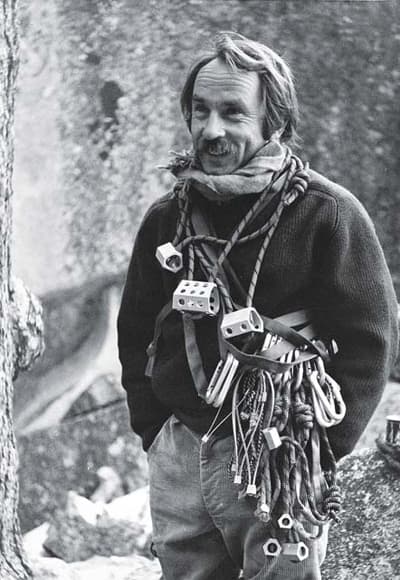
Yvon Chouinard
Patagonia
A pioneering figure in the sportswear and athletics industry, Yvon Chouinard founded Patagonia in 1973, transforming it into a leader in sustainable business practices. Guided by principles of simplicity and intentional living, he championed the idea that knowledge and experience can diminish reliance on material goods. Under his leadership, Patagonia became known for its commitment to environmental activism, donating over $100 million to grassroots organizations. Chouinard's philosophy that passion is essential for fulfillment in work resonates with entrepreneurs today, encouraging them to pursue endeavors that align with their values. As he famously stated, "If I had to be a businessman, I was going to do it on my own terms," reflecting his belief in authenticity and purpose-driven enterprise.
Core Principles
competitive advantage
Make products so good and unique they have no competition. Quality becomes your distribution strategy, not advertising or price.
Rather than compete on price, advertising, or distribution, Chouinard focused relentlessly on making products that were unmatched in quality. This became Patagonia's core competitive advantage.
“I'd much rather design and sell products so good and unique that they have no competition.”
Differentiate by creating products so good and unique they have no competitors, rather than competing on price or advertising.
Chouinard would rather design products so superior they require no marketing warfare. iPhone sold 233 million units while Samsung Galaxy sold 23 million, largely because iPhone competes on quality rather than price. Patagonia jackets are not in the same category as discount retailers.
“I'd much rather design and sell products so good and unique that they have no competition.”
culture
Employees want to feel useful and enlivened by their work, not just paid competitively. They don't want to be ashamed of their company or leave their values at home.
Chouinard discovered that competitive wages and benefits weren't enough to build loyalty. Employees needed to feel their work had meaning and aligned with their values.
“To earn employee commitment and trust begs more of a company than providing competitive pay and benefits and enacting humane environmental policies. Not everyone can satisfy his heart's desire working for your company, but everyone does want to feel useful at, or better yet, enlivened by what they do all day long. No one wants to be ashamed to name the company he works for.”
Meaningful work combines doing something you love with doing it in concert with others who share your values.
Chouinard separated meaningful work from talent or education. It was about alignment: loving what you do and knowing your work served a purpose beyond profit.
“Meaningful work is doing things you love to do often, though not always with other people. Doing what you love to do makes work meaningful. Doing the right thing with others makes work meaningful.”
On-site childcare isn't progressive HR, it's practical respect for employees who are humans with families. The benefits include retention, culture, and demonstrated values.
Chouinard initially resisted childcare costs but was convinced by his wife Melinda. Once implemented, it reduced turnover, made the company feel more human, and showed employees that the company actually cared about their lives.
“It costs Patagonia roughly fifty thousand dollars on average to recruit train and get up to speed a new employee if we want to make any money it's a good idea to keep the ones we have happy and fully engaged.”
Tedium becomes bearable when it has meaning. Mundane tasks are easier to endure when connected to a larger purpose.
Much of running a business is boring. Chouinard discovered that by connecting daily work to the company's environmental and social values, employees found meaning even in repetitive tasks.
“Tedium is easier to take when it has meaning.”
Organize employees into small groups of four to seven people for maximum creativity, cooperation, and morale.
Alexander Paul Hare's research on small groups shows teams of four to seven are most successful at problem-solving and are more democratic, egalitarian, and cooperative. Small group employees show lower absenteeism, less sickness, higher productivity, and greater morale.
“Groups sized between four and seven were most successful at problem solving, largely because small groups are more democratic, egalitarian, mutualistic, cooperative, and inclusive.”
customer obsession
Repair and recirculation programs aren't charity, they're good business. A happy customer who feels cared for is worth far more than the cost of a single transaction.
Patagonia's repair-for-life policy and Well Worn resale program cost money upfront but created evangelical customers who spread word-of-mouth that no amount of advertising could match.
Make customers aware of problems and offer solutions. They will follow if you treat them as intelligent people who share your values.
When Chouinard explained why pitons were harmful and introduced chalks as a superior alternative, customers switched willingly without marketing pressure. They respected the honesty.
“At Chouinard Equipment, we learned that we can inspire our customers to do less harm simply by making them aware of the problem and then offering a solution. We also learned that by addressing the problem, we had forced ourselves to make a better product.”
Customer acquisition is expensive and growing more so. Treat customers like neighbors or colleagues, not transactions to be optimized.
As digital advertising costs skyrocket, the lifetime value of a loyal customer far exceeds the cost of acquisition. Building real relationships is both more moral and more profitable.
“Customers are expensive to find and replace and it will become more so. The responsible company has to treat the customer as, if not a friend, a neighbor or colleague who shares a love for what the company offers.”
Build lasting customer relationships through durability and service, not through constant replacement sales.
Patagonia repairs clothing for free for life and advertises telling people not to buy if unnecessary. A customer who buys a lifetime-quality jacket becomes a loyal buyer of other products, while a customer who buys cheap goods that fail becomes a lost customer who won't complain.
finance
Profit is evidence that you are doing everything else right, not the primary goal itself.
Patagonia's mission statement contains no mention of profit. The family considers the bottom line to be the amount of good the business has accomplished. However, profit is necessary to stay in business and accomplish other goals. The Zen perspective is that profits happen when you do everything else right.
“At Patagonia, making a profit is not the goal because the Zen master would say, profits happen when you do everything else right.”
Remain privately held with no debt to maintain independence and values-driven decision making.
Patagonia has never raised outside capital or taken on significant debt. This allows the company to refuse growth opportunities that conflict with quality or values, to make long-term investments without answering to investors, and to prioritize mission over shareholder returns.
“We are a privately owned company, and we have no desire to sell the company or sell stock to outside investors, and we don't want to be financially leveraged.”
Profit is not the goal; it is a consequence of doing everything else right. Manage the top line (customers, products, strategy) and the bottom line will follow.
Patagonia's mission statement said nothing about profit. Yet by obsessing over quality, controlling costs, and building loyal customers, the company became highly profitable. Chouinard saw profit as a vote of confidence from customers.
“Profits happen when you do everything else right. Quality not price has the highest correlation with business success.”
Maintain cash flow discipline. A company with little or no debt has the freedom to act quickly and survive downturns that would destroy leveraged competitors.
Patagonia achieved zero debt, which gave them the cash reserves to invest in new products, weather crises, and make decisions based on values rather than lender demands. This was countercultural for growing companies.
“Our goal is to have no debt, which we have achieved.”
hiring
Study juvenile delinquents to understand entrepreneurs. Both reject the status quo and say 'this sucks, I'm going to do my own thing.'
Chouinard used this insight to hire unconventional people who questioned established ways of doing things. This hiring philosophy attracted misfits who became his most valuable employees.
“If you want to understand the entrepreneur, study the juvenile delinquent. The delinquent is saying with his actions, this sucks, I'm going to go do my own thing.”
Hire people with diverse backgrounds, not business school clones. Diversity in thought and openness to new approaches outweighs codified business training.
Patagonia intentionally hired misfits, climbers, surfers, and people from unconventional backgrounds rather than MBA graduates. This diversity led to innovative thinking and better problem-solving.
“Hiring people with diverse backgrounds brings in a flexibility of thought and openness to new ways of doing things as opposed to hiring clones from business schools who have been taught a codified way of doing business.”
Promote from within and maintain robust training programs. External hiring for promotions signals something is seriously wrong with your company.
Chouinard viewed internal promotion as a sign of a healthy company culture. Constant external hiring wastes institutional knowledge and signals that the company isn't developing its own talent.
“It maintained substantial training and education programs and promoted from within. There's like checklists at the back of the book, and I think you can download them for free online... but he talks about like something is seriously wrong with your company if you have to hire if you have to when there's new opportunities for promotions if you're constantly hiring externally.”
Unconventional people often discover capabilities they didn't know they had when given the right environment. No one knew what they couldn't do, so they ended up doing things they never imagined.
Patagonia hired misfits and found they often excelled in unexpected ways. A high school counselor once told Christine Tompkins not to bother with college, yet she became a key CEO during critical early growth.
“Many Patagonia employees turned out to have a vocation working for a small, quirky company where no one knew what they couldn't do, so ended up doing things that they had no idea they could do in the company of others doing the same thing.”
Hire independent-minded employees who will question bad decisions and work excellently once they buy into the mission.
Patagonia deliberately hires highly independent employees that a psychologist said would be unemployable in typical companies. Rather than drones who follow orders, they seek people who question decisions, then work like demons once convinced. This creates a self-managing culture where leaders are unnecessary for daily operations.
“We don't hire the kind of people you can order around. We want the kind of employees who will question the wisdom of something they regard as a bad decision.”
innovation
Be bold occasionally to disrupt accepted practices and discover new solutions. Combine steady improvements with breathtaking moves to keep the organization awake.
Chouinard balanced incremental improvements with occasional radical shifts like phasing out pitons or redesigning supply chains. These bold moves showed leadership and kept the culture innovative.
“We advocate a combination of steady improvements with the occasional, breathtakingly bold move to keep everyone awake and motivated, to show leadership that reflects well on everyone in the company.”
Innovate from existing products rather than inventing from scratch; innovation is faster and more practical than pure invention.
Patagonia did not invent fleece, bunting fleece, or baggies. They observed existing products, identified problems, and improved them. Like creative cooks using recipes as inspiration, Patagonia views existing designs as starting points and closes the book to do their own thing.
“Successful inventing requires tremendous energy, time, and money. Innovation can be achieved much more quickly because you already start with an existing product or design.”
Plan for continuous adaptation and change; complacency in a rapidly evolving environment leads to extinction.
Nature constantly evolves through natural selection and catastrophic events. Businesses operate the same way. Evolution and innovation happen at the fringe of ecosystems where diversity is high, while entrenched species at the center eventually fail. The mandate for managers is to instigate change.
“It's the only way we're going to survive in the long run.”
Learn from nature's principles of evolution and stress. A healthy organization, like a healthy ecosystem, needs constant stress and diversity to grow and adapt.
Chouinard applied the Iroquois concept of seven-generation thinking and the falconry term 'yerak' (alert, hungry, ready) to business. He intentionally created challenges when none existed to keep the company evolving.
“Evolution, change, does not happen without stress. When there is no crisis, the wise leader will invent one.”
Learn by doing and iterating quickly. Don't spend endless time planning; take a step, observe if it feels good, and adjust.
Rather than studying problems until failure is impossible, Chouinard acted on his rugby shirt idea and discovered a massive market. This entrepreneurial approach outpaced competitors who over-planned.
“The entrepreneurial way is to immediately take a step, and if that feels good, take another. If not, step back. Learn by doing.”
leadership
Responsible companies bear multiple obligations: profit shareholders, provide employee well-being, make excellent products, serve the community, and protect nature.
Rather than viewing these as competing goals, Chouinard argued that truly responsible companies pursue all of them simultaneously, creating a virtuous cycle that strengthens over time.
“How is a company responsible? Should it profit its shareholders, provide for the well-being of its employees, make excellent products, be a good force in the community, and protect nature? We think that a responsible company bears all of these obligations.”
Practice management by absence, deliberately stepping back to force the organization to self-manage and adapt.
Chouinard regularly leaves for months at a time, testing equipment in extreme conditions while company leadership must make decisions independently. This absence forces the development of self-directed teams and prevents dependency on a single leader. The approach is inspired by natural systems and ecological resilience.
“I continue to practice my MBA theory of management, management by absence, while I wear tested our clothing and equipment in the most extreme conditions.”
Frameworks
Management by Absence (MBA)
The leader deliberately removes themselves from day-to-day operations for extended periods, forcing the organization to develop self-managing capabilities. This tests the organization's resilience and prevents dependency on a single decision-maker. The practice mirrors natural systems where no central authority is required for the ecosystem to function.
Use case: Scaling organizations where the goal is to develop independent leadership capacity at all levels and prevent bottlenecks at the top
The Eighty Percenter Philosophy
Achieve eighty percent proficiency in an activity or discipline, then move on to something different rather than pursuing perfectionism in a single area. This approach creates diversity of experience and perspective, applied organizationally through diverse product lines and employee backgrounds.
Use case: Building versatile product portfolios and developing well-rounded leaders who bring diverse perspectives to problem-solving
Seven Generation Decision-Making
Make all business decisions as if you will be in business for one hundred years, using long-term thinking to guide choices. This framework incorporates a representative of the seventh generation into the decision process (adapted from Iroquois governance). Long-term thinking prevents overexploitation and short-term profit maximization.
Use case: Strategic planning for sustainable businesses, particularly those with environmental or social mission components
Quality as Solution
When facing any serious business decision, increase quality rather than cutting costs or raising prices. Quality is directly correlated with profitability and customer retention. A high-quality product creates loyal customers who buy other products, while cheap products that fail create permanent customer loss.
Use case: Product development and pricing decisions; differentiating in competitive markets; recession-proof business planning
Nonfiction Marketing
Build brand image through authentic representation of who the company is and what it believes, rather than fictional narratives. Patagonia tells the truth about its values, practices, and mission. The formula of authenticity cannot be copied; the only way to sustain it is to live up to it.
Use case: Brand development and marketing for values-driven companies; creating sustainable competitive advantage through authenticity
Innovation from Source
Gather product improvement ideas from end users actively using products in real conditions, not from salespeople, focus groups, or competitor analysis. The 'dirtbag core' customer using equipment in extreme conditions is the primary source of innovation insight.
Use case: Product development for specialized or professional markets; maintaining cutting-edge competitive advantage
Innovation vs. Invention Framework
Distinguish between invention (rare, time-intensive, fundamental breakthroughs) and innovation (rapid improvement and adaptation of existing designs). For most businesses, innovation is more practical and faster than pursuing pure invention. Patagonia views successful designs as recipes for inspiration.
Use case: Product development strategy; resource allocation between R and D activities
Natural Growth Model
Grow only at the rate demanded by customers, not through artificial demand creation. When customers complain of stockouts, increase production. Avoid advertising that creates artificial demand. This slows growth but maintains quality, culture, and sustainability.
Use case: Companies prioritizing quality and culture over market dominance; sustainable scaling strategies
Decentralized Systems Organization
Structure organizations like natural ecosystems and SEAL teams, where members understand the mission and their role but manage themselves. The leader is present but not necessary for operations. This requires hiring independent-minded people who buy into the mission.
Use case: Building self-managing organizations with independent-minded employees; crisis leadership situations where the formal leader is unavailable
Stress as Growth Catalyst
Deliberately introduce manageable challenges and stress into the organization to drive evolution and prevent complacency. Crisis spurs innovation and unity. In peaceful times, wise leaders invent challenges. This mirrors natural selection where stress drives adaptation.
Use case: Scaling and mature organizations; maintaining competitive edge and employee engagement; organizational change management
Stories
Tom Brokaw and friends, including Yvon Chouinard, attempted ice climbing on Mount Rainier with minimal training. Crossing a steep patch of black ice where a slip meant 1,000 feet of descent, Brokaw suggested roping up for safety. Chouinard refused, saying 'If you go, then I go, and I don't want to do that,' explaining it as 'every man for himself,' like catching a taxi in New York on a rainy day.
Lesson: This reflects Chouinard's independent mindset and willingness to embrace calculated risk. He doesn't rely on others to save him, and doesn't bind himself to others' fates. It demonstrates the same spirit that drives his business philosophy: self-reliance and personal accountability.
In 1981, while attempting to climb 23,000-foot Ganga Shan in Tibet, Chouinard and three friends triggered an avalanche. They were carried 1,500 feet and stopped 30 feet from a 300-foot cliff. One friend died of a broken neck, another broke his back, and Chouinard suffered a concussion and broken ribs. After recovery, he lost interest in high-altitude climbing.
Lesson: This tragedy taught Chouinard 'Never exceed your limits.' You push the envelope and live for moments when you're on the edge, but you don't go over. This philosophy directly informed his approach to business: 'The sooner a company tries to be what it is not, the sooner it will die.'
In the early 1990s, Patagonia was growing too fast with eight product lines, three distribution channels, and multiple department leaders. Chouinard felt he had lost control and brought in consultant Dr. Michael Kami, who asked 'Why are you in business?' When told about environmental giving, Kami said, 'That's bullshit. If you're serious, sell the company for $100 million and create a foundation.' The response felt like a Zen master's stick hit.
Lesson: Sometimes external perspective is needed to clarify true mission. Chouinard realized that continuing to build Patagonia was itself the mission: to model environmental stewardship and prove another way of doing business was possible. This catalyzed the philosophy classes that redirected the company.
Patagonia's organic cotton conversion of 1994-1996 created a company-wide crisis that mobilized everyone. Rather than viewing this as a burden, Chouinard reflects that 'Our company has always done its best work whenever we've had a crisis.' The stress of this commitment to quality and values unified and energized the organization.
Lesson: Artificial growth and comfortable operations breed complacency. Strategic crises and challenging commitments force clarity, alignment, and excellence. Evolution requires stress; stagnation comes from ease.
Chouinard Equipment had become the dominant supplier of pitons for rock climbing. But repeated hammering of pitons was scarring pristine climbing routes like the Nose of El Capitan. In 1972, despite pitons being their most profitable product, Chouinard and climbing partner Tom Frost decided to phase out the entire line. Instead of mandating it, they published a 14-page essay by Sierra climber Doug Robinson about 'clean climbing' with protective chalks that left no trace.
Lesson: Your customers are smart people who share your values. If you educate them honestly about a problem and offer a superior solution, they will follow willingly, even when it means changing established behavior. This builds far deeper loyalty than any marketing could.
In the early days of Patagonia, workers brought their babies to work, draping blankets over computer monitors and leaving toys scattered on the floor. Most of the company opposed spending money on childcare, including Chouinard initially. But his wife Melinda doggedly pursued the cause until the men (including Chouinard) were persuaded. Once implemented, they discovered unexpected benefits: lower turnover, a more human culture, and the presence of children making adults conscious of their broader responsibilities.
Lesson: Sometimes the resistance to good ideas comes from not having thought them through. When an idea is truly good, the benefits (lower turnover costs, better culture, higher retention) often exceed the initial investment far more than the skeptics anticipated. Have the humility to be persuaded.
A high school guidance counselor told Christine Tompkins' mother not to waste money sending her daughter to college. Christine was unmotivated and indifferent as a student. Yet at age 30, she became Patagonia's fast-learning CEO during its most critical early growth phase, proving that traditional indicators of success don't predict real capability.
Lesson: Intelligence and capability don't always look like good grades or business school pedigrees. The right environment can unlock potential that the formal system never detected. Hire unconventional people and let them surprise you.
Chouinard's immigrant family left farms in Quebec to work in Maine's cotton mills around 1908. His nine-year-old father went to work at the Bates Manufacturing Company as an industrial laborer. Though it provided reliable income, factory life stripped away the autonomy, purpose, and connection to nature that farm life had offered. The family gained stability but lost dignity and self-fulfillment.
Lesson: Economic security without meaningful work creates a particular kind of poverty. This experience shaped Chouinard's entire philosophy that companies must do more than pay competitive wages: they must enable people to feel their work matters and that they can maintain their humanity and values while working.
As a young teacher forced to write lines as punishment, Chouinard lined up three pencils with sticks and rubber bands to write three lines at a time instead of one. This act of resourcefulness illustrated a deeper philosophy he'd carry into business: invent your own game rather than accept the rules others set.
Lesson: Resourcefulness and creative problem-solving are developed early. When faced with constraints, rather than complying grudgingly, look for ways to bend or reframe the situation to your advantage.
Chouinard's father, a French-Canadian tradesman with only three years of schooling, couldn't afford a dentist so he pulled his own teeth with pliers. This extreme self-reliance and refusal to pay for what he could do himself became a lifelong influence on Yvon's approach to problems.
Lesson: Extreme resourcefulness and self-reliance are often modeled early in life by those close to us. A parent or mentor who solves problems themselves rather than deferring to specialists teaches a powerful lesson.
Notable Quotes
“If I had to be a businessman, I was going to do it on my own terms.”
Explaining his decision to accept the identity of businessman while rejecting conventional business practices and cultural norms
“Make the best is a difficult goal. It doesn't mean among the best or the best at a particular price point. It means make the best, period.”
Defining Patagonia's core product philosophy and quality standard
“We want customers who need our clothing, not just desire it. We never wanted to be a big company. We want to be the best company.”
Explaining the choice to limit growth and market expansion to maintain quality and specialization
“It's easier to try to be the best small company than the best big company.”
Justifying the deliberate decision to remain small and specialized rather than pursue maximum scale
“I continue to practice my MBA theory of management, management by absence, while I wear tested our clothing and equipment in the most extreme conditions.”
Describing his approach to leadership where intentional absence forces organizational self-management
“Quality, not price, has the highest correlation with business success.”
Citing data from the Strategic Planning Institute to justify quality-first strategy over cost-cutting
“I'd much rather design and sell products so good and unique that they have no competition.”
Explaining preference for competitive differentiation through superior quality rather than competing on price or marketing
“How you do one thing is how you do all things.”
Principle applied to every aspect of business, from product design to catalogues to computer programs, establishing consistent quality standards
“At Patagonia, making a profit is not the goal because the Zen master would say, profits happen when you do everything else right.”
Explaining the financial philosophy where profit is a symptom of doing things correctly, not the objective
“A familial company like ours runs on the trust rather than on authoritarian rule.”
Describing organizational culture built on trust rather than hierarchy, where the system self-regulates when leaders are absent
Frequently Asked Questions
What are Yvon Chouinard's key business principles?▼
Yvon Chouinard's core principles include: Make products so good and unique they have no competition. Quality becomes your distribution strategy, not advertising or price.. Differentiate by creating products so good and unique they have no competitors, rather than competing on price or advertising.. Employees want to feel useful and enlivened by their work, not just paid competitively. They don't want to be ashamed of their company or leave their values at home.. Founder Almanac has cataloged 30 total principles from Yvon's career.
What can entrepreneurs learn from Yvon Chouinard?▼
Key lessons from Yvon Chouinard include: This reflects Chouinard's independent mindset and willingness to embrace calculated risk. He doesn't rely on others to save him, and doesn't bind himself to others' fates. It demonstrates the same spirit that drives his business philosophy: self-reliance and personal accountability.. Explore 10 stories and 10 frameworks from Yvon's experience.
What is Yvon Chouinard known for in business?▼
A pioneering figure in the sportswear and athletics industry, Yvon Chouinard founded Patagonia in 1973, transforming it into a leader in sustainable business practices. Guided by principles of simplicity and intentional living, he championed the idea that knowledge and experience can diminish reliance on material goods. Under his leadership, Patagonia became known for its commitment to environmental activism, donating over $100 million to grassroots organizations. Chouinard's philosophy that passion is essential for fulfillment in work resonates with entrepreneurs today, encouraging them to pursue endeavors that align with their values. As he famously stated, "If I had to be a businessman, I was going to do it on my own terms," reflecting his belief in authenticity and purpose-driven enterprise.
More Sportswear & Athletics Founders

Want Yvon's advice on your business?
Our AI has studied Yvon Chouinard's biography, principles, and decision-making frameworks. Ask any business question.
Start a conversation