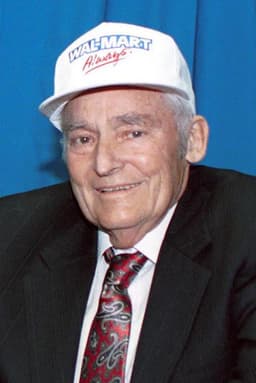
Barnett C. Helzberg Jr.
Helzberg Diamonds
A visionary in the retail industry, Barnett C. Helzberg Jr. founded and led Helzberg Diamonds from 1962 to 1994, transforming it into a prominent jewelry retailer with over 200 locations at its peak. He believed in upgrading the herd annually by concentrating on high-potential opportunities and eliminating distractions, principles that allowed his company to thrive in a competitive market. Helzberg famously approached Warren Buffett on a New York City sidewalk, succinctly pitching his business and ultimately leading to a significant acquisition by Berkshire Hathaway. His mantra, "You don't need to invent a new industry to start a new business. Study an existing industry and just do it lots better," continues to resonate with entrepreneurs seeking to innovate within established markets.
Core Principles
customer obsession
Treat customers and employees with hospitality and respect; create a welcoming environment rather than posting negative restrictions.
While competitors posted signs prohibiting food and drink, Helzberg invited customers to bring their food, signaling they were customer-centric. This small but memorable difference communicated a fundamentally different company culture.
“Ours said your food and drink are welcome here. We were trying to say we are here on your terms and we are different.”
focus
Focus is a lever to success; concentrate your company's efforts on what it does best and eliminate distracting product lines.
Helzberg Diamonds phased out non-jewelry merchandise like china, crystal, silver, luggage, and radios to focus exclusively on diamonds. Contrary to expectations, this narrowing of focus increased both volume and profit by allowing better execution.
“We believed that the dollar volume of business would decrease, but the profits would increase... Less is indeed more.”
hiring
Hire the absolute best people you can find; good people hire good people, while poor hires cascade downward throughout the organization.
Helzberg emphasized that talent acquisition is foundational to company performance. He observed that each B-player hired lowers the standard for subsequent hires, eventually degrading the entire organization's capability.
“Good people hire good people. I fear the reverse is true also.”
leadership
Extract honest feedback from employees and managers by asking direct questions designed to surface improvement opportunities rather than seeking reassurance.
Helzberg developed three specific questions to bypass filtering and get truthful input: What am I doing you like? What am I doing you dislike? What am I not doing you would like? The third question typically yields the most useful strategic insights.
learning
Borrow wisdom from the accumulated knowledge of others; you can access the learned experiences of thousands of entrepreneurs and experts.
Helzberg explicitly positioned himself as a plagiarist of good ideas, attending annual meetings, reading biographies, and calling successful people to learn from their experience. This systematic borrowing of wisdom accelerated his decision-making.
“I was always taught that many people were out there developing ideas that I could use. I have found that to be true throughout my life.”
mindset
Pick up the phone and ask for help; most successful people will talk to you if you reach out directly with genuine questions.
Helzberg learned from Steve Jobs that the risk-reward ratio of asking for help is exceptional. Even if someone says no, you lose only minutes of time. But successful conversations can provide years of value.
“What's the worst case scenario? You wasted a phone call? What a fabulous risk reward ratio.”
Become an entrepreneur or adopt founder mentality regardless of whether you founded your company; ownership mindset is more important than founding status.
Helzberg inherited his family business at age 29 and was thrust into leadership, yet he maintained an entrepreneurial mindset. He viewed himself as owner and master of his destiny, not merely an executor of his father's legacy.
“You don't have to start a business in order to be an entrepreneur. I certainly did not.”
Entrepreneurial drive comes from a desire for control, independence, and self-determination; it is often irrational from a purely financial perspective.
Helzberg reflects that true entrepreneurs are willing to make less money working for themselves than they would working for a large organization, because they need control over their destiny and time.
“That feeling that you're your own boss, that your future is in your hands is a frightening and thrilling prospect.”
Maintain perspective on life balance; missing important family moments for work has permanent consequences on your children even if you forget the work emergency.
Helzberg concludes his book emphasizing that children will remember your absence at their performances or events far longer than you will remember the work reason you missed them. This shapes how you allocate time and energy.
“If you miss a child's play or performance or sporting event, you will have forgotten a year later the work emergency that caused you to miss it. But the child won't have forgotten that you were not there.”
Understand mentoring as a brain marination process rather than direct instruction; absorb diverse perspectives and synthesize them into your own judgment.
Helzberg reframed mentoring as a cumulative process where varied inputs from different mentors combine to produce intuition and wisdom specific to your situation, rather than following any single mentor's advice.
“When your brain is adequately marinated, you will look in the mirror and a light bulb on top of your cranium will flash the answer that best fits you and your situation.”
operations
Act with urgency and speed in all communications and decisions; speed is a competitive advantage and signals organizational values.
Helzberg believed that urgency must be modeled from leadership and that prompt action and communication demonstrate priorities more effectively than words alone.
“By acting with a sense of urgency, you are modeling the behavior that you want from your associates.”
Test new strategic ideas with your best people in your strongest locations to ensure accurate results and credibility for full rollout.
Before outsourcing customer credit across all stores, Helzberg tested the concept with one of their best store managers in a successful location. The successful test provided proof that justified company-wide implementation.
“Marty chose one of our best store managers to test his idea.”
strategy
Upgrade the herd annually by focusing resources on high-potential opportunities rather than attempting to salvage underperforming ones.
When facing a choice between incrementally improving a $800,000 store or dramatically growing a $4.5 million store, Helzberg adopted the principle of closing weak stores annually rather than wasting talent on turnarounds. This opportunity cost thinking dramatically improved profitability.
“We would rather spend time and effort on a $4.5 million store that could ultimately achieve $6 million in revenue than on lower volume store with less potential.”
Frameworks
Upgrade the Herd Annually
Systematically close or improve the weakest performing stores or business units each year rather than attempting expensive turnarounds. Focus available talent and capital on the strongest performers that can be scaled. This approach maximizes return on effort by applying opportunity cost thinking to resource allocation.
Use case: Scaling retail or multi-location businesses where performance varies significantly across locations; deciding where to invest limited management attention and capital.
Test with Your Best
When piloting a new strategic idea, assign your best people and deploy the test in your strongest location rather than testing in a weak location or with average talent. This ensures accurate results reflect the idea's merit rather than being confounded by poor execution or poor context.
Use case: Product testing, new business model validation, or operational changes where you need reliable data to decide on company-wide rollout.
Brain Marination Process
Seek input and wisdom from multiple mentors and sources over time without following any single mentor's advice as command. Allow these diverse perspectives to accumulate and synthesize in your unconscious mind until intuitive clarity emerges that is uniquely suited to your situation.
Use case: Developing judgment as a leader; learning from mentors while maintaining independent decision-making authority.
Opportunity Cost Thinking
Before allocating resources to any activity, explicitly consider what alternatives you sacrifice by choosing that activity. Decisions should be made by comparing the return of your chosen path against the return of the best alternative use of that resource.
Use case: Strategic resource allocation across competing initiatives; prioritizing where to invest management attention, capital, and talent.
Stories
In 1994, Helzberg spotted Warren Buffett on a New York City sidewalk and approached him directly, introducing himself and his business in under 30 seconds. He mentioned his company matched Buffett's investment criteria and asked Buffett to review financial information. Buffett agreed, and months later purchased Helzberg Diamonds for Berkshire Hathaway.
Lesson: Preparation enables serendipity. Helzberg had spent five years attending Berkshire shareholder meetings and deeply understanding Buffett's philosophy, so when chance presented an opportunity, he was ready to capitalize on it. Bold action combined with preparation creates luck.
In the mid-1960s, Helzberg's bank refused to extend promised credit during a critical moment despite a 30-year relationship. Instead of burning that bridge, Helzberg maintained the relationship while pivoting to a second bank (Security National) that provided the needed credit. He continued doing business with both banks afterward.
Lesson: Maintaining relationships even after disappointment preserves options for the future. You never know when someone might become valuable again or when you might need to rebuild a relationship. Bridges burned in anger become unavailable when you later need them.
Helzberg followed a mentor's advice to avoid shopping mall locations because malls were supposedly inferior to business districts. He later realized this was a critical mistake as malls became central to retail success. He had to reverse course and pursue mall locations aggressively.
Lesson: Even trusted mentors' advice must be evaluated against your own judgment and market reality. Mentors can provide perspective, but you alone are responsible for decisions. Blindly following advice without critical thinking can nearly destroy a business.
Helzberg's company had been struggling to incrementally improve a $800,000-volume store to $850,000. A mentor (Steve Lieberman) advised him that 'you make more money closing bad stores than by opening new ones.' Helzberg shifted focus to growing his $4.5 million store to $6 million instead.
Lesson: Opportunity cost thinking reveals that effort applied to weak performers is usually wasted relative to amplifying winners. Destroying mediocre businesses may be more profitable than attempting to rehabilitate them.
Helzberg tested the concept of outsourcing customer credit to banks by assigning his best store manager to implement it in a strong performing location. After the test proved successful, company-wide implementation was justified because the test couldn't be attributed to weak management or poor location.
Lesson: Your test results are only credible if you test with your best people in your best locations. Testing weak ideas with weak execution in weak contexts creates confounded results that don't provide valid learning.
Helzberg phased out non-core product lines like china, crystal, silver, luggage, and radios to focus exclusively on diamonds. He expected revenue to decline but profitability to increase. Instead, both revenue and profit increased significantly.
Lesson: Focus as a lever multiplies rather than constrains business performance. Deep excellence in one domain often outperforms scattered mediocrity across many domains.
While all competitors posted 'No Food or Drink' signs in their retail stores, Helzberg deliberately posted 'Your Food and Drink Are Welcome Here.' This small difference in hospitality communicated that Helzberg customers were welcome and valued on their own terms.
Lesson: Customer obsession shows up in small, memorable gestures that communicate values. Reversing standard industry practice to serve customers better creates differentiation and loyalty.
Notable Quotes
“You don't need to invent a new industry to start a new business. Study an existing industry and just do it lots better.”
Summarizing the principle that competitive advantage comes from execution excellence, not novel concepts.
“I never found anybody that didn't want to help me if I asked them.”
Illustrating that most successful people will talk to you and help if you reach out directly with genuine questions.
“Advice is advice, not a command.”
Reflecting on his mistake of blindly following a mentor's advice to avoid shopping malls; emphasizing personal responsibility for decisions.
“Cicero is famous for saying that a man who doesn't know what happened before he's born goes through life like a child.”
Emphasizing the critical importance of studying history to avoid repeating mistakes and learning from the experience of predecessors.
“Trust only movement.”
Emphasizing that actions reveal priorities and commitments better than words or intentions; leadership is demonstrated through speed and urgency.
“Quality is never an accident. It is always a result of high intention, sincere effort, intelligent direction, and skillful execution.”
Illustrating that execution and attention to detail determine outcomes; quality and success are not chance occurrences.
“Good people hire good people. I fear the reverse is true also.”
Illustrating that hiring quality cascades; A players hire A players while B players hire C players, degrading organizational capability.
“The greatest thing you could do for your competition is hiring poorly.”
Emphasizing the competitive advantage that comes from maintaining high hiring standards.
“Focus is your lever to success. Do not underestimate the incredible amount of mental discipline it takes to focus yourself and your teammates.”
Emphasizing that focus is a critical competitive advantage and requires sustained discipline to maintain against constant distractions and temptations.
“Commit yourself to be the best. Define what that means and focus on the head of that pin like no one in your industry.”
Explaining that specialization and deep focus on excellence in a defined domain creates sustainable competitive advantage.
Frequently Asked Questions
What are Barnett C. Helzberg Jr.'s key business principles?▼
Barnett C. Helzberg Jr.'s core principles include: Treat customers and employees with hospitality and respect; create a welcoming environment rather than posting negative restrictions.. Focus is a lever to success; concentrate your company's efforts on what it does best and eliminate distracting product lines.. Hire the absolute best people you can find; good people hire good people, while poor hires cascade downward throughout the organization.. Founder Almanac has cataloged 16 total principles from Barnett's career.
What can entrepreneurs learn from Barnett C. Helzberg Jr.?▼
Key lessons from Barnett C. Helzberg Jr. include: Preparation enables serendipity. Helzberg had spent five years attending Berkshire shareholder meetings and deeply understanding Buffett's philosophy, so when chance presented an opportunity, he was ready to capitalize on it. Bold action combined with preparation creates luck.. Explore 7 stories and 4 frameworks from Barnett's experience.
What is Barnett C. Helzberg Jr. known for in business?▼
A visionary in the retail industry, Barnett C. Helzberg Jr. founded and led Helzberg Diamonds from 1962 to 1994, transforming it into a prominent jewelry retailer with over 200 locations at its peak. He believed in upgrading the herd annually by concentrating on high-potential opportunities and eliminating distractions, principles that allowed his company to thrive in a competitive market. Helzberg famously approached Warren Buffett on a New York City sidewalk, succinctly pitching his business and ultimately leading to a significant acquisition by Berkshire Hathaway. His mantra, "You don't need to invent a new industry to start a new business. Study an existing industry and just do it lots better," continues to resonate with entrepreneurs seeking to innovate within established markets.
More Retail Founders




Want Barnett's advice on your business?
Our AI has studied Barnett C. Helzberg Jr.'s biography, principles, and decision-making frameworks. Ask any business question.
Start a conversation