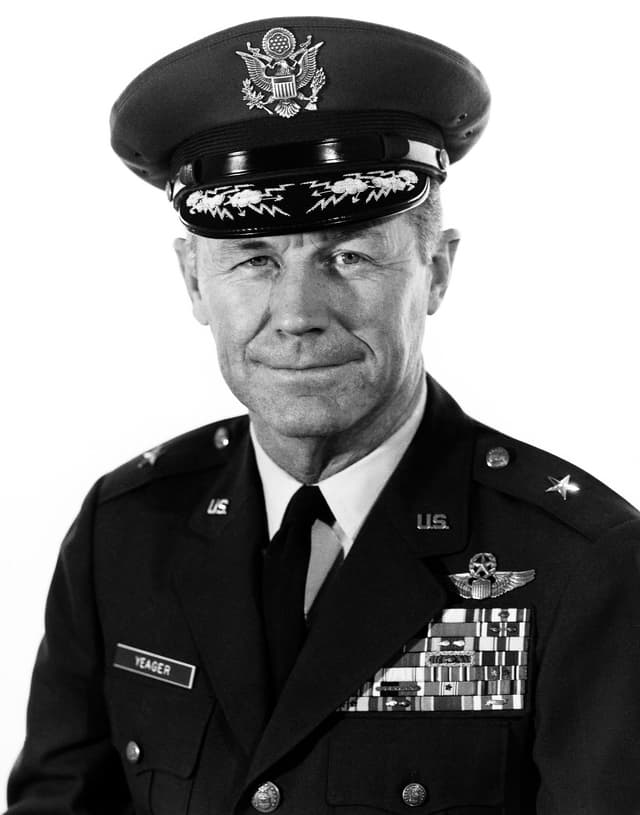
Chuck Yeager
United States Air Force
A pioneering figure in the Aviation and Aerospace industry, Chuck Yeager became the first person to break the sound barrier in 1947, a feat that solidified his legacy and showcased the power of relentless practice and mastery. His philosophy emphasized that success stems from putting in more reps than anyone else, a principle he embodied throughout his career as a test pilot and fighter ace. Yeager's deep understanding of aviation systems, honed through extensive flight experience, allowed him to navigate high-stakes environments effectively, ensuring safety and operational excellence. With over 10,000 flight hours logged, he famously stated, "I flew more than anybody else and there wasn't a thing about an airplane that didn't fascinate me down to the smallest bolt," underscoring his commitment to thorough knowledge and avoidance of mistakes in critical situations.
Core Principles
competitive advantage
Identify your competitive edge and play where odds are in your favor. Superior preparation creates the conditions for seeming luck.
Yeager had extraordinary eyesight (20/10 vision), deep mechanical knowledge, and obsessive flying time. He didn't charge blindly into combat. He set up his attacks to have the advantage, waiting until odds favored him before engaging. This systematic approach to leverage was his real advantage.
“I shut down two very quickly with the advantage of having sharp eyes that could see forever, he set up his attack to take them by surprise when the odds were in his favor.”
culture
In high-stakes collaborative environments, surround yourself with people who understand your world and share your values.
Yeager's core social circle was other test pilots and aviators. They understood the psychological and physical stresses of his work in ways civilians never could. This shared understanding created deep bonds and mutual support that sustained them through trauma.
“The physical and mental stresses we felt were felt by all of us and drew us together in special ways.”
mindset
Do only what you love. When your work becomes fun, you unlock excellence and create your own breaks in life.
Yeager's core principle was doing only what interested him. He refused to be derailed by promises of power or money into pursuits that didn't fascinate him. This clarity allowed him to focus entirely on flying, which he loved more than anything else, and this obsession made him exceptional.
“I did only what I enjoyed and I wouldn't let anyone derail me by promises of power or money into doing things that weren't interesting to me.”
Know if you have the right job by this simple test: you can't imagine being anything else.
Yeager describes the moment he became a fighter pilot as profound satisfaction. He couldn't imagine doing anything else. This clarity of purpose sustained him through decades of risk and shaped every decision he made.
“Now that I was a fighter pilot I couldn't imagine being anything else.”
Use fear as a tool to push yourself forward, not as a barrier to stop you.
Yeager was always afraid of dying, but he weaponized this fear to study his equipment obsessively and maintain absolute alertness in the cockpit. Fear kept him respectful of his machine and drove him to learn everything he could, which saved his life repeatedly.
“I was always afraid of dying. Always. It was my fear that made me learn everything I could about my airplane.”
Be stubborn about the present, not overly focused on the future. The future takes care of itself when you refuse to quit today.
Yeager didn't consciously plan to become famous or break the sound barrier. He was simply stubborn about refusing to go home when told to leave after World War II. This stubbornness in the moment created the chain of events that led to everything that followed in his career.
“I wasn't consciously thinking about my future. I was just being stubborn about the present.”
Recognize that timing and luck are legitimate parts of success. Acknowledge luck while still taking credit for preparation and skill.
Yeager was born at exactly the right moment when aviation was revolutionizing. He had the right skills at the right time. He explicitly credits luck while also acknowledging his exceptional ability. This balanced perspective avoids both false humility and false pride.
“I don't deny that I was damn good. If there's such a thing as the best, I was at least one of the title contenders. But what really strikes me looking back over all those years is how lucky I was.”
operations
Complexity and arrogance are dangerous together. Humility and ongoing learning prevent catastrophic failures.
An engineer installed a bolt upside down due to arrogance about knowing better than instructions. This small mistake killed multiple pilots. Scott Crossfield's arrogance about needing no instruction manual led him to fly a plane through a hangar. Accepting guidance and remaining humble saves lives and prevents disasters.
“Those complex airplanes were unforgiving of mistakes.”
product
Master your business from A to Z. Deep understanding of every system and component is a critical advantage that can save your life.
Yeager learned not just how to fly planes but how they worked mechanically. This knowledge allowed him to diagnose problems in mid-flight and survive accidents that killed other pilots who lacked this understanding. Other pilots outsourced mechanical knowledge to specialists and died as a result.
“There is no problem you cannot solve if you understand your business from A to Z.”
resilience
Back up but never give up. When circumstances change, adapt to the next best option rather than stopping entirely.
When grounded from high-performance jets, Yeager's attitude was to find the next best flying option rather than quit. He rejected the idea that aging should force retirement from what you love. The principle applies to all setbacks: adapt downward but keep going.
“You do what you can for as long as you can, and when you finally can't, you do the next best thing. You back up, but you don't give up.”
simplicity
Simplicity in decision-making creates clarity and power. Have one simple formula for whether to continue or move on.
Yeager's simple formula was: either the Air Force was still fun or it wasn't. If it wasn't fun, why stay? This one question guided his major life decisions without needing elaborate strategic planning.
“Either the Air Force was still fun for me or it wasn't much fun anymore. If it wasn't fun, why would I hang around?”
strategy
Look for opportunities that can only exist right now. Being born at the right time with the right skills is luck you can create by recognizing your era.
Yeager was born in 1923, coming of age as aviation was transitioning from propellers to jets to rockets. He explicitly acknowledges this timing was critical to his opportunities. The lesson is to identify what's unique about your current moment and position yourself at the intersection of emerging possibilities.
“How lucky, for example, to have been born in 1923 and not 1963, so that I came of age just as aviation itself was entering the modern era.”
Frameworks
The Fear as a Tool Framework
Instead of letting fear paralyze you, use fear as a motivator to obsess over preparation and mastery. Transform fear from a barrier into a drive mechanism. Yeager was terrified of dying but converted that fear into obsessive study of his equipment and procedures. The fear kept him alert and humble.
Use case: Any high-risk endeavor where fear is present. Use it as a signal to prepare more thoroughly rather than as a reason to avoid the challenge.
The Edge Identification Framework
Identify your specific competitive advantages (vision, knowledge, speed, skill) and only engage when odds are in your favor. Don't compete on equal terms. Yeager had superior eyesight, mechanical knowledge, and flying experience, so he set up combats where these advantages mattered most. He avoided fair fights.
Use case: Competition of any kind. Rather than fighting where you're weak, create conditions where your specific advantages dominate.
The Obsession Clarity Framework
Find the one thing you cannot imagine not doing. This becomes your north star for all decisions. Yeager couldn't imagine being anything other than a fighter pilot. This clarity made every major life decision obvious. It also attracted people, opportunities, and circumstances that aligned with this obsession.
Use case: Career decisions, life direction, where to invest time and energy. The right answer becomes clear when you know what you're truly obsessed with.
The Stubbornness About the Present Framework
Don't obsess over distant future planning. Be stubborn about refusing to quit in the present moment. Show up, do excellent work, and refuse to accept defeat today. Yeager's entire life changed because he stubbornly refused to go home when ordered. The future takes care of itself.
Use case: When facing major life decisions or career inflection points. Commit to the present rather than over-planning the future.
Stories
Yeager was shot down over occupied France at age 21 with a fractured back. Rather than giving up, he evaded capture for weeks, walking across the Pyrenees in winter at 11,000 feet with another wounded pilot on his back. He eventually made it to Spain and back to American forces, becoming the first evadee allowed back into combat due to sheer stubbornness.
Lesson: Extraordinary determination and refusal to accept failure can overcome seemingly impossible circumstances. Yeager's stubbornness in the moment created the conditions for everything that followed in his life.
During a test flight, Yeager's aircraft went into a catastrophic spin at 51,000 feet with multiple systems failing. His helmet fogged, his instruments were useless, and he was being thrown violently around the cockpit. Through instinct and his deep mechanical knowledge, he remembered the stabilizer setting, adjusted it in the dark, and recovered from a 51,000-foot spin in 51 seconds to land safely.
Lesson: Deep knowledge of your tools can save your life when everything goes wrong. Preparation doesn't guarantee survival, but it dramatically improves odds. Mastery of fundamentals matters more than luck.
An engineer installed a bolt upside down on aircraft ailerons, claiming he knew bolts were supposed to go head-up. Multiple pilots died before the error was discovered. At the same time, Scott Crossfield refused guidance on flying a new plane, claiming the handbook was sufficient. He immediately flew the plane through a hangar.
Lesson: Arrogance and complexity together are deadly. Staying humble enough to accept guidance and obsessing over details prevents catastrophic failures. Small mistakes compound in complex systems.
After breaking the sound barrier and becoming world famous, Yeager was unimpressed by the fame and public attention. He saw no financial benefit and found it irrelevant to his actual work. His wife worried the fame would distract him, but he simply returned to flying. He treated celebrity as noise that didn't matter to his mission.
Lesson: Don't get distracted by external validation or fame if it doesn't align with your core purpose. Success should be measured by your own standards, not public opinion.
Yeager met Poncho Barnes, an unpolished female aviator who owned a bar and airstrip in the Mojave. Despite her rough appearance and language, she was one of the best pilots alive and had incredible life experience. She became his closest friend for decades and understood his world as few others could.
Lesson: Don't judge people by surface appearances or conventional standards. Some of the most valuable relationships come from unexpected people who share your obsession and understand your world.
Notable Quotes
“I flew more than anybody else and there wasn't a thing about an airplane that didn't fascinate me down to the smallest bolt.”
Describing why he became the best pilot: volume of practice combined with obsessive learning.
“In nearly every case the worst pilots died by their own stupidity.”
Observing that pilot deaths were typically caused by carelessness or poor judgment, not lack of skill.
“I did only what I enjoyed and I wouldn't let anyone derail me by promises of power or money into doing things that weren't interesting to me.”
Explaining his core life principle that guided all major decisions.
“Now that I was a fighter pilot I couldn't imagine being anything else.”
The moment he knew he had found his calling, a simple test for whether you're in the right work.
“I was always afraid of dying. Always. It was my fear that made me learn everything I could about my airplane.”
How he weaponized fear as a tool for preparation rather than as a barrier to avoid risk.
“I wasn't consciously thinking about my future. I was just being stubborn about the present.”
Explaining how his refusal to quit in the moment shaped his entire life trajectory.
“If you love the hell out of what you're doing, you're usually pretty good at it. And you wind up making your own breaks.”
On how excellence and opportunity creation come from obsessive love of your work.
“Anger was my defense mechanism. I lost count of how many good friends have augured in over the years. But either you become calloused or you crack.”
On processing trauma and death in high-risk professions through emotional hardening.
“Those complex airplanes were unforgiving of mistakes.”
Why arrogance combined with complexity leads to catastrophic failures in high-stakes environments.
“How lucky, for example, to have been born in 1923 and not 1963, so that I came of age just as aviation itself was entering the modern era.”
On the critical importance of being born at the right moment in history with the right skills.
Frequently Asked Questions
What are Chuck Yeager's key business principles?▼
Chuck Yeager's core principles include: Identify your competitive edge and play where odds are in your favor. Superior preparation creates the conditions for seeming luck.. In high-stakes collaborative environments, surround yourself with people who understand your world and share your values.. Do only what you love. When your work becomes fun, you unlock excellence and create your own breaks in life.. Founder Almanac has cataloged 20 total principles from Chuck's career.
What can entrepreneurs learn from Chuck Yeager?▼
Key lessons from Chuck Yeager include: Extraordinary determination and refusal to accept failure can overcome seemingly impossible circumstances. Yeager's stubbornness in the moment created the conditions for everything that followed in his life.. Explore 5 stories and 4 frameworks from Chuck's experience.
What is Chuck Yeager known for in business?▼
A pioneering figure in the Aviation and Aerospace industry, Chuck Yeager became the first person to break the sound barrier in 1947, a feat that solidified his legacy and showcased the power of relentless practice and mastery. His philosophy emphasized that success stems from putting in more reps than anyone else, a principle he embodied throughout his career as a test pilot and fighter ace. Yeager's deep understanding of aviation systems, honed through extensive flight experience, allowed him to navigate high-stakes environments effectively, ensuring safety and operational excellence. With over 10,000 flight hours logged, he famously stated, "I flew more than anybody else and there wasn't a thing about an airplane that didn't fascinate me down to the smallest bolt," underscoring his commitment to thorough knowledge and avoidance of mistakes in critical situations.
More Aviation & Aerospace Founders
Want Chuck's advice on your business?
Our AI has studied Chuck Yeager's biography, principles, and decision-making frameworks. Ask any business question.
Start a conversation